
Any discussion of fenbendazole or other drugs in the benzimidazole class should be based on medical research and evidence—not social media videos or anecdotal claims.
Benzimidazole drugs have been extensively studied, particularly as antiparasitic medications. Mebendazole, for example, has been used safely in humans for decades and has a well-established safety profile. Fenbendazole has also been studied extensively in veterinary medicine as an antiparasitic drug. Because of these characteristics, researchers have investigated whether benzimidazole drugs could be repurposed for cancer treatment.
However, it is important to distinguish between scientific interest and proven cancer treatment. Fenbendazole is a veterinary deworming medication and has not been approved for use in humans to treat cancer. Evidence that it can safely and effectively treat cancer in humans remains insufficient.
Two important points to remember
1. Absorption matters.
Fenbendazole has very low water solubility, which can affect how well the body absorbs it. Its absorption may vary depending on factors such as formulation and what is present in the gastrointestinal tract. This does not mean that simply combining it with other substances makes it an effective cancer treatment.
2. More is not necessarily better.
With any drug, dose matters. Increasing the dose does not automatically make a medication more effective and can increase the risk of adverse effects or toxicity. A dose that is safe in one context may not be safe in another.
Mebendazole and fenbendazole should also not be treated as interchangeable simply because they belong to the same chemical class. Mebendazole is an antiparasitic medication used in humans, while fenbendazole is primarily a veterinary medication.
Fenbendazole has attracted considerable attention because it is inexpensive and widely available for veterinary use. Anecdotal reports from people using it for cancer continue to circulate online, but anecdotes are not a substitute for controlled clinical evidence. Laboratory and animal findings can provide useful leads for research, but they do not establish that a treatment is safe or effective in humans.
For people who lack access to cancer care or cannot afford conventional treatment, the appeal of inexpensive alternatives is understandable. However, limited access to medical care makes it even more important to separate what is known from what is hoped for. Self-administering an unapproved drug can carry real risks, including unknown dosing, drug interactions, side effects, and delaying treatments that have demonstrated benefits.
Just the facts.
Before taking any medication outside its approved use, learn what the human evidence actually shows. Look for clinical studies, safety data, known drug interactions, and information from qualified medical professionals—not just testimonials or social media posts.
If you are considering fenbendazole or another off-label or alternative treatment, discuss it with your doctor whenever possible. If you disagree with your doctor’s recommendation, seeking a qualified second opinion can be a reasonable next step.
The goal should always be the same: make treatment decisions based on the best available medical evidence, understand the risks, and avoid confusing anecdotal claims with established medical facts.
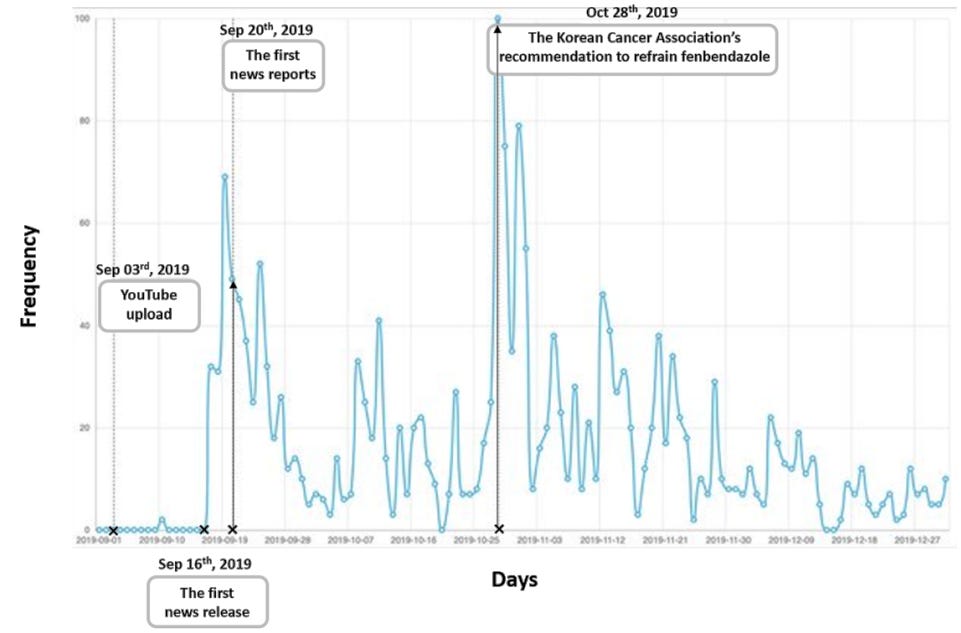
The fenbendazole scandal was a highly controversial public health event in South Korea that began in late 2019 and intensified throughout 2020. It serves as a representative example of how false and unverified cancer information regarding complementary and alternative medicine (CAM) can rapidly spread and disrupt the cancer information market.
The incident centered around the widespread, unverified belief that fenbendazole—an over-the-counter veterinary dewormer used to treat parasites in dogs—could cure terminal lung cancer. This rumor sparked national confusion, leading to the drug selling out at pharmacies across South Korea as desperate patients rushed to get it.
1. The Origin: Joe Tippens and the “Kitruda” Misunderstanding
The scandal originated with claims made by an American cancer patient, Joe Tippens, who asserted that veterinary fenbendazole had cured his terminal lung cancer. However, public media and online communities largely omitted a critical clinical detail: Tippens was also participating in a clinical trial for Kitruda (an immuno-oncology drug) at the MD Anderson Cancer Center.
The narrative that fenbendazole was a standalone “miracle cure” took root.
2. The South Korean Catalyst: Comedian Kim Chul-min
Although the rumor started in the United States, it became a major social phenomenon in South Korea because of celebrity influence. Kim Chul-min, a beloved Korean comedian suffering from lung cancer, announced on social media in September 2019 that he was taking fenbendazole to treat his illness.
At the beginning of the issue, Korean health authorities and medical experts immediately issued press releases warning the public about severe potential side effects, but desperate patients largely ignored them, focusing instead on Kim’s journey.
The timeline of Kim’s public self-treatment illustrates the tragic trajectory of the scandal:
September 2019: Kim announced his intention to take fenbendazole.
September 2020: After a year of self-treatment, Kim publicly declared that the drug was ineffective, announced he was stopping his self-medication, and warned other patients not to take it.
December 2021: Kim Chul-min sadly passed away from his illness.
3. Media Failures and Fragmented Information
A qualitative study utilizing focus group interviews with 21 lung cancer patients exposed severe systemic failures in how health information was reported by the media.
While patients daily sought general cancer information from dedicated internet communities, they passively encountered the fenbendazole rumor through traditional television news and broadcasts. However, this media coverage was highly fragmented and lacked depth:
Chemotherapy Omission: An overwhelming majority of interviewed patients believed that Kim Chul-min was treating his cancer exclusively with the dog dewormer. TV headlines heavily sensationalized the dewormer but completely failed to mention that Kim was concurrently undergoing standard hospital chemotherapy.
Lack of Source Verification: Only a tiny fraction of patients actively cross-checked the original source videos on YouTube to discover that Joe Tippens was also undergoing concurrent immunotherapy. The rest relied on simplified, sensationalized snippets broadcast on television and internet portals.
4. Patient Psychology and the “What If” Factor
The focus groups revealed a profound psychological conflict among cancer patients. While most patients rationally understood that fenbendazole was medically unverified and lacked scientific backing, their terminal diagnoses bred a desperate “what if” hope:
“When I hear a story like someone ate something and recovered … it sparks the hope for ‘what if’. Even with the slightest hope like this, I want to try it.”
This desperation caused patients to actively ignore official medical warnings. Because they felt a lack of guidance on self-care and immune-boosting protocols at home, they took matters into their own hands:
Subjective Filtering: Patients created their own arbitrary guidelines based on “common sense” or gut feelings to determine if an online rumor was an exaggerated commercial.
Self-Clinical Testing: Desperate patients used their own bodies as testing grounds, trying the drug and monitoring their own physical reactions to gauge success. For example, one patient in the study noted that they ultimately had to stop taking fenbendazole because it was damaging their liver.
5. The Role of “YouTube Journalism”
The study highlighted that YouTube has evolved into a uniquely powerful, active search channel for patients. While patients initially heard about fenbendazole passively on TV, they immediately turned to YouTube to search for personal testimonials, patient diaries, and alternative opinions.
Because YouTube lacks the strict peer-review or verification of professional medicine, the highly emotional “evidence of experience” shared by other patients often completely overrode the scientific warnings of the medical community.
6. Political and Policy Repercussions
The social chaos and panic surrounding the dewormer were so severe that the fenbendazole scandal was raised during South Korea’s 2020 parliamentary audit of the Ministry of Health and Welfare.
Researchers and policy experts concluded that health authorities must transition away from slow, reactive press releases and instead establish preemptive, user-centered communication networks. The study recommended that governments actively monitor online platforms, collaborate with medical experts to quickly verify trending CAM claims, and work with video platforms to introduce verification labels that help vulnerable patients distinguish expert medical advice from unverified personal anecdotes.
ORIGINAL RESEARCH article:
How cancer patients get fake cancer information: From TV to YouTube, a qualitative study focusing on fenbendazole scandle
Front. Oncol., 27 October 2022
Sec. Cancer Epidemiology and Prevention
Volume 12 - 2022 | https://doi.org/10.3389/fonc.2022.942045
https://www.frontiersin.org/journals/oncology/articles/10.3389/fonc.2022.942045/full
Unfortunately, after what governments, health authorities, medical institutions, scientific journals and corporate media did around the World during the so-called pandemic of Covid-19, we can no longer trust any of these groups, either.
For example, I fail to see how one can trust any doctor or scientist who subscribes to mRNA technology. Doing so is like trusting an engineer who says that F=ma does not matter and have no consequence.
Frontiersin for an oncologist journal says it all