
Drug repurposing (also known as drug repositioning) is an emerging therapeutic strategy that identifies new uses for existing, FDA-approved, or previously abandoned pharmaceuticals. By reusing established compounds with well-characterized safety and pharmacokinetic profiles, drug repurposing can replace or accelerate traditional, high-cost de novo drug development.
1. Repurposing Benzimidazole Anthelmintics
A prominent class of repurposed agents highlighted in your source is benzimidazole derivatives (BZMs):
Anthelmintic Origins: BZMs—including albendazole, mebendazole, and flubendazole—are broad-spectrum antiparasitic drugs with low toxicity that traditionally target parasitic energy metabolism.
Oncology Repositioning: Researchers have systematically repurposed these compounds in oncology because they can disrupt cancer cell glycolysis, induce cell cycle arrest, trigger apoptosis, and downregulate angiogenesis and hypoxic signaling.
2. Albendazole Across Diverse Malignancies
As a repurposed agent, albendazole demonstrates broad anticancer activity across numerous tumor types:
Multi-Cancer Efficacy: Preclinical evaluations report that albendazole suppresses tumor growth and development in hepatocellular carcinoma, colorectal, ovarian, lung, breast, gastric, leukemia, and head and neck cancers.
General Anti-Tumor Mechanisms: It inhibits tumor cell glycolytic metabolism, downregulates vascular endothelial growth factor receptor (VEGFR) and hypoxia-inducible factor 1α (HIF-1α) expression, and triggers ROS-dependent apoptosis.
Combination Synergies: Albendazole has been shown to synergize with conventional chemotherapeutics, such as docetaxel or 2-methoxyestradiol, to enhance antitumor response.
3. Mechanistic Case Study: Repurposed Albendazole in Prostate Cancer
Focusing on prostate cancer, repurposed albendazole demonstrates targeted, selective anti-tumor efficacy:
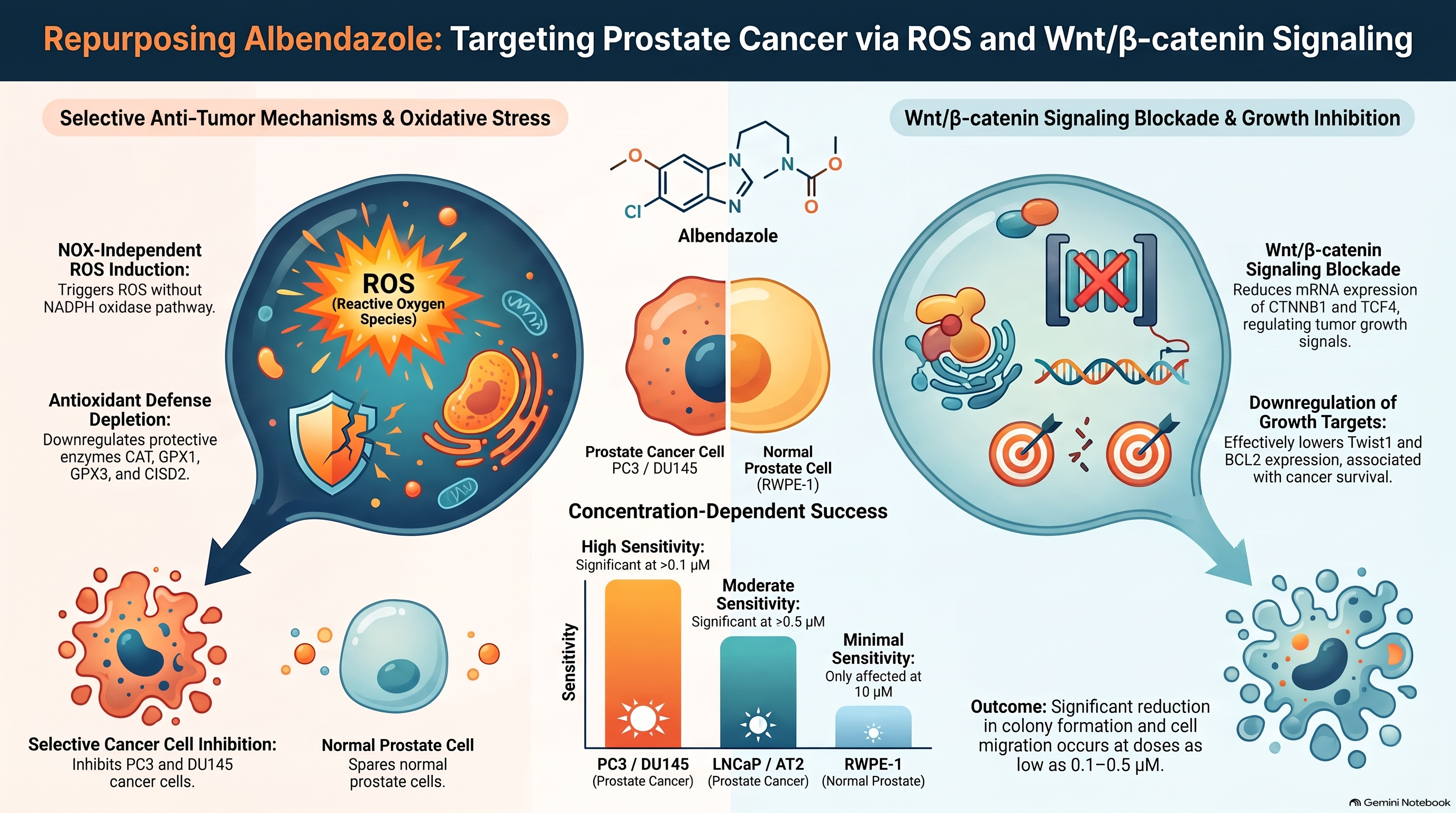
Selective Cytotoxicity: Albendazole selectively inhibits the proliferation, colony formation, and migration of human (PC3, DU145, LNCaP) and rodent (AT2) prostate cancer cells without impairing normal prostate epithelial cells (RWPE-1) at concentrations below 10 µM.
NOX-Independent ROS Accumulation: Albendazole drives cancer cell death by inducing reactive oxygen species (ROS) production independently of NADPH oxidase (NOX) enzymes.
Suppression of Internal Antioxidant Defenses: It strips cancer cells of their internal oxidative protection by downregulating mRNA expression of key antioxidant enzymes—catalase (CAT), glutathione peroxidase 1 (GPX1), and glutathione peroxidase 3 (GPX3)—alongside the redox-sensitive regulator CISD2 and the hypoxic mediator HIF1A.
Wnt/β-Catenin Pathway Blockade: Albendazole inhibits canonical Wnt/β-catenin signaling by reducing CTNNB1 (β-catenin) and TCF4 expression, downregulating downstream oncogenic targets, including the cell invasion promoter TWIST1 and the anti-apoptotic protein BCL2.
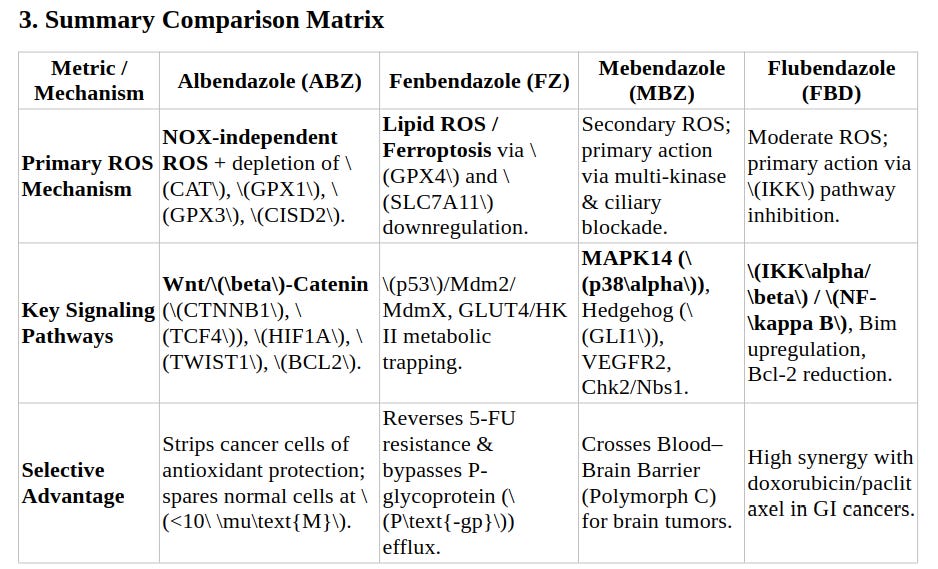
While all benzimidazole carbamates (BZMs) share a core chemical structure and tubulin-binding capabilities, albendazole (ABZ) stands out for its primary reliance on NOX-independent reactive oxygen species (ROS) induction paired with the active dismantling of the cell’s antioxidant defenses.
1. Albendazole’s ROS Signature: Double-Barreled Oxidative Stress
In contrast to drugs that merely generate transient ROS as a secondary byproduct, albendazole executes a two-pronged attack on tumor redox homeostasis:
NOX-Independent ROS Generation: Albendazole drives intracellular ROS accumulation independently of NADPH oxidase (NOX) enzymes (confirmed because the NOX inhibitor DPI fails to block ABZ-induced ROS). Antioxidants like glutathione (GSH) and N-acetylcysteine (NAC) directly rescue cancer cell viability, proving that ROS accumulation is the primary driver of cytotoxicity.
Dismantling Internal Defenses: To ensure ROS levels reach lethal thresholds, albendazole downregulates key enzymatic antioxidant genes—catalase (\(CAT\)), glutathione peroxidase 1 (\(GPX1\)), and \(GPX3\)—which normally convert \(H_2O_2\) into water.
Suppressing \(CISD2\) and \(HIF1A\): It downregulates \(CISD2\) (a redox-sensitive gene protecting cancer cells against ROS) and \(HIF1A\) (hypoxia-inducible factor 1\(\alpha\)). Because HIF-1\(\alpha\) overexpression normally dampens ROS accumulation, suppressing \(HIF1A\) further accelerates oxidative damage.
Wnt/\(\beta\)-Catenin Crosstalk: Albendazole inhibits \(CTNNB1\) (\(\beta\)-catenin) and \(TCF4\), shutting down downstream \(TWIST1\) and \(BCL2\). Cross-talk between Wnt signaling suppression and ROS generation further pushes cells into apoptosis.
2. Comparative Mechanistic Breakdown Across Benzimidazoles
Albendazole (ABZ) vs. Fenbendazole (FZ)
ROS & Cell Death Pathways: While albendazole relies on \(CAT\)/\(GPX1\)/\(GPX3\)/\(CISD2\) depletion and NOX-independent ROS, fenbendazole specifically targets ferroptosis—an iron-dependent, lipid ROS cell death pathway—by concurrently downregulating \(GPX4\) (glutathione peroxidase 4) and \(SLC7A11\) (cystine/glutamate antiporter).
p53 Dependency: Fenbendazole engages p53-dependent mitochondrial apoptosis in \(p53\)-wild-type cells, but switches to ferroptosis-augmented, p53-independent cell death in chemoresistant or \(p53\)-mutant cells. Albendazole works effectively through ROS-mediated Wnt/\(\beta\)-catenin and \(BCL2\) suppression.
Albendazole (ABZ) vs. Mebendazole (MBZ)
Primary Target Focus: Mebendazole operates primarily as a multi-kinase inhibitor (\(MAPK14\)/\(p38\alpha\), \(VEGFR2\), \(ABL1\)) and Hedgehog pathway blocker (\(GLI1\)/primary cilia disruption), alongside microtubule depolymerization and \(NLRP3\)/\(GSDMD\) pyroptosis.
CNS & Pharmacokinetics: MBZ (specifically Polymorph C) is optimized to cross the blood–brain barrier (BBB) for neuro-oncology (gliomas/medulloblastomas), whereas albendazole is primarily studied in systemic/solid tumors (prostate, cutaneous SCC, ovarian, hepatocellular), where it targets oxidative stress and metabolic pathways.
Albendazole (ABZ) vs. Flubendazole (FBD)
Upstream Kinase Signaling: Flubendazole primarily acts as an upstream \(IKK\alpha/\beta\) inhibitor, suppressing the \(NF-\kappa B\ p65\) pathway to trigger Bim-mediated intrinsic apoptosis (e.g., in esophageal cancer). Albendazole targets upstream redox homeostasis and canonical Wnt/\(\beta\)-catenin signaling rather than directly blocking \(IKK\).
Albendazole Prostate Oncology
Albendazole is being evaluated for repurposing as an anticancer agent against prostate cancer, showing selective cytotoxicity, induction of reactive oxygen species (ROS), suppression of antioxidant defense systems, and downregulation of the Wnt/β-catenin signaling pathway.
1. Selective Antiproliferative & Anti-Migratory Effects
Selective Toxicity for Cancer Cells: Albendazole inhibits proliferation in multiple human prostate cancer cell lines (PC3, DU145, and LNCaP), as well as rat prostate cancer cells (AT2). Notably, concentrations below 10 µM do not significantly affect the viability of RWPE-1 normal human prostate epithelial cells, indicating a tumor-selective safety window.
Inhibition of Clonogenicity & Cell Migration: Treatment with low concentrations of albendazole (0.1 µM and 0.5 µM) significantly decreases the long-term colony formation capacity and wound-healing migration velocity of PC3 and DU145 prostate cancer cells in a concentration-dependent manner.
2. ROS-Dependent Cytotoxicity Mechanism
Induction of Intracellular ROS: Albendazole treatment significantly increases intracellular reactive oxygen species (ROS) levels in PC3 and DU145 cells.
NOX-Independent Generation: Co-treatment with diphenyleneiodonium chloride (DPI), a NADPH oxidase (NOX) inhibitor, reduces baseline ROS levels but fails to suppress albendazole-induced ROS, proving that albendazole generates ROS independently of NOX.
Reversal by Antioxidants: Treating cells with antioxidants such as glutathione (GSH) or N-acetylcysteine (NAC) reduces albendazole-induced ROS levels and directly offsets/blocks albendazole’s antiproliferative effects, confirming that ROS generation is central to its cytotoxic mechanism.
3. Downregulation of Antioxidant Defenses & Hypoxic Signaling
Suppression of Antioxidant Genes: Albendazole downregulates the mRNA expression of key enzymatic antioxidants—including catalase (CAT), glutathione peroxidase 1 (GPX1), and glutathione peroxidase 3 (GPX3)—thereby dampening the tumor cell’s capacity to convert hydrogen peroxide into water.
Suppression of CISD2: Albendazole decreases CISD2 (CDGSH iron sulfur domain 2) mRNA levels, a redox-sensitive gene that normally protects cancer cells against oxidative stress.
HIF-1α Inhibition: Albendazole treatment significantly reduces HIF1A (hypoxia-inducible factor 1α) mRNA expression, an essential mediator of tumor hypoxia, metabolic regulation, and progression.
4. Blockade of the Wnt/β-Catenin Signaling Pathway
Downregulation of Core Pathway Factors: Albendazole inhibits the canonical Wnt/β-catenin pathway by reducing the expression of CTNNB1 (catenin β1) and TCF4 (transcription factor 4) at both mRNA and protein levels.
Downstream Target Suppression: Shutting down Wnt/β-catenin signaling decreases expression of key downstream targets, including TWIST1 (a promoter of cell invasion) and the anti-apoptotic protein BCL2.
5. Broader Anti-Cancer Activity Across Other Malignancies
Beyond prostate cancer, your source highlights that albendazole exerts anticancer effects across several other cancer types through additional mechanisms:
Metabolic & Vascular Blockade: Inhibits tumor cell glycolytic metabolism and downregulates vascular endothelial growth factor receptor (VEGFR) and HIF-1α expression.
Cell Cycle Arrest & Apoptosis: Induces cell cycle arrest and triggers apoptosis in leukemia, hepatocellular carcinoma, colorectal, ovarian, breast, gastric, and head and neck cancers.
Albendazole exerts antiproliferative effects on prostate cancer cells by inducing reactive oxygen species generation
Kim U, Shin C, Kim CY, Ryu B, Kim J, Bang J, Park JH. Albendazole exerts antiproliferative effects on prostate cancer cells by inducing reactive oxygen species generation. Oncol Lett. 2021 May;21(5):395. doi: 10.3892/ol.2021.12656. Epub 2021 Mar 18. PMID: 33777218; PMCID: PMC7988661.
Beautiful, and important!
Does DHEA, which ensures activation of TP53 by blocking 6GPD, fit in, with this ?