
Enhancing Fenbendazole Bioavailability Through Acid Cocrystallization
Correction
This article has been corrected. The use of the term aspirin in place of salicylic acid was incorrect and has been corrected.
The salicylic acid discussed in the paper below refers specifically to a fenbendazole–salicylic acid cocrystal, or salicylic acid cocrystal. This is a laboratory-produced product.
Thank you to the sharp-eyed readers who brought this error to my attention.
The cocrystal solubility comparison plot from this study illustrates a highly promising chemical strategy to solve the poor bioavailability bottleneck of fenbendazole by pairing it with organic acid coformers:
Fenbendazole Saturation Solubility Comparison
Pure Fenbendazole (Baseline): Exhibits an exceptionally low aqueous saturation solubility of 0.210 mg/mL, highlighting why the raw drug suffers from poor intestinal absorption.
Cinnamic Acid Cocrystal: Increases saturation solubility 4.0-fold to 0.845 mg/mL.
Benzoic Acid Cocrystal: Increases saturation solubility 4.7-fold to 0.985 mg/mL.
Salicylic Acid Cocrystal: Achieves the highest solubility boost, increasing baseline solubility 5.0-fold to 1.052 mg/mL.
Why Cocrystallization Matters for Clinical Translation
Because fenbendazole is a BCS Class II compound (low solubility, high permeability), its therapeutic absorption in the human digestive tract is physically limited by how fast it can dissolve in gastric and intestinal fluids.
By engineering a cocrystal—where fenbendazole and an FDA-approved coformer (like salicylic acid) are bound together in a single crystalline lattice—scientists can alter the drug’s physical dissolution rate without changing its chemical structure. This 5-fold increase in solubility allows a significantly higher concentration of active fenbendazole to dissolve, cross the intestinal epithelium, and enter the bloodstream to target distant tumors.
The Cellular Connection: The Dual Role of Eosinophils
Interestingly, this document also contains a detailed immunological illustration that visually maps the connection between fighting parasites and fighting cancer.
It highlights how activated eosinophils utilize the exact same highly toxic granule proteins—including Major Basic Protein (MBP), Eosinophil Cationic Protein (ECP), Eosinophil-Derived Neurotoxin (EDN), and Eosinophil Peroxidase (EPO)—to target and destroy both large parasitic worms and malignant cancer cell membranes.
Additional information from a second paper:
Source:
Fenbendazole acts as a moderate microtubule destabilizing agent and causes cancer cell death by modulating multiple cellular pathways
Sci. Rep. 2018 Aug 9;8(1):11926. doi: 10.1038/s41598-018-30158-6
PMCID: PMC6085345 PMID: 30093705
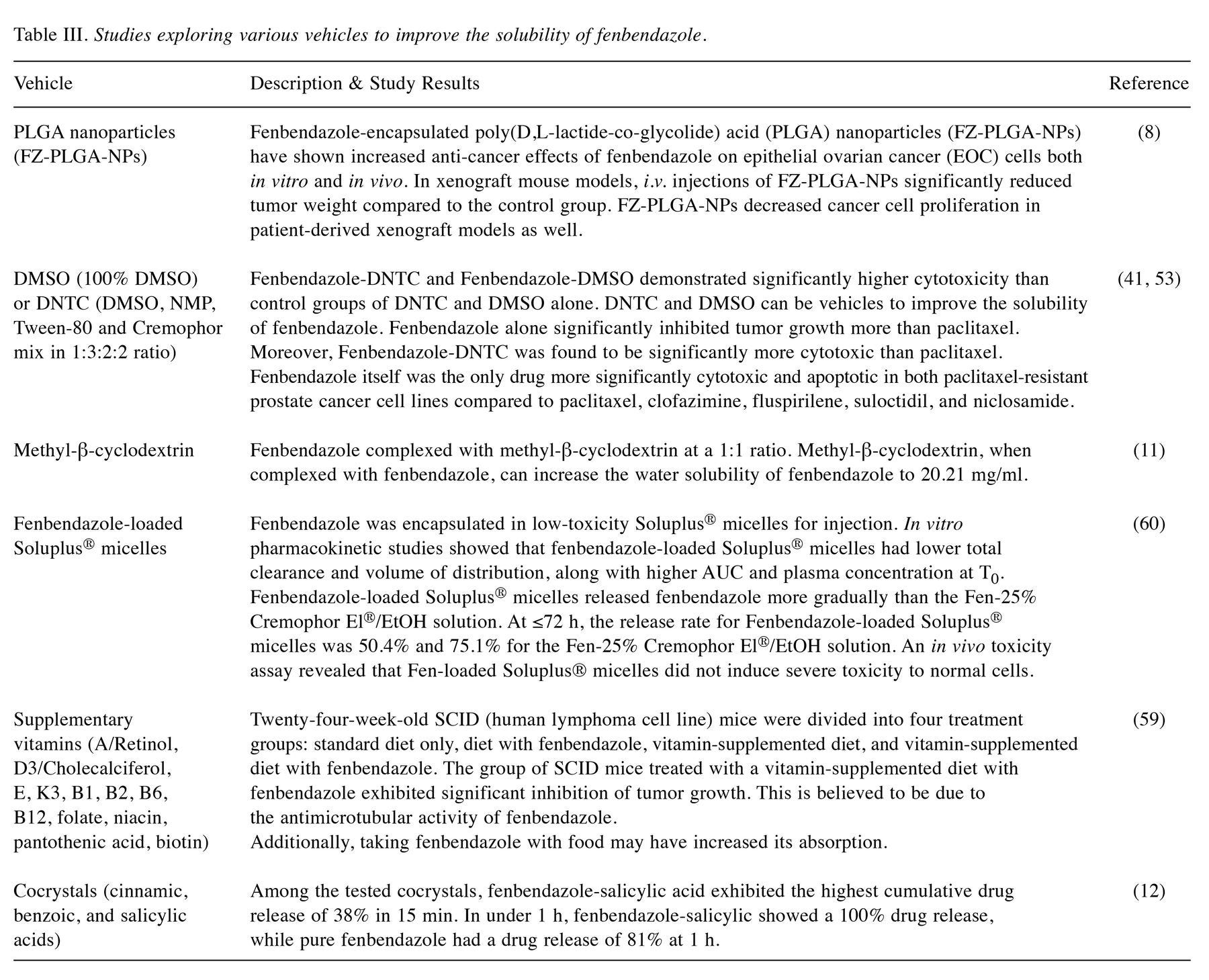
Salicylic Acid Cocrystal
Fenbendazole-salicylic acid is a laboratory-created crystal mixture (cocrystal) designed to help the poorly soluble veterinary drug fenbendazole dissolve faster and more completely.
Separately, salicylic acid is the base compound. When you take aspirin, your body breaks it down into salicylic acid as its main active metabolite.
Salicylic acid would also be an excellent vehicle to improve the drug release rate of fenbendazole. Fenbendazole-salicylic acid performed exceptionally well, achieving a 100% drug release rate in under 1 hour and a solubility of 1.052 mg/ml. This improved drug-release rate could enable immediate therapeutic action.
Aspirin was introduced into clinical practice more than 100 years ago. This unique drug belongs to a family of compounds called the salicylates, the simplest of which is salicylic acid, the principal metabolite of aspirin. Salicylic acid is responsible for aspirin's anti-inflammatory action. Yet salicylic acid and other salicylates occur naturally in fruits and plants,
*Salicylic acid: a link between aspirin, diet and the prevention of colorectal cancer*
QJM 2001 Aug;94(8):445-8. doi: 10.1093/qjmed/94.8.445.
https://pubmed.ncbi.nlm.nih.gov/11493722/
Does the poor bioavailability apply to Mebendazole as well as Fenbendazole? and do the same organic acid coformers work the same way with Mebendazole?
Thank you!