
Correction
This article has been corrected. The use of aspirin instead of salicylic acid was incorrect and has been corrected.
The salicylic acid discussed in the paper below refers specifically to a fenbendazole–salicylic acid cocrystal, or salicylic acid cocrystal. This is a laboratory-produced product.
Thank you to the sharp-eyed readers who brought this error to my attention.
Fenbendazole (FBZ) is classified as a highly hydrophobic, poorly water-soluble drug, which results in exceptionally low oral bioavailability and limits its therapeutic performance. To overcome this biopharmaceutical hurdle, research has focused on preparing pharmaceutical cocrystals to dramatically enhance its solubility and dissolution rate.
Here are the source details for the synthesis, characterization, and performance of these novel formulations:
1. The Method: Liquid-Assisted Grinding (LAG)
To synthesize these cocrystals, researchers utilized the Liquid-Assisted Grinding (LAG) technique. Equimolar quantities of pure fenbendazole and specific carboxylic acid conformers (coformers) were ground together in a mortar and pestle at room temperature, using methanol added dropwise as a catalytic solvent. The resulting mass was then dried and evaporated.
The three primary coformers tested were:
Salicylic acid
Benzoic acid
Cinnamic acid
2. Aqueous Solubility Enhancement
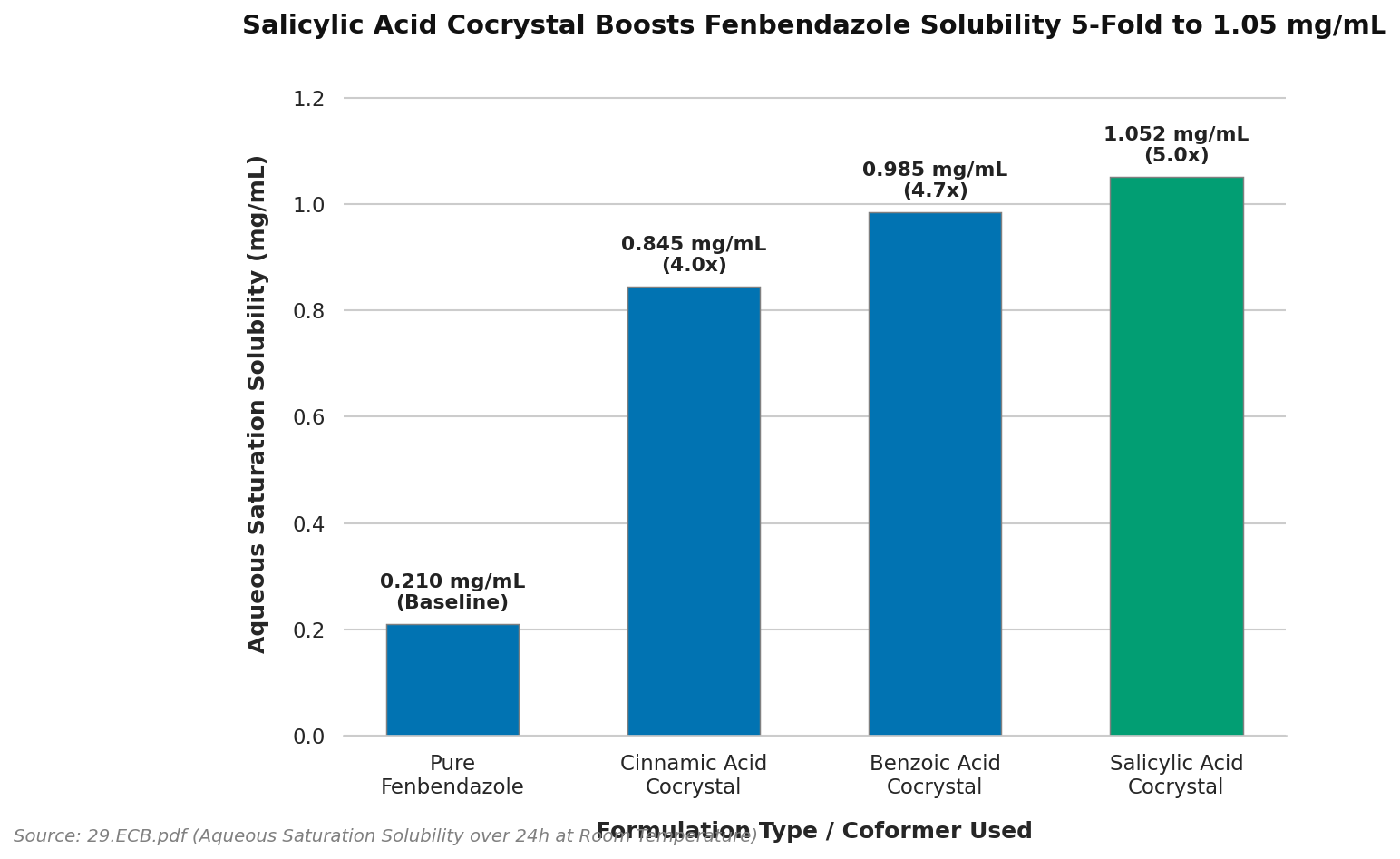
Saturation solubility testing in an aqueous medium over 24 hours revealed substantial improvements when comparing the prepared cocrystals to the pure, unmodified drug:
Pure Fenbendazole: Exhibited a baseline aqueous solubility of 0.21 mg/ml.
Fenbendazole-Cinnamic Acid: Increased solubility to 0.845 mg/ml.
Fenbendazole-Benzoic Acid: Increased solubility to 0.985 mg/ml.
Fenbendazole-Salicylic Acid: Achieved the highest solubility at 1.052 mg/ml.
While the mathematical difference between 1.052 mg/ml and 0.21 mg/ml represents a ~5-fold increase, the researchers state that these synthesized cocrystals demonstrated a 3-fold to 5-fold improvement in aqueous solubility over the pure API.
3. Accelerated In Vitro Dissolution
The improvement in saturation solubility directly translated to faster, more complete drug release during in vitro dissolution experiments (conducted in a buffer at 37 ºC):
At 15 Minutes: The Fenbendazole-Salicylic acid cocrystal achieved a 38% cumulative drug release, compared to just 22% for the pure drug.
At 1 Hour: While the pure drug reached an 81% release, the salicylic acid cocrystal achieved 100% complete drug release in under an hour. This rapid release dramatically increases the drug's active surface area available for physiological absorption.
4. Underlying Hydrogen-Bonding Mechanism
The creation of these stable, highly soluble neutral crystalline structures is driven by specific intermolecular interactions:
Hydrogen Bonding: Structural characterization indicates that fenbendazole and the pharmaceutical coformers engage via strong hydrogen bonds. Specifically, the -NH group of the donor (fenbendazole) binds to the oxygen atoms of the acceptor (the carboxylic acid conformers).
Novel Crystalline Phase: Differential Scanning Calorimetry (DSC) thermograms of the cocrystals showed a single, sharp melting endotherm at a distinct position from both pure fenbendazole and the free coformers, confirming a unique crystalline phase.
Optimizing Fenbendazole Solubility via Salicylic Acid Cocrystallization
The salicylic acid coformer performed best among the three organic acids tested.
Performance Metrics:
Aqueous Solubility: The fenbendazole-salicylic acid cocrystal achieved the highest saturation solubility of 1.052 mg/ml (compared to 0.985 mg/ml for benzoic acid, 0.845 mg/ml for cinnamic acid, and just 0.21 mg/ml for the pure drug). This represents a 50-fold improvement in aqueous solubility over the unmodified drug.
In Vitro Dissolution: It reached a 38% cumulative drug release within 15 minutes (compared to 22% for the pure drug) and achieved 100% complete drug release in under one hour, whereas the pure drug only reached 81% release in the same timeframe.
Because of these outstanding solubility and dissolution results, the researchers concluded that salicylic acid is the preferred coformer for producing advanced, high-bioavailability fenbendazole formulations.
Source:
COCRYSTALS OF FENBENDAZOLE WITH ENHANCED IN VITRO DISSOLUTION PERFORMANCE
Accepted: 15/06/23 Doi: 10.31838/ecb/2023.12.Si8.826