

1. Introduction & Global Burden of Prostate Cancer
Data from the global cancer observational databases (GLOBOCAN 2020/2022) demonstrate that the global oncological burden reached approximately 20 million new cancer diagnoses and nearly 10 million cancer-related fatalities in 2020 alone. Within this burden, prostate cancer (PCa) represents a major global healthcare challenge, accounting for approximately 1.5 million new clinical diagnoses and nearly 400,000 deaths worldwide annually.
The conventional management paradigm for prostate cancer encompasses several clinical modalities, dictated primarily by histological grading, disease staging, biochemical recurrence, and metastatic status:
Surgical Interventions (e.g., Radical Prostatectomy) & Radiation Therapy: Employed primarily for localized disease control and definitive intention.
Cryotherapy: Utilized as a focal ablation strategy or salvage intervention following localized treatment failure.
Chemotherapy (e.g., Taxane-based regimens): Reserved for advanced, metastatic, or castration-resistant settings.
Androgen Deprivation Therapy (ADT): Functions as the core therapeutic backbone for recurrent, high-risk, biochemical, and metastatic prostate cancer.
Although ADT is initially effective at suppressing androgen-driven tumor growth, systemic androgen ablation causes significant treatment-related adverse effects due to multi-organ physiological androgen receptor signaling suppression. Key clinical adverse effects documented with ADT include:
Anemia (secondary to suppressed erythropoietin production and bone marrow androgen deprivation)
Depression, cognitive disturbances, and mood instability
Hot flashes and vasomotor instability
Erectile dysfunction, loss of libido, and metabolic dysfunction
In addition to physical and psychological adverse events, continuous ADT monotherapy almost universally leads to secondary therapeutic resistance, manifesting as metastatic castration-resistant prostate cancer (mCRPC). Consequently, drug repurposing in translational oncology aims to identify well-characterized, commercially feasible non-oncology compounds capable of:
Mitigating monotherapy toxicities through dose-reduction co-treatment strategies.
Bypassing or reversing secondary antiandrogen and chemotherapeutic resistance mechanisms.
Decreasing drug development timelines, attrition rates, and clinical delivery costs.
Expanding accessible, orally bioavailable systemic therapeutic options for broad patient populations.
2. Standard of Care Antiandrogen Monotherapy & Resistance Mechanisms
In clinical uro-oncology, nonsteroidal antiandrogens are essential for competitive androgen receptor (AR) antagonism. Flutamide (Eulexin) is an established first-generation nonsteroidal antiandrogen agent indicated as a primary or alternative endocrine option for advanced prostate cancer. Clinically, Flutamide is administered either as single-agent monotherapy or in combination with luteinizing hormone-releasing hormone (LHRH) agonists/analogs to achieve complete androgen blockade (CAB).
Clinical Performance & Limitations
Despite its historical utility, Flutamide monotherapy exhibits significant performance limitations in advanced disease settings:
Prostate-Specific Antigen (PSA) Response Rate: Flutamide monotherapy achieves a modest PSA response rate ( reduction in serum PSA levels) of approximately 35%.
Therapy Resistance: Primary (intrinsic) or secondary (acquired) antiandrogen resistance affects approximately 30% of treated patients, typically manifesting within 12 to 24 months of initiating therapy.
Cellular and Molecular Mechanisms of Resistance
The emergence of resistance to Flutamide and related AR-pathway inhibitors is driven by adaptive biological adaptations within tumor cells:
Androgen Receptor Heterogeneity and Transactivation: Genomic amplification of AR, point mutations within the AR ligand-binding domain (LBD; e.g., T878A, W742C), truncated AR splice variants lacking the LBD (e.g., AR-V7), and crosstalk with alternative receptor tyrosine kinase (RTK) pathways permit sustained AR transactivation despite systemic androgen suppression or competitive antagonist binding.
Microtubule and Tubulin Isoform Upregulation: Antiandrogen resistance is associated with remodeling of the neuronal and cytoskeletal architecture. Specifically, upregulation of Class III -tubulin (TUBB3) occurs during AR pathway inhibition, driving aggressive neuroendocrine differentiation (NED), taxane cross-resistance, and impaired apoptotic sensitivity.
Apoptotic Cascade Evasion: Suppression of intrinsic apoptotic machinery through an imbalance in family proteins—predominantly the downregulation of pro-apoptotic BAX relative to anti-apoptotic BCL2—preserves cell survival under therapeutic stress.
3. Repurposed Anthelmintic Agents: Class-Wide Mechanisms & Preclinical Evidence
Antiparasitic compounds, particularly benzimidazole derivatives and macrocyclic lactones, demonstrate off-target antineoplastic properties in diverse preclinical cancer models.
3.1 Benzimidazole Derivatives (Fenbendazole, Mebendazole, Flubendazole, Albendazole)
Benzimidazoles are heterocyclic aromatic molecules consisting of a benzene ring fused to an imidazole ring.
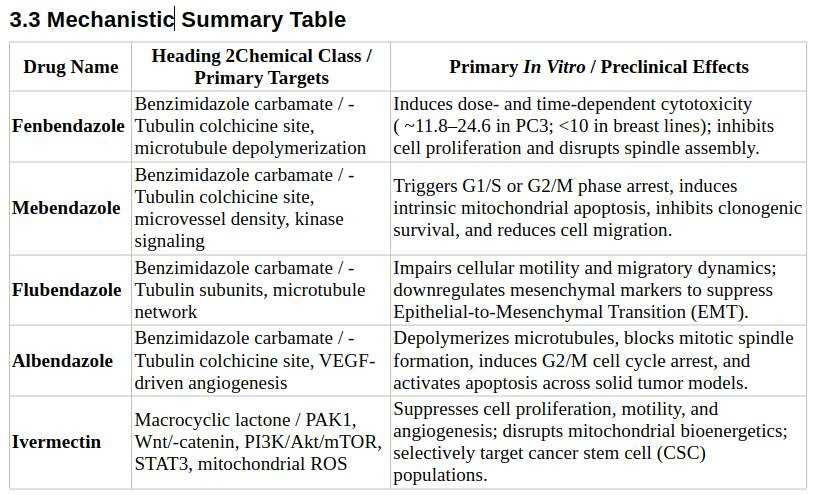
Class-Wide Mechanism of Action: Benzimidazoles selectively bind the -tubulin subunit at or near the colchicine-binding site, inhibiting -tubulin heterodimerization and microtubule polymerization dynamics. This action disrupts mitotic spindle assembly, induces cell cycle arrest (predominantly at G1/S or G2/M phases), impairs glucose uptake, disrupts structural cell scaffold integrity, and activates mitochondrial-mediated apoptotic cascades.
Fenbendazole Sensitivity Profile: In vitro evaluation using AlamarBlue proliferation assays demonstrates that Fenbendazole exerts dose- and time-dependent cytotoxicity across multiple solid tumor cell lines.
Prostate Cancer (PC3): Analytical standard and commercial formulations show time- and dose-dependent cytotoxic sensitivity. Reported half-maximal inhibitory concentration () values across timepoints are:
24 Hours: Range of 20.86 (Brand S) to 24.62 (Brand P), with the analytical standard at 22.62 .
48 Hours: Range of 14.29 (Brand S) to 14.95 (Brand P), with the analytical standard at 15.31 .
72 Hours: Range of 11.83 (Brand S) to 13.61 (Brand P), with the analytical standard at 12.90 .
Breast Cancer Sensitivity: Pronounced cytotoxicity is observed in human breast carcinoma models, specifically triple-negative MDA-MB-231 cells ( ~6.32–8.76 at 48–72h) and hormone receptor-positive MCF7 cells ( ~7.78–9.41 at 48–72h).
Mebendazole, Flubendazole, and Albendazole:
Mebendazole: Binds the colchicine-binding domain of tubulin, blocks mitotic progression, inhibits cell migration, reduces clonogenic potential, and triggers caspase-dependent apoptosis across solid tumor lines.
Flubendazole: Inhibits cell motility, halts microtubule function, and suppresses key drivers of the Epithelial-to-Mesenchymal Transition (EMT).
Albendazole: Demonstrates potent microtubule-depolymerizing activity by binding -tubulin, preventing spindle formation, inducing G2/M phase arrest, and triggering apoptosis across diverse tumor types.
3.2 Macrocyclic Lactones (Ivermectin)
Ivermectin is a lipophilic macrocyclic lactone derived from Streptomyces avermitilis with multi-target antineoplastic properties:
Oncogenic Signaling Cascade Suppression: Inhibits several critical oncogenic driver pathways, including p21-activated kinase 1 (PAK1), Wnt/-catenin, Phosphoinositide 3-kinase (PI3K)/Akt/mTOR, and Signal Transducer and Activator of Transcription 3 (STAT3).
Mitochondrial Disruption & Stem Cell Eradication: Induces mitochondrial membrane hyperpolarization, increases reactive oxygen species (ROS) accumulation, and selectively targets cancer stem cell (CSC) sub-populations responsible for therapy resistance and metastatic relapse.
4. In Vitro Combination Analysis: Enhanced Cytotoxicity of Mebendazole and Flutamide
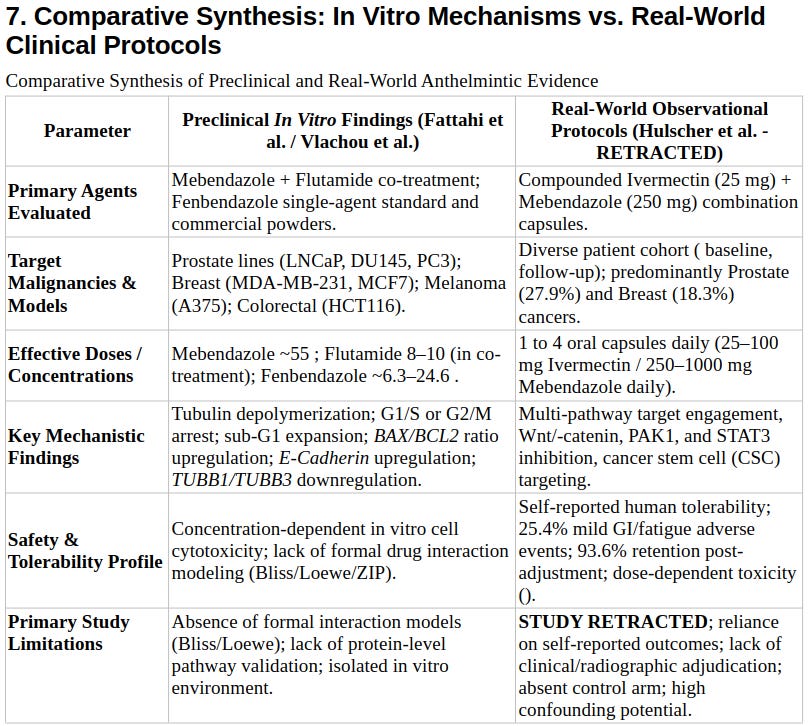
A comprehensive 2026 in vitro study (Fattahi et al.) evaluated co-administration of Mebendazole and Flutamide across three human prostate cancer cell lines with varying androgen sensitivities and metastatic phenotypes: LNCaP (androgen-sensitive, non-metastatic), DU145 (androgen-insensitive, moderately metastatic), and PC3 (androgen-insensitive, highly metastatic).
Methodological Limitation Note: No formal drug-interaction modeling (e.g., combination-index, Bliss independence, Loewe additivity, or zero interaction potency [ZIP] analysis) was performed in this study. Consequently, these findings should be interpreted as enhanced co-treatment cytotoxicity and co-administrative dose reduction, rather than formal pharmacological synergism or additivity.
Dose Lowering & Viability Modifications
MTT metabolic assays over 24, 48, and 72 hours established single-agent and co-treatment parameter profiles at 48 hours:
Single-Agent Thresholds (at 48h):
Mebendazole: ~55 across LNCaP, DU145, and PC3 cell lines.
Flutamide: 10 for LNCaP and DU145; 12 for PC3.
Co-Treatment Dose Reduction Profile (at 48h):
In LNCaP and DU145 cells, combining Mebendazole (50 ) reduced the required dose of Flutamide to 8 .
In PC3 cells, combining Mebendazole (55 ) reduced the required dose of Flutamide to 10 .
Co-treatment significantly reduced cell viability compared to monotherapy at matching concentrations across all three cell lines.
Cellular Assays & Phenotypic Findings
Morphological Alterations: Phase-contrast microscopy showed that Flutamide (10–12 ) or Mebendazole (55 ) monotherapy induced cell rounding and minor loss of adherence. Co-treatment regimens produced extensive loss of cell density, severe cellular shrinkage, membrane blebbing, and widespread detachment indicative of enhanced cell death.
Colony Formation (Clonogenic Potential): Long-term 14-day clonogenic assays showed marked inhibition of colony formation. The combination regimen (Flutamide 8–10 + Mebendazole 50–55 ) inhibited clonogenic survival significantly more than Flutamide alone ( to ) or Mebendazole alone ( to ).
Scratch-Wound Migration: Scratch-wound assays revealed that co-treatment significantly restricted wound closure at 48 hours compared to untreated controls and monotherapies, reducing cell migration across LNCaP, DU145, and PC3 lines.
Cell Cycle Kinetics & Apoptosis
Annexin V/PI Flow Cytometry: Total apoptosis (sum of early and late apoptotic populations) peaked under co-treatment, most prominently in LNCaP and DU145 cells.
DNA Cell Cycle Redistribution:
LNCaP & DU145: Co-treatment induced pronounced arrest at the G1/S transition, accompanied by expansion of the sub-G1 population (indicative of apoptotic DNA fragmentation).
PC3: Co-treatment shifted cell distribution toward S/G2 or G2/M phase arrest, alongside sub-G1 population expansion.
Gene Expression Alterations (RT-PCR Transcriptional Profiling)
Real-time quantitative PCR following 48 hours of treatment demonstrated the following transcriptional responses:
Apoptosis Pathway Markers:
Significant elevation of pro-apoptotic BAX mRNA expression.
Significant downregulation of anti-apoptotic BCL2 mRNA.
Statistically significant increase in the BAX/BCL2 mRNA ratio () across all three lines, favoring apoptotic cascade execution.
Epithelial-to-Mesenchymal Transition (EMT) Markers:
Significant upregulation of the epithelial cell adhesion marker E-Cadherin in LNCaP (), DU145 (), and PC3 ().
Downregulation of the mesenchymal marker N-Cadherin (statistically significant in PC3 cells).
Cytoskeletal Tubulin Isoforms:
Significant downregulation of TUBB1 mRNA in DU145 cells ().
Significant downregulation of TUBB3 mRNA in DU145 () and PC3 () cells. (No significant change in tubulin isoforms was detected in LNCaP cells).
Angiogenic and Prostatic Biomarkers:
No statistically significant alterations were observed for VEGFC, HIF1A, SNAIL1, or KLK3 (PSA) under these experimental parameters.
Translational Caveats & Tubulin Dynamics in CRPC
Transcriptional vs. Translational Gap: The reported RT-PCR gene expression shifts represent transcript-level alterations. Downstream Western blot and protein-level functional validation are necessary to confirm activation of these apoptotic and cytoskeletal pathways.
Biological Relevance of Tubulin Regulation in CRPC: Class III -tubulin (TUBB3) upregulation is linked to taxane resistance (docetaxel/cabazitaxel) and neuroendocrine transdifferentiation in castration-resistant prostate cancer. The downregulation of TUBB3 by co-treatment in androgen-insensitive, metastatic lines (DU145 and PC3) suggests a potential strategy to lower taxane resistance thresholds.
Role of Androgen Receptor (AR) Signaling Heterogeneity: Contrast between AR-sensitive LNCaP cells (which maintained stable tubulin isoform levels) and AR-insensitive DU145/PC3 cells (which showed marked TUBB3 downregulation) indicates that baseline AR signaling modulates tubulin dynamics. Loss of AR activity in aggressive PCa phenotypes appears to increase sensitivity to benzimidazole-mediated tubulin isoform transcriptional suppression.
5. Pharmacokinetic, Dissolution, and Bioavailability Challenges
Despite promising preclinical efficacy, the translational application of repurposed anthelmintics is limited by severe physical, chemical, and pharmacokinetic barriers.
Analytical Validation of Commercial Formulations
Laboratory characterization (Vlachou et al.) of commercial Fenbendazole formulations—Brand P (Panacur C) and Brand S (Safe-guard 4)—using High-Performance Liquid Chromatography (HPLC), Liquid Chromatography-Mass Spectrometry (LC-MS), and Proton/Diffusion-Ordered Spectroscopy Nuclear Magnetic Resonance (/DOSY NMR) confirmed:
Active Ingredient Quantitites: Commercial preparations matched label claims of 22.2% active compound (222 mg/g powder). HPLC quantification verified 216.4–217.2 mg/g in Brand P and 217.2–218.8 mg/g in Brand S.
Excipient Signals: /DOSY NMR identified unlabelled excipient signals in the 1–6 ppm chemical shift region in both commercial products.
Dissolution Profile Deficits & Batch Variability
Dissolution testing (USP Apparatus 2, paddle at 100 rpm, 37°C) identified significant systemic release limits:
Phosphate Buffer Saline (PBS, pH 6.8): Both powders dispersed rapidly upon wetting, but electrostatic charge caused powder to adhere to test paddles. Extensive undissolved particulate remained visible throughout testing, yielding low, non-homogeneous drug release across all timepoints.
2% Sodium Dodecyl Sulfate (SDS) Solution: SDS surfactant was added well above its Critical Micelle Concentration (CMC = 8.2 mM) to enhance solubilization. However, release profiles remained low and exhibited significant batch-to-batch inconsistency across both commercial brands, rather than intrinsic performance differences between manufacturers.

Summary: At 90 minutes in 2% SDS, release ranged from 15.7% to 26.5% for Brand P batches and 15.3% to 26.6% for Brand S batches. These findings demonstrate that unformulated commercial veterinary powders exhibit batch-dependent variability and overall low aqueous dissolution profiles (<27% maximum release under optimized micellar conditions).
Formulative Requirements for Systemic Bioavailability
Benzimidazoles and macrocyclic lactones exhibit high lipophilicity (LogP > 3.0) and extremely low aqueous solubility (<1 ). When administered as unformulated crude powders or basic oral suspensions, gastrointestinal absorption is minimal, preventing the achievement of the micromolar systemic plasma concentrations ( ~11–55 ) required for oncological efficacy.
Translational drug development requires drug delivery platforms to achieve therapeutic exposure:
Self-Nanoemulsifying Drug Delivery Systems (SNEDDS): Isotropic mixtures of oils, surfactants, and co-solvents that spontaneously form fine oil-in-water nanoemulsions (<100 nm) in GI fluids, increasing surface area and solubilization.
Polymeric Nanoparticles & Nanocrystals: PEGylated polymeric carriers (e.g., PLGA) or wet-milled drug nanocrystals that increase dissolution rates and prolong circulation half-life.
Solid Lipid Nanocarriers (SLNs) & Liposomes: Lipid matrices that promote lymphatic transport, bypass hepatic first-pass metabolism, and enhance systemic bioavailability.
Cyclodextrin Inclusion Complexes: Chemically modified cyclodextrin complexes (e.g., HP--CD) that encapsulate hydrophobic guest molecules to increase aqueous solubility.
6. Real-World Clinical Evidence & Protocol Analysis: Compounded Ivermectin–Mebendazole Cohort
Critical Literature Integrity Disclosure: The observational study discussed below (Hulscher et al., 2026) was RETRACTED by the journal Anticancer Research on October 1, 2026. The inclusion of these data serves exclusively to review real-world observational frameworks and self-reported patient protocols. Due to its retracted status, extreme caution must be exercised, and no clinical efficacy or safety conclusions should be drawn from these data.
Patient Profile & Administration Protocol
Cohort Demographics: Baseline patients; completed the 6-month follow-up survey (61.9% retention fraction). Mean age was 67 years (); sex distribution was 52.3% male and 47.7% female. Median time since cancer diagnosis was 1.2 years.
Primary Malignancies: Broad spectrum led by prostate cancer (27.9%, ) and breast cancer (18.3%, ). At baseline, 37.1% of patients reported active disease progression.
Intervention Protocol: Patients received compounded oral capsules containing 25 mg Ivermectin and 250 mg Mebendazole per capsule, dispensed through a U.S. telemedicine platform (The Wellness Company) via a 90-capsule starter pack.
Dosing Distribution: Reported daily dosing regimens were 1 capsule/day (44.3%), 2 capsules/day (27.9%), 3 capsules/day (11.5%), and 4 capsules/day (12.3%). Medication adherence was high, with 86.9% completing the initial 90-capsule prescription and 66.4% remaining on therapy at 6 months.
Primary Patient-Reported Clinical Metrics (At 6 Months)
Clinical Benefit Ratio (CBR): 84.4% (95% CI: 77.0–89.8%; defined as NED + Regression + Stable Disease).
No Evidence of Disease (NED) / Tumor Regression: 48.4% combined total (32.8% NED []; 15.6% tumor regression []).
Stable Disease: 36.1% ().
Disease Progression: 15.6% ().
Safety, Tolerability, and Dose-Stratified Analysis
Mild adverse events were self-reported by 25.4% () of participants, primarily gastrointestinal symptoms (38.7%), fatigue/weakness (32.3%), and dizziness (22.6%). Overall tolerability was reported as high: 93.6% of patients experiencing side effects continued therapy following minor dosage adjustments or temporary holds.
Dose–Response Efficacy Analysis: Reported clinical benefit remained consistent across dosing tiers (). The proportion of patients reporting NED or regression ranged from 46.7% to 50.0% across 1, 2, 3, or 4 capsules daily (CBR peaked at 91.2% in the 2-capsule group).
Dose–Response Toxicity Analysis: A statistically significant association was observed between higher daily dosing and adverse event incidence (), with side effects reported in 16.7% of the 1-capsule group versus 47.1% of the 2-capsule group.
Concurrent Integrations
Participants frequently co-administered the compounded formulation with standard-of-care oncological therapies and integrative modalities: chemotherapy (27.9%), radiation therapy (21.3%), surgery (19.7%), dietary supplements (49.2%; e.g., Vitamin D, Turmeric, Berberine), and dietary modifications (37.7%; e.g., ketogenic diets, fasting).
Reference List
Ali, A., & Kulik, G. (2021). Signaling pathways that control apoptosis in prostate cancer. Cancers, 13(5), Article 937. https://doi.org/10.3390/cancers13050937
Bai, R.-Y., Staedtke, V., Aprhys, C. M., Gallia, G. L., & Riggins, G. J. (2011). Antiparasitic mebendazole shows survival benefit in 2 preclinical models of glioblastoma multiforme. Neuro-Oncology, 13(9), 974–982. https://doi.org/10.1093/neuonc/noq201
Bray, F., Laversanne, M., Sung, H., Ferlay, J., Siegel, R. L., Soerjomataram, I., & Jemal, A. (2024). Global cancer statistics 2022: GLOBOCAN estimates of incidence and mortality worldwide for 36 cancers in 185 countries. CA: A Cancer Journal for Clinicians, 74(3), 229–263. https://doi.org/10.3322/caac.21834
Chang, A., Yeap, B., Davis, T., Blum, R., Hahn, R., Khanna, O., Fisher, H. A., & Coleman, M. (1996). Double-blind, randomized study of primary hormonal treatment of stage D2 prostate carcinoma: Flutamide versus diethylstilbestrol. Journal of Clinical Oncology, 14(8), 2250–2257. https://doi.org/10.1200/JCO.1996.14.8.2250
De Gendt, K., Denolet, E., Willems, A., Daniels, V. W., Clinckemalie, L., Denayer, S., & Verhoeven, G. (2011). Expression of Tubb3, a beta-tubulin isotype, is regulated by androgens in mouse and rat Sertoli cells. Biology of Reproduction, 85(5), 934–945. https://doi.org/10.1095/biolreprod.111.091199
Fattahi, M. R., Taheri, D., Inanloo, S. H., Mirzaei, A., Ghajar, H. A., Reis, L. O., & Aghamir, S. M. K. (2026). Effects of Mebendazole and Flutamide combination in prostate cancer cell lines: A comprehensive in vitro analysis. Cellular Physiology and Biochemistry, 60(4), 458–472. https://doi.org/10.33594/000000883
Guerini, A. E., Triggiani, L., Maddalo, M., Bonù, M. L., Frassine, F., Baiguini, A., Alghisi, A., Tomasini, D., Borghetti, P., & Magrini, S. M. (2019). Mebendazole as a candidate for drug repurposing in oncology: An extensive review of current literature. Cancers, 11(9), Article 1284. https://doi.org/10.3390/cancers11091284
Hulscher, N., Victory, K., Thorp, J. A., Pinsky, D., Diaz-Villalobos, A., Gillooly, P., Coulson, F., Annazone, M., Radesi, C., Brooks, J., McCullough, P. A., & Risch, H. (2026). Real-world clinical outcomes of Ivermectin and Mebendazole in cancer patients: Results from a prospective observational cohort. Anticancer Research, 46(6), 3243–3255. https://doi.org/10.21873/anticanres.18194 (Retraction published October 1, 2026, Anticancer Research, 46(10), 5100)
Iguchi, T., Tamada, S., Kato, M., Yasuda, S., Yamasaki, T., & Nakatani, T. (2019). Enzalutamide versus flutamide for castration-resistant prostate cancer after combined androgen blockade therapy with bicalutamide: Study protocol for a multicenter randomized phase II trial (the OCUU-CRPC study). BMC Cancer, 19(1), Article 339. https://doi.org/10.1186/s12885-019-5558-1
Jamroze, A., Chatta, G., & Tang, D. G. (2021). Androgen receptor (AR) heterogeneity in prostate cancer and therapy resistance. Cancer Letters, 518, 1–9. https://doi.org/10.1016/j.canlet.2021.05.035
Kralova, V., Hanušová, V., Caltová, K., Špaček, P., Hochmalová, M., Skálová, L., & Boušová, I. (2018). Flubendazole and mebendazole impair migration and epithelial to mesenchymal transition in oral cell lines. Chemico-Biological Interactions, 293, 124–132. https://doi.org/10.1016/j.cbi.2018.07.024
Maahs, L., Sanchez, B. E., Gupta, N., Van Harn, M., Barrack, E. R., Reddy, P. V., & Hwang, C. (2019). Class III -tubulin expression as a predictor of docetaxel-resistance in metastatic castration-resistant prostate cancer. PLoS ONE, 14(10), Article e0222510. https://doi.org/10.1371/journal.pone.0222510
Martarelli, D., Pompei, P., Baldi, C., & Mazzoni, G. (2008). Mebendazole inhibits growth of human adrenocortical carcinoma cell lines implanted in nude mice. Cancer Chemotherapy and Pharmacology, 61(5), 809–817. https://doi.org/10.1007/s00280-007-0538-z
Mirzaei, A., Akbari, M. R., Zadeh, S. S. T., Khatami, F., Mashhadi, R., & Aghamir, S. M. K. (2022). Novel combination therapy of prostate cancer cells with arsenic trioxide and flutamide: An in-vitro study. Tissue and Cell, 74, Article 101684. https://doi.org/10.1016/j.tice.2021.101684
Mora-Rodríguez, J. M., Sánchez, B. G., Sebastián-Martín, A., Díaz-Yuste, A., Sánchez-Chapado, M., Palacín, A. M., & Vázquez-Levin, M. H. (2023). Resistance to 2-hydroxy-flutamide in prostate cancer cells is associated with the downregulation of phosphatidylcholine biosynthesis and epigenetic modifications. International Journal of Molecular Sciences, 24(21), Article 15814. https://doi.org/10.3390/ijms242115814
Pantziarka, P., Bouche, G., Meheus, L., Sukhatme, V., & Sukhatme, V. P. (2014). Repurposing Drugs in Oncology (ReDO)—mebendazole as an anti-cancer agent. ecancermedicalscience, 8, Article 443. https://doi.org/10.3332/ecancer.2014.443
Sasaki, J.-I., Ramesh, R., Chada, S., Gomyo, Y., Roth, J. A., & Mukhopadhyay, T. (2002). The anthelmintic drug mebendazole induces mitotic arrest and apoptosis by depolymerizing tubulin in non-small cell lung cancer cells. Molecular Cancer Therapeutics, 1(13), 1201–1209.
Sekhoacha, M., Riet, K., Motloung, P., Gumenku, L., Adegoke, A., & Mashele, S. (2022). Prostate cancer review: Genetics, diagnosis, treatment options, and alternative approaches. Molecules, 27(17), Article 5730. Concurrent Integrationshttps://doi.org/10.3390/molecules27175730
Sekino, Y., Han, X., Babasaki, T., Miyamoto, S., Kobatake, K., Kitano, H., & Teishima, J. (2021). TUBB3 is associated with PTEN, neuroendocrine differentiation, and castration resistance in prostate cancer. Urologic Oncology: Seminars and Original Investigations, 39(11), 786.e1–786.e10. https://doi.org/10.1016/j.urolonc.2021.05.006
Sekino, Y., Han, X., Kawaguchi, T., Babasaki, T., Goto, K., Inoue, S., Shiota, M., & Teishima, J. (2019). TUBB3 reverses resistance to docetaxel and cabazitaxel in prostate cancer. International Journal of Molecular Sciences, 20(16), Article 3936. https://doi.org/10.3390/ijms20163936
Suzuki, H., Okihara, K., Miyake, H., Fujisawa, M., Miyoshi, S., Matsumoto, T., & Akaza, H. (2008). Alternative nonsteroidal antiandrogen therapy for advanced prostate cancer that relapsed after initial maximum androgen blockade. The Journal of Urology, 180(3), 921–927. https://doi.org/10.1016/j.juro.2008.05.039
Vellky, J. E., & Ricke, W. A. (2020). Development and prevalence of castration-resistant prostate cancer subtypes. Neoplasia, 22(11), 566–575. https://doi.org/10.1016/j.neo.2020.09.002
Vlachou, I., Parsonidis, P., Mamagkaki, A., Bouris, I., & Papasotiriou, I. (2022). Teaching an old dog new tricks: The case of Fenbendazole. Cancer Treatment and Research Communications, 32, Article 100601. https://doi.org/10.1016/j.ctarc.2022.100601
Wirth, M. P., Hakenberg, O. W., & Froehner, M. (2007). Antiandrogens in the treatment of prostate cancer. European Urology, 51(2), 306–314. https://doi.org/10.1016/j.eururo.2006.08.038
Yang, Z., Liu, Y., Shi, C., Zhang, Y., Lv, R., Zhang, R., & Zou, J. (2017). Suppression of PTEN/AKT signaling decreases the expression of TUBB3 and TOP2A with subsequent inhibition of cell growth and induction of apoptosis in human breast cancer MCF-7 cells via ATP and caspase-3 signaling pathways. Oncology Reports, 37(2), 1011–1019. https://doi.org/10.3892/or.2016.5326
If you enter these words into google " ivermectin and microtubules " you will see ivermectin like fenbendazole mebendazole albendazole is a microtubule disruptor. Other substances with this mode of action are, wormwood, cannabis oil, ashwagandah, lemon grass oil, Curcumin and soursop. All potently antifungal/anticancer.