
The 2026 study by Hulscher et al., published in the international peer-reviewed journal Anticancer Research, evaluated the real-world clinical outcomes of cancer patients receiving a compounded combination of ivermectin and mebendazole.
1. Study Design & Patient Cohort
Patient Population: The study initially enrolled 197 patients across various cancer diagnoses (including a subgroup of 36 breast cancer patients).
Follow-Up: 122 patients completed the full 6-month follow-up period.
Dosing Regimen: Patients were prescribed compounded capsules containing 25 mg ivermectin and 250 mg mebendazole and took up to 4 capsules per day based on physician recommendations.
2. Key Findings (6-Month Follow-Up Group, n = 122)
84.4% Overall Clinical Benefit: 84.4% of patients who completed 6 months of follow-up reported clinical benefit, defined as no evidence of disease, tumor regression, or disease stabilization.
32.8% No Evidence of Disease (NED): Nearly a third of the follow-up cohort (32.8%) achieved complete disease clearance / NED.
15.6% Tumor Shrinkage: 15.6% of patients demonstrated active tumor regression.
Disease Stabilization: The remaining subset within the clinical benefit group maintained stable disease without progression.
3. Significance in Repurposing Research
As one of the largest observational human studies on this specific combination, the Hulscher cohort provides real-world observational data supporting the adjunctive use of ivermectin and mebendazole in clinical oncology practice.
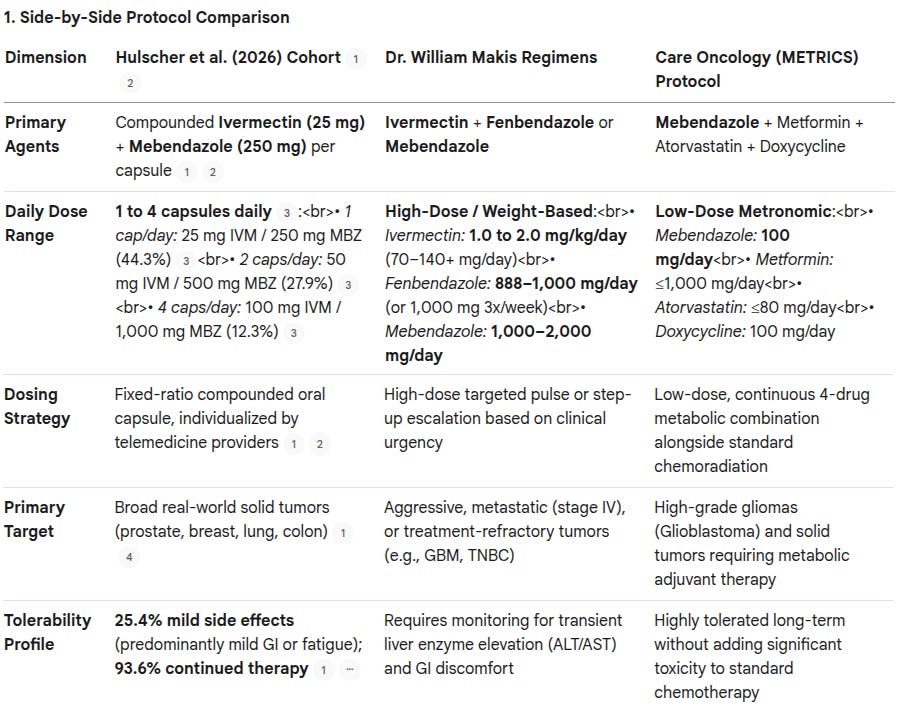
Comparing the Hulscher et al. (2026) observational study, Dr. William Makis’ high-dose regimens, and the Care Oncology (METRICS) protocol reveals key differences in dosing intensity, drug selection, combination strategies, and clinical objectives:
2. Key Distinctions in Clinical Philosophy
Low-Dose Metronomic Synergism (METRICS Protocol): Uses a modest daily dose of mebendazole (100 mg/day) alongside three other repurposed non-cancer drugs (metformin, statins, doxycycline). The goal is to continuously stress cancer cell bioenergetics, stemness, and microenvironmental factors without inducing added systemic toxicity during standard temozolomide chemoradiation.
Moderate Compounded Combination (Hulscher Cohort): Utilizes a single fixed-ratio compounded capsule (25 mg IVM / 250 mg MBZ). Most patients in the study maintained disease control on 1 to 2 capsules per day (25–50 mg IVM and 250–500 mg MBZ). The study demonstrated that higher daily intake (3–4 capsules) did not yield significantly greater clinical benefit, though higher doses increased the frequency of mild gastrointestinal side effects.
High-Dose Targeted Escalation (Makis Protocols): Employs aggressive, weight-based dosing (1.0–2.0 mg/kg/day ivermectin paired with 1,000–2,000 mg/day benzimidazoles) specifically tailored for rapid, advanced metastatic progression or primary intracranial tumors requiring high tissue and blood-brain barrier concentration.
Comparison of Protocols in Glioblastoma & Primary Brain Tumors
Primary brain tumors—such as Glioblastoma Multiforme (GBM), DIPG, and medulloblastoma—present unique pharmacological challenges, primarily due to the Blood-Brain Barrier (BBB), rapid recurrence, and therapy resistance driven by cancer stem cells (CSCs).
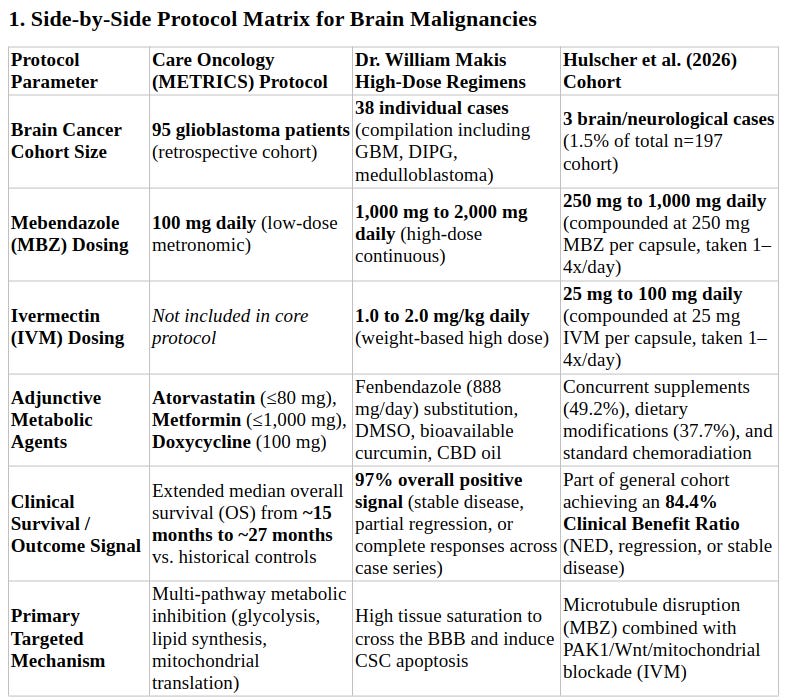
The three protocols approach brain tumor treatment with distinct dosing strategies, drug combinations, and therapeutic objectives:
2. Key Distinctions in Brain Cancer Strategy
Care Oncology (METRICS) Metronomic Approach:
Continuous Bioenergetic Stress: Rather than relying on high-dose single-agent cytotoxicity, this protocol uses a low daily dose of mebendazole (100 mg/day) alongside three repurposed non-cancer drugs (metformin, atorvastatin, and doxycycline).
Therapeutic Synergism: Simultaneously targets glycolytic fuel production, lipid membrane synthesis, mitochondrial translation, and tubulin dynamics during standard temozolomide chemoradiation without adding severe systemic toxicity.
Makis High-Dose Intracranial Regimens:
Overcoming the Blood-Brain Barrier: Employs significantly higher doses of mebendazole (1,000–2,000 mg/day) combined with weight-based ivermectin (1.0–2.0 mg/kg/day).
CSC Eradication: Designed to maximize drug lipophilicity and tissue concentrations across the BBB, targeting quiescent, chemoresistant glioblastoma stem cells and inhibiting aggressive invasive signaling.
Hulscher et al. Compounded Combination:
Real-World Telemedicine Data: Evaluated a fixed-ratio compounded oral capsule (25 mg IVM / 250 mg MBZ) across a broad patient population.
Tolerability & Compliance: Demonstrated high completion rates (86.9%) and favorable safety (25.4% mild, mostly GI side effects), confirming that fixed oral combinations can be safely administered alongside standard surgery, radiation, or chemotherapy.
Hulscher N, Victory K, Thorp JA, Pinsky D, Diaz-Villalobos A, Gillooly P, Coulson F, Annazone M, Radesi C, Brooks J, McCullough PA, Risch H. Real-world Clinical Outcomes of Ivermectin and Mebendazole in Cancer Patients: Results from a Prospective Observational Cohort. Anticancer Res. 2026 Jun;46(6):3243-3255. doi: 10.21873/anticanres.18194. PMID: 42203321.
https://ar.iiarjournals.org/content/anticanres/46/6/3243.full.pdf