
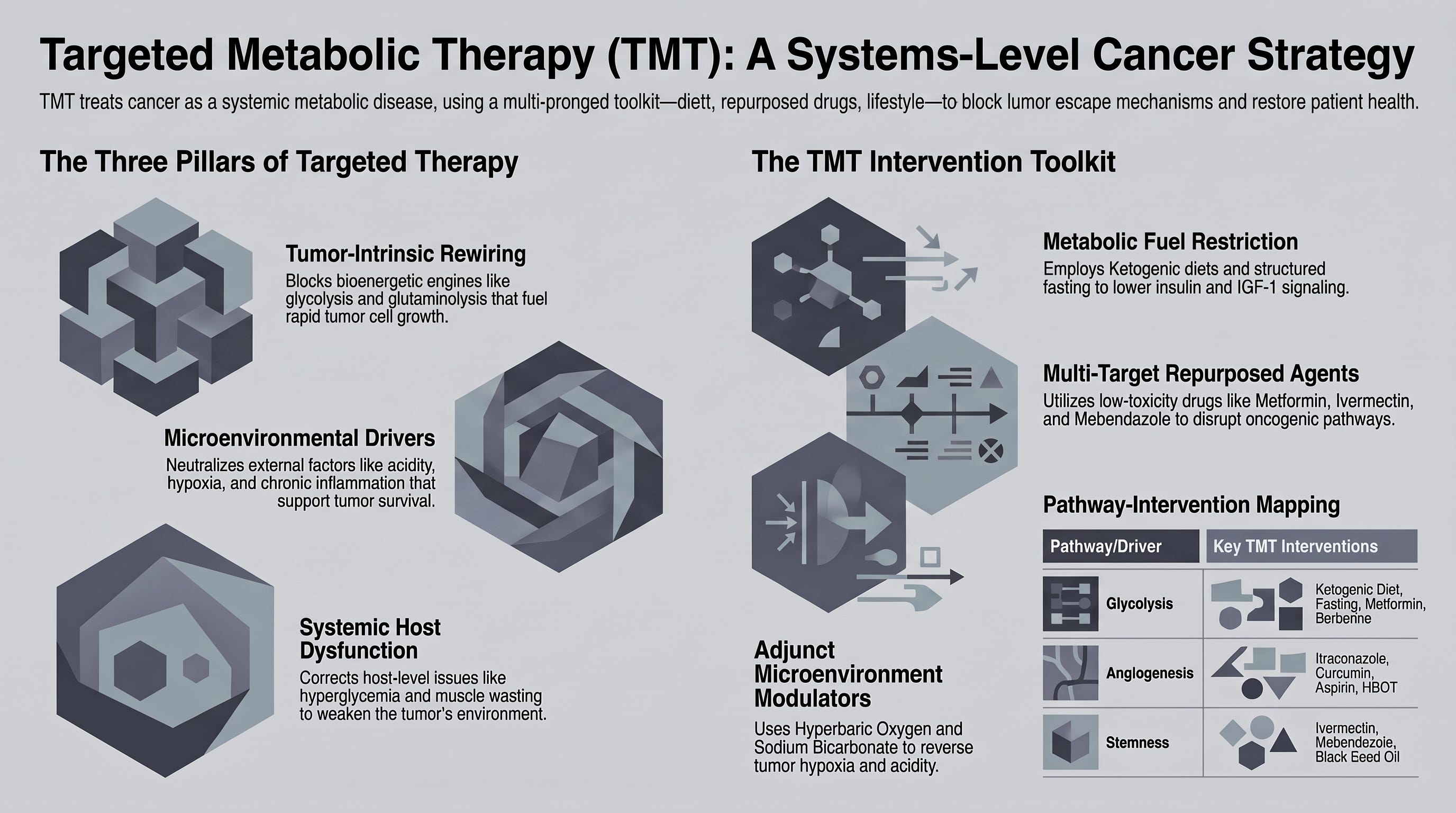
Here is how TMT constructs tailored multi-agent protocol combinations for Glioblastoma, Breast Cancer, Lung Cancer (NSCLC), and Colon Cancer:
Adapting TMT for Glioblastoma (Glioma / Brain Malignancies)
Glioblastoma is characterized by high glycolytic dependence, profound local hypoxia, blood-brain barrier (BBB) transport challenges, and resistant glioma stem cell populations. TMT adapts its strategy for glioblastoma around three key pillars:
Glucose Restriction via Ketogenic Diets: Glioblastoma tumors rely heavily on glucose to fuel rapid expansion. Ketogenic diets (KDs) restrict carbohydrate intake to lower circulating glucose and insulin, suppressing the downstream IGF-1/PI3K-AKT-mTOR growth pathway. Early clinical data in glioblastoma demonstrate the feasibility and metabolic benefits of ketogenic approaches.
Microtubule & Transporter Blockade (Benzimidazoles): Repurposed benzimidazoles (such as mebendazole and fenbendazole) cross the blood-brain barrier to bind \(\beta\)-tubulin, disrupting both mitosis and microtubule-dependent GLUT glucose transporter trafficking. Observational studies and case reports document tumor stabilization or regression in glioblastoma when these agents are incorporated. Mebendazole additionally suppresses tumor neovascularization by downregulating VEGF signaling.
Redox Modulation & Signaling Inhibition (CBD Oil): Cannabidiol (CBD oil) acts as an adjunct microenvironmental and redox modulator. Preclinical evidence demonstrates that CBD disrupts mitochondrial respiration, induces ROS-mediated apoptosis, inhibits AKT/mTOR signaling, and enhances sensitivity when combined with standard care (such as temozolomide) in glioma models.
Adapting TMT for Breast Cancer (including Highly Glycolytic / Resistant Subtypes)
Breast cancers—particularly aggressive, highly glycolytic subtypes like triple-negative breast cancer (TNBC)—exhibit high rates of glucose consumption, elevated inflammatory cytokine signaling, and susceptibility to chemotherapy toxicity. TMT adapts its protocol for breast cancer around these specific vulnerabilities:
Differential Stress Resistance via Fasting: Short-term and intermittent fasting protocols cycle feeding windows to lower circulating insulin and IGF-1 levels. Clinical and preclinical studies in breast cancer demonstrate that structured short-term fasting protects healthy tissues while sensitizing tumor cells, reducing chemotherapy-related toxicities and improving treatment tolerance.
AMPK Activation & Glycolytic Inhibition (Berberine & Curcumin): Berberine activates AMPK, leading to downstream inhibition of the mTOR pathway, improved insulin sensitivity, and reduced glycolytic flux in breast cancer models. Curcumin complements this by downregulating the GLUT1 transporter and lactate dehydrogenase A (LDH-A) to reduce intracellular lactate generation.
Immunomodulatory & Host Restoration Adjuncts:
Medicinal Mushrooms (\(\beta\)-glucans): Randomized controlled trials in breast cancer show improved survival and reduced recurrence when \(\beta\)-glucan-containing mushroom extracts are used as adjuncts to activate NK-cell and macrophage activity.
Vitamin D & Exercise: Low serum Vitamin D levels correlate with higher incidence and mortality in breast cancer. Vitamin D supplementation promotes cell-cycle arrest and immune modulation, while structured exercise improves insulin sensitivity, reduces chronic systemic inflammation, and lowers recurrence rates in breast cancer survivors.
Non-Small Cell Lung Cancer (NSCLC) Protocol Construction
Advanced lung cancers frequently display elevated glycolytic flux, intense VEGF-driven angiogenesis, GLUT-4/HK II overexpression, and resistance to standard antimitotics.
Angiogenesis & Hedgehog Blockade (Intrinsic & Microenvironment): Itraconazole (repurposed triazole antifungal) suppresses VEGFR-mediated endothelial proliferation and blocks the Hedgehog signaling pathway, targeting both vascular supply and cancer stemness.
Glycolytic & Mitotic Disruption (Intrinsic): Fenbendazole or mebendazole depolymerizes microtubules at the colchicine-binding site, downregulates GLUT-4 transporters, directly inhibits Hexokinase II (HK II), and forces G2/M mitotic arrest.
AMPK Activation & Metabolic Starvation (Intrinsic & Host): Metformin activates AMPK to shut down mTOR-dependent protein/lipid synthesis and lower systemic insulin/IGF-1.
Inflammatory & Apoptotic Modulation (Microenvironment): Bioactives like thymoquinone (black seed oil) and curcumin attenuate pro-inflammatory IL-6/TNF-\(\alpha\)/NF-\(\kappa\)B signaling, downregulate lactate dehydrogenase A (LDH-A), and induce ROS-mediated apoptosis.
Colorectal Cancer (CRC) Protocol Construction
Colorectal cancers are strongly driven by Wnt/\(\beta\)-catenin activation, COX-2-driven tissue inflammation, platelet-mediated metastatic seeding, and extracellular acidification.
Platelet Uncloaking & COX-2 Suppression (Microenvironment & Metastasis): Low-dose baby aspirin irreversibly inhibits COX-1 to prevent platelet cloaking of circulating tumor cells in the bloodstream, while suppressing COX-2-derived prostaglandin E2 (\(PGE_2\)) to reduce local inflammation and angiogenesis. Long-term use is associated with reduced CRC incidence, recurrence, and mortality.
Wnt/\(\beta\)-Catenin & Stemness Inhibition (Intrinsic & Microenvironment): Ivermectin blocks Wnt/\(\beta\)-catenin and YAP/Hippo signaling to deplete cancer stem cell compartments and reduce tumor-initiating capacity.
AMPK Activation & Glycolytic Suppression (Intrinsic): Berberine activates AMPK, inhibits mTOR signaling, reduces circulating glucose, and suppresses colon tumorigenesis.
Anti-Metastatic Galectin-3 Blockade (Microenvironment): Modified Citrus Pectin (MCP) inhibits galectin-3 to block tumor-cell adhesion, prevent intravasation/extravasation, and enhance NK-cell accessibility.
Host Genomic & pH Stabilization (Host): Restoring baseline Vitamin D (activates VDR to promote cell-cycle arrest) and Magnesium (supports DNA repair and insulin sensitivity) directly addresses inverse epidemiological associations with CRC risk.
Summary of the Selection Strategy
As summarized in the framework, a successful TMT protocol does not rely on a single agent, nor does it prescribe every supplement available. Instead, clinicians select 2–4 overlapping interventions that converge on specific mechanistic targets—such as pairing a glucose-restricting diet with a glucose-transporter blocker, an anti-angiogenic agent, and an extracellular pH buffer—to achieve synergistic tumor control while preserving patient organ function and quality of life.
In the Targeted Metabolic Therapy (TMT) framework, multi-agent protocols are constructed by mapping specific, multi-target interventions across three primary domains: tumor-intrinsic signaling, the tumor microenvironment, and host systemic metabolism. Rather than deploying every agent at once, TMT prioritizes low-toxicity interventions that hit multiple overlapping metabolic bottlenecks simultaneously, shutting down adaptive escape routes.
Source:
Anane Y (May 06, 2026) Targeted Metabolic Therapy in Cancer: A Comprehensive Metabolic Treatment Strategy. Cureus 18(5): e108373. DOI 10.7759/cureus.108373
https://pmc.ncbi.nlm.nih.gov/articles/PMC13240970/pdf/cureus-0018-00000108373.pdf