
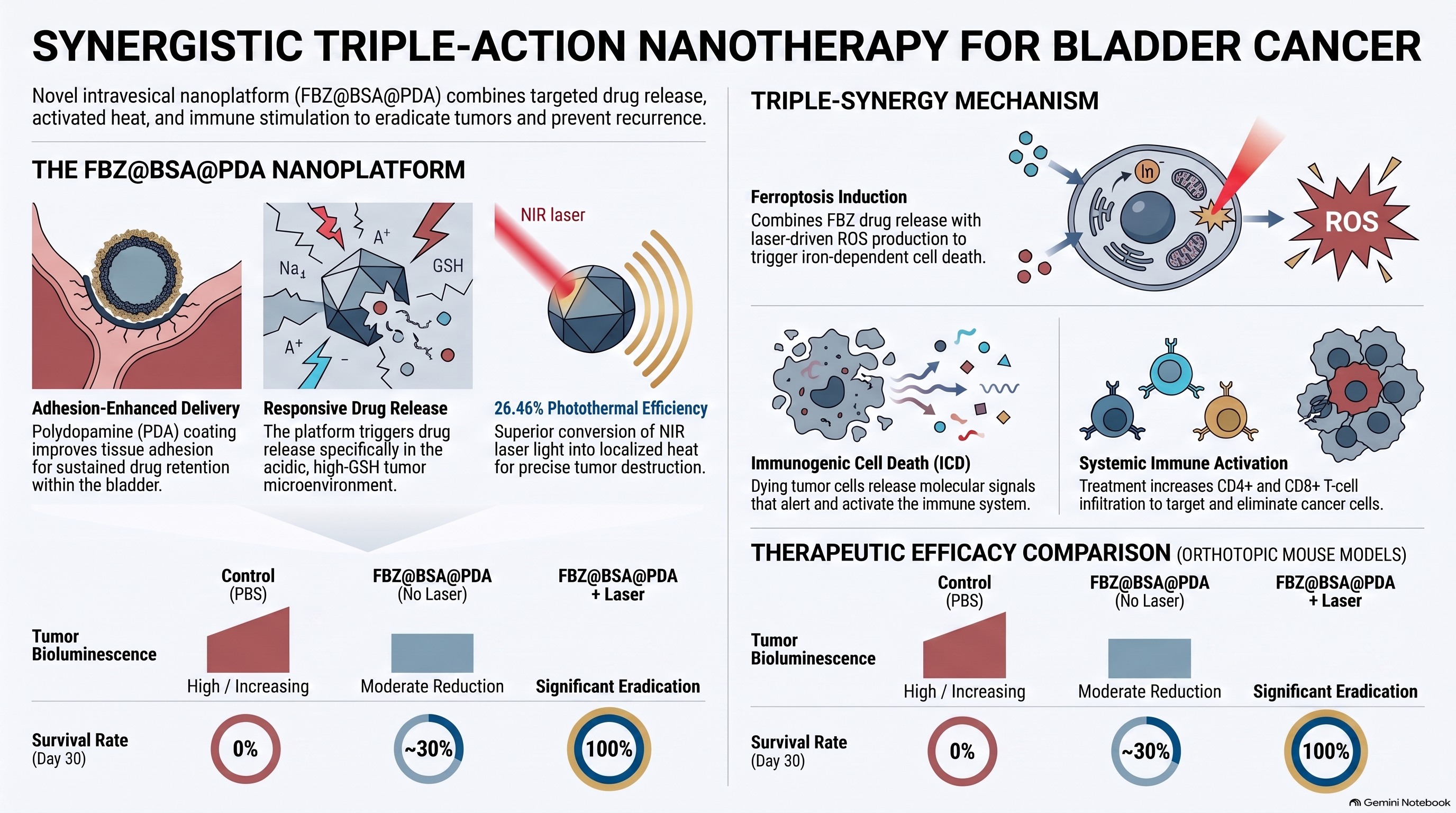
Scientists built a microscopic particle that delivers fenbendazole—an inexpensive anti-worm medicine—directly into a bladder tumor. When a doctor shines a near-infrared light on it, the particle heats up and releases the drug. Together, the heat and the drug push the cancer cells into a built-in self-destruct process that depends on iron (called ferroptosis), and they also wake up the body’s immune system to attack the tumor. In mice, this shrank the tumors. Important: it was tested only in lab-grown cells and mice—never in people—and it requires a special laser, so it is not yet a treatment available at your local hospital.
Bladder cancer is a relentless adversary. Among the most common malignancies of the urinary system, its defining trait is not just its aggression, but its stubbornness; it carries a staggering recurrence rate that forces patients into a grueling cycle of surgeries and intravesical therapies. For decades, the standard of care has relied on localized treatments like the BCG vaccine or traditional chemotherapy, but many tumors eventually learn to evade these defenses.
However, the bladder’s unique anatomy offers a rare opportunity. As a “hollow organ,” it can serve as a biological reaction chamber—a place where medicine can be “clamped” and concentrated without the collateral damage of systemic treatment. Now, a study published in Advanced Science has unveiled a high-tech “triple-threat” nanoplatform that transforms a common veterinary drug into a precision-guided weapon, using targeted light and “iron death” to not only kill tumors but to train the immune system to hunt them down.
The Solubility Paradox: From Vet Clinics to Nano-Medicine
At the center of this breakthrough is Fenbendazole (FBZ). In veterinary medicine, it is a humble anthelmintic—a common dewormer. In oncology, however, FBZ has long been a “hidden gem” with potent anti-tumor properties. The problem? It is pathologically hydrophobic. Because it refuses to dissolve in water, it has been nearly impossible to deliver effectively to human patients.
To solve this, researchers utilized a “molecular heat-shield” made of bovine serum albumin (BSA). By using thermally induced unfolding, the team successfully encapsulated the hydrophobic dewormer inside a water-soluble protein shell. “FBZ exhibits multiple anti-tumor characteristics... However, owing to its poor solubility in water, FBZ has not yet been utilized in anti-tumor research,” the researchers noted, highlighting how nanotechnology finally unlocked a drug that had been sidelined for years by its own chemistry.
Rusting the Cancer from Within
Traditional chemotherapy typically relies on apoptosis, a form of “cell suicide” that many advanced cancers have evolved to ignore. This new platform, known as FBZ@BSA@PDA, bypasses those defenses by triggering ferroptosis—literally, “iron death.”
Ferroptosis is a visceral, biochemical collapse. It involves depleting glutathione (GSH) and downregulating the protective protein GPX4, which essentially strips the cell of its antioxidant armor. Without these defenses, the cell’s fatty membranes begin to “rust” through a process called lipid peroxidation. During RNA sequencing, the researchers discovered a fascinating signature: the treated cells showed gene expression profiles reminiscent of Neutrophil Extracellular Trap (NET) formation. Even though no neutrophils were present, the “ferroptosis stress” was so intense it left behind a unique biochemical echo usually seen in the body’s most violent immune responses.
The study verified this collapse through three critical markers:
Lethal Lipid Peroxidation (LPO): The accumulation of damaged fats that compromises the cell’s integrity.
GSH Depletion: The total exhaustion of the cell’s primary defense against oxidative stress.
Mitochondrial Dysfunction: The structural breakdown of the cell’s internal power plants.
The Light-Driven Ignition Switch
To ensure this “rusting” only occurs within the tumor, the researchers coated the platform in Polydopamine (PDA), a substance that acts as a photothermal agent. When hit with an 808 nm near-infrared laser, the PDA converts light into localized heat.
This isn’t just about burning the cell. In the acidic environment of a tumor, the chemical reactions needed to create cell-killing radicals—known as Fenton reactions—often stall because of the low pH. The laser serves as a “biochemical ignition switch,” using heat to catalyze these reactions and overcome the environmental stalemate. By keeping the bladder within a specific “hyperthermia window” of 43–50 °C, the researchers triggered the drug’s release and amplified its toxicity exactly where the light was pointed, sparing surrounding healthy tissue from thermal damage.
The Accidental Vaccine: Turning Death into a Roadmap
The most profound aspect of this therapy is that it doesn’t just kill the primary tumor; it converts the dying cells into a bespoke, in-situ vaccine through Immunogenic Cell Death (ICD).
As the cancer cells succumb to the combination of ferroptosis and laser heat, they don’t just vanish—they “explode” with molecular “danger signals” called DAMPs. These signals alert the immune system to a threat it had previously ignored. The study observed a precise sequence of immune recruitment: Calreticulin (CRT) was exposed on the cell surface as an “eat me” signal, while HMGB1 was released from the nucleus and ATP was secreted into the surrounding space.
“Mechanistically, it induced lipid peroxidation (LPO), GSH depletion, and mitochondrial dysfunction... This was accompanied by key ICD markers, including calreticulin (CRT) exposure, high mobility group box 1 (HMGB1) release, and adenosine triphosphate (ATP) secretion.”
This molecular flare matures Dendritic Cells (DCs) and activates T-cells, effectively “teaching” the body to recognize and attack any remaining bladder cancer cells.
A Precision Strike in the Biological Chamber
The bladder's “hollow organ” nature allowed researchers to implement a “clamped” delivery strategy. In orthotopic mouse models, researchers instilled the treatment directly into the bladder, then clamped it for 1.5 hours. This ensured the nanoplatform had maximal contact with the bladder wall without entering the bloodstream.
The result was a level of biosafety rarely seen in oncology. While the tumors vanished, the mice showed “no systemic toxicity,” with major organs and blood chemistry remaining entirely healthy. By keeping the fight localized and using light as the trigger, the researchers achieved a precision strike that avoids the “scorched earth” side effects of systemic chemotherapy.
The Future of the Smart Response
The FBZ@BSA@PDA platform suggests a future where cancer treatment is no longer a blunt instrument. By combining the “iron death” of ferroptosis, the catalyst of photothermal heat, and the immune system's long-term memory, we are entering an era of synergistic medicine.
If we can turn a cancer cell’s own destruction into a roadmap for the immune system, we are moving past the era of simply poisoning the body to save it. The question now is: how many other “hidden gems” like Fenbendazole are waiting in the wings, just one nanocarrier away from becoming the next great breakthrough in human health?
A 2026 study published in Advanced Science outlines a breakthrough nanoplatform that combines fenbendazole (FBZ), an inexpensive anti-worm medication, with photothermal therapy (PTT) to treat bladder cancer. By inducing ferroptosis—an iron-dependent form of programmed cell death—and triggering immunogenic cell death (ICD), the strategy activates a robust, dual-immune response against tumors in preclinical models. Here is the source paper that outlined this stack.
Ferroptosis Induction by Fenbendazole Combined With Photothermal Therapy Triggers Dual-ImmunotherapyAgainst Bladder Cancer
Advanced Science, 2026; 13:e74876 Accepted: 28 February 2026
https://doi.org/10.1002/advs.748761 of 13
https://advanced.onlinelibrary.wiley.com/doi/epdf/10.1002/advs.74876
I take fen ben. 222 mg X 2 times a day. i take it with whole wheat toast, butter, and the olive oil. then I sprinkle the oull all over the toast. I do not drink nothing for 1/2- 1 hour. it works.