
The debate regarding the use of vitamins and nutriceuticals during cancer treatment centers on a fundamental disagreement between conventional and complementary medicine. Conventional oncologists typically advise against supplement use—specifically antioxidants (AOs)—fearing they neutralize the reactive oxygen species (ROS) required for radiation and chemotherapy to be effective. Conversely, complementary practitioners argue that supplements ameliorate treatment toxicity and may enhance clinical outcomes.
A deep analysis of the clinical literature reveals that the fear of AO interference with chemotherapy is largely unsubstantiated by randomized trials. While the evidence regarding radiation is more complex, negative outcomes are often confounded by patient behaviors, such as smoking during treatment. Robust evidence supports the use of specific agents, notably melatonin, fish oil, and mushroom extracts (PSK), which have demonstrated significant survival benefits and reduced toxicity across various cancer types.
The Core Conflict: Conventional vs. Complementary Paradigms
The disagreement over supplements reflects differing underlying philosophies and interpretations of sparse clinical data.
Conventional View: Based on the “first principle” that radiation and chemotherapy kill cancer cells by creating ROS. Antioxidants, by definition, neutralize ROS and are therefore presumed to reduce treatment efficacy.
Complementary View: Argues that ROS damage to normal tissue causes the debilitating side effects of treatment. Furthermore, recent research suggests direct ROS-induced killing is only a minor part of the cytotoxic mechanism; the more critical factor is whether damage induces apoptosis (programmed cell death), a process regulated by proteins that can be favorably influenced by AOs.
The “Catch-22” of Clinical Research: Conventional oncologists insist on evidence from randomized clinical trials before recommending supplements. However, because supplements cannot be patented, there is no financial incentive for the private sector to fund the necessary multi-million dollar trials. Consequently, complementary medicine often relies on a vast body of experimental literature (in vitro and in vivo).
Detailed Analysis of Antioxidant (AO) Evidence
Theories of Supplementation Strategy
Practitioners of integrative medicine differ on how AOs should be administered:
High-Dose Synergy (Prasad): Argues that only high doses of specific AOs used in combination (e.g., Vitamin C, E, A, and beta-carotene) should be used, as they can inhibit cancer cell growth. Prasad recommends against low-dose multivitamins and agents that boost endogenous AOs (such as alpha-lipoic acid or N-acetylcysteine), fearing they may protect cancer cells.
Toxicity/Division Balance (Conklin): Suggests that AOs may improve chemotherapy effectiveness because the rate of cancer cell division is inversely related to oxidative stress. Since chemotherapy only kills dividing cells, reducing oxidative stress may increase the population of cells vulnerable to treatment.
Clinical Trial Findings for Traditional AOs
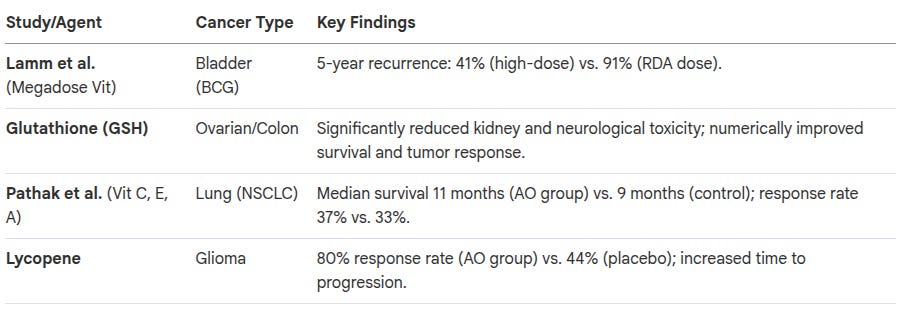
A systematic review of 19 randomized trials comparing chemotherapy alone to chemotherapy plus AOs found no evidence of significant decreases in efficacy. In many instances, the AO groups showed increased survival and tumor response.
Specialized Treatment Agents
Melatonin: The Most Robust Clinical Evidence
Melatonin is a potent AO that also regulates circadian rhythms and stimulates the immune system.
Survival Benefit: A meta-analysis of 10 randomized trials found a significant 1-year relative risk of death of 0.66 among those using melatonin.
Lung Cancer: In a trial of 100 metastatic NSCLC patients, those receiving melatonin had a 40% one-year survival rate compared to 20% in the chemotherapy-only group. Toxicity was also significantly reduced.
Glioblastoma: Patients receiving radiation plus 20 mg/day of melatonin showed significantly longer survival than those receiving radiation alone.
Amifostine: The Synthetic AO
Amifostine was developed to ameliorate radiation toxicity. Because it is metabolized more effectively in normal cells than cancer cells, it provides selective cytoprotection. Two meta-analyses concluded it significantly reduces radiation toxicity (mucositis, dysphagia) without reducing—and potentially improving—complete response rates.
Non-Anti-Oxidant Supplements
Polyunsaturated Fatty Acids (PUFAs/Fish Oil)
Fish oil components (EPA and DHA) are technically pro-oxidant because they generate ROS, but they also reduce inflammation and increase cell membrane permeability.
Lung Cancer: Patients receiving EPA/DHA with chemotherapy had a 60% response rate, compared with 26% with chemotherapy alone.
Breast Cancer: A Phase II trial showed that patients with high plasma DHA levels had a median survival of 34 months versus 18 months for those with low levels.
Mushroom Extracts (PSK)
PSK, an extract from the Coriolus Versicolor mushroom, is used for its immunological effects (stimulating T-cell activity and interferon production).
Lung Cancer: Stage I patients using PSK had a 39% five-year survival rate vs. 22% for controls.
Colorectal Cancer: PSK significantly improved three-year disease-free survival (81% vs. 69%).
Evaluation of Adverse Evidence
Conventional oncology’s opposition to AOs often cites three primary studies (Lawenda et al.), but closer examination reveals significant caveats:
The Lesperance Study (Breast Cancer): A trend toward interference was noted, but patients taking supplements were also more likely to reject radiotherapy, which is known to increase recurrence.
The Vitamin E/Oral Cancer Study: A trend toward worse survival in the Vitamin E group was noted. However, the “placebo” group received primrose oil (GLA), which has its own therapeutic benefits, and the Vitamin E group had more advanced stage III/IV cancers.
The Bairatti Study (Quebec Head-and-Neck): This large trial found a significant risk of recurrence and mortality for supplement users. However, re-analysis showed the deleterious effect occurred only in patients who smoked during radiation. For non-smokers, AOs did not negatively impact effectiveness and significantly reduced side effects.
Conclusion
There is no convincing clinical evidence that AO supplements generally interfere with chemotherapy. While the data for radiation is more debated, negative trends are frequently linked to confounding variables or specific behaviors like smoking.
Key Recommendations for Evaluation:
Context Matters: Prudence is suggested for cancers where conventional treatment has a high success rate. However, for metastatic or resistant cancers where conventional treatment has a poor record, the potential benefits of supplements likely outweigh the hypothetical harms.
Idiosyncratic Interactions: Some specific interactions must be avoided, such as Green Tea (EGCG) with the drug Bortezomib, as they bind and neutralize each other.
Clinical Utility: Supplements such as melatonin, PSK, and fish oil have robust evidence supporting improved survival and quality of life by reducing the “slash, burn, and poison” toxicities associated with conventional oncology.
Source: The Role of Supplements (including Anti-Oxidants) in Cancer Treatment By Ben A. Williams University of California, San Diego Last Revised: July 12, 2014