
Technical Deep Dive Podcast: How Cheap De-wormers Dismantle Cancer
1. A Billion-Dollar Bottleneck
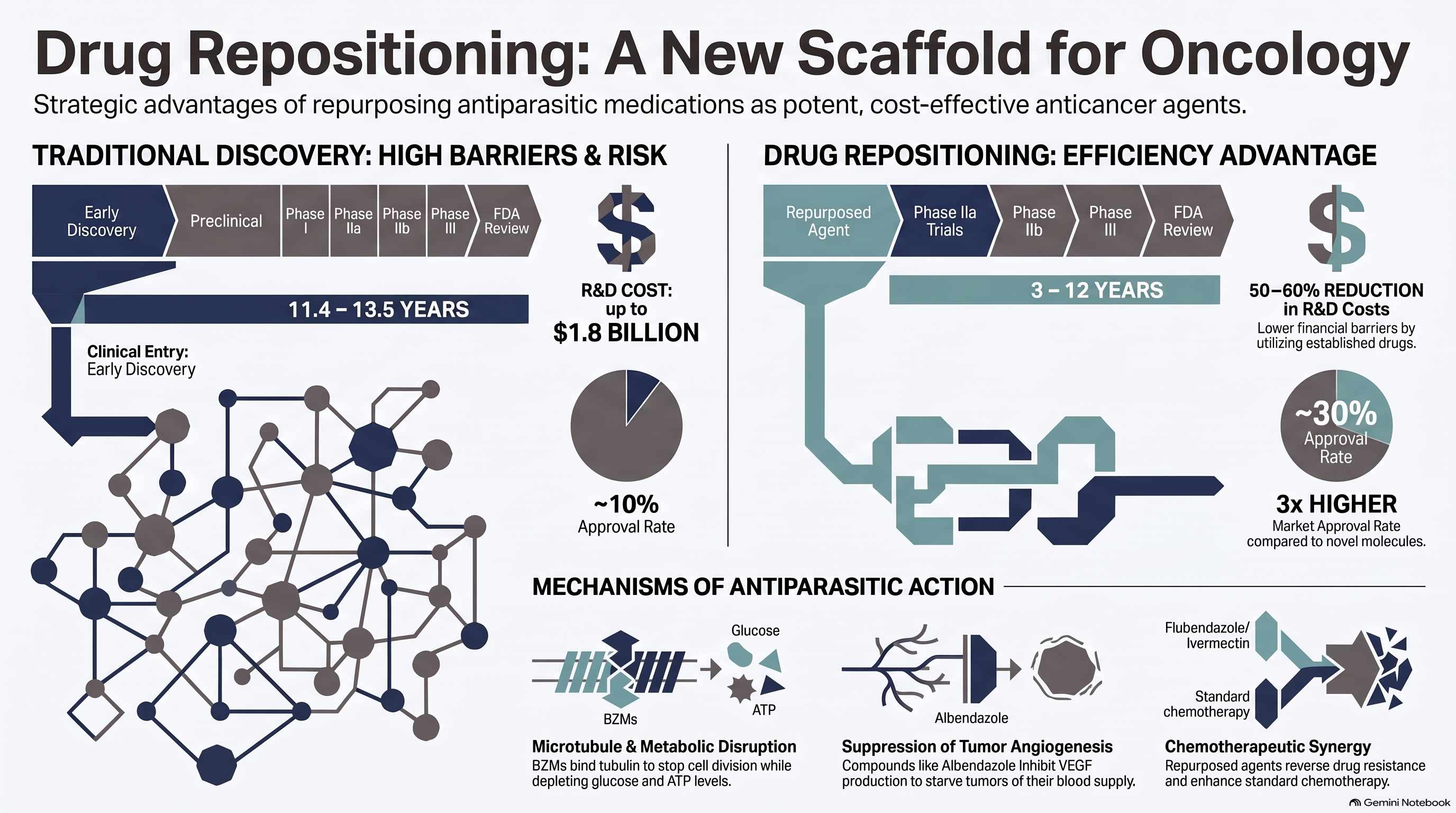
In the high-stakes theater of modern medicine, the path from molecular discovery to a patient’s bedside is a grueling war of attrition. Developing a novel anticancer molecule from scratch—a process known as de novo development—is a notoriously inefficient gambit. It requires a staggering investment ranging from $161 million to $1.8 billion per pharmaceutical product and a temporal commitment of 11.4 to 13.5 years.
These findings challenge the high-cost oncology paradigm, proving that the traditional model is no longer the only path forward. While the industry has long obsessed over the “next big molecule,” a far more efficient revolution is quietly gaining ground: drug repositioning. By identifying novel anticancer indications for non-oncology drugs with established safety profiles, we are discovering that the most potent weapons against our most complex diseases might already be sitting on pharmacy shelves, disguised as simple antiparasitics and stomach acid reducers.
2. The 30% Edge: Why “Old” Drugs are Winning the Race
The clinical and economic advantages of drug repositioning are not merely marginal; they are transformative. In traditional drug discovery, the failure rate is staggering: only about 5% of candidate drugs survive the gauntlet to reach clinical trials. In contrast, repurposed drugs enter the arena with a decisive “head start.”
Because their toxicological profiles, pharmacokinetics, and dosing regimens are already documented in humans, researchers can often bypass Phase I safety trials. This “Phase I skip” creates a massive market-driven incentive: by using compounds with de-risked toxicology, investors mitigate financial risk and achieve exponentially higher ROI. The data confirms this advantage:
The Success Gap: While novel molecules have a meager 10% market approval rate, repurposed drugs boast a 30% success rate.
Temporal Velocity: Approval timelines are slashed to 3–12 years, compared to the 13-year industry average.
Economic Efficiency: Repositioning reduces overall research and development costs by 50% to 60%.
3. From Veterinary Clinics to Oncology Wards: The Benzimidazole Revolution
At the epicenter of this shift is a class of heterocyclic organic compounds known as Benzimidazole derivatives (BZMs). Historically utilized as broad-spectrum anthelmintics (worm treatments) for livestock and humans, BZMs are characterized by a sophisticated structural analogy to nucleotides. This allows them to interact with the cell's most fundamental machinery.
The primary mechanism of BZMs involves binding specifically to Beta-tubulin, which disrupts the microtubule “scaffold” that cancer cells rely on for division and vesicle transport. However, recent pharmacology has revealed they are far more than just “scaffold breakers.” For instance, Albendazole (ABZ) has demonstrated a powerful anti-angiogenic effect by suppressing Vascular Endothelial Growth Factor (VEGF) production, effectively starving a tumor’s ability to grow new blood vessels. Meanwhile, Flubendazole (FLU) engages the p53 tumor-suppressor pathway through interactions with MDM2 inhibitors like nutlin-3, making it exceptionally potent in neuroblastoma models.
As the research matures, the medical community increasingly views this class not as simple dewormers, but as:
“Multimodal scaffold for modern oncology.”
4. Mebendazole: Crossing the Final Frontier
Perhaps no BZM illustrates this potential better than Mebendazole (MBZ). While it has served for decades as a common treatment for parasitic infestations, it is now proving to be a high-precision tool for the brain. MBZ possesses the rare ability to cross the blood-brain barrier and reach therapeutic concentrations in central nervous system tissues.
In animal models, MBZ has significantly extended survival in glioblastoma multiforme (GBM) and medulloblastoma. Its efficacy is so profound that in human melanoma xenografts, its ability to trigger apoptosis through Bcl-2 phosphorylation and XIAP downregulation matches temozolomide—a specialized, high-cost chemotherapy drug. Far from being a theoretical laboratory curiosity, MBZ is currently the subject of six actively recruiting clinical trials, signaling its transition from the veterinary clinic to the frontline of human oncology.
5. Ivermectin: The Resistance Breaker
One of the most persistent hurdles in oncology is “multidrug resistance,” often driven by P-glycoprotein (P-gp)—a molecular “pump” that cancer cells use to eject chemotherapy drugs. Ivermectin, a staple antiparasitic, has emerged as a formidable resistance breaker.
Ivermectin inhibits the EGFR/ERK/Akt/NF-kappaB signaling axis, directly suppressing P-gp transcription. By disabling this defense mechanism, Ivermectin restores the efficacy of traditional chemotherapies. Its reach extends further into the heart of tumor recurrence by targeting Cancer Stem Cells (CSCs) via SIN3 corepressor inhibition and the blocking of canonical Wnt/Beta-catenin signaling. Crucially, the drug also inhibits Yes-associated protein 1 (YAP1), a key regulator of apoptotic suppression, and exhibits KPNB1-dependent properties that arrest the cell cycle in ovarian cancer. By targeting these sophisticated hallmarks, Ivermectin transforms from a simple antiparasitic into a multimodal anticancer agent.
6. Starving the Tumor: The Metabolic Attack
Beyond structural disruption and resistance breaking, repositioned drugs are launching a metabolic offensive. BZMs have been shown to inhibit glucose uptake and deplete glycogen stores, effectively slashing the tumor's ATP levels (cellular energy currency).
Omeprazole (OMP), the ubiquitous proton pump inhibitor used for gastric ulcers, is a prime example of this metabolic interference. Recent pharmacological studies reveal that OMP can:
Inhibit human fatty acid synthase, a vital enzyme for cancer cell survival.
Block invasion and metastasis in breast and pancreatic cancer cells by downregulating transcription of the chemokine receptor CXCR4.
Act as a synergistic adjuvant that improves chemoradiotherapy efficacy while decreasing the recurrence rate of rectal cancer.
7. Conclusion: A New Chapter in Modern Oncology
The transition of these drugs from veterinary and basic anti-parasitic roles to human oncology trials represents a necessary evolution in medical research. As the traditional de novo drug discovery process becomes increasingly unsustainable because of high attrition rates and astronomical costs, intelligently repurposing existing assets offers a viable, data-driven alternative.
These medications—originally designed for the simplest organisms—are now targeting the most sophisticated hallmarks of human cancer: metabolism, metastasis, and stem-cell-driven recurrence. They represent a “multimodal scaffold” that challenges our very definition of medical innovation. If the cures for our most complex and devastating diseases are already hiding in plain sight within our existing pharmacopeia, how can we justify any approach to medical research that doesn’t first look back at what we already have?
Benzimidazole derivatives (BZMs) are heterocyclic organic compounds structurally analogous to nucleotides that function as broad-spectrum anthelmintics with low mammalian toxicity. In oncology, BZMs exert antitumor activity primarily by binding specifically to tubulin, disrupting microtubule structure and microtubule-mediated vesicle transport in tumor cells, while also inhibiting glucose uptake, depleting glycogen stores, and reducing cellular ATP levels.
Key antiparasitic and repurposed compounds evaluated for their specific antitumor mechanisms include:
1. Albendazole (ABZ)
Antiproliferative & Microtubule Activity: Inhibits proliferation in hepatocellular carcinoma (HCC) and colorectal carcinoma (CRC) cells in vitro, and demonstrates efficacy in vivo in peritoneal carcinomatosis xenograft models. ABZ remains active in leukemia and ovarian cancer cells resistant to conventional microtubule-targeting drugs.
Anti-Angiogenic Effects: Suppresses vascular endothelial growth factor (VEGF) production and inhibits tumor angiogenesis in mouse models of peritoneal ovarian cancer.
2. Flubendazole (FLU)
Multimodal Cytotoxicity: Exhibits antiproliferative activity across leukemia, multiple myeloma, melanoma, breast cancer, and neuroblastoma cell lines. It alters microtubule architecture, induces apoptosis and cell differentiation, blocks cell migration, and generates reactive oxygen species (ROS) that trigger autophagy.
p53 Pathway Engagement: Its high activity in neuroblastoma involves interactions with the MDM2 inhibitor and p53 activator nutlin-3.
Chemotherapeutic Synergy: Potentiates the cytotoxic action of standard chemotherapeutics, including fluorouracil (5-FU), doxorubicin, vinblastine, and vincristine.
3. Mebendazole (MBZ)
CNS Tumors & Microtubule Inhibition: Extends survival in animal models of glioblastoma multiforme (GBM) and displays strong therapeutic efficacy in medulloblastoma models by reaching effective therapeutic concentrations in the brain. MBZ blocks tubulin polymerization to inhibit lung cancer cell growth.
Kinase & Apoptotic Signaling: It interacts with multiple protein kinases, including BCR-ABL, and inhibits it. In melanoma cells, it triggers apoptosis by phosphorylating Bcl-2 and downregulating XIAP (X-linked inhibitor of apoptosis), matching temozolomide efficacy in human melanoma xenografts.
4. Omeprazole (OMP)
Proton Pump & Invasive Signaling Blockade: As a selective proton pump inhibitor, BZM and OMP block breast and pancreatic cancer cell invasion by downregulating chemokine receptor type 4 (CXCR4) transcription.
Metabolic & Chemoradiotherapy Synergy: Inhibits human fatty acid synthase, reduces rectal cancer recurrence when combined with chemoradiotherapy, and acts as an adjuvant to relieve chemotherapy side effects.