
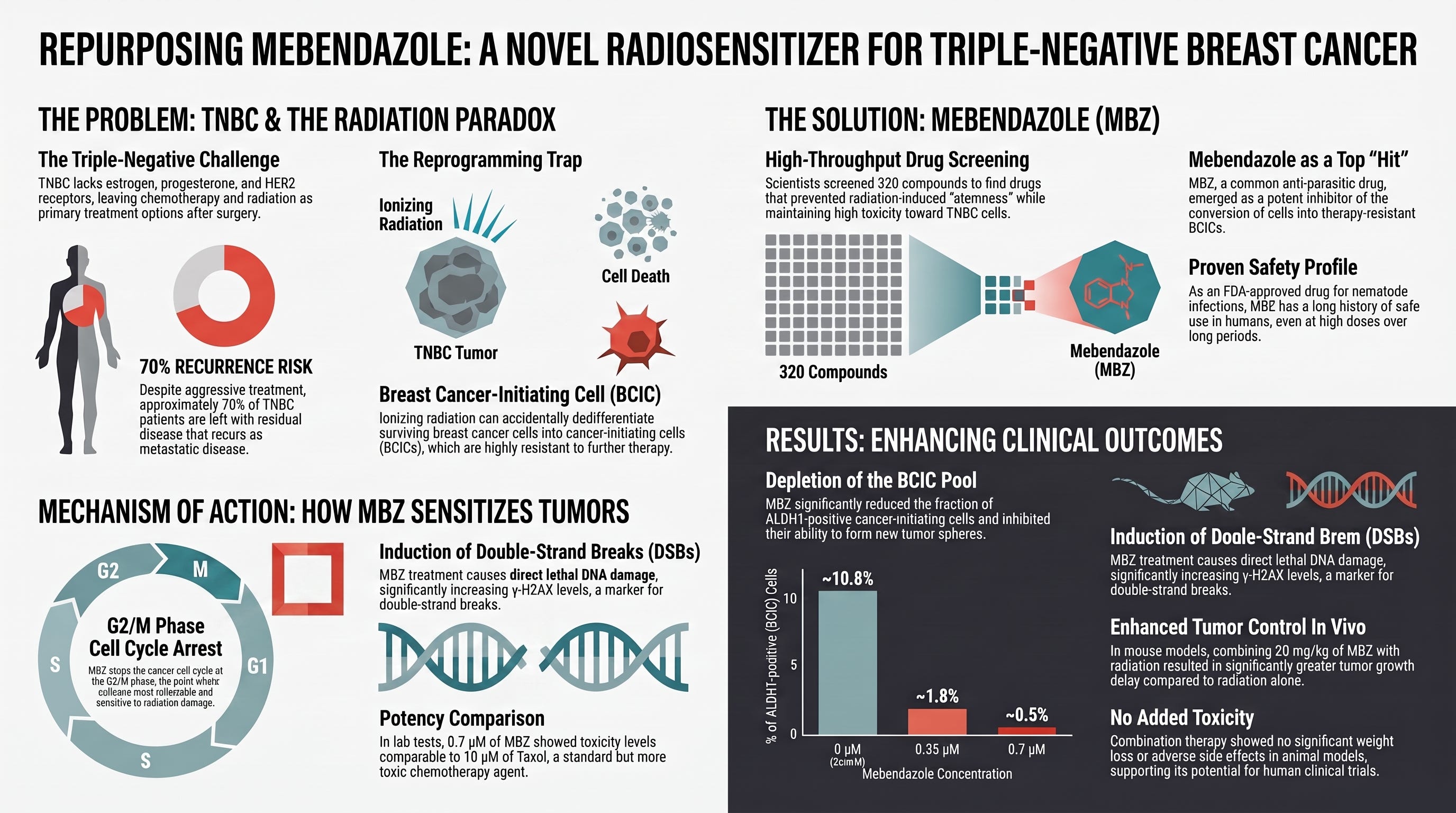
1. The Strategy of Drug Repurposing
In the search for novel oncology treatments, scientists are increasingly looking at “old” medicines through a modern scientific lens. This strategy is known as drug repurposing (or repositioning). It involves taking drugs already FDA-approved for one condition and testing their effectiveness against another disease, such as cancer.
A primary example currently under investigation is mebendazole (MBZ). For decades, MBZ has served as a standard, broad-spectrum anthelmintic (anti-parasitic) drug used to treat nematode (worm) infections in both adults and children.
Repurposing drugs like MBZ can dramatically speed up medical breakthroughs. Because millions of people worldwide have already used these drugs, their safety profiles and pharmacokinetics are well documented. This allows researchers to bypass many early safety trials and move directly to testing efficacy against aggressive diseases like Triple-Negative Breast Cancer (TNBC).
This strategy is especially important when addressing the unique clinical challenges and cellular plasticity of TNBC.
2. What is Triple-Negative Breast Cancer?
Breast cancer is a heterogeneous group of diseases managed based on specific biological features. Most subtypes are treated by targeting “receptors”—proteins on the cell surface that receive growth signals. However, Triple-Negative Breast Cancer (TNBC) is defined by its lack of the three most common receptors:
Estrogen Receptor (ER)
Progesterone Receptor (PR)
Human Epidermal Growth Factor Receptor 2 (HER2)
According to epidemiological data, TNBC accounts for 10% to 20% of all breast cancers. Because it lacks these three molecular targets, standard hormonal and HER2-directed therapies are ineffective. Triple-negative breast cancer (TNBC) represents one of the most clinically formidable subtypes of breast cancer, primarily due to its distinct molecular profile and high rate of recurrence. This article discusses TNBC pathology, the cellular mechanisms driving recurrence, and how the repurposed anthelmintic mebendazole (MBZ) is being investigated as a potential therapy to address these challenges.
Why TNBC is a Critical Target
Lack of Molecular Targets: The absence of ER, PR, and HER2 leaves clinicians without clear “anchors” for targeted therapy.
Reliance on Aggressive Methods: Treatment is primarily limited to surgery followed by intense chemotherapy and ionizing radiation (IR).
High Risk of Recurrence: Despite aggressive intervention, approximately 70% of patients are left with residual disease that often recurs as visceral metastasis.
Lower Survival Rates: Patients with TNBC have significantly lower overall survival rates than those with receptor-positive subtypes.
Most breast cancer subtypes are managed using targeted hormonal or HER2-directed therapies because they express estrogen receptors (ER+), progesterone receptors (PR+), or human epidermal growth factor receptor 2 (HER2+). However, approximately 10% to 20% of breast cancer patients lack all three of these receptors, resulting in a diagnosis of triple-negative breast cancer.
The absolute lack of these targetable receptors makes TNBC incredibly challenging to treat. Currently, the only standard treatment options after surgery are systemic chemotherapy and radiation therapy (RT). Even with aggressive chemoradiation regimens, approximately 70% of TNBC patients are left with residual disease that ultimately recurs as visceral metastases, leading to significantly lower overall survival rates compared to non-TNBC patients.
While radiation is a cornerstone of TNBC management, researchers have identified a biological paradox where treatment may inadvertently fuel future recurrence.
3. When Treatment Creates New Problems
The Recurrence Driver: Radiation-Induced Dedifferentiation
Breast cancers are organized hierarchically and contain a small subpopulation of breast cancer-initiating cells (BCICs). These stem-like cells are highly resistant to conventional chemotherapy and radiation, allowing them to survive treatment and drive subsequent tumor recurrence.
Furthermore, exposing surviving cancer cells to ionizing radiation (IR) can actively trigger a dedifferentiation program, reprogramming non-tumorigenic cancer cells back into highly aggressive, therapy-resistant BCICs. The research notes that this therapeutic bottleneck is particularly severe in TNBC:
This means that unless a standard treatment is 100% effective at eliminating every single breast cancer cell, the therapy itself can inadvertently generate a pool of highly resistant stem-like cells that cause recurrence.
BCICs function as the “seeds” of a tumor.
Higher Stemness Potential: Baseline TNBC lines (such as MDA-MB-231 and SUM159PT) contain a much larger proportion of intrinsic BCICs than luminal breast cancer subtypes (like MCF7 and T47D).
Enhanced Reprogramming Efficiency: Surviving non-initiating TNBC cells dedifferentiate into BCICs far more efficiently—both spontaneously and in response to ionizing radiation—than luminal cancer cells.
Researchers discovered that TNBC lines (such as SUM159PT and MDA-MB-231) undergo this dedifferentiation process much more efficiently than luminal lines (like MCF7 or T47D). To study this, scientists leveraged a ZsGreen-cODC reporter system. This system uses a fluorescent protein (ZsGreen) fused to a degron (cODC) that the cell’s proteasome normally destroys. BCICs, which exhibit low proteasome activity, allow the protein to accumulate, making these “seed” cells visible under a laser-scanning cytometer.
Eliminating the bulk of a tumor is insufficient if the treatment itself triggers a dedifferentiation program that creates therapy-resistant “seeds.” This discovery marks a necessary shift from “tumor-centric” to “cell-plasticity-centric” treatment strategies, where we must inhibit the cell’s ability to reprogram itself into a more aggressive state.
4. Mebendazole: The Anthelmintic Hero
To address this paradox, researchers performed a high-throughput screen of 20 anthelmintic drugs. MBZ, a benzimidazole, emerged as a potent inhibitor of this reprogramming. Out of 20 tested anthelmintic (anti-parasitic) drugs, mebendazole (MBZ) was identified as a leading therapeutic candidate. It was chosen for further development because of its dual-action profile: it is highly toxic to bulk TNBC cells in vitro and efficiently inhibits radiation-induced dedifferentiation, while maintaining an exceptionally favorable safety profile in human clinical use.
The researchers selected MBZ based on four desirable characteristics:
High Toxicity to TNBC: It effectively kills the bulk TNBC cell population.
FDA Approval: It is already approved for human use with a long history of clinical safety.
Inhibition of Dedifferentiation: It prevents the conversion of non-tumorigenic cells into BCICs.
Favorable Safety Profile: It can be administered at high doses over extended periods.
MBZ targets the intrinsic BCIC pool, reducing the fraction of cells expressing ALDH1 activity—a reliable functional marker for BCICs. Additionally, MBZ downregulates GLI1 expression, a key effector of the Hedgehog (Hh) signaling pathway that maintains the cancer-initiating phenotype. By preventing cells from forming functional mammospheres (clumps of self-renewing cells), MBZ does more than just kill cells—it prepares the entire tumor for radiation-induced destruction.
5. How Radiosensitization Works: Making Cancer Vulnerable
MBZ acts as a radiosensitizer, meaning it makes TNBC cells significantly more vulnerable to radiation damage without increasing the radiation dose given to the patient.
While many sensitizers work by increasing oxidative stress, the researchers found that MBZ does not work by increasing Reactive Oxygen Species (ROS). Instead, it utilizes three distinct biological mechanisms:
Cell Cycle Arrest (G2/M Phase): MBZ is a tubulin-disrupting drug. By causing tubulin depolymerization, it inhibits normal spindle formation, trapping TNBC cells in the G2/M phase—when they are most sensitive to radiation.
DNA Double-Strand Breaks: MBZ may act through direct DNA intercalation. When combined with radiation, it increases lethal DNA damage, measured by a significant increase in γ-H2AX staining (a marker of DNA breaks).
Inducing Apoptosis: MBZ triggers apoptosis (programmed cell death) by inactivating survival proteins like Bcl-2. When combined with a 2 Gy dose of radiation, the percentage of cells undergoing “cell suicide” expands significantly.
Crucial Insight: By directly targeting the cell's physical structure (tubulin) and genetic stability (DNA) rather than relying on ROS, MBZ offers a more direct and reliable way to make aggressive TNBC cells succumb to treatment.
The discovery of mebendazole’s action in TNBC has profound clinical implications. Standard chemotherapeutic agents like doxorubicin (Adriamycin) are also effective at preventing radiation-induced reprogramming, but they are notorious for inducing cardiotoxicity. Combining doxorubicin with breast radiation severely heightens cardiovascular risks for patients because critical cardiac structures must often reside within the irradiation field.
Mebendazole provides a highly attractive alternative, achieving strong radiosensitization and preventing therapy-induced reprogramming without introducing cardiac or systemic toxicities.
6. From the Lab to the Patient: Evidence of Success
The effectiveness of MBZ was verified using both in vitro (cell culture) and in vivo (animal model) studies, including the in vivo limiting dilution assay—the “gold standard” for identifying the BCIC phenotype.
Key Findings:
Broad Effectiveness: MBZ showed potent dose-dependent toxicity across diverse TNBC lines, including the basal MDA-MB-231 and claudin-low SUM159PT models.
Synergistic Tumor Control: While MBZ alone had a modest effect on growth in living models, combining it with a single 10 Gy dose of radiation significantly delayed tumor growth compared with radiation alone.
Refined Safety Profile: Researchers administered 20 mg/kg of MBZ intraperitoneally on a “5-days-on, 2-days-off” schedule for three weeks. Although the maximum weight loss was 10%, there was no statistical difference in weight loss between the treated and control groups, suggesting the drug was well tolerated.
These results transition the study from a laboratory observation to a viable clinical strategy for improving outcomes in patients with residual disease.
7. Conclusion: A New Era of Combination Therapy
The data strongly support the conclusion that mebendazole is a potent radiosensitizer for Triple-Negative Breast Cancer. By depleting the BCIC pool and blocking radiation-induced dedifferentiation, MBZ addresses the primary mechanisms of therapy resistance and recurrence in TNBC.
The implications of this combination therapy extend beyond breast cancer. This strategy could potentially improve the efficacy of radiation for other difficult-to-treat malignancies, such as:
Brain Cancers: Including glioblastoma and medulloblastoma.
Head and Neck Cancers: Specifically squamous cell carcinomas.
Ultimately, this research underscores the profound value of drug repurposing. By viewing a common anti-parasitic medicine through the lens of modern oncology, scientists have identified a powerful, safe, and cost-effective ally in the fight to save lives from the most aggressive forms of cancer.
Main Source:
Mebendazole Potentiates Radiation Therapy in Triple-Negative Breast Cancer
2019 Jan 1;103(1):195-207.
PMID: 30196056, PMCID: PMC6457649, DOI: 10.1016/j.ijrobp.2018.08.046
https://pubmed.ncbi.nlm.nih.gov/30196056/
---------------
There’s another post that looks at fenbendazole and Triple Negative Breast Cancer from August 3, 2026
The Fenbendazole Benefit: TNBC
A Possible Tool for Targeting Triple-Negative Breast Cancer?

https://www.amazon.com/s?k=fenbendazole
https://thehappyhealingstore.com/product-category/fenben/ I've taken these
In the USA, mebendazole requires a doctor's prescription. Online, you can get that at any number of participating doctors; here are a few big ones.
https://www.twc.health/
https://jase.com/search?q=mebendazole&options%5Bprefix%5D=last
https://www.makishealthclinic.com/
Depending on where you live and local regulations, this is a very inexpensive pharma seller in India; people order directly for very low prices. He is vetted and reliable; it takes about 15 days to receive meds in the USA. Please check local regulations/laws; we don't want to break any laws.
Harish
Vitalcure Impex
+91-9284715183
+91-9270894667
vitalcureimpex@gmail.com
Vitalcureimpex1@gmail.com
If you need further assistance, just drop us a line. Thanks.
Where can I purchase a good source of Fenbenzdole/ Menbenzadole?? Thanks!