
In translational medicine, we often view progress as a linear race to invent something entirely “new.” However, some of the most profound breakthroughs in oncology come from looking backward at the medicines already in our cabinets. This is drug repurposing—the scientific art of identifying new therapeutic applications for established, clinically approved drugs.
1. The Starting Point: Why We Look for Shortcuts
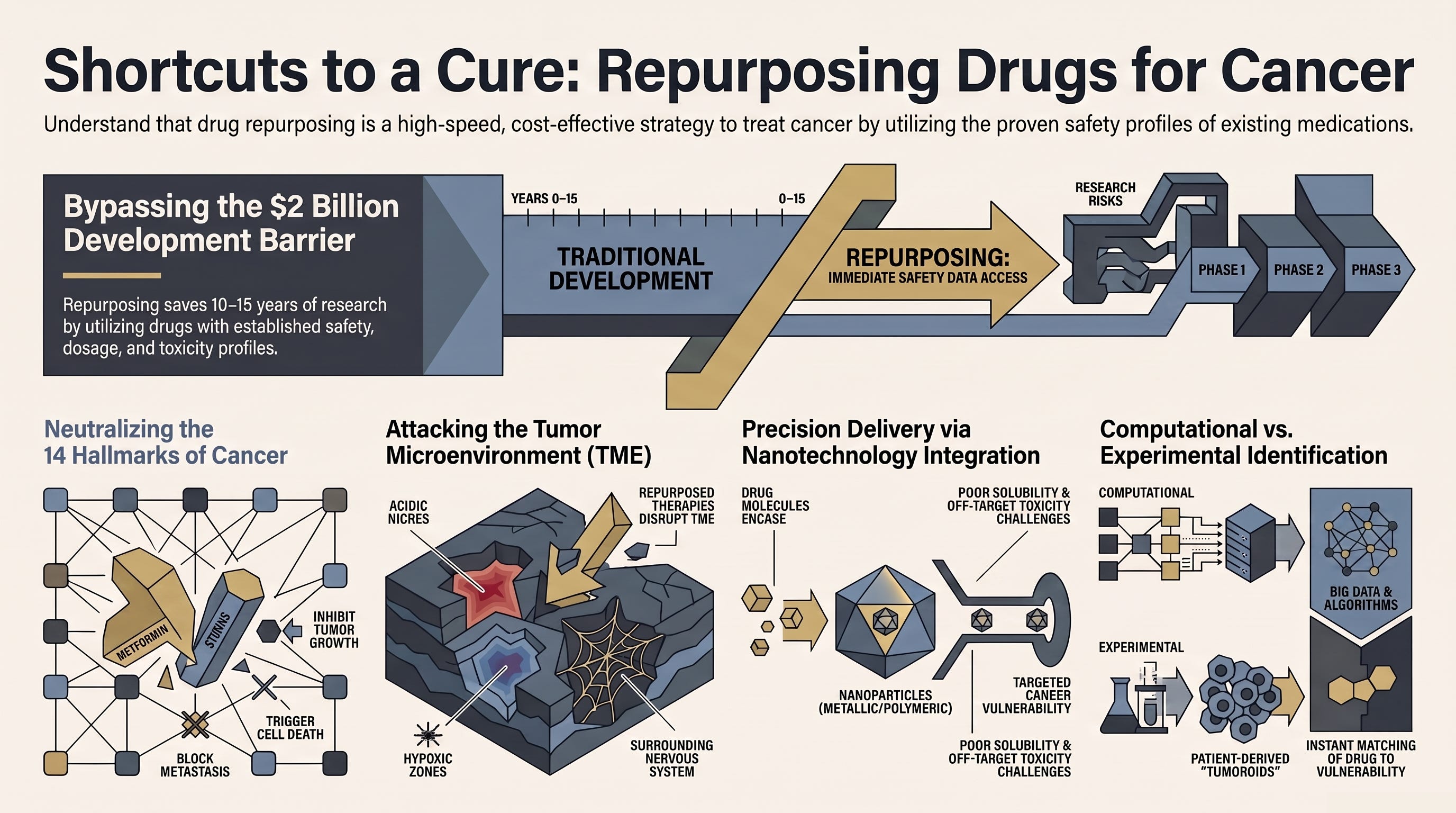
Developing a de novo drug is a monumental task often compared to finding a needle in a haystack—while the haystack is on fire and costs billions to search. Drug repurposing offers a strategic “shortcut” by leveraging our existing knowledge of a medicine’s safety profile.

The Inherent Advantages of Repurposing
For a patient, these advantages are the difference between waiting decades or months for a treatment:
Proven Safety Profiles: Because these drugs are already FDA-approved, we have extensive longitudinal data on human toxicity and pharmacokinetics.
Established Dosage Guidelines: Clinical educators and practitioners don’t have to start from zero; we already understand the human body’s tolerance levels.
Accelerated Development: By bypassing early safety trials, we dramatically expedite the transition from the laboratory bench to the patient’s bedside.
Because traditional discovery is prohibitively slow and expensive, we must act as scientific detectives, using creative hypothesis generation to uncover the “hidden” cancer-fighting properties of established medicines.
2. Phase I: Generating the Hypothesis (The Spark)
How do we decide that a drug for alcoholism or arthritis might actually treat a tumor? The journey begins with a spark of data-driven logic.
The Three Stages of the Repurposing Journey
Hypothesis Generation: Identifying “core targets” of the disease and matching them to an existing drug’s profile.
Efficacy Testing: Validating that the drug works in controlled laboratory environments (in vitro and in vivo).
Clinical Trials: Moving directly into Phase II human trials once the safety data from the drug’s original use is confirmed.
Finding the Candidates
We utilize two primary methodologies to identify potential candidates:

3. Phase II: The Scientist’s Lab (The Tools of Discovery)
In this phase, we use advanced models to simulate the human body. Two of the most powerful tools in our arsenal are Tumoroids and Phenotypic Screening.
Tumoroids: The “Mini-Organs”
A tumoroid is a specialized type of cancer organoid—an in vitro 3D tissue grown from a patient’s own cells.
Why they mimic real tumors:
Architecture: They grow in complex 3D structures rather than flat layers.
Genetic Profile: They retain the patient’s specific DNA mutations.
Mutational Landscape: They maintain the original tumor's biological diversity.
Therapeutic Response: They react to drugs with high fidelity to the patient’s actual clinical response.
Critical Thinking Note: As educators, we must recognize that while tumoroids are a massive leap forward, they currently lack vascularization and the complex Tumor Immune Microenvironment (TIME), such as immune and neural cells. They are a vital step toward patient reality, but not a full replacement.
Phenotypic Screening: Function-First
Rather than focusing on a single gene, scientists watch how a drug changes the cancer's “phenotype” (its physical behavior).
Case Study: Calcium Channel Blockers (CCBs) Originally indicated for hypertension and heart conditions, CCBs like Amlodipine, Felodipine, Dicloamanidipine, and Cilidipine underwent a phenotypic screen. Scientists found they inhibited filopodia formation—the “fingers” cancer cells use to crawl. This proved these heart drugs could physically prevent cancer cell invasion.
Once a tool proves a drug can work, we must map exactly where it attacks the cancer’s survival strategy.
4. Mapping the Target: The 14 Hallmarks of Cancer
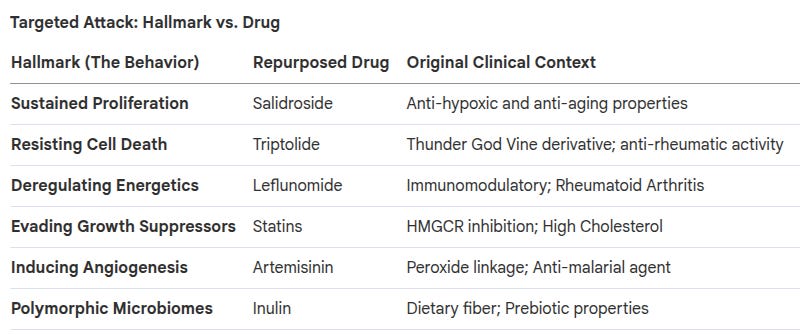
Cancer is no longer viewed as a single disease, but a set of 14 updated hallmarks or survival behaviors. Repurposed drugs are chosen because they “flip the switch” on these specific behaviors.
Flipping the Switch: The Tumor Microenvironment (TME)
Cancer cells create “neighborhoods” (TMEs) that hide them from the immune system. We use repurposed drugs to disrupt these niches:
Acidic Niche: Tumors are more acidic (pH 6.4–7) than healthy tissue. Proton Pump Inhibitors (PPIs) can neutralize this acidity, making chemotherapy more effective and preventing immune evasion.
Hypoxic Microenvironment: Tumors thrive in low-oxygen zones. Ascorbic Acid (Vitamin C) has been shown to decrease the expression of HIF-1α, the protein that helps tumors survive without oxygen.
Microbial Microenvironment: Gut bacteria can dictate treatment success. Inulin reshapes the gut’s “polymorphic microbiome,” boosting the immune system’s natural attack on the cancer.
While the lab results look promising, the journey from bench to bedside is fraught with practical obstacles.
5. Phase III: The Reality Check (Challenges & Clinical Trials)
Even a biologically “perfect” drug faces massive hurdles before it can be prescribed in an oncology ward.
Hurdles to Clinical Adoption
Intellectual Property (IP) Rights:
Student Insight: When a drug is “off-patent,” pharmaceutical companies have little financial incentive to fund the $100M+ trials required for a new indication, even if the drug is highly effective.
Dosage and Toxicity (The “Off-Target” Risk):
Student Insight: The dose required to kill a tumor may be much higher than the dose used for the drug’s original purpose. For example, using statins or metformin at oncology-level doses risks inducing severe hypolipidemia or hypoglycemia in patients.
Regulatory Barriers:
Student Insight: Formal global guidance and incentives are currently lacking to help researchers navigate approval of “old” drugs for “new” life-saving roles.
Clinical Trial Spotlight
These drugs are currently undergoing the “reality check” of human testing:
Metformin: Testing against Breast, Pancreas, and Prostate cancers.
Statins: Testing against Gastric and Colorectal cancers.
Celecoxib: Testing against Melanoma and postoperative Recurrent Gastric cancer.
These challenges are significant, but emerging delivery technologies like nanotechnology are helping us bypass dosage and toxicity limitations.
6. The Horizon: The Future of Repurposing
The future of this field lies in precision. We are no longer just finding the right drug; we are building better “delivery vehicles” for them.
Nanotechnology: Precision Topical Drug Delivery
Nanoparticles (liposomes, micelles, or metallic particles) act as microscopic envelopes that carry repurposed drugs directly to the tumor.
The EPR Effect: We utilize the Enhanced Permeability and Retention (EPR) effect, where nanoparticles naturally accumulate in the “leaky” vasculature of tumor tissue while bypassing healthy cells.
Reducing Side Effects: By “shielding” the drug until it reaches its target, we prevent it from accumulating in the kidneys or spleen, effectively lowering the systemic toxicity of high-dose treatments.
Increasing Bioavailability: Many repurposed drugs (like Curcumin or Niclosamide) have poor water solubility; nanotechnology keeps them stable in the bloodstream until they reach the tumor site.
Final Insight: The Renaissance of Medicine
Drug repurposing represents a true “Renaissance” in medicine. It teaches us that the solutions to our most complex modern challenges might already be in our hands. By combining traditional medicinal wisdom, 20th-century pharmacology, and 21st-century nanotechnology, we are creating a more hopeful, faster, and more affordable future for cancer patients worldwide.
Drug repurposing for cancer therapy, April 2024
Signal Transduction and Targeted Therapy 9(1) DOI:10.1038/s41392-024-01808-1
https://www.researchgate.net/publication/379911710_Drug_repurposing_for_cancer_therapy