
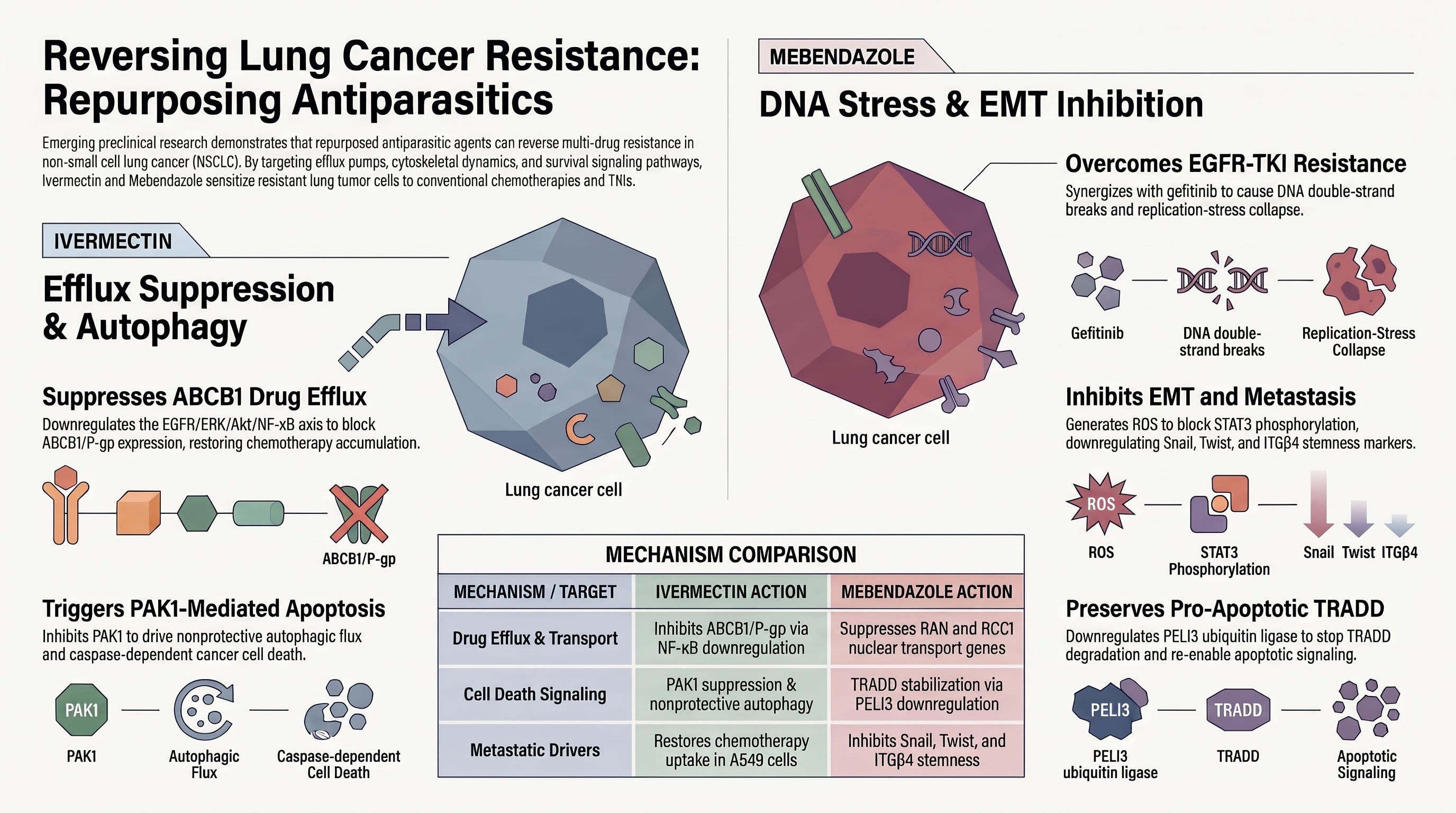
In non-small cell lung cancer (NSCLC), ivermectin and mebendazole overcome therapeutic resistance through distinct, complementary molecular mechanisms. While ivermectin predominantly reverses efflux-mediated chemotherapy resistance (particularly to taxanes) and downregulates survival kinases, mebendazole primarily overcomes targeted therapy resistance (such as EGFR-TKIs) and mitotic blocks by disrupting microtubule dynamics, triggering replication stress, and downregulating STAT3 and PELI3/TRADD signaling.
1. Primary Resistance Phenotypes Targeted
Ivermectin — Taxane and Multidrug Efflux Resistance:
P-gp / ABCB1 Reversal: The hallmark mechanism of ivermectin in chemoresistant NSCLC is the inhibition and prevention of P-glycoprotein (P-gp) overexpression. In human lung adenocarcinoma (A549) cells subjected to stepwise, long-term exposure to paclitaxel (PTX), ABCB1 mRNA increases by over 80-fold, driving drug efflux and causing chemoresistance. Co-treatment with ivermectin completely abolishes P-gp induction, significantly restoring intracellular paclitaxel concentrations and resensitizing resistant cells.
HSP27 Suppression: Ivermectin directly inhibits Heat Shock Protein 27 (HSP27) in A549 lung cancer models, impairing downstream oncogenic signaling and sensitizing cells to both taxane chemotherapy and targeted oncogene therapies.
Mebendazole — EGFR-TKI and Replication-Stress Resistance:
Overcoming Gefitinib Resistance: Mebendazole resensitizes EGFR-mutant, gefitinib-resistant NSCLC cells (HCC827 GR5) to EGFR-tyrosine kinase inhibitors. While gefitinib alone produces negligible cytotoxicity (~7% reduction in viability) in these resistant cells, combining low-dose mebendazole (0.1 µM) with gefitinib (1 µM) reduces cell viability to 37.7% and significantly delays tumor growth in vivo.
Bypassing the Taxane-Binding Site: Mebendazole binds to the colchicine-binding domain of β-tubulin rather than the paclitaxel or vinca alkaloid binding sites. This distinct binding site allows it to circumvent tubulin mutations or alterations that typically confer taxane resistance.
2. Upstream Kinase and Signaling Axis Modulations
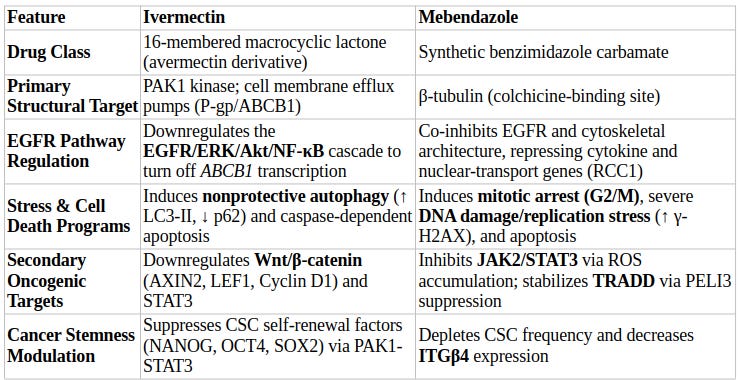
3. Contrasting Upstream and Downstream Mechanisms
Ivermectin’s Dual Mechanism: EGFR/NF-κB Blockade and PAK1 Autophagy
Transcriptional Silencing of Efflux Transporters: Rather than acting merely as a competitive substrate, ivermectin suppresses the phosphorylation of EGFR and its downstream mediators (p-ERK, p-Akt, and p-NF-κB). Because NF-κB transcriptionally drives ABCB1, ivermectin shuts down P-gp synthesis at the source.
PAK1 and Nonprotective Autophagy: Ivermectin directly downregulates PAK1 protein expression in lung adenocarcinoma cells. PAK1 overexpression blunts ivermectin-induced cell death. The resulting autophagic response is characterized as nonprotective (sensitizing rather than survival-promoting), marked by elevated LC3-II puncta and p62 degradation, which directly collaborates with apoptosis to kill tumor cells.
Mebendazole’s Dual Mechanism: Mitotic Disruption and Replication-Stress Collapse
Replication Stress and DNA Double-Strand Breaks: In gefitinib-resistant NSCLC cells, mebendazole disrupts microtubule-dependent replication fork stability. This induces marked replication-associated cellular stress, evidenced by a significant accumulation of phosphorylated histone γ-H2AX foci and comet-assay fragmentation.
ROS-Driven JAK2/STAT3 Downregulation: In NSCLC cells and A549 xenografts, mebendazole promotes reactive oxygen species (ROS) accumulation, which directly suppresses the JAK2/STAT3 signaling pathway, inhibiting tumor migration and activating apoptosis.
PELI3/TRADD Inactivation: Mebendazole downregulates the E3 ubiquitin ligase PELI3, preventing the proteasomal degradation and ubiquitination of tumor necrosis factor receptor type 1-associated death domain protein (TRADD), which restores apoptotic signaling in NSCLC cells.
4. Translational and Clinical Considerations
Complementarity in Preclinical Combination: Because ivermectin addresses membrane-level drug efflux and pro-survival kinase signaling (PAK1/Akt/mTOR), while mebendazole attacks cytoskeletal spindle dynamics, replication stress, and JAK2/STAT3, preclinical models support that the two agents target non-overlapping vulnerability axes.
Current Clinical Status: While a prospective observational cohort previously reported high self-reported clinical benefit with compounded ivermectin and mebendazole in cancer patients, that paper was formally retracted, and its findings were recognized as uncontrolled and strictly hypothesis-generating. In NSCLC specifically, neither agent is currently approved for clinical oncology practice, and their use in lung cancer drug resistance remains under preclinical and early-phase clinical exploration.
Sources
Here are the peer-reviewed sources that formed the basis of our discussion on ivermectin, mebendazole, NSCLC drug resistance, and in vivo models.
1. Primary NSCLC & Drug Resistance Studies (Ivermectin & Mebendazole)
Hayashi, A., Kamio, K., Miyanaga, A., Yoshida, K., Noro, R., Matsuda, K., Tozuka, T., Omori, M., Hirao, M., Fukuizumi, A., Hisakane, K., Takeuchi, S., Matsumoto, M., Kasahara, K., Amano, T., Honda, K., & Seike, M. (2024). Ivermectin enhances paclitaxel efficacy by overcoming resistance through modulation of ABCB1 in non-small cell lung cancer. Anticancer Research, 44(12), 5271–5282. https://doi.org/10.21873/anticanres.17355
Li, M.-Y., Zhang, J., Lu, X., Zhou, D., Deng, X.-F., Liu, Q.-X., Dai, J.-G., & Zheng, H. (2024). Ivermectin induces nonprotective autophagy by downregulating PAK1 and apoptosis in lung adenocarcinoma cells. Cancer Chemotherapy and Pharmacology, 93(1), 41–54. https://doi.org/10.1007/s00280-023-04589-6
Liang, Z., Chen, Q., Pan, L., She, X., & Chen, T. (2024). Mebendazole induces apoptosis and inhibits migration via the reactive oxygen species-mediated STAT3 signaling downregulation in non-small cell lung cancer. Journal of Thoracic Disease, 16(2), 1412–1423. https://doi.org/10.21037/jtd-23-1978
El-Tanani, M., Satyam, S. M., Rabbani, S. A., El-Tanani, Y., Sutherland, M., & Muhana, F. (2025). Disruption of epidermal growth factor receptor signaling and cytoskeletal dynamics by mebendazole and gefitinib synergistically impairs paracrine cytokine signaling in non-small cell lung cancer and triple-negative breast cancer cell lines. PLOS ONE, 20(12), Article e0338027. https://doi.org/10.1371/journal.pone.0338027
El-Tanani, M., Satyam, S. M., Prabhakar, S., El-Tanani, Y., Safaii, E., Rabbani, S. A., & Sutherland, M. (2026). Dual targeting of EGFR signaling and microtubule dynamics enhances replication-associated cellular stress and suppresses tumor growth in gefitinib-resistant non-small cell lung cancer. PLOS ONE, 21(10), Article e0360164. https://doi.org/10.1371/journal.pone.0360164
Li, F., Li, X., Li, H., Li, S., Liu, Y., Bai, X., Qi, T., Zhao, X., & He, Y. (2026). Mebendazole inhibits PELI3-mediated ubiquitination of TRADD in non-small cell lung cancer cells. Frontiers in Oncology, 15, Article 1728170. https://doi.org/10.3389/fonc.2025.1728170
2. In Vivo, Metastasis, and Microenvironment Studies
Joe, N. S., Godet, I., Milki, N., Ain, N. U. I., Oza, H. H., Riggins, G. J., & Gilkes, D. M. (2022). Mebendazole prevents distant organ metastases in part by decreasing ITGβ4 expression and cancer stemness. Breast Cancer Research, 24(1), Article 98. https://doi.org/10.1186/s13058-022-01591-3
Mansoori, S., Blom, K., Andersson, C., Fryknäs, M., Larsson, R., & Nygren, P. (2026). Characterization of the anticancer effect of mebendazole and its interaction with standard cytotoxic drugs in patient tumor cells ex vivo and in an in vivo mouse model. Oncology Reports, 55(1), Article 9. https://doi.org/10.3892/or.2025.9014
Mukherjee, P., Maurer, J., Stopka, S. A., Greenwood, B., Aristizabal-Henao, J. J., Karmacharya, S., Chimento, A., Ta, N., Lee, D. C., Duraj, T., Bronson, R. T., Kiebish, M. A., & Seyfried, T. N. (2026). The therapeutic efficacy of mebendazole and devimistat in juvenile syngeneic high-grade glioma. Cell Reports Medicine, 7(6), Article 102845. https://doi.org/10.1016/j.xcrm.2026.102845
Sung, S. J., Kim, H.-K., Hong, Y.-K., & Joe, Y. A. (2019). Autophagy is a potential target for enhancing the anti-angiogenic effect of mebendazole in endothelial cells. Biomolecules & Therapeutics, 27(1), 117–125. https://doi.org/10.4062/biomolther.2018.222
3. Oncology Drug Repositioning Reviews & Clinical Reports
Al-Zoubi, R. M., Farhan, A., Hanbali, B., Al-Zoubi, S. R., Khan, A., Shkoor, M., Bani-Yaseen, A. D., Al Zoubi, M. S., & Agouni, A. (2026). Antiparasitic agents in oncology: Innovative mechanisms, emerging evidence and clinical potential in cancer treatment. European Journal of Medicinal Chemistry, 316, Article 118987. https://doi.org/10.1016/j.ejmech.2026.118987
Guerini, A. E., Triggiani, L., Maddalo, M., Bonù, M. L., Frassine, F., Baiguini, A., Alghisi, A., Tomasini, D., Borghetti, P., Pasinetti, N., Bresciani, R., Magrini, S. M., & Buglione, M. (2019). Mebendazole as a candidate for drug repurposing in oncology: An extensive review of current literature. Cancers, 11(9), Article 1284. https://doi.org/10.3390/cancers11091284
Hulscher, N., Victory, K., Thorp, J. A., Pinsky, D., Diaz-Villalobos, A., Gillooly, P., Coulson, F., Annazone, M., Radesi, C., Brooks, J., McCullough, P. A., & Risch, H. (2026). RETRACTED: Real-world clinical outcomes of ivermectin and mebendazole in cancer patients: Results from a prospective observational cohort. Anticancer Research, 46(7), 3243–3255. https://doi.org/10.21873/anticanres.18194
Son, D.-S., Lee, E.-S., & Adunyah, S. E. (2020). The antitumor potentials of benzimidazole anthelmintics as repurposing drugs. Immune Network, 20(4), Article e29. https://doi.org/10.4110/in.2020.20.e29
4. Drug Delivery & Nanotechnology Formulations
Anaaa, H., Muhana, F., El-Tanani, M., Madi, R., & Kerfan, R. (2022). Mebendazole loaded nanoparticles for lung cancer therapy. International Journal of Drug Delivery Technology, 12(3), 1053–1065. https://doi.org/10.25258/ijddt.12.3.22
El Halawany, M., Sharaky, M., & Aziz, D. (2025). Stearyl amine tailored spanlastics embedded within Tetronic® nanogel for boosting the repurposed anticancer potential of mebendazole: Formulation, in vitro profiling, cytotoxicity assessment, and in vivo permeation analysis. DARU Journal of Pharmaceutical Sciences, 33(1), Article 17. https://doi.org/10.1007/s40199-025-00560-3
I am very pleased with the findings of this study.
The results of this research are truly impressive.
My mother has currently lost hope in conventional medical therapies, as her chemotherapy regimen was terminated due to lack of efficacy. Our family is profoundly grateful for the work of Dr. William Makis and fellow researchers who are committing their full efforts to this critical area of oncology.