

Introduction
What if an inexpensive, decades-old antiparasitic tablet sitting in neighborhood pharmacies holds the key to dismantling multi-drug resistance in aggressive, late-stage cancers? While conventional oncology spends billions developing single-target drugs that tumors rapidly learn to bypass, researchers are turning to drug repurposing—and discovering that a common deworming medication named Mebendazole (MBZ) can attack cancer through a multi-pronged assault.
By the end of this lesson, you will be able to:
Explain the economic and pharmacological rationale behind drug repurposing in oncology.
Identify the core molecular mechanisms of Mebendazole, including tubulin disruption, anti-angiogenesis, signal pathway inhibition, and hypoxia suppression.
Analyze how Mebendazole sensitizes chemoresistant prostate, melanoma, and ovarian cancer cell lines when combined with standard therapies.
Evaluate the experimental evidence for Mebendazole’s role in reprogramming the tumor microenvironment and activating anti-tumor immune responses.
The Promises and Principles of Drug Repurposing
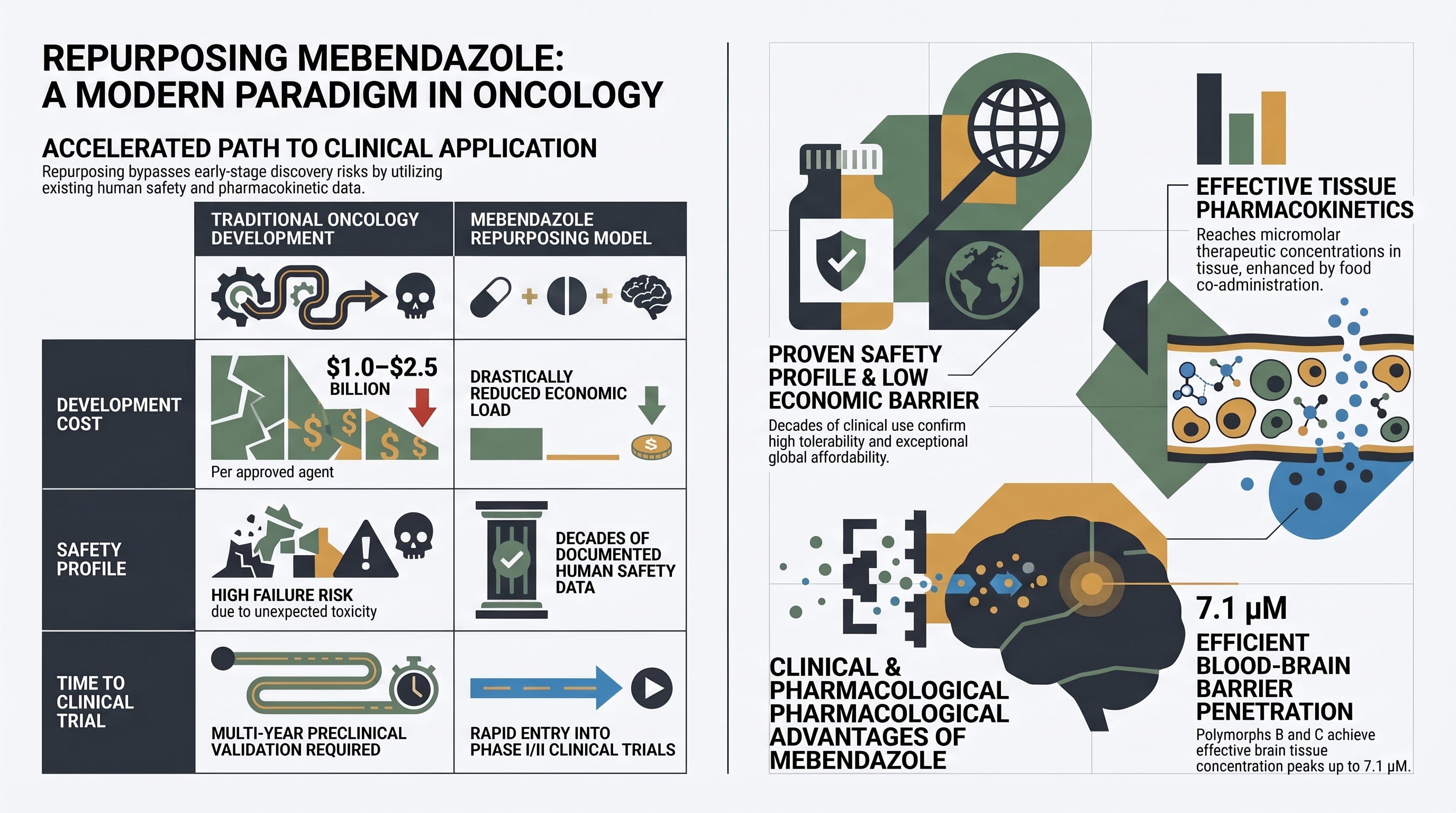
Developing a novel anticancer pharmaceutical from scratch is an uphill battle. It typically demands between $1 billion and $2.5 billion and takes over a decade, with a high rate of failure due to unexpected toxicity or late-stage drug resistance. Drug repurposing bypasses many of these hurdles by identifying new therapeutic indications for existing, FDA-approved compounds.
An ideal candidate for oncological repurposing must fulfill specific criteria:
A proven safety profile: Well-documented toxicity, side effects, and dosing limits across diverse patient populations.
Favorable pharmacokinetics: The ability to reach effective therapeutic concentrations at disease sites, including difficult-to-penetrate tissues like the brain.
Multi-target activity: The capacity to hit multiple survival pathways simultaneously, preventing cancer cells from developing simple bypass resistance.
Low cost and high accessibility: Ease of manufacturing and global availability.
Mebendazole (MBZ)—a synthetic benzimidazole traditionally used to treat intestinal helminthiasis—fits these requirements remarkably well. While prescribed in standard short courses for parasite infections, long-term high-dose therapy for alveolar echinococcosis (up to 40–50 mg/kg/day for months or years) has confirmed its safety in humans. Furthermore, MBZ’s lipophilic nature and low molecular weight allow its active polymorphs (specifically Polymorphs B and C) to cross the blood–brain barrier, achieving micromolar brain tissue concentrations capable of suppressing intracranial tumors.
Disrupting the Cancer Cell: Tubulin, Angiogenesis, and Signaling Pathways
Mebendazole does not rely on a single magic bullet; instead, it acts as a broad-spectrum molecular interrupter. Its anti-cancer activity spans four major cellular mechanisms:
1. Microtubule Depolymerization
Like traditional chemotherapy agents (e.g., paclitaxel or vincristine), MBZ disrupts cell division. However, MBZ specifically binds to the colchicine-sensitive site on the -subunit of tubulin. This prevents tubulin dimerization, leading to mitotic arrest in the G2/M phase, cell cycle blockade, and progressive apoptosis.
2. Inhibition of Angiogenesis
Tumors require new blood vessels to supply oxygen and nutrients for growth. MBZ inhibits VEGFR2 autophosphorylation on endothelial cells. In preclinical xenograft models (such as non-small cell lung cancer and medulloblastoma), MBZ significantly reduces tumor microvessel density and hemoglobin content without damaging normal blood vessels.
3. Suppression of Oncogenic Signaling Pathways
MBZ downregulates key signal transduction cascades that drive proliferation and stemness:
Sonic Hedgehog (SHH) Pathway: MBZ inhibits Smoothened (SMO) mutant proteins and reduces GLI1 expression, blocking tumor growth in medulloblastoma and basal cell carcinoma models.
MAPK/ERK & Kinase Cascade: MBZ functions as a nanomolar inhibitor for kinases like BRAF, MEK1/2, TNIK, and BCR-ABL.
Anti-Apoptotic Regulators: MBZ downregulates XIAP (X-linked inhibitor of apoptosis protein) and c-MYC, leaving tumor cells vulnerable to programmed cell death.
4. Matrix Degradation and Metastasis Blockade
By decreasing Matrix Metalloproteinase-2 (MMP-2) expression and altering GTPases (such as Rho-A and Rac1), MBZ inhibits cancer cell migration and tissue invasion.
Breathing Room: Targetting Hypoxia and Immunomodulation
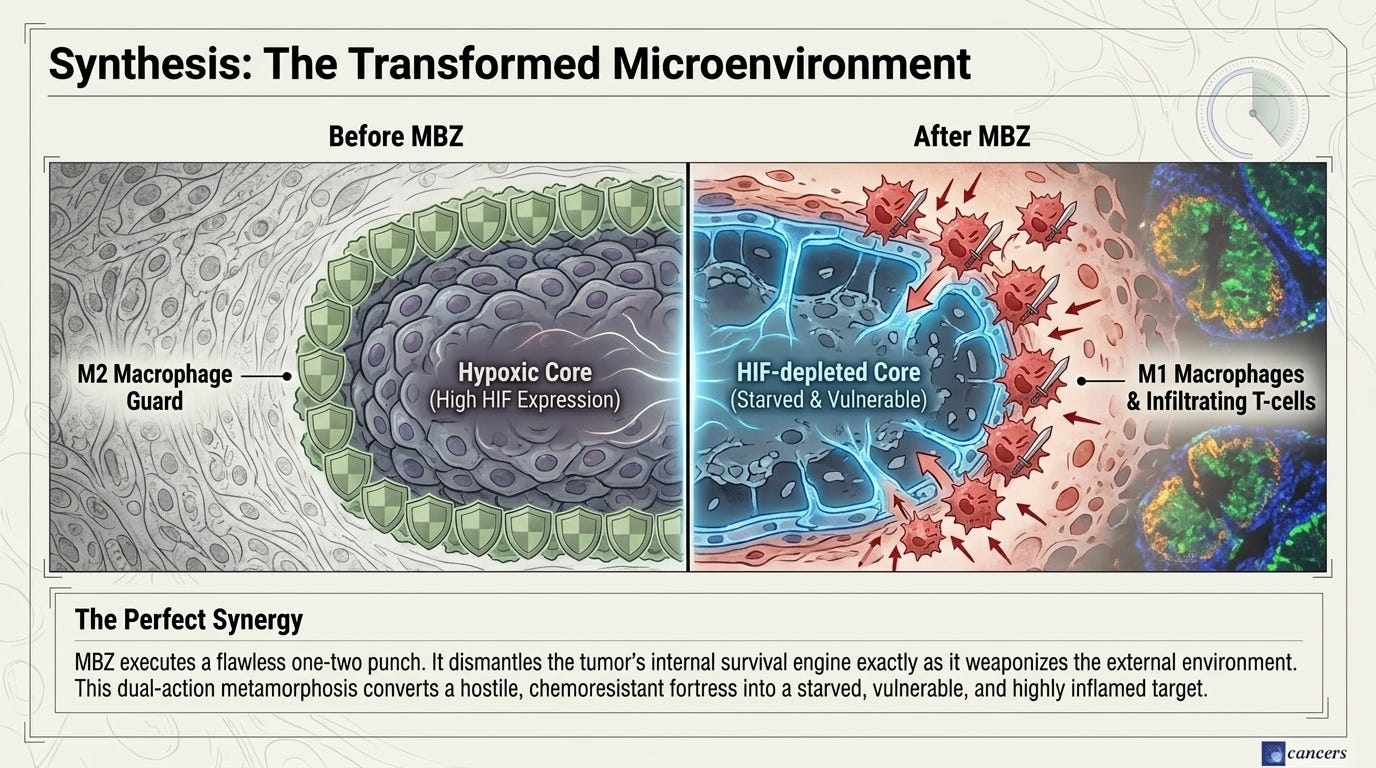
Two major barriers to effective cancer treatment are tumor hypoxia (low oxygen environments that induce chemoresistance) and immunosuppressive tumor microenvironments. Recent breakthroughs highlight how MBZ dismantles both defenses.
Overcoming Tumor Hypoxia
When solid tumors outgrow their blood supply, hypoxic regions emerge. Under low oxygen, cells stabilize Hypoxia-Inducible Factors (HIF-1, HIF-2, and HIF-1), triggering downstream transcription of over 1,000 genes responsible for stemness, altered metabolism, and therapeutic resistance.
Comparative transcriptomic profiling (such as CLUE.io connectivity mapping) revealed that MBZ’s gene expression signature closely matches known HIF inhibitors like Digoxin. In breast cancer models (MDA-MB-231, SUM159, MCF-7), MBZ prevents the protein stabilization of HIF-1, HIF-2, and HIF-1 under hypoxic conditions, blocking the transcription of hypoxia-response elements and preventing chemotherapy resistance.
Reprogramming the Immune Microenvironment
Tumors often co-opt immune cells, forcing macrophages into an alternatives M2-polarized, immunotolerant state that protects the tumor. MBZ acts as an immunomodulator by shifting macrophages toward a classically activated M1-polarized phenotype.
Exposing monocytes and macrophages to MBZ triggers the activation of the ERK1/2 pathway and inflammasomes, inducing the release of pro-inflammatory cytokines such as TNF, IL-1, IL-6, and IL-8. In co-culture models, MBZ-stimulated M1 macrophages enhance cytotoxic T-cell recruitment and active tumor killing.
Combination Strategies: Prostate Cancer and Flutamide
Monotherapies frequently fail in advanced prostate cancer (PCa) due to acquired resistance or severe antiandrogen side effects. In a 2026 study by Fattahi et al., researchers tested combining Mebendazole with the nonsteroidal antiandrogen Flutamide across three human prostate cancer cell lines representing distinct disease phenotypes: LNCaP (androgen-sensitive), DU145, and PC3 (androgen-independent/castration-resistant).
Key Experimental Findings:
IC50 Reduction: As single agents, MBZ exhibited an of approximately across all three cell lines, while Flutamide yielded values of (LNCaP, DU145) and (PC3). When MBZ was added, the required Flutamide dose to achieve viability reduction dropped significantly to (LNCaP, DU145) and (PC3).
Cell Migration & Clonogenicity: Scratch-wound and colony formation assays showed that the combination treatment inhibited wound closure and clonogenic cell growth far more effectively than either drug alone.
Apoptosis and Cell Cycle Arrest: Combination treatment triggered substantial accumulation in the sub- phase, arresting LNCaP and DU145 cells in and PC3 cells in .
Gene Expression Profiling: Real-Time PCR revealed a sharp increase in the pro-apoptotic BAX/BCL2 mRNA ratio and upregulation of the cell-adhesion marker E-cadherin (). Additionally, combination therapy significantly downregulated tubulin isoforms TUBB1 in DU145 and TUBB3 in DU145 and PC3 cells.
Important Pharmacological Caveat: While the combination produced greater inhibitory responses at tested concentrations, the study authors explicitly noted that no formal interaction models (such as Bliss, Loewe, or Combination Index) were performed. Thus, these outcomes represent enhanced efficacy rather than mathematically proven synergy.
Unlocking Chemoresistance: Melanoma and Ovarian Cancer Case Studies
To understand how Mebendazole restores chemo-sensitivity in resistant malignancies, let us examine two prominent case studies in melanoma and ovarian cancer.
Case Study 1: Reversing Bcl-2 Inactivation in Chemoresistant Melanoma
In chemoresistant melanoma cells (such as M-14 and SK-Mel-19), high expression of anti-apoptotic Bcl-2 protects tumor cells from traditional chemotherapies like cisplatin and temozolomide (Doudican et al., 2008).
Selectivity: MBZ inhibited melanoma growth with an average of , whereas healthy melanocytes (melan-a) resisted treatment ().
Mechanism: Tubulin disruption by MBZ triggers rapid phosphorylation of Bcl-2 at Ser70.
Outcome: Phosphorylated Bcl-2 loses its ability to bind and neutralize the pro-apoptotic protein Bax. Unbound Bax forms homodimers, activating the intrinsic mitochondrial pathway (cleavage of caspases-9, -7, -3, and PARP) and driving selective melanoma cell apoptosis.
Case Study 2: Sensitizing Platinum-Resistant Ovarian Cancer
Ovarian cancer frequently recurs as platinum-resistant disease. Huang et al. (2021) developed stable cisplatin-resistant lines (OVCAR8CR and SKOV3CR) to evaluate MBZ’s sensitizing capabilities.
Growth & Migration Blockade: MBZ inhibited proliferation in OVCAR8CR () and SKOV3CR () cells and blocked wound healing in a dose-dependent manner.
Pathway Suppression: Reporter assays showed MBZ simultaneously blocked major cancer driver pathways, including ELK/SRF, NF-B, MYC/MAX, and E2F/DP1.
In Vivo Synergy: In athymic nude mouse xenografts bearing SKOV3CR tumors, combined MBZ and cisplatin treatment drastically blunted tumor growth compared to either drug alone, showing marked reductions in proliferating cell nuclear antigen (PCNA) expression.
Summary
Mebendazole represents a quintessential candidate for oncological drug repurposing, combining an exceptional human safety profile and low cost with a multi-targeted ability to disrupt tubulin polymerization, inhibit angiogenesis, suppress hypoxia responses, flip immune microenvironments, and restore chemotherapy sensitivity.
Key Takeaways:
Mechanism of Action: MBZ binds the colchicine site of -tubulin, inhibits VEGFR2 autophosphorylation, downregulates HIF-1/HIF-2, and polarizes tumor-associated macrophages to an M1 anti-tumor phenotype.
Prostate Cancer Synergy: Combined with Flutamide, MBZ reduces the required Flutamide dose, upregulates the pro-apoptotic BAX/BCL2 ratio and E-cadherin, downregulates TUBB1/TUBB3, and inhibits migration across PC3, DU145, and LNCaP lines.
Targeting Bcl-2 in Melanoma: In chemoresistant melanoma, MBZ induces Bcl-2 Ser70 phosphorylation, disrupting Bax/Bcl-2 binding and selectively triggering Bax-mediated intrinsic apoptosis.
Reversing OVCAR Resistance: In cisplatin-resistant ovarian cancer (OVCAR8CR/SKOV3CR), MBZ suppresses ELK/SRF, NF-B, and MYC/MAX pathways, working synergistically with cisplatin to arrest xenograft tumor growth.
Sources:
Chai, J.-Y., Cho, S.-Y., Sohn, W.-M., & Hong, S.-T. (2021). Albendazole and mebendazole as anti-parasitic and anti-cancer agents: An update. The Korean Journal of Parasitology, 59(3), 189–225. https://doi.org/10.3347/kjp.2021.59.3.189
Doudican, N., Rodriguez, A., Osman, I., & Orlow, S. J. (2008). Mebendazole induces apoptosis via Bcl-2 inactivation in chemoresistant melanoma cells. Molecular Cancer Research, 6(8), 1308–1315. https://doi.org/10.1158/1541-7786.MCR-07-2159
Fattahi, M. R., Taheri, D., Inanloo, S. H., Mirzaei, A., Ghajar, H. A., Reis, L. O., & Aghamir, S. M. K. (2026). Effects of mebendazole and flutamide combination in prostate cancer cell lines: A comprehensive in vitro analysis. Cellular Physiology and Biochemistry, 60, 458–472. https://doi.org/10.33594/000000883
Guerini, A. E., Triggiani, L., Maddalo, M., Bonù, M. L., Frassine, F., Baiguini, A., Alghisi, A., Tomasini, D., Borghetti, P., Pasinetti, N., Bresciani, R., Magrini, S. M., & Buglione, M. (2019). Mebendazole as a candidate for drug repurposing in oncology: An extensive review of current literature. Cancers, 11(9), Article 1284. https://doi.org/10.3390/cancers11091284
Huang, L., Zhao, L., Zhang, J., He, F., Wang, H., Liu, Q., Shi, D., Ni, N., Wagstaff, W., Chen, C., Reid, R. R., Haydon, R. C., Luu, H. H., Shen, L., He, T.-C., & Tang, L. (2021). Antiparasitic mebendazole (MBZ) effectively overcomes cisplatin resistance in human ovarian cancer cells by inhibiting multiple cancer-associated signaling pathways. Aging, 13(16), Article 203232. https://doi.org/10.18632/aging.203232
Joe, N. S., Wang, Y., Oza, H. H., Godet, I., Milki, N., Riggins, G. J., & Gilkes, D. M. (2023). Mebendazole treatment disrupts the transcriptional activity of hypoxia-inducible factors 1 and 2 in breast cancer cells. Cancers, 15(4), Article 1330. https://doi.org/10.3390/cancers15041330
Nygren, P., Fryknäs, M., Ågerup, B., & Larsson, R. (2013). Repositioning of the anthelmintic drug mebendazole for the treatment for colon cancer. Journal of Cancer Research and Clinical Oncology, 139(12), 2133–2140. https://doi.org/10.1007/s00432-013-1539-5
Pantziarka, P., Bouche, G., Meheus, L., Sukhatme, V., & Sukhatme, V. P. (2014). Repurposing Drugs in Oncology (ReDO)—mebendazole as an anti-cancer agent. ecancermedicalscience, 8, Article 443. https://doi.org/10.3392/ecancer.2014.443