
Introduction
What if a cheap, common medicine used to treat parasitic worm infections since 1972 holds the key to attacking some of the most aggressive and lethal brain cancers? Drug repurposing is turning this wild idea into a serious scientific quest, focusing on a drug called Mebendazole. While traditionally used to treat helminth infections, scientists have discovered that Mebendazole has a hidden talent: it can cross the protective blood-brain barrier and target cancer cells through multiple biological pathways.
By the end of this page, you will be able to:
Explain the concept of drug repurposing and why the blood-brain barrier is such a formidable opponent in neuro-oncology.
Describe Mebendazole’s diverse, multi-targeted mechanisms of action against brain tumors.
Identify the role of drug formulations—specifically Polymorph C—in ensuring effective delivery to the brain.
Critically analyze the current gap between highly promising preclinical results and modest clinical trial outcomes.
The Logic of Drug Repurposing and the Brain’s Great Wall
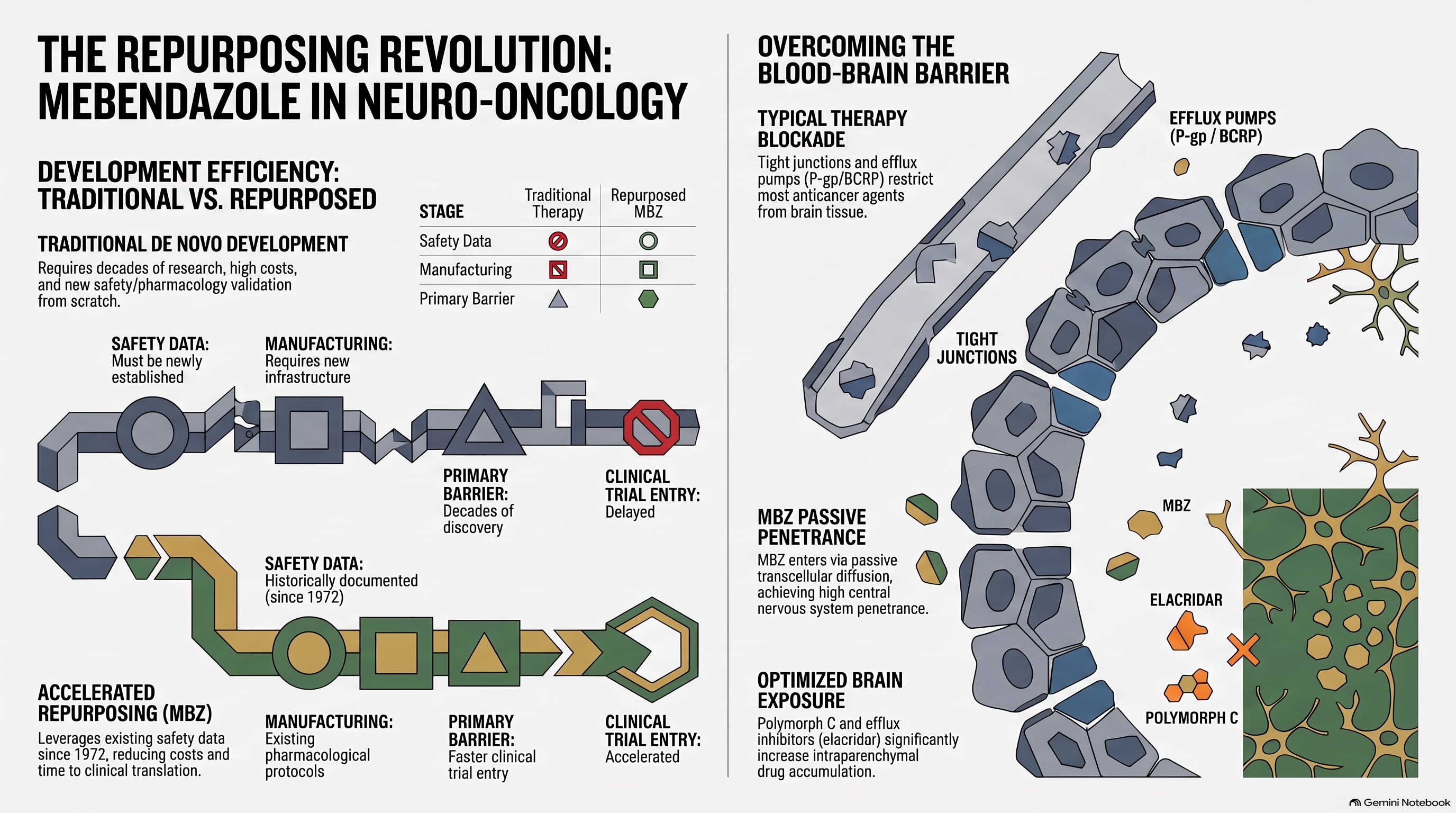
Developing a brand-new cancer drug from scratch is incredibly slow, enormously expensive, and has a high failure rate. Drug repurposing bypasses many of these hurdles by taking medications that are already FDA-approved for non-cancer conditions and finding new therapeutic uses for them. Because their safety and pharmacology profiles are already well established in humans, repurposed drugs can move straight into late-stage clinical testing.
But treating brain tumors presents a unique, physical challenge: the Blood-Brain Barrier (BBB). This tightly regulated cellular wall protects the brain from toxins, but it also relentlessly blocks over 90% of traditional chemotherapy drugs. Furthermore, drug efflux pumps act like cellular bouncers, actively throwing out any foreign molecules that manage to slip inside.
This is where Mebendazole (MBZ) shines. Unlike many other chemotherapies, it possesses a favorable chemical structure that naturally allows it to penetrate the central nervous system, making it an ideal candidate for neuro-oncology.
One Drug, Many Targets: How Mebendazole Attacks Cancer
Unlike modern “targeted” therapies that only focus on one single mutation, Mebendazole is a master of multitasking. In preclinical lab tests, it has shown an ability to attack brain tumors through several completely different pathways simultaneously.
First, it disrupts the cell's skeletal structure. Just like it does in parasitic worms, MBZ binds to tubulin, causing microtubules to depolymerize. This prevents cancer cells from dividing, locking them in the G2/M phase of the cell cycle and forcing them into programmed cell death (apoptosis or pyroptosis).
Second, it blocks survival signals. MBZ acts as a multi-kinase inhibitor, notably shutting down MAPK14 (p38α), ABL1, and ERK2. It also interferes with the infamous Hedgehog signaling pathway—a key driver in childhood medulloblastomas—by preventing primary cilium formation, even in tumor cells that have grown resistant to standard Hedgehog drugs.
Third, it starves the tumor and disrupts its repair mechanisms. By inhibiting VEGFR-2, MBZ blocks tumor angiogenesis (the creation of new blood vessels), starving the tumor of nutrients. Finally, it prevents key DNA-repair proteins (like Chk2 and Nbs1) from entering the cell nucleus. Without these repair proteins, cancer cells cannot fix damage caused by radiation, making them highly sensitive to radiotherapy.
The Chemistry of Delivery: Not All Mebendazole Is Equal
Here is a surprising twist: if you went to a pharmacy and bought standard over-the-counter Mebendazole, it might do virtually nothing for a brain tumor. That is because Mebendazole exists in three distinct crystal structures called polymorphs: A, B, and C.
Polymorph A is practically insoluble and is barely absorbed by the body, which is fine when you only want the drug to stay in the gut to fight intestinal worms. Polymorph B is slightly better but causes notable toxicity. Polymorph C is the absolute hero of neuro-oncology. It penetrates the brain beautifully, reaching therapeutic levels in brain tissue up to 20 times higher than the concentrations needed to kill cancer cells in a dish, all while remaining highly tolerable.
To make Polymorph C work even better, scientists are designing high-tech delivery vehicles. These include pairing it with elacridar (an efflux pump inhibitor) to stop the brain from spitting the drug back out, developing intranasal microemulsions (nasal sprays that deliver the drug straight to the brain via the olfactory pathway), and formulating albumin-wrapped nanosuspensions to help it glide through the bloodstream.
Preclinical Triumph Meets Clinical Reality
In animal models, Mebendazole’s results are nothing short of spectacular. It has been shown to double survival times in mice with medulloblastoma, extend survival by over 60% in glioblastoma models, and, when combined with radiation, create long-term, tumor-free survivors in models of IDH1-mutant glioma.
However, the story becomes more complicated in human clinical data. Early clinical trials in both adults and children have proved that high-dose oral Mebendazole is safe, feasible, and well-tolerated. Patients generally experience only minor side effects, such as reversible liver enzyme elevations.
Unfortunately, the evidence of actual efficacy in human patients remains modest and inconsistent. In a randomized Phase II clinical trial, adding Mebendazole to standard chemotherapy failed to meet its overall survival targets. The drug showed a faint signal of benefit only in a small, highly specific subgroup of patients who already had a good performance status.
Why this massive gap between mice and men? Scientists point to a few culprits: human tumors are far more complex and heterogeneous than lab models, human clinical trials have historically used inconsistent or poorly reported drug formulations (often failing to specify whether they used Polymorph C), and the physical size of human brains makes uniform drug distribution much harder.
Summary
Let’s review the main lessons from Mebendazole’s journey from a humble anti-parasitic treatment to an experimental neuro-oncology candidate:
The Repurposing Advantage: Utilizing established drugs bypasses early-stage safety trials, and Mebendazole’s unique ability to cross the blood-brain barrier makes it a rare candidate for brain tumor research.
Multi-Target Mechanisms: MBZ behaves like a molecular Swiss Army knife—depolymerizing microtubules, blocking survival kinases, inhibiting angiogenesis, and slowing down tumor DNA repair.
The Polymorph Variable: Crystal structure is everything. Only Polymorph C possesses the pharmacokinetics needed to accumulate in brain tissue at therapeutic concentrations.
The Translation Gap: Despite spectacular success in animal models, human trials have yet to show robust, consistent efficacy. Future trials must focus on precise formulation reporting, biomarker selection, and rational combination therapies.
From anthelmintic to neuro-oncology: A systematic review of mebendazole repurposing for brain tumour therapy
Blum CB, McMenamin M, Khoo T, Edwin JM, Jose P, O’Callaghan LA. From anthelmintic to neuro-oncology: A systematic review of mebendazole repurposing for brain tumour therapy. Br J Clin Pharmacol. 2026 May 12. doi: 10.1002/bcp.70565. Epub ahead of print. PMID: 42120351. https://pubmed.ncbi.nlm.nih.gov/42120351/
Mebendazole and Cancer Metabolism: What a New 2026 Glioma Study Suggests
By trinovahealth July 20, 2026, https://www.trinovahealth.com/mebendazole-cancer/
Medical disclaimer: This article is provided for educational purposes only and is not medical advice. Mebendazole is not FDA-approved to diagnose, treat, cure or prevent cancer. The research discussed includes laboratory and animal findings that may not translate into clinical benefit for humans. Do not begin, discontinue or modify cancer treatment, mebendazole therapy or a ketogenic diet without consulting a qualified physician.