
Introduction
What if a widely available anti-parasitic medication used in veterinary medicine holds the key to solving one of oncology’s most stubborn challenges—cervical cancer recurrence?
In this article, we will explore groundbreaking 2025 preclinical research from Jilin University demonstrating how Fenbendazole (FBZ) simultaneously eliminates bulk cervical cancer cells and drug-resistant cancer stem cells, halting tumor growth without the severe toxic side effects of traditional chemotherapy. This article discusses in vitro and in vivo preclinical testing (lab & animal).
By the end of this piece, you will be able to:
Identify the biological role of cervical cancer stem cells (CCSCs) in driving therapy resistance and tumor relapse.
Explain the principles of drug repurposing and why antiparasitic drugs exhibit potent selective anti-cancer activity.
Analyze the molecular signaling pathways (CDK1, Wee1, cdc25C, cyclin B1) involved in FBZ-induced G2/M cell cycle arrest.
Evaluate FBZ's in vivo efficacy, survival outcomes, and safety profile compared with standard chemotherapy in xenograft models.
The Modern Challenge of Cervical Cancer and the CSC Threat
Cervical cancer remains a formidable global health threat, accounting for over 660,000 new cases and 348,000 deaths annually. While early-stage cervical cancer responds well to surgical intervention, advanced stages present a grim prognosis: 5-year survival rates hover around 40% for Stage III and drop to an alarming 20% for Stage IV.
Why are advanced tumors so difficult to eradicate permanently? The main culprit is tumor heterogeneity and a specialized subpopulation of cells known as Cancer Stem Cells (CSCs).
The “Weed and Root” Analogy
Think of a malignant tumor as a persistent backyard weed:
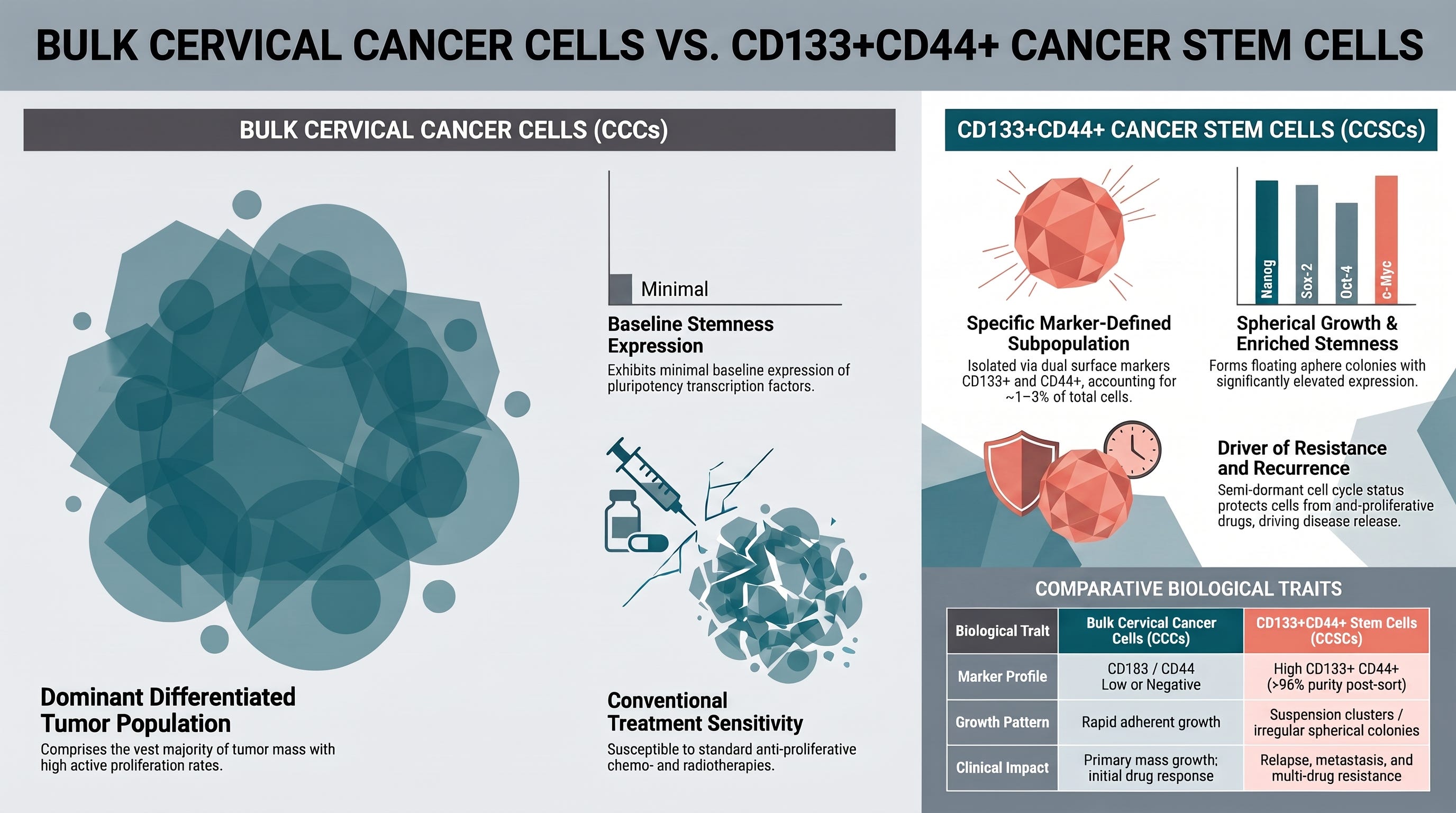
Bulk Cervical Cancer Cells (CCCs) are the visible leaves and stems above ground. Traditional treatments like standard chemotherapy and radiation trim these leaves, causing the tumor to shrink initially.
Cervical Cancer Stem Cells (CCSCs) are the deep, semi-dormant taproots underground. Because CSCs proliferate slowly, they easily dodge conventional anti-proliferative therapies. After treatment ends, these surviving stem-cell roots regenerate the entire tumor, driving invasion, metastasis, and treatment resistance.
Isolating and Profiling the Roots
To study these elusive stem cells, researchers isolated CD133+CD44+ cells from human cervical cancer cell lines (HeLa and C-33 A) using immunomagnetic bead sorting, achieving over 96–97% purity. When cultured in serum-free media, these stem cells grew into free-floating, irregular cellular spheres (HeLa SCs and C-33 A SCs).
Western blot analysis revealed that these sorted CCSCs significantly overexpressed key stemness transcription factors:
Oct-4 and Sox-2: Master regulators that maintain self-renewal capacity.
Nanog and c-Myc: Key drivers of pluripotency, cellular survival, and tumor initiation.
Drug Repurposing & The Antiparasitic Discovery
Developing a novel pharmaceutical from scratch is notoriously slow, expensive, and high-risk, often taking over a decade and failing frequently. Drug repurposing—identifying new therapeutic uses for already approved medications—bypasses many of these hurdles because the compound’s safety profile and manufacturing processes are already well established.
Why Antiparasitics Target Tumors
Remarkably, parasitic organisms and human cancer cells share striking biological similarities:
Metabolic Reliance: Both rely heavily on high-rate glycolysis (the Warburg effect in tumors) for energy generation.
Immune Evasion: Both manipulate the host microenvironment to evade detection by immune surveillance.
Cytoskeletal Vulnerability: Both rely on rapid, dynamic tubulin assembly for cell survival and multiplication.
Enter Fenbendazole (FBZ)
Fenbendazole (FBZ) is a low-cost, broad-spectrum benzimidazole anthelmintic traditionally used to treat gastrointestinal parasites in animals. It binds to parasite beta-tubulin, disrupting microtubule assembly. Crucially, human Phase 1 safety trials with its primary metabolite, oxfendazole, confirmed excellent tolerability up to 60 mg/kg without serious side effects.
Selective Cytotoxicity In Vitro
When tested across multiple human cancer cell lines using MTS cell viability assays, FBZ demonstrated potent, dose-dependent anti-proliferative activity:
HeLa (Cervical Cancer): IC50 = 0.59 µM (highest sensitivity)
C-33 A (Cervical Cancer): IC50 = 0.84 µM
MDA-MB-231 & ZR-75-1 (Breast Cancer): IC50 = 1.80 µM and 1.88 µM
HCT 116 (Colon Cancer): IC50 = 3.19 µM
Remarkably, when applied to normal human fibroblast cells (BJ cell line), FBZ showed no significant cytotoxicity, suggesting its destructive power is selectively tuned to malignant cells while sparing healthy tissue.
Slide Show Download

Dual-Targeting Mechanism: Halting the Cell Cycle and Triggering Apoptosis
How does Fenbendazole successfully destroy both rapidly dividing bulk cancer cells and sluggish stem cells? The answer lies in its precise disruption of the G2/M checkpoint.
Locking the Gate at G2/M
Cell division requires cells to pass through specific regulatory checkpoints. The G2/M checkpoint acts like a strict security gate before a cell enters mitosis (M phase) to divide into two daughter cells. Flow cytometry revealed that 24-hour treatment with 1 µM FBZ trapped >90% of HeLa cells and HeLa SCs and >70% of C-33 A cells and C-33 A SCs in the G2/M phase.
The Molecular Control Panel
To understand this traffic jam, scientists examined four key regulatory proteins that control the CDK1-cyclin B1 complex (the master engine driving entry into mitosis):
Cyclin B1 (The Accelerator Pedal): FBZ treatment markedly upregulated Cyclin B1 protein levels. Because Cyclin B1 peaks during G2, this accumulation confirmed a massive cellular backlog stuck right before mitosis.
CDK1 (The Engine): While total CDK1 levels remained constant, FBZ drastically reduced inhibitory phosphorylation at Tyr15 (p-CDK1 down), leaving the CDK1 engine in a hyper-activated state.
Wee1 (The Brake): Wee1 normally brakes CDK1 by phosphorylating Tyr15. FBZ downregulated Wee1, effectively cutting the brake line.
cdc25C (The Ignition Switch): cdc25C removes the inhibitory lock on CDK1. FBZ upregulated phosphorylation at Ser198 (activating site) while downregulating phosphorylation at Ser216 (inhibitory site).
From Arrest to Apoptosis
When cells are locked in G2/M with hyperactivated CDK1-cyclin B1 complexes, prolonged arrest alters pro-apoptotic protein signaling and triggers the mitochondrial apoptotic pathway. Annexin V-FITC/PI staining proved that 48-hour FBZ exposure induced over 80% apoptosis in both bulk HeLa cells and HeLa stem cells.
In Vivo Validation: Efficacy, Survival, and Safety in Mouse Xenografts
To test whether FBZ’s in vitro power translates to living organisms, researchers established xenograft models by transplanting human HeLa cells into female nude mice. Tumor-bearing mice were split into four groups treated daily for 23 days:
Model Group: Untreated control
50 mg/kg FBZ Group: Oral low-dose FBZ
100 mg/kg FBZ Group: Oral high-dose FBZ
DDP Group: Cisplatin (3 mg/kg twice weekly, positive chemotherapy control)
Tumor Inhibition vs. Systemic Toxicity
At the end of treatment, tumor weight reductions demonstrated strong anti-tumor efficacy across treatment groups:
50 mg/kg FBZ: 40.6% tumor inhibition
100 mg/kg FBZ: 52.6% tumor inhibition
Cisplatin (DDP): 74.6% tumor inhibition
However, tumor weight tells only half the story. The safety profile revealed a dramatic contrast:
Cisplatin Toxicity: Mice given cisplatin suffered severe, continuous body weight loss, lethargy, and systemic distress.
Fenbendazole Tolerability: Mice treated with 100 mg/kg FBZ maintained steady, healthy body weight trajectories identical to non-tumor controls, remained active, had smooth fur, and showed no organ damage (normal heart, liver, lung, and kidney coefficients).
Long-Term Survival Outcomes
The most striking finding emerged during an 80-day post-inoculation survival observation:
Untreated Controls: 0% survival (all mice succumbed to tumor burden).
Cisplatin Group: 40% survival (limited by drug toxicity and eventual relapse).
FBZ Groups (50 & 100 mg/kg): 100% survival across the entire 80-day period!
Histopathology (HE staining) confirmed widespread necrotic tumor foci in FBZ-treated tissue, while immunohistochemistry showed significant suppression of Ki67 (a cell-proliferation marker) and ROCK1 (a tumor invasion and metastasis marker).
Summary
Fenbendazole is a promising, highly effective drug-repurposing candidate that overcomes cervical cancer heterogeneity by dual-targeting bulk tumor cells and therapy-resistant stem cells through G2/M cell-cycle arrest, achieving 100% long-term survival in animal models without severe systemic toxicity.
Key Takeaways
Dual-Targeting Action: FBZ eradicates both bulk cervical cancer cells (CCCs) and cancer stem cells (CCSCs), addressing the root cause of relapse and metastasis.
Stem Cell Markers: CCSCs isolated via CD133+CD44+ surface markers display high expression of stemness genes including Oct-4, Sox-2, Nanog, and c-Myc.
Selective Cytotoxicity: FBZ shows high sensitivity in cervical cancer lines (HeLa IC50 = 0.59 µM) while sparing normal human fibroblast cells.
G2/M Blockade Mechanism: FBZ inhibits tubulin polymerization, downregulates Wee1, activates cdc25C (p-Ser198), dephosphorylates CDK1 (Tyr15), and elevates Cyclin B1 to trigger apoptosis.
Superior In Vivo Safety: In mouse xenografts, 100 mg/kg oral FBZ achieves dramatic tumor regression and 100% 80-day survival without the severe weight loss and toxicity associated with standard chemotherapy like cisplatin.
Reference
Lei, X., Wang, Y., Chen, Y., Duan, J., Gao, X., & Cong, Z. (2025). Fenbendazole exhibits antitumor activity against cervical cancer through dual targeting of cancer cells and cancer stem cells: Evidence from in vitro and in vivo models. Molecules, 30(11), Article 2377.