
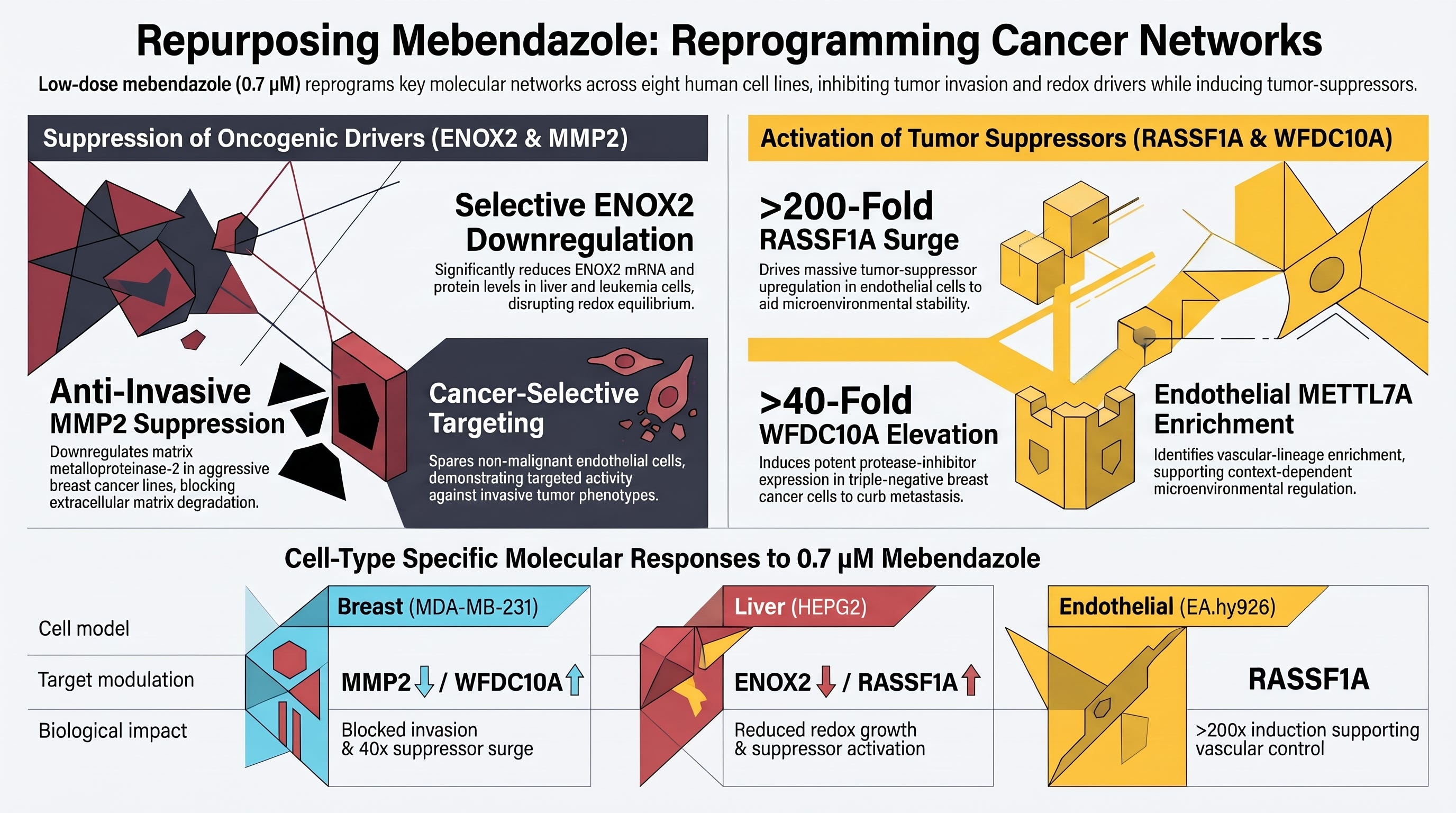
This January 2026 research paper, summarized and discussed here, explores the anticancer mechanisms of repurposed mebendazole, specifically how this common antiparasitic medication successfully reprograms oncogenic and tumor-suppressor gene networks across multiple human cancer cell lines. Using eight distinct cell models, quantitative RT-PCR and Western blotting show that mebendazole downregulates key invasion drivers like ENOX2 and MMP2 while selectively inducing tumor-suppressor genes such as RASSF1A and WFDC10A. Ultimately, the study highlights the therapeutic potential and cost-effectiveness of drug repurposing and provides valuable multi-gene biomarker insights that could improve early cancer detection and targeted treatment strategies for aggressive malignancies. This article discusses in vitro and in vivo preclinical testing (lab & animal). This article is for educational and informational purposes only. We are not doctors and do not provide medical advice. Nothing shared here is intended to diagnose, treat, cure, or prevent any disease.
Video: The Molecular Sabotage: Mebendazole’s War on Metastasis
Mebendazole Oncology Networks
Repurposing mebendazole (MBZ)—a safe, widely accessible benzimidazole anthelmintic—has emerged as a compelling strategy in oncology due to its ability to reprogram interconnected oncogenic and tumor-suppressor networks across multiple cancer types.
Recent mechanistic studies demonstrate that mebendazole exerts cell-type–specific modulation over key enzymatic, matrix remodeling, and epigenetic pathways at clinically achievable concentrations:
1. Anti-Invasive & Extracellular Matrix Modulation (MMP2 & WFDC10A)
MMP2 Suppression: Matrix metalloproteinase-2 (gelatinase A) degrades type IV collagen in the basement membrane, enabling metastatic spread. Mebendazole treatment (0.7 µM) significantly downregulates MMP2 transcript and protein expression in both hormone-responsive (MCF7) and triple-negative breast cancer (MDA-MB-231) cells, impairing extracellular matrix degradation.
Dramatic WFDC10A Induction: WFDC10A functions as a protease inhibitor and tumor suppressor. Mebendazole dramatically upregulates WFDC10A expression by >40-fold in triple-negative breast cancer cells (MDA-MB-231), as well as inducing it in liver (HEPG2) and colorectal (HT29) models, establishing a dual anti-invasive mechanism alongside MMP2 suppression.
2. Redox Control & Metabolic Disruption (ENOX2)
Targeting Cancer-Specific Oxidase: ENOX2 (tNOX) is a cancer-specific cell-surface NADH oxidase that regulates cellular redox state, cell growth, and survival.
Selective Downregulation: Mebendazole selectively reduces ENOX2 mRNA and protein levels in hepatocellular carcinoma (HEPG2) and chronic myeloid leukemia (K562) cells, disrupting redox equilibrium and promoting growth arrest.
3. Tumor Suppressor Reactivation & Vasculature Normalization (RASSF1A & METTL7A)
RASSF1A Induction: The RASSF1A tumor suppressor regulates the cell cycle and microtubule stability but is frequently silenced by promoter hypermethylation in human cancers. Mebendazole reactivates RASSF1A transcription in liver (HEPG2) and colorectal (HT29) carcinomas.
Endothelial Sensitivity: Mebendazole triggers a >200-fold upregulation of RASSF1A in endothelial cells (EA.hy926), suggesting a strong capacity for tumor vasculature normalization and anti-angiogenic synergy.
METTL7A Regulation: METTL7A, an endothelial-enriched methyltransferase involved in stress survival and microenvironmental modulation, is selectively upregulated by mebendazole across breast, liver, leukemia, and endothelial cell lines.
4. Translational & Global Health Impact
Mebendazole effectively modulates multi-gene network signatures (ENOX2, MMP2, RASSF1A, WFDC10A, METTL7A) at non-cytotoxic concentrations (0.7 µM), offering an affordable, off-patent therapeutic option to overcome invasive phenotypes and chemoresistance in resource-limited settings.
Important Disclaimer:
Always consult with your licensed healthcare provider before starting any new protocol, medication, or supplement, especially if you have cancer or any serious health condition. Results vary, and these approaches are considered experimental by mainstream medicine.
We encourage respectful, kind, and supportive discussions.
Mebendazole Tumor Suppression
The regulation of tumor-suppressor networks plays a crucial role in restricting malignant transformation, cell cycle progression, and metastatic dissemination. Exposure to low-dose mebendazole (0.7 µM) demonstrates a remarkable ability to selectively reactivate key tumor suppressors and regulatory genes across diverse human cancer and endothelial cell models:
1. RASSF1A (Ras Association Domain Family Member 1, Isoform A)
Functional Role: RASSF1A is a classical tumor suppressor that regulates cell cycle arrest, stabilizes microtubules, and induces apoptosis. It is frequently silenced by promoter hypermethylation across a wide range of human solid tumors.
Massive Endothelial Activation: Mebendazole triggers a >200-fold upregulation of RASSF1A mRNA in EA.hy926 endothelial cells relative to control conditions. This dramatic response highlights a strong capacity for tumor vasculature normalization and anti-angiogenic synergy.
Selective Tumor Induction: Mebendazole significantly induces RASSF1A transcription in hepatocellular carcinoma (HEPG2) and colorectal carcinoma (HT29) cells. However, its effect is context-dependent: RASSF1A levels remain unchanged in breast cancer lines (MDA-MB-231, MCF7) and decrease in lung (A549), leukemia (K562), and pancreatic (PANC1) models.
2. WFDC10A (WAP Four-Disulfide Core Domain Protein 10A)
Functional Role: WFDC10A belongs to a family of protective proteins with protease-inhibitory and immune-regulatory properties. By inhibiting proteolytic activity, it prevents extracellular matrix degradation and limits metastatic invasion.
Dramatic Induction in Invasive Breast Cancer: Mebendazole causes a >40-fold induction of WFDC10A in aggressive triple-negative breast cancer cells (MDA-MB-231) compared to untreated controls.
Broad Anti-Invasive Network: Significant upregulation of WFDC10A is also observed in hormone-responsive breast cancer (MCF7), liver (HEPG2), colorectal (HT29), and endothelial (EA.hy926) cells. This induction works synergistically with the drug’s suppression of matrix metalloproteinase-2 (MMP2) to impair metastatic cell motility.
3. METTL7A (Methyltransferase-Like Protein 7A)
Functional Role: METTL7A is involved in methyltransferase activity, lipid metabolism, stress survival, and tumor microenvironment adaptation.
Endothelial-Specific Lineage Enrichment: Under basal conditions, METTL7A is intrinsically enriched in non-malignant endothelial cells (EA.hy926) and is completely absent/undetectable in breast cancer lines (MDA-MB-231 and MCF7) at both mRNA and protein levels.
Heterogeneous Transcriptional Response: Upon mebendazole exposure, METTL7A is upregulated in breast, liver, leukemia, pancreatic, and endothelial cell lines, while being downregulated in colorectal (HT29) and lung (A549) carcinoma lines, reflecting cell-line-specific epigenetic signaling.
4. Coordinated Network Reprogramming
Rather than acting solely on a single gene target, mebendazole reprograms the broader oncogenic–tumor suppressor axis. While selectively reactivating tumor suppressors (RASSF1A, WFDC10A), it simultaneously suppresses major functional drivers of redox growth (ENOX2) in liver and leukemia cells and metastatic degradation (MMP2) in breast cancer cells.
Mebendazole Multi-Cancer Profiling
In the multi-cancer study evaluating mebendazole (0.7 µM) across seven distinct human cancer cell lines and an endothelial control lineage, researchers demonstrated that mebendazole reprograms interconnected oncogenic and tumor-suppressor gene networks in a cell-type–specific manner:
1. Multi-Cancer Panel & Lineage Models
The profiling evaluated eight human cell lines spanning diverse tissue origins:
Breast Cancer: Triple-negative (MDA-MB-231) and hormone-responsive (MCF7).
Gastrointestinal Cancers: Hepatocellular carcinoma (HEPG2), colorectal adenocarcinoma (HT29), and pancreatic carcinoma (PANC1).
Thoracic & Hematological Malignancies: Lung adenocarcinoma (A549) and chronic myeloid leukemia (K562).
Vascular Control: Endothelial cells (EA.hy926) as a non-malignant baseline.
2. Selective Suppression of Oncogenic & Metastatic Drivers
ENOX2 (ecto-NADH Oxidase): Mebendazole significantly downregulated ENOX2 mRNA and protein levels in liver carcinoma (HEPG2) and chronic myeloid leukemia (K562), disrupting cancer-specific redox metabolism and cellular growth. Downregulation was also observed in MDA-MB-231, HT29, and PANC1 cells, while EA.hy926 endothelial cells maintained stable expression.
MMP2 (Gelatinase A): Mebendazole markedly suppressed MMP2 transcript and protein levels in both triple-negative (MDA-MB-231) and hormone-responsive (MCF7) breast cancer cells. Because MMP2 breaks down type IV collagen in the basement membrane, its selective inhibition impairs metastatic cell invasion without affecting non-malignant endothelial cells.
3. Cell-Type–Specific Reactivation of Tumor Suppressors
WFDC10A (Protease Inhibitor & Suppressor): Mebendazole produced its most dramatic response in invasive triple-negative breast cancer (MDA-MB-231), triggering a >40-fold upregulation of WFDC10A mRNA. Significant induction was also demonstrated in MCF7, HEPG2, HT29, and EA.hy926 cells, enhancing cellular anti-protease defenses against invasive spread.
RASSF1A (Microtubule & Apoptosis Regulator): In non-malignant endothelial cells (EA.hy926), mebendazole induced a >200-fold increase in RASSF1A mRNA, highlighting strong potential for tumor vasculature normalization. RASSF1A was also significantly upregulated in liver (HEPG2) and colorectal (HT29) carcinomas.
4. Endothelial Lineage Enrichment (METTL7A)
Endothelial Specificity: Under basal conditions, the methyltransferase-like protein METTL7A was highly enriched in EA.hy926 endothelial cells and completely undetectable in breast cancer lines (MDA-MB-231 and MCF7).
Heterogeneous Drug Response: Mebendazole elevated METTL7A levels in breast, liver, leukemia, pancreatic, and endothelial models, while downregulating it in colorectal (HT29) and lung (A549) cancer lines.
5. Translational Value as a Multi-Gene Biomarker Panel
Rather than relying on a single, non-specific mechanism, mebendazole targets a 5-gene signature (ENOX2, MMP2, RASSF1A, WFDC10A, METTL7A). This multi-cancer framework provides a foundation for developing clinically testable biomarker panels for patient stratification, pharmacodynamic monitoring, and therapeutic response tracking in aggressive malignancies.
Oncogenic Networks Mebendazole
In the multi-cancer study evaluating mebendazole (journal.pone.0345701.pdf), oncogenic networks are defined by coordinated functional drivers that promote cell growth, alter redox equilibrium, degrade the extracellular matrix (ECM), and facilitate metastatic dissemination.
1. Core Drivers of the Oncogenic Network
ENOX2 (ecto-NADH Oxidase / tNOX):
Cancer Specificity: Unlike its constitutively expressed isoform (CNOX), ENOX2 is expressed exclusively on the surface of transformed/malignant cells and is absent in normal, healthy tissues.
Redox & Proliferative Control: ENOX2 regulates cellular redox status and drives cell growth and survival through periodic NADH oxidase and disulfide-thiol exchange activity. Its suppression disrupts cellular redox balance and triggers growth inhibition or apoptosis.
Clinical & Diagnostic Relevance: ENOX2 isoforms are shed into serum and urine, making it a key biomarker for non-invasive liquid biopsies as well as a target for therapeutic intervention.
MMP2 (Matrix Metalloproteinase-2 / Gelatinase A):
Extracellular Matrix Degradation: MMP2 is a zinc-dependent endopeptidase that specifically degrades type IV collagen, the primary structural component of basement membranes.
Invasion & Angiogenesis: Cleavage of the basement membrane by MMP2 enables tumor cell motility, intra/extravasation, blood vessel sprouting (angiogenesis), and distant metastatic colonization.
Prognostic Impact: Elevated MMP2 expression across solid tumors (including breast, pancreatic, lung, and colorectal carcinomas) correlates strongly with advanced stage, high metastatic potential, and poor patient survival.
2. The Functional ENOX2–MMP2 Interplay
Integrated Signaling Axis: The research establishes the ENOX2–MMP2 pathway as an interconnected oncogenic axis driving tumor invasiveness and metastatic competence.
Redox-Mediated Feedback: ENOX2-driven redox alterations modulate MMP2 expression and activity, creating a functional feedback loop that accelerates basement membrane destruction and metastatic spread.
3. Reprogramming Oncogenic Networks with Mebendazole
Exposure to low-dose mebendazole (0.7 µM) selectively disrupts these oncogenic drivers while sparing non-malignant tissue:
Tumor-Selective ENOX2 Downregulation: Mebendazole significantly reduces ENOX2 mRNA and protein levels in hepatocellular carcinoma (HEPG2, \(p < 0.01\)) and chronic myeloid leukemia (K562, \(p < 0.05\)), while maintaining stable ENOX2 expression in non-malignant EA.hy926 endothelial cells.
Anti-Invasive Blockade of MMP2: Mebendazole causes significant downregulation of MMP2 transcript and protein levels in both triple-negative (MDA-MB-231, \(p < 0.05\)) and hormone-responsive (MCF7, \(p < 0.01\)) breast cancer cells, without impairing MMP2 levels in normal endothelial cells.
Network Interconnection with Tumor Suppressors: Mebendazole’s suppression of oncogenic ENOX2 and MMP2 operates in tandem with the cell-type-specific reactivation of protective regulatory genes—such as triggering a >40-fold upregulation of WFDC10A in invasive breast cancer cells and a >200-fold upregulation of RASSF1A in endothelial cells.
Mebendazole Biomarkers
The study evaluated a 5-gene molecular biomarker panel—comprising ENOX2, MMP2, RASSF1A, WFDC10A, and METTL7A—across seven human cancer cell lines and a non-malignant endothelial control line (EA.hy926). This panel assesses both the basal oncogenic/suppressive state of distinct tumor lineages and the dynamic, cell-type–specific response to low-dose mebendazole (0.7 µM) therapy.
1. Oncogenic & Invasiveness Biomarkers
ENOX2 (ecto-NADH Oxidase 2 / tNOX):
Biological Role: A cancer-specific cell-surface NADH oxidase that regulates cellular redox equilibrium, cell growth, and survival. Because it is shed into serum and urine, it serves as a liquid biopsy biomarker for early detection.
Response to Therapy: Mebendazole causes significant downregulation of ENOX2 transcript and protein levels in hepatocellular carcinoma (HEPG2, \(p < 0.01\)) and chronic myeloid leukemia (K562, \(p < 0.05\)), signaling a disruption of redox-driven cell proliferation.
MMP2 (Matrix Metalloproteinase-2 / Gelatinase A):
Biological Role: A zinc-dependent endopeptidase that degrades type IV collagen in the basement membrane, serving as an indicator of extracellular matrix breakdown, cell invasion, angiogenesis, and metastatic potential.
Response to Therapy: Mebendazole treatment significantly suppresses MMP2 transcript and protein levels in both triple-negative (MDA-MB-231, \(p < 0.05\)) and hormone-responsive (MCF7, \(p < 0.01\)) breast cancer cells, establishing a direct anti-invasive mechanism without altering MMP2 in normal endothelial cells.
2. Tumor-Suppressor & Regulatory Biomarkers
RASSF1A (Ras Association Domain Family Member 1, Isoform A):
Biological Role: A tumor suppressor that stabilizes microtubules, regulates the cell cycle, and promotes apoptosis, but is frequently silenced by promoter hypermethylation in human cancers.
Response to Therapy: Mebendazole induces a >200-fold upregulation of RASSF1A mRNA in EA.hy926 endothelial cells (\(p < 0.01\)), highlighting a strong capacity for tumor vasculature normalization. It also significantly reactivates RASSF1A in HEPG2 liver and HT29 colorectal carcinoma cells (\(p < 0.05\)).
WFDC10A (WAP Four-Disulfide Core Domain Protein 10A):
Biological Role: A protective protein with protease-inhibitory properties that limits proteolytic degradation of the extracellular matrix and blocks cancer cell dissemination.
Response to Therapy: Mebendazole triggers a >40-fold induction of WFDC10A mRNA in aggressive triple-negative breast cancer cells (MDA-MB-231, \(p < 0.001\)). Moderate but significant induction is also observed in MCF7, HEPG2, HT29, and EA.hy926 cells.
METTL7A (Methyltransferase-Like Protein 7A):
Biological Role: A dual-purpose protein involved in methyltransferase activity, lipid metabolism, stress adaptation, and tumor microenvironment regulation.
Lineage Enrichment & Response: METTL7A displays distinct endothelial lineage enrichment, showing high basal expression in EA.hy926 endothelial cells while remaining completely undetectable at mRNA and protein levels in breast cancer lines (MDA-MB-231 and MCF7). Following mebendazole exposure, METTL7A is upregulated in breast, liver, leukemia, pancreatic, and endothelial cells, but significantly downregulated in colorectal (HT29, \(p < 0.001\)) and lung (A549, \(p < 0.01\)) cancer models.
3. Translational & Diagnostic Value
By integrating these five targets into a single experimental framework, the study demonstrates that ENOX2 and MMP2 suppression can function as pharmacodynamic indicators of therapeutic response, while RASSF1A, WFDC10A, and METTL7A modulation provides a molecular signature for patient stratification in prospective clinical repurposing trials.
Aqel, R. S., Ismail, A. S., El-Tanani, M., & Satyam, S. M. (2026). Repurposing mebendazole to reprogram oncogenic and tumor-suppressor networks: Multi-cancer insights from ENOX2, MMP2, RASSF1A, WFDC10A and METTL7A. PLoS ONE, 21(3), Article e0345701. https://doi.org/10.1371/journal.pone.0345701