

Treatment for prostate cancer spans conventional standard-of-care modalities as well as emerging investigational and repurposed therapeutic strategies aimed at overcoming drug resistance.
1. Standard-of-Care Modalities & Mechanisms of Resistance
Standard management depends on disease stage (localized, metastatic hormone-sensitive, or metastatic castration-resistant):
Primary Interventions: Localized prostate cancer is managed primarily with radical prostatectomy, radiotherapy (external beam or brachytherapy), or active surveillance.
Androgen Deprivation Therapy (ADT): ADT (e.g., leuprolide, degarelix, relugolix) serves as the backbone treatment for advanced or metastatic disease. It is frequently combined with second-generation androgen receptor pathway inhibitors such as abiraterone, enzalutamide, apalutamide, or flutamide.
Chemotherapy & Targeted Agents: Taxane-based chemotherapeutics—such as docetaxel and cabazitaxel—are used in advanced settings. For patients with specific germline or somatic DNA repair mutations (e.g., BRCA2), PARP inhibitors (olaparib, rucaparib) or radieligand therapies (such as lutetium-177 / Pluvicto) are employed.
Therapeutic Resistance: Nearly all patients receiving ADT eventually progress to castration-resistant prostate cancer (CRPC). Key resistance drivers include Androgen Receptor (AR) splice variants (such as AR-V7, which confers resistance to enzalutamide and abiraterone), downregulation of apoptotic pathways, and overexpression of multidrug resistance efflux pumps (e.g., P-glycoprotein / Pgp) that limit taxane efficacy. ADT is also associated with systemic toxicities, including hot flashes, cardiovascular risks, and progressive bone demineralization (up to 11% per year with leuprolide).
2. Repurposed Anthelmintic & Antiparasitic Strategies
Due to the high cost and lengthy timeline of new drug development, repurposed antiparasitic compounds—specifically benzimidazoles (fenbendazole, mebendazole, albendazole, flubendazole) and ivermectin—have been investigated in preclinical prostate cancer models and evaluated in real-world patient cohorts.
Primary Pharmacological & Molecular Mechanisms
Microtubule Disruption: Benzimidazoles selectively bind \(\beta\)-tubulin to inhibit microtubule polymerization, causing G2/M cell cycle arrest and mitotic catastrophe in prostate cancer cell lines (PC-3, DU145, LNCaP). Unlike taxanes or Vinca alkaloids, benzimidazoles bind to a distinct tubulin domain on the outside of the microtubule and are not substrates for multidrug resistance transporters (Pgp, MRP2, Bcrp1), allowing them to retain potency against paclitaxel-resistant prostate cancer (PC-3TxR, DU145TxR).
Ferroptosis & p53 Activation: Flubendazole and fenbendazole stabilize the tumor suppressor p53, which binds the promoter of SLC7A11 (a component of system \(\text{X}_c^-\)) to downregulate its expression along with GPX4. This promotes iron-dependent lipid peroxidation (ferroptosis) in castration-resistant prostate cancer cells.
ROS Production & Wnt/\(\beta\)-Catenin Inhibition: Albendazole selectively induces reactive oxygen species (ROS) accumulation in prostate cancer cells while sparing normal prostate epithelial cells (RWPE-1). It downregulates antioxidant enzymes (catalase, GPX1/3, CISD2) and inhibits Wnt/\(\beta\)-catenin signaling targets (TCF4, Twist1, BCL2).
Synergistic Dual Therapies: Mebendazole acts synergistically with flutamide—lowering required flutamide \(\text{IC}_{50}\) doses, increasing the pro-apoptotic \(BAX/BCL2\) mRNA ratio, and downregulating taxane-resistance genes (\(TUBB1\), \(TUBB3\)). Flubendazole demonstrates synergy with 5-fluorouracil (5-FU), while mebendazole also synergizes with docetaxel.
3. Nanotechnology & Delivery Engineering
The clinical translation of raw benzimidazoles (fenbendazole, albendazole) is constrained by their hydrophobic structure and poor oral bioavailability:
PEGylated Silica Nanoparticles (PEG-MCM-41-FBZ): Encapsulating fenbendazole into PEGylated mesoporous silica nanoparticles increases drug solubility, lowers the \(\text{IC}_{50}\) in PC-3 prostate cancer cells from 30.6 \(\mu\text{M}\) to 8.1 \(\mu\text{M}\), boosts intracellular ROS production, and suppresses cancer cell migration.
Gastric-Protected Nanoparticles (FBZ-MCM-48-BLG): Functionalizing MCM-48 silica nanoparticles with succinylated \(\beta\)-lactoglobulin (a milk protein) prevents premature drug degradation in stomach acid and reduces the PC-3 cell \(\text{IC}_{50}\) to 6 \(\mu\text{M}\), inhibiting cell invasion by up to 99% without harming non-cancerous kidney cells (HEK-293).
Polymeric Micelles & PLGA Formulations: Encapsulating albendazole or fenbendazole in PLGA nanoparticles or Soluplus® polymeric micelles significantly extends systemic circulation and survival in animal models with established lung and bone metastases.
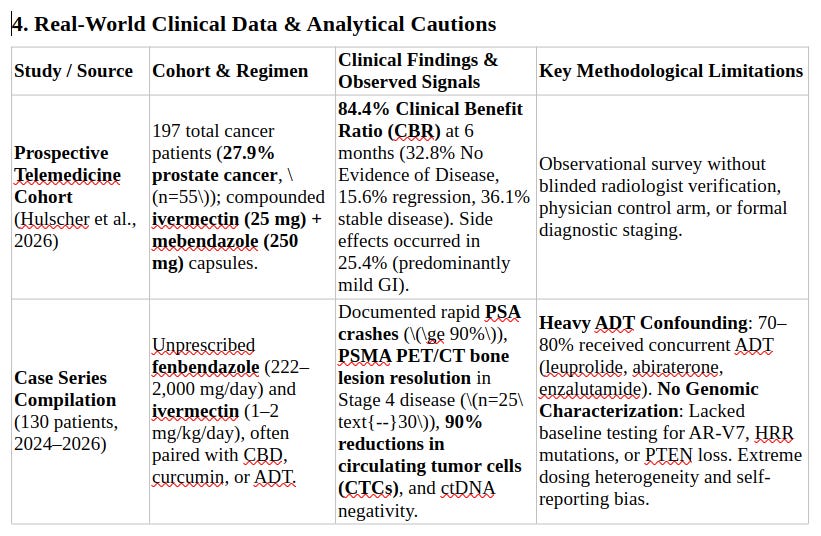
Researchers emphasize that while preclinical nanoformulations and objective biomarker drops (such as CTC reductions and PSMA PET resolution) demonstrate biological activity, randomized controlled trials (RCTs) incorporating molecular profiling and defined comparators are strictly necessary before clinical efficacy can be established.
References
Chang, C.-S., Ryu, J.-Y., Choi, J.-K., Cho, Y.-J., Choi, J.-J., Hwang, J. R., Choi, J.-Y., Noh, J. J., Lee, C. M., Won, J. E., Han, H. D., & Lee, J.-W. (2023). Anti-cancer effect of fenbendazole-incorporated PLGA nanoparticles in ovarian cancer. Journal of Gynecologic Oncology, 34(5), Article e58.
Esfahani, M. K. M., Alavi, S. E., Cabot, P. J., Islam, N., & Izake, E. L. (2021). PEGylated mesoporous silica nanoparticles (MCM-41): A promising carrier for the targeted delivery of fenbendazole into prostate cancer cells. Pharmaceutics, 13(10), Article 1605.
Esfahani, M. K. M., Alavi, S. E., Cabot, P. J., Islam, N., & Izake, E. L. (2022). β-Lactoglobulin-modified mesoporous silica nanoparticles (MCM-48): A promising carrier for the targeted delivery of fenbendazole into prostate cancer cells. Pharmaceutics, 14(4), Article 884.
Han, Y., & Joo, H.-G. (2020). Involvement of reactive oxygen species in the anti-cancer activity of fenbendazole, a benzimidazole anthelmintic. Korean Journal of Veterinary Research, 60(2), 79–83.
Hulscher, N., Makis, W., & Alexander, P. E. (2026). Fenbendazole and ivermectin for prostate cancer: A case series of 133 patients (August 2026 update). Observational Case Series Report.
Jin, I. S., Jo, M. J., Park, C.-W., Chung, Y. B., Kim, J.-S., & Shin, D. H. (2020). Physicochemical, pharmacokinetic, and toxicity evaluation of Soluplus® polymeric micelles encapsulating fenbendazole. Pharmaceutics, 12(10), Article 1000.
Jung, H., Kim, S.-Y., & Joo, H.-G. (2023). Fenbendazole exhibits differential anticancer effects in vitro and in vivo in models of mouse lymphoma. Current Issues in Molecular Biology, 45(11), 8925–8938.
Jung, H., Lee, Y.-J., & Joo, H.-G. (2023). Differential cytotoxic effects of fenbendazole on mouse lymphoma cells and normal spleen cells. Korean Journal of Veterinary Research, 63, Article e40.
Karimi, A., Barea, P., Benito-Román, Ó., Blanco, B., Sanz, M. T., Higginbotham, C. L., & Lyons, J. G. (2025). Investigation of fenbendazole solubility using particle size reduction methods in the presence of Soluplus®. Pharmaceutics, 17(9), Article 1163.
Karimi, A., Bezerra, G. S. N., Higginbotham, C. L., & Lyons, J. G. (2026). Evaluation of the drug–polymer compatibility and dissolution behaviour of fenbendazole–Soluplus® solid dispersions prepared by hot-melt extrusion. Polymers, 18(3), Article 333.
Makis, W. (2026). Makis health: Repurposed medications and alternative oncology commentary. Substack.
Nguyen, T. Q., Phan, U. T. T., Can, M. V., Nguyen, D. H., Han, B., & Hoang, B. X. (2025). Synergistic anti-tumor effect of fenbendazole and diisopropylamine dichloroacetate in immunodeficient BALB/c nude mice transplanted with A549 lung cancer cells. Translational Lung Cancer Research, 14(7), 2509–2521.
Olutayo, E., Phan, M. V., Willis, J., & Hu, Z. I. (2024). A single institutional experience on patterns of ivermectin and fenbendazole use among patients with gastrointestinal cancers. Journal of Clinical Oncology, 42(16_suppl), Article e15050.
Park, D., Lee, J.-H., & Yoon, S.-P. (2022). Anti-cancer effects of fenbendazole on 5-fluorouracil-resistant colorectal cancer cells. The Korean Journal of Physiology & Pharmacology, 26(5), 377–387.
Pantziarka, P., Bouche, G., Meheus, L., Sukhatme, V., Sukhatme, V. P., & Vikas, P. (2014). Repurposing drugs in oncology (ReDO)—mebendazole as an anti-cancer agent. ecancermedicalscience, 8, Article 443.
Sultana, T., Jan, U., Lee, H., Lee, H., & Lee, J. I. (2022). Exceptional repositioning of dog dewormer: Fenbendazole fever. Current Issues in Molecular Biology, 44(10), 4977–4986.
Vlachou, I., Parsonidis, P., Mamagkaki, A., Bouris, I., & Papasotiriou, I. (2022). Teaching an old dog new tricks: The case of fenbendazole. Cancer Treatment and Research Communications, 32, Article 100601.
Wang, X., Tian, W., Wang, N., Yang, X., Liu, Z., Li, L., Zhao, T., Wang, C., Zhang, H., Yang, H., & Jia, Y. (2024). Transcriptome analysis reveals the anticancer effects of fenbendazole on ovarian cancer: An in vitro and in vivo study. BMC Cancer, 24, Article 1593.
The FDA, WHO, our Media and Politicians always lie.
What do you do when insane CEO's of huge industries in the United States make everything from eye drops, nose wash solutions, mouth washes, ear drops, to water tasting fruit containing drinks and bottled water too expensive for working people ?
Make something at home.
Commonly available over-the-counter eye wash solutions contain mostly purified water. But they may also contain ingredients that may cause uncommon or allergic reactions. If you experience any side effects or the eye wash doesn’t help, you should stop using it and consult your eye doctor.
If you have a First Aid kit with medicines and eye drops 10 years old the medicines and eye drops are more than likely out of date and possibley dangerous to use.
https://www.allaboutvision.com/treatments-and-surgery/drugs-medications/eyewash-solutions-saline-solutions/
https://firstaidlongs.com/first-aid-kit-expiration/