
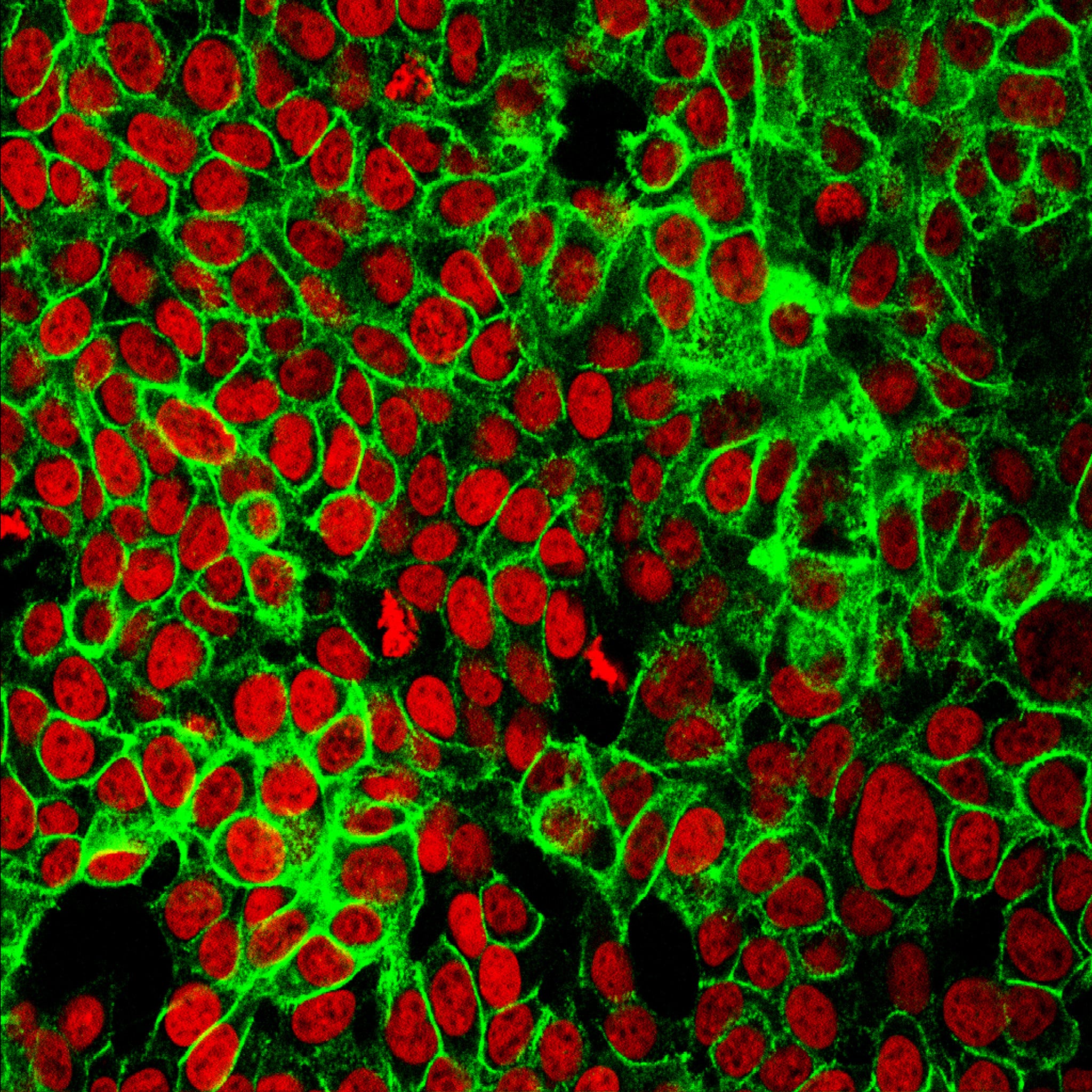
Preclinical studies demonstrate that the deworming medication fenbendazole exhibits promising anticancer properties across a wide variety of laboratory and animal tumor models. The primary mechanism driving this activity is microtubule and tubulin disruption, which consistently triggers subsequent cellular events such as programmed cell death, metabolic suppression, and cell cycle arrest. However, the overall evidence remains heterogeneous, as strong in vitro results do not always translate into successful animal outcomes. To overcome the drug's inherent limitations, researchers are developing advanced nanocarrier formulations to improve absorption, solubility, and therapeutic delivery.
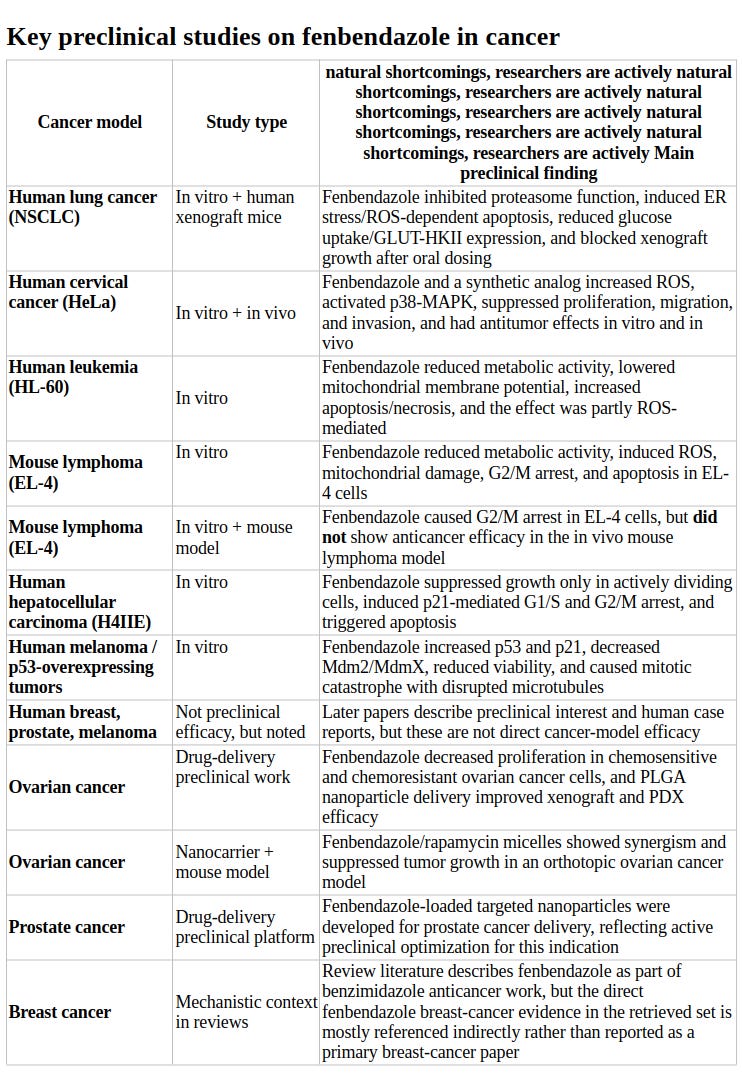
Fenbendazole has substantial preclinical cancer research, mostly in cell culture and mouse/xenograft models, with recurring signals for microtubule disruption, p53/p21 signaling, ROS induction, glucose-uptake inhibition, and apoptosis; however, not every model is positive, and one lymphoma mouse study found no in vivo antitumor effect despite in vitro activity.
What these studies collectively show
Most consistent mechanism: microtubule/tubulin disruption is the central recurring theme across fenbendazole cancer studies.
Frequent downstream effects: G2/M arrest, apoptosis, ROS production, p53/p21 activation, and metabolic inhibition recur across multiple models.
Formulation matters: several studies focus on improving solubility, absorption, and delivery with micelles, PLGA nanoparticles, cyclodextrin complexes, and other carriers because native fenbendazole is poorly soluble.
Evidence is mixed in vivo: while xenograft and orthotopic models show antitumor activity in some settings, at least one mouse lymphoma model showed no in vivo benefit despite in vitro cytotoxicity.
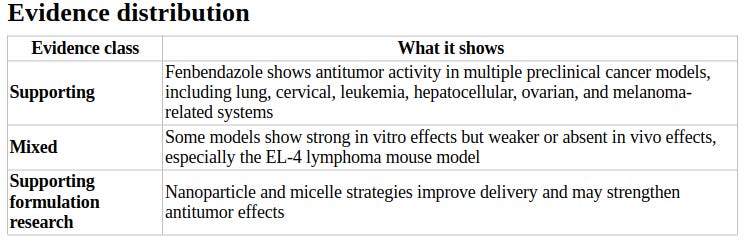
Bottom line: the preclinical fenbendazole literature is real and fairly broad, but it is heterogeneous—strongest for cell-line cytotoxicity and mechanism studies, more variable for animal efficacy, and still limited by poor solubility and inconsistent in vivo translation.
References
Dogra, N., Kumar, A., Mukhopadhyay, T. (2018) Fenbendazole acts as a moderate microtubule destabilizing agent and causes cancer cell death by modulating multiple cellular pathways. Scientific Reports. https://doi.org/10.1038/s41598-018-30158-6
Dogra, N., Mukhopadhyay, T. (2012) Impairment of the ubiquitin-proteasome pathway by methyl N-(6-phenylsulfanyl-1H-benzimidazol-2-yl)carbamate leads to a potent cytotoxic effect in tumor cells: A novel antiproliferative agent with a potential therapeutic implication. Journal of Biological Chemistry. https://doi.org/10.1074/jbc.M111.324228
Park, D. (2022) Fenbendazole Suppresses Growth and Induces Apoptosis of Actively Growing H4IIE Hepatocellular Carcinoma Cells via p21-Mediated Cell-Cycle Arrest. Biological and Pharmaceutical Bulletin. https://doi.org/10.1248/bpb.b21-00697
Jung, H., Kim, S.-Y., Joo, H.-G. (2023) Fenbendazole Exhibits Differential Anticancer Effects In Vitro and In Vivo in Models of Mouse Lymphoma. Current Issues in Molecular Biology. https://doi.org/10.3390/cimb45110560
Peng, Y., Pan, J., Ou, F., (...), Yu, L. (2022) Fenbendazole and its synthetic analog interfere with HeLa cells’ proliferation and energy metabolism via inducing oxidative stress and modulating MEK3/6-p38-MAPK pathway. Chemico-Biological Interactions. https://doi.org/10.1016/j.cbi.2022.109983
Han, Y., Joo, H.-G. (2020) Involvement of reactive oxygen species in the anti-cancer activity of fenbendazole, a benzimidazole anthelmintic. Korean Journal of Veterinary Research. https://doi.org/10.14405/kjvr.2020.60.2.79
Jung, H., Lee, Y.-J., Joo, H.-G. (2023) Differential cytotoxic effects of fenbendazole on mouse lymphoma EL-4 cells and spleen cells. Korean Journal of Veterinary Research. https://doi.org/10.14405/kjvr.20220040
Mrkvová, Z., Uldrijan, S., Pombinho, A., (...), Slaninová, I. (2019) Benzimidazoles downregulate MDM2 and MDMX and activate p53 in MDMX overexpressing tumor cells. Molecules. https://doi.org/10.3390/molecules24112152
Makis, W., Baghli, I., Martinez, P. (2025) Fenbendazole as an Anticancer Agent? A Case Series of Self-Administration in Three Patients. Case Reports in Oncology. https://doi.org/10.1159/000546362
Vlachou, I., Parsonidis, P., Mamagkaki, A., (...), Papasotiriou, I. (2022) Teaching an old dog new tricks: The case of Fenbendazole. Cancer Treatment and Research Communications. https://doi.org/10.1016/j.ctarc.2022.100601
Yamaguchi, T., Shimizu, J., Oya, Y., (...), Hida, T. (2021) Drug-Induced Liver Injury in a Patient with Nonsmall Cell Lung Cancer after the Self-Administration of Fenbendazole Based on Social Media Information. Case Reports in Oncology. https://doi.org/10.1159/000516276
Chang, C.-S., Ryu, J.-Y., Choi, J.-K., (...), Lee, J.-W. (2023) Anti-cancer effect of fenbendazole-incorporated PLGA nanoparticles in ovarian cancer. Journal of Gynecologic Oncology. https://doi.org/10.3802/jgo.2023.34.e58
Shin, Y.B., Choi, J.-Y., Shin, D.H., Lee, J.-W. (2023) Anticancer Evaluation of Methoxy Poly(Ethylene Glycol)-b-Poly(Caprolactone) Polymeric Micelles Encapsulating Fenbendazole and Rapamycin in Ovarian Cancer. International Journal of Nanomedicine. https://doi.org/10.2147/IJN.S394712
Shin, H.J., Jo, M.J., Jin, I.S., (...), Shin, D.H. (2021) Optimization and pharmacokinetic evaluation of synergistic fenbendazole and rapamycin co-encapsulated in methoxy poly(Ethylene glycol)-b-poly(caprolactone) polymeric micelles. International Journal of Nanomedicine. https://doi.org/10.2147/IJN.S315782
Rana, N., Deval, Singh, H., (...), Sharma, S. (2026) Current landscape and recent developments of PI3K/AKT/mTOR targeted inhibitors for breast carcinoma. Bioorganic Chemistry. https://doi.org/10.1016/j.bioorg.2025.109430
Ding, Y., Zhang, Z., Ding, C., (...), Xu, Z. (2024) Preparation and evaluation of fenbendazole methyl-β-cyclodextrin inclusion complexes. BMC Veterinary Research. https://doi.org/10.1186/s12917-024-04056-1
Jin, I.S., Jo, M.J., Park, C.-W., (...), Shin, D.H. (2020) Physicochemical, pharmacokinetic, and toxicity evaluation of soluplus® polymeric micelles encapsulating fenbendazole. Pharmaceutics. https://doi.org/10.3390/pharmaceutics12101000
Karimi, A., Barea, P., Benito-Román, Ó., (...), Lyons, J.G. (2025) Investigation of Fenbendazole Solubility Using Particle Size Reduction Methods in the Presence of Soluplus®. Pharmaceutics. https://doi.org/10.3390/pharmaceutics17091163
Duan, Q., Liu, Y., Rockwell, S. (2013) Fenbendazole as a potential anticancer drug. Anticancer Research. https://www.scopus.com/pages/publications/84875878997
Duan, Q., Liu, Y., Booth, C.J., Rockwell, S. (2012) Use of fenbendazole-containing therapeutic diets for mice in experimental cancer therapy studies. Journal of the American Association for Laboratory Animal Science. https://www.scopus.com/pages/publications/84859149741