

Based on the research priorities and methodology outlined in the breast cancer case-series analysis, here is the summary matrix mapping the prioritized clinical trial designs by target patient population (eligibility), primary & secondary endpoints, and required imaging and diagnostic modalities.
Clinical Trial Design Matrix for Repurposed Antiparasitic Oncology Studies
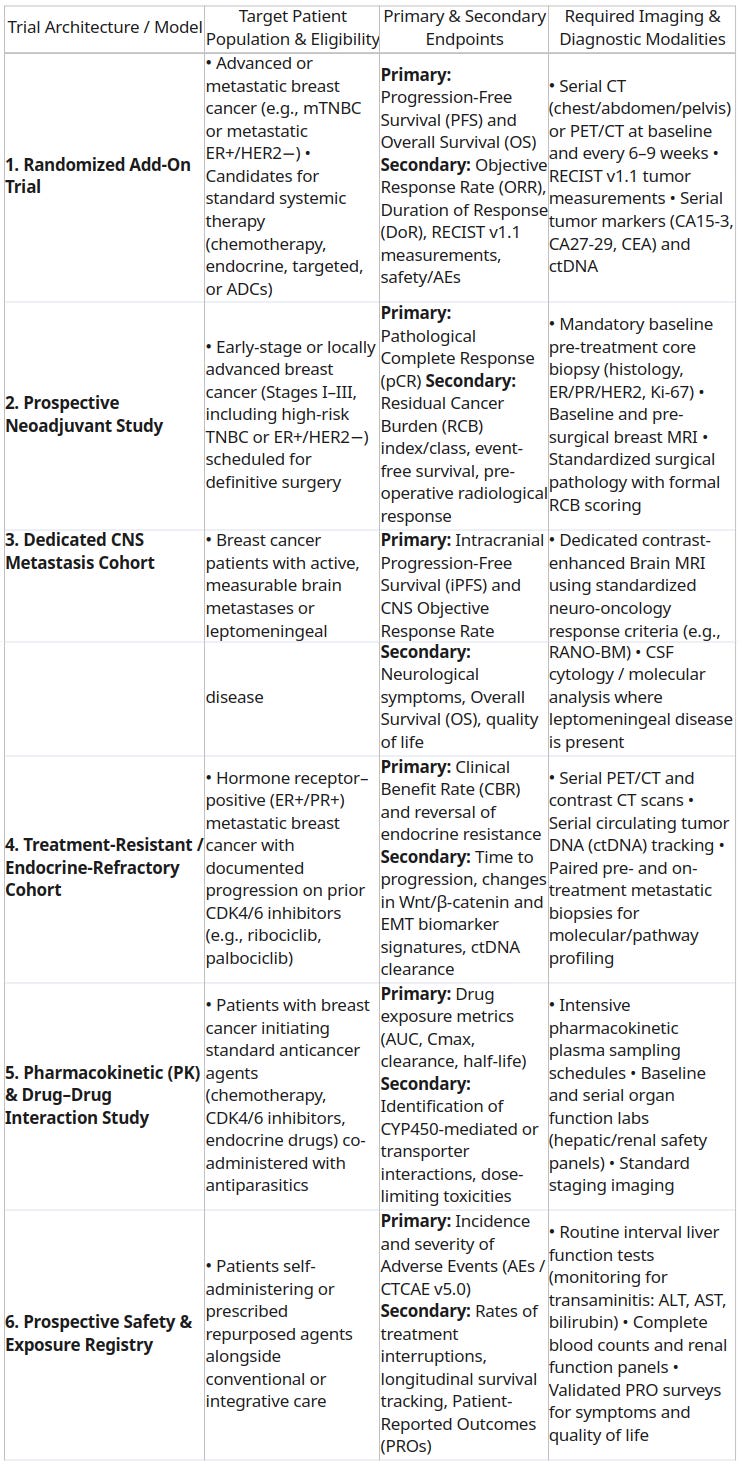
Key Methodological Standards Across All Designs
Elimination of Retrospective Gaps: Every trial design requires pre-specifying baseline receptor status (ER/PR/HER2), tumor grade, Ki-67 index, exact drug formulations, and start/stop dates to prevent missing data (”NR”) common in retrospective archives.
Standardized Criteria: Imaging evaluation moves away from subjective impressions (”lesions look better”) to validated criteria: RECIST v1.1 for solid/visceral tumors, RANO-BM for CNS lesions, and RCB scoring for surgical specimens.
Sources
Structures the 6 prospective trial models—Randomized Add-On, Prospective Neoadjuvant, Dedicated CNS, Endocrine-Refractory, Pharmacokinetic/Interaction, and Safety Registry—mapping patient eligibility, primary/secondary endpoints, and diagnostic modalities.
1. Primary Source Documents
Structured Case-Series Analysis (Source for Trial Models, Endpoints & Diagnostic Architecture): Cancer Advisor | OneDayMD. (2026, September 1). Ivermectin, mebendazole and fenbendazole for breast cancer: A structured case-series analysis of 130 reports. Cancer Advisor. https://cancer.aestheticsadvisor.com/2026/09/ivermectin-mebendazole-fenbendazole-breast-cancer.html (The primary methodological framework proposing the six prioritized study models, mandatory diagnostic modalities, and standardized response endpoints to transition beyond retrospective case series).
Comprehensive Case Repository & Exposure Data: OneDayMD Editorial Team. (2026, November 10). Fenbendazole, ivermectin and mebendazole for cancer: Case series of 800+ case reports (November 2026 update) (F. Yap, Med. Rev.). The Medical Advisor. https://www.onedaymd.com/2024/02/fenbendazole-cancer-success-stories.html (Source informing patient eligibility parameters, multi-agent dosing combinations, and recurring clinical response phenotypes across tumor types).
Hybrid Protocol & Metabolic Monitoring Intervals: Baghli, I., Makis, W., Marik, P. E., Gonzalez, M. J., Grant, W. B., Hunninghake, R., Levy, T. E., Lim, H., Cheng, R. Z., Bondarenko, I., Bousquet, P., Ortiz, R., Mary, M., D’Agostino, D. P., & Martinez, P. (2024). Targeting the mitochondrial-stem cell connection in cancer treatment: A hybrid orthomolecular protocol. Journal of Orthomolecular Medicine, 39(3). (Source for laboratory monitoring intervals and safety endpoints for prospective registries.
2. Standardized Oncologic & Neuro-Radiological Criteria
Solid Tumor Measurement Guidelines (RECIST v1.1): Eisenhauer, E. A., Therasse, P., Bogaerts, J., Schwartz, L. H., Sargent, D., Ford, R., Dancey, J., Arbuck, S., Gwyther, S., Mooney, M., Rubinstein, L., Shankar, L., Dodd, L., Kaplan, R., Lacombe, D., & Verweij, J. (2009). New response evaluation criteria in solid tumours: Revised RECIST guideline (version 1.1). European Journal of Cancer, 45(2), 228–247. (The validated standard utilized in the matrix for objective response rate [ORR] and progression-free survival [PFS] endpoints).
Brain Metastases Response Criteria (RANO-BM): Lin, N. U., Lee, E. Q., Aoyama, H., Barani, I. J., Baumert, B. G., Brown, P. D., Camidge, D. R., Chang, S. M., Dancey, J., Gaspar, L. E., Harris, G. J. R., Hodi, F. S., Kalkanis, S. N., Linskey, M. E., Macdonald, D. R., Margolin, K., Mehta, M. P., Schiff, D., Soffietti, R., … Wen, P. Y. (2015). Response assessment in neuro-oncology brain metastases (RANO-BM) criteria: A consensus proposal. The Lancet Oncology, 16(6), e270–e278. (The required diagnostic standard specified in the matrix for the Dedicated CNS Metastasis Cohort).
Pathological Response & Residual Cancer Burden (RCB) Scoring: Symmans, W. F., Peintinger, F., Hatzis, C., Rajan, R., Kuerer, H., Valero, V., Erdogan, L., Patel, R., Azad, N., Morandi, P., Hsu, L., Ross, J. S., Hortobagyi, G. N., & Pusztai, L. (2007). Measurement of residual breast cancer for the calculation of the Residual Cancer Burden (RCB) after neoadjuvant therapy. Journal of Clinical Oncology, 25(28), 4414–4422. (The surgical pathology endpoint specified in the matrix for the Prospective Neoadjuvant Cohort).
Adverse Event & Toxicity Scale (CTCAE v5.0): National Cancer Institute. (2017). Common Terminology Criteria for Adverse Events (CTCAE) version 5.0. U.S. Department of Health and Human Services, National Institutes of Health. (The regulatory toxicity scale designated in the matrix for safety and adverse-event registries).
3. Translational & Pharmacological Foundations by Cohort
Neoadjuvant Standard-of-Care Benchmark (KEYNOTE-522): Schmid, P., Cortés, J., Dent, R., Pusztai, L., McArthur, H., Kümmel, S., Bergh, J., Denkert, C., Park, Y. H., Hui, R., Harbeck, N., Takahashi, M., Untch, M., Fasching, P. A., Cardoso, F., Andersen, J., Patt, D., Danso, M., Ferreira, M., … O’Shaughnessy, J. (2020). Pembrolizumab for early triple-negative breast cancer. New England Journal of Medicine, 382(9), 810–821. (Benchmark control data informing the inclusion criteria and comparative pCR baseline for the Neoadjuvant Study model).
Endocrine Re-Sensitization & Biomarker Endpoints: Rujimongkon, K., Adchariyasakulchai, P., Boonyaratsewee, C., Horpratraporn, K., & Ketchart, W. (2026). Ivermectin inhibits ER, HER2, and TGF-β pathways in ER-positive and endocrine-resistant breast cancer cells. PLoS ONE, 21(4), Article e0348260. https://doi.org/10.1371/journal.pone.0348260 (Preclinical basis for the Treatment-Resistant / Endocrine-Refractory Cohort endpoints, tracking Wnt/β-catenin and EMT modulation).
Blood-Brain Barrier Penetration & Intracranial Targeting: Bai, R. Y., Staedtke, V., Aprhys, C. M., Gallia, G. L., & Riggins, G. J. (2011). Antiparasitic mebendazole shows survival benefit in 2 preclinical models of glioblastoma multiforme. Neuro-Oncology, 13(9), 974–982. (Translational rationale underpinning the drug selection and pharmacokinetic endpoints for the CNS Metastasis Cohort).
Pharmacokinetics & Dose-Escalation Tolerability: Guzzo, C. A., Furtek, C. I., Porras, A. G., Chen, C., Tipping, R., Clineschmidt, C. M., Sciberras, D. G., Hsieh, J. Y., & Lasseter, K. C. (2002). Safety, tolerability, and pharmacokinetics of escalating high doses of ivermectin in healthy adult subjects. The Journal of Clinical Pharmacology, 42(10), 1122–1133. Mansoori, S., Fryknäs, M., Alvfors, C., Loskog, A., Larsson, R., & Nygren, P. (2021). A phase 2a clinical study on the safety and efficacy of individualized-dose mebendazole in patients with advanced gastrointestinal cancer. Scientific Reports, 11(1), Article 8981. https://doi.org/10.1038/s41598-021-88433-y (Foundational clinical PK and tolerability data supporting the Pharmacokinetic & Drug–Drug Interaction study architecture).