
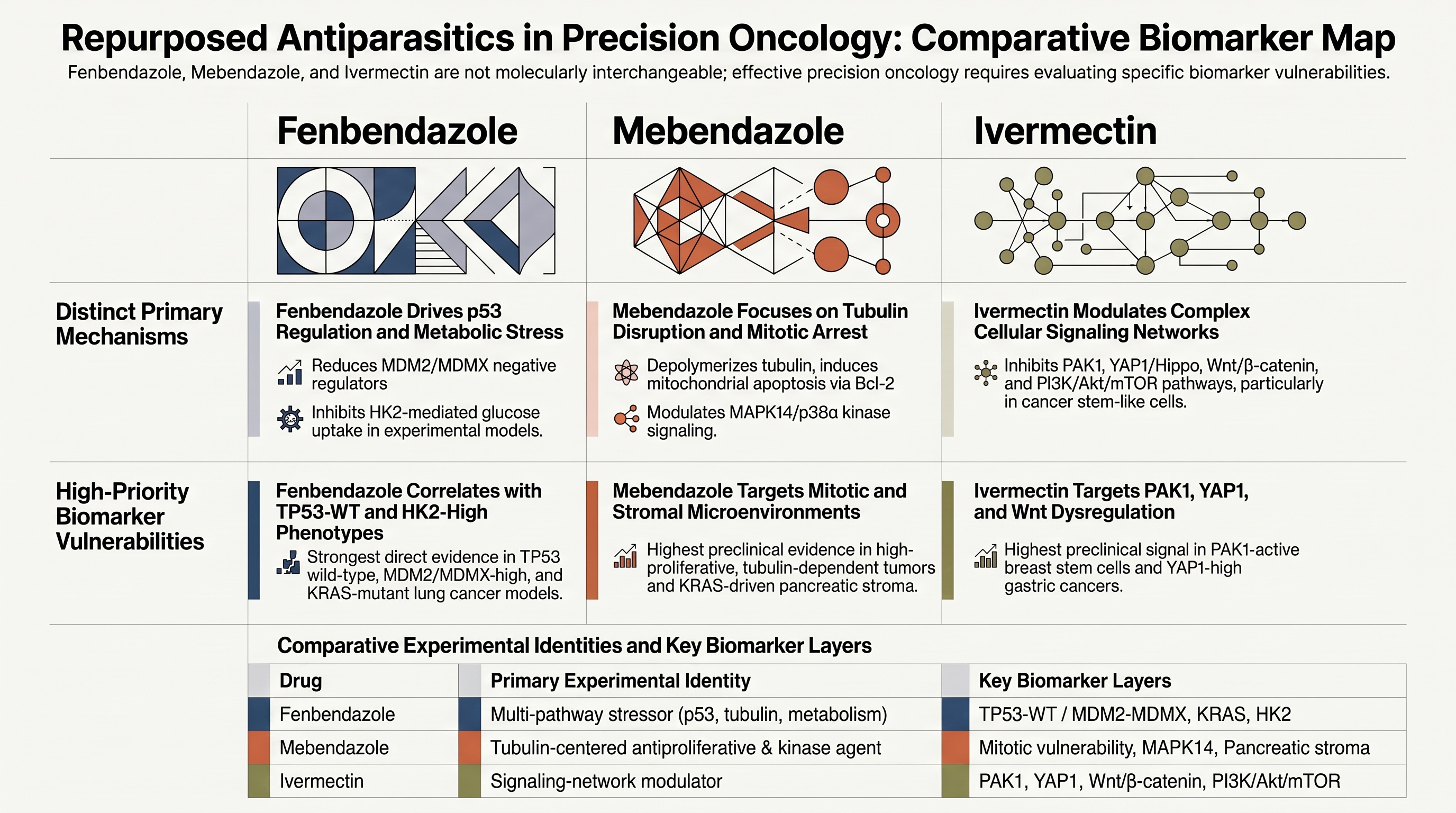
Cancer biomarker mapping for repurposed antiparasitic compounds (fenbendazole, mebendazole, and ivermectin) replaces a generic “antiparasitic drugs kill cancer cells” model with a precision oncology framework. Rather than treating these drugs as molecular equivalents, biomarker mapping evaluates which specific driver mutations, signaling dependencies, and metabolic phenotypes create theoretical vulnerabilities to each compound.
The literature uses a four-tier evidence grading scale (Grade A: direct drug-biomarker experimental evidence; Grade B: strong drug-specific mechanistic rationale; Grade C: indirect or exploratory pathway overlap; Grade D: insufficient evidence) to map each drug across distinct cancer phenotypes:
1. Fenbendazole: p53 Regulation, KRAS, and Metabolic Stress
Fenbendazole (FBZ) exhibits the strongest direct evidence for targeting a functional p53 regulatory network and tumor glucose metabolism:
The p53–MDM2–MDMX Axis (Grade A): In experimental melanoma and breast cancer models, fenbendazole downregulates negative p53 regulators (MDM2 and MDMX/MDM4), restoring TP53-wild-type protein stability and upregulating p21 to induce cell-cycle arrest and apoptosis. This makes TP53-WT + MDM2/MDMX-high its clearest molecular phenotype.
KRAS-Mutant NSCLC (Grade A): Drug-library screens identified fenbendazole as a selective cytotoxic agent in KRAS-mutant non-small cell lung cancer (NSCLC) models by suppressing RAS-related signaling.
Glycolytic & Hexokinase II Vulnerabilities (Grade A/B): Fenbendazole reduces glucose uptake, downregulates GLUT transporters, suppresses hexokinase II (HK2), and triggers mitochondrial p53 translocation and cell death.
2. Mebendazole: Mitotic Disruption, Kinases, and Tumor Stroma
Mebendazole (MBZ) occupies a tubulin-centered pharmacologic niche rather than a p53-activation profile:
Microtubule & Mitotic Arrest (Grade A): Mebendazole depolymerizes tubulin, causes abnormal spindle formation, induces mitotic arrest, and triggers cytochrome-c release and caspase activation.
Bcl-2 & Kinase Signaling (Grade A/B): In chemoresistant melanoma, mebendazole induces apoptosis via Bcl-2 inactivation/phosphorylation. Target prediction screens identify MAPK14/p38α and ABL1 as potent kinase targets.
KRAS-Driven Pancreatic Stroma (Grade B): In KRAS-driven pancreatic cancer models (KC/KPC), mebendazole reduces neoplastic burden while disrupting the desmoplastic stromal microenvironment.
3. Ivermectin: Signaling Network Modulation & Stemness
Unlike the benzimidazoles, ivermectin (IVM) is a macrocyclic lactone that targets signaling cascades and cancer stem cell (CSC) traits rather than tubulin:
PAK1 & STAT3 Inhibition (Grade A/B): Ivermectin inhibits PAK1 kinase signaling, suppressing JAK2/STAT3 activation and inhibiting breast cancer stem-cell formation.
YAP1 / Hippo Pathway (Grade A/B): In gastric cancer models, ivermectin acts as a YAP1 inhibitor, with sensitivity directly correlating with YAP1 expression levels.
Wnt/β-Catenin & Akt/mTOR Cascades (Grade A/B): Ivermectin blocks Wnt-TCF transcription (downregulating AXIN2, LGR5, and ASCL2) and modulates the PI3K/Akt/mTOR pathway, regulating autophagy and CSC populations.
4. High-Priority Composite Research Phenotypes
To translate these mechanisms into precision oncology, the literature proposes testing composite biomarker profiles:
Fenbendazole Phenotype: TP53-WT + MDM2/MDMX-high or KRAS-mutant + HK2-high / glycolytic dependence.
Mebendazole Phenotype: High proliferative burden + tubulin dependence or KRAS-driven pancreatic cancer + desmoplasia.
Ivermectin Phenotype: PAK1-high + STAT3-active CSC phenotype or YAP1-high gastric cancer.
5. Critical Translational & Evidence Limitations
The review emphasizes that these biomarker associations represent preclinical research hypotheses, not validated clinical selection algorithms or treatment recommendations:
Lack of Clinical Validation: None of the three compounds has a prospectively validated cancer biomarker or established FDA-approved oncology indication.
In-Vitro Potency vs. Human Exposure: Experimental cell culture concentrations often exceed clinically achievable free-drug plasma levels.
Requirement for Prospective Trials: Demonstrating that a drug alters a pathway in vitro does not prove clinical efficacy; rigorous validation requires molecularly characterized organoids, patient-derived xenografts, and biomarker-stratified randomized controlled trials.
1. The 7-Step Experimental Validation Model
To rigorously test whether specific tumor genotypes predict sensitivity to fenbendazole, mebendazole, or ivermectin, the literature proposes moving away from unselected patient treatment and establishing a structured, 7-step preclinical-to-clinical validation pipeline:
Genomic Sequencing: Characterize driver mutations and suppressor status (TP53, KRAS, EGFR, BRAF, MYC, RB1, CDKN2A).
Protein Profiling: Quantify key regulatory and metabolic proteins (MDM2, MDMX, p53, p21, HK2, GLUT1, PAK1, YAP1).
Comparative Drug Exposure: Expose models to head-to-head comparisons of fenbendazole vs. mebendazole vs. ivermectin.
Pharmacodynamic Assessment: Evaluate functional downstream endpoints, including mitotic arrest, cell-cycle markers, apoptosis, metabolic flux, and pathway inhibition.
Organoid & Xenograft Validation: Test activity in patient-derived 3D organoids and xenografts to account for tissue architecture and microenvironment interactions.
Biomarker-Response Interaction Testing: Run statistical analyses where the critical test is not simply whether a drug inhibits tumor growth, but whether biomarker status significantly modifies treatment response.
Biomarker-Stratified Prospective Clinical Trials: Enrol molecularly defined patient cohorts based on pre-treatment tumor profiling.
2. Biomarker Mapping Applied Across Specific Cancer Types
A. Glioblastoma & Central Nervous System Tumors
Primary Agent: Mebendazole has the most substantial translational and clinical research record in brain tumors.
Molecular Targets: Tubulin depolymerization, MAPK14/p38α kinase inhibition, ABL1 signaling, and angiogenesis inhibition.
Clinical Insights: A Phase I trial combining mebendazole (up to 200 mg/kg/day) with temozolomide in high-grade glioma patients demonstrated safety up to standard doses, though elevated liver enzymes occurred at high experimental levels. Systematic reviews note that while preclinical brain tumor data is broad, clinical efficacy remains inconclusive and limited by pharmacokinetic variability.
B. Breast Cancer
Fenbendazole Profile: Targets TP53-wild-type + MDMX/MDM2-high tumors by suppressing negative p53 regulators, while simultaneously inhibiting Hexokinase II (HK2) and glucose uptake to induce glycolytic stress.
Ivermectin Profile: Targets PAK1-high breast cancer cells, suppressing the PAK1–JAK2–STAT3 signaling axis to inhibit breast cancer stem cell (CSC) self-renewal and IL-6 activation.
C. Non-Small Cell Lung Cancer (NSCLC)
Fenbendazole Profile: High-throughput drug screens identified fenbendazole as selectively cytotoxic in KRAS-mutant NSCLC models by downregulating RAS-related signaling. It also disrupts HK2/GLUT1-mediated glycolysis and microtubule stability in lung cancer cells.
Mebendazole Profile: Induces mitotic spindle abnormalities, caspase activation, and cytochrome-c release in lung cancer models.
D. Gastrointestinal Cancers (Gastric & Pancreatic)
Gastric Cancer (Ivermectin): Acts as a YAP1 inhibitor in YAP1-high / Hippo-dysregulated gastric cancer, where YAP1 knockdown directly correlates with ivermectin sensitivity.
Pancreatic Cancer (Mebendazole): In KRAS-driven pancreatic models (KC and KPC), mebendazole reduces neoplastic lesions and alters the surrounding desmoplastic stroma, targeting both tumor cells and the microenvironment.
3. Key Distinctions & Experimental Cautions
No Molecular Equivalence: The literature stresses that fenbendazole (p53/metabolism stressor), mebendazole (tubulin/kinase/stromal agent), and ivermectin (PAK1/Wnt/YAP1 signaling modulator) operate through distinct pathways and cannot be substituted for one another.
Translational Gap: In-vitro potency does not equal human efficacy. Achieving effective concentrations in human tissue is constrained by drug pharmacokinetics, hepatic metabolism, and potential liver toxicity.
Research Hypotheses Only: These biomarker mappings are designed to guide structured laboratory and clinical trial research, not to serve as prescribing rules or off-label treatment selection guidelines.
Source 1: 30 Best Alternative and Repurposed Cancer Treatments
Publication Metadata
Article Title: 30 Best Alternative and Repurposed Cancer Treatments: Evidence Based Literature Review (2026 Update)
Authors / Editorial: OneDayMD Editorial Team
Medical Reviewer: Dr. Frank Yap, MD
Platform / Publication: Cancer Advisor (OneDayMD Oncology Intelligence)
Publication Date: October 2, 2026
Last Revision / Version: September 2026 (v2.1)
URL:
https://cancer.aestheticsadvisor.com/2025/04/best-alternative-cancer-treatments-2025.html
Source 2: Dr. William Makis’s Recommended Dosages for Cancer
Publication Metadata
Article Title: Dr. William Makis’s Recommended Ivermectin, Fenbendazole and Mebendazole Dosages for Cancer (2026)
Authors / Editorial: OneDayMD Editorial Team
Medical Reviewer / Subject: Medically reviewed and updated (synthesizing clinical protocols by Dr. William Makis, MD)
Platform / Publication: Cancer Advisor (OneDayMD Oncology Intelligence)
Publication Date: September 21, 2026
Last Revision: August 2026
URL:
https://cancer.aestheticsadvisor.com/2025/10/dr-william-makiss-recommended.html
Source 3: Cancer Biomarker Map for Precision Oncology
Publication Metadata
Article Title: Cancer Biomarker Map for Fenbendazole, Mebendazole and Ivermectin: A Comparative Mechanistic Analysis for Precision Oncology (2026)
Authors / Editorial: OneDayMD Editorial Team / Cancer Advisor Editorial
Platform / Publication: Cancer Advisor (OneDayMD Oncology Intelligence)
Publication Date: September 22, 2026
URL:
https://cancer.aestheticsadvisor.com/2026/09/biomarker-ivermectin-mebendazole-fenbendazole.html
Source 4: Ivermectin and Mebendazole in High-Grade Glioma (Retrospective Compilation)
Publication Metadata
Article Title: Ivermectin and Mebendazole as Adjunctive Therapy in High-Grade Glioma and Other Intracranial Tumors: A Retrospective Compilation of Publicly Reported Cases
Authors / Editorial: OneDayMD Editorial Team / Retrospective Case Series Research Group
Status: Draft Manuscript / Retrospective Case Series
Platform / Publication: Cancer Advisor (OneDayMD Oncology Intelligence)
Publication Date: September 1, 2026 (Compiled July 2026)
URL:
https://cancer.aestheticsadvisor.com/2026/07/ivermectin-mebendazole-brain-cancer.html
Citations
OneDayMD Editorial Team. (2026, September 1). Ivermectin and mebendazole as adjunctive therapy in high-grade glioma and other intracranial tumors: A retrospective compilation of publicly reported cases (Draft Manuscript). Cancer Advisor. https://cancer.aestheticsadvisor.com/2026/07/ivermectin-mebendazole-brain-cancer.html
OneDayMD Editorial Team. (2026, October 2). 30 best alternative and repurposed cancer treatments: Evidence based literature review (2026 update) (F. Yap, Med. Rev.; v2.1). Cancer Advisor. https://cancer.aestheticsadvisor.com/2025/04/best-alternative-cancer-treatments-2025.html
OneDayMD Editorial Team. (2026, September 21). Dr. William Makis’s recommended ivermectin, fenbendazole and mebendazole dosages for cancer (2026). Cancer Advisor. https://cancer.aestheticsadvisor.com/2025/10/dr-william-makiss-recommended.html
OneDayMD Editorial Team. (2026, September 22). Cancer biomarker map for fenbendazole, mebendazole and ivermectin: A comparative mechanistic analysis for precision oncology (2026). Cancer Advisor. https://cancer.aestheticsadvisor.com/2026/09/biomarker-ivermectin-mebendazole-fenbendazole.html