

Albendazole and mebendazole, widely recognized as anti-parasitic medications, exhibit significant potential in modern oncology by effectively suppressing the proliferation of various cancer cells, including ovarian cancer. Research demonstrates that these anthelmintic agents disrupt microtubule dynamics and inhibit angiogenesis, providing a promising alternative for tumors resistant to conventional therapies like paclitaxel. Furthermore, animal studies reveal that peritoneal carcinomatosis alters the pharmacokinetics of albendazole, leading to elevated concentrations of its active metabolites within the peritoneal cavity. These findings highlight how disease-induced pathophysiological changes can influence drug absorption and distribution during targeted intraperitoneal cancer treatments. Ultimately, repurposing these safe, well-tolerated de-worming compounds offers new therapeutic avenues for overcoming drug resistance and improving outcomes in advanced oncology.
Both albendazole (ABZ) and mebendazole (MBZ)—broad-spectrum, FDA-approved benzimidazole anthelmintics—demonstrate remarkable potential in modern oncology as multi-targeted drug repositioning candidates. Because of their well-established clinical safety profiles, low manufacturing costs, and ability to modulate several key oncogenic pathways simultaneously, these agents offer an attractive strategy for suppressing cancer proliferation and overcoming multi-drug resistance.
Core Mechanisms of Proliferation Suppression
Microtubule Disruption & Cell-Cycle Arrest: ABZ and MBZ bind directly to the colchicine-binding site on \(\beta\)-tubulin, preventing microtubule polymerization. This destabilizes the mitotic spindle apparatus, arresting cells at the G2/M phase of the cell cycle and leading to mitotic catastrophe and apoptosis.
Induction of ROS, DNA Damage, & Apoptosis: Both drugs induce intracellular accumulation of reactive oxygen species (ROS) and trigger oxidative stress. ABZ causes DNA double-strand breaks and epigenetic modification (marked by increased \(\gamma\text{H2AX}\) phosphorylation) while depleting reduced glutathione (GSH). This damage activates p53, increases the pro-apoptotic Bax/Bcl-xL ratio, downregulates pro-survival proteins like Bcl-2 and XIAP, and executes apoptosis via caspase-3, caspase-9, and PARP cleavage.
Anti-Angiogenesis & Metabolic Reprogramming: ABZ and MBZ inhibit tumor neovascularization and malignant ascites formation by downregulating vascular endothelial growth factor (VEGF), hypoxia-inducible factor 1-alpha (HIF-1\(\alpha\)), and VEGFR2 kinase activity. Furthermore, they block glucose uptake and suppress cellular bioenergetics/glycolysis, depleting ATP levels in tumor cells.
Inhibition of Oncogenic Signaling Networks: Beyond cytoskeletal disruption, these compounds suppress critical survival and stemness pathways, including Wnt/\(\beta\)-catenin, STAT3/STAT5, PI3K/Akt/mTOR, Notch1, and Hedgehog signaling.
Suppression of Ovarian Cancer Proliferation
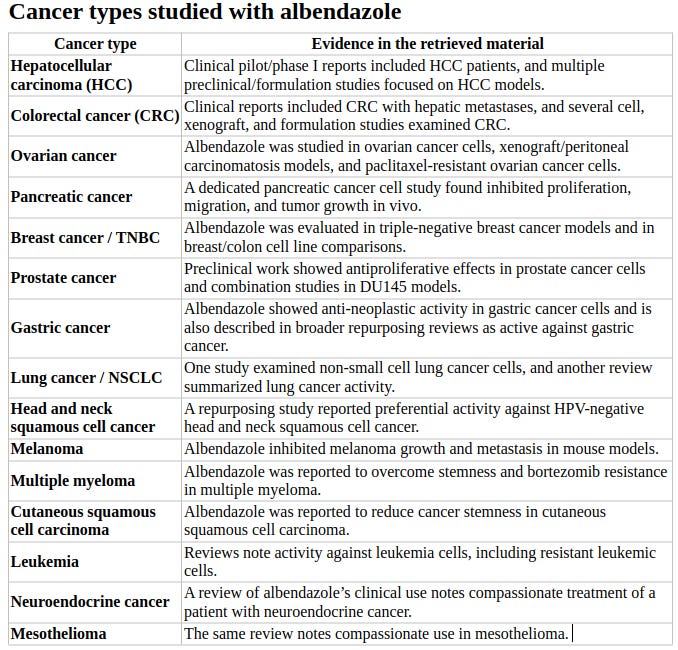
Ovarian carcinoma is particularly responsive to benzimidazole derivatives across several preclinical and translational models:
Overcoming Chemoresistance (Paclitaxel & Cisplatin): Resistance to standard taxane and platinum chemotherapy remains a major clinical obstacle in ovarian cancer. ABZ effectively inhibits tubulin polymerization and cell proliferation in paclitaxel-resistant human ovarian cancer cell lines (such as 1A9PTX22, which harbors a \(\beta\)-tubulin point mutation) where paclitaxel itself fails. Similarly, MBZ suppresses multiple cancer-associated signaling networks (including ELK/SRF, MYC/MAX, E2F/DP1, and NF-\(\kappa\)B) to overcome cisplatin resistance and blunt ovarian tumor growth.
Inhibition of Peritoneal Carcinomatosis & Ascites Formation: Advanced epithelial ovarian cancer frequently spreads throughout the peritoneal cavity, forming malignant ascites driven by VEGF hyperpermeability. In peritoneal carcinomatosis mouse models (such as OVCAR-3 tumor-bearing mice), ABZ suppresses VEGF expression, blocks peritoneal angiogenesis, and halts malignant ascites accumulation.
Broad In Vitro & In Vivo Efficacy: Both ABZ and MBZ demonstrate strong antiproliferative effects across a wide panel of ovarian cancer cell lines, including OVCAR-3, A2780, SKOV3, PA-1, OVCAR8CR, and SKOV3CR. MBZ has been identified as a promising candidate for both primary treatment and maintenance therapy in ovarian cancer.
Enhanced Targeting via Nanomedicine Formulations: To overcome poor aqueous solubility, advanced delivery platforms—such as albendazole-loaded albumin nanoparticles (nab-ABZ) and cyclodextrin inclusion complexes—have been developed. These pH-responsive nano-formulations trigger localized drug release inside endosomes, enhancing cytotoxic efficacy against ovarian cancer cells (A2780, OVCAR-3, SKOV3) while exhibiting significantly lower toxicity toward normal ovarian epithelial cells.
References
Aliabadi, A., Moradi, S. Z., Abdian, S., Fakhri, S., & Echeverría, J. (2025). Critical dysregulated signaling pathways in drug resistance: Highlighting the repositioning of mebendazole for cancer therapy. Frontiers in Pharmacology, 16, Article 1631419. https://doi.org/10.3389/fphar.2025.1631419
Alavi, S. E., & Ebrahimi Shahmabadi, H. (2021). Anthelmintics for drug repurposing: Opportunities and challenges. Saudi Pharmaceutical Journal, 29(5), 434–445. https://doi.org/10.1016/j.jsps.2021.04.004
Al-Zoubi, R. M., Farhan, A., Hanbali, B., Al-Zoubi, S. R., Khan, A., Shkoor, M., Bani-Yaseen, A. D., Al Zoubi, M. S., & Agouni, A. (2026). Antiparasitic agents in oncology: Innovative mechanisms, emerging evidence and clinical potential in cancer treatment. European Journal of Medicinal Chemistry, 316, Article 118987. https://doi.org/10.1016/j.ejmech.2026.118987
Badawy, M. A. S., Bräse, S., Ali, T. F. S., Abdel-Aziz, M., & Abdel-Rahman, H. M. (2025). Biologically active benzimidazole hybrids as cancer therapeutics: Recent advances. Pharmaceuticals, 18(10), Article 1454. https://doi.org/10.3390/ph18101454
Bai, W., Tang, X., Xiao, T., Qiao, Y., Tian, X., Zhu, B., Chen, J., Chen, C., Li, Y., Lin, X., Cai, J., Lin, Y., Zhu, W., Yan, G., Liang, J., & Hu, J. (2024). Enhancing antitumor efficacy of oncolytic virus M1 via albendazole-sustained CD8+ T cell activation. Molecular Therapy Oncology, 32, Article 200813. https://doi.org/10.1016/j.omton.2024.200813
Becerril-Vega, J., Hernández-Campos, A., González-Hernández, I., Flores-Ramos, M., Castillo, R., Leyva-Gómez, G., Mayet-Cruz, L., & Jung-Cook, H. (2023). Development and pharmacokinetic evaluation of two parenteral formulations of albendazole using prodrug and cosolvent approaches. AAPS PharmSciTech, 24(6), Article 158. https://doi.org/10.1208/s12249-023-02613-9
Castro, L. S. E. P. W., Kviecinski, M. R., Ourique, F., Parisotto, E. B., Grinevicius, V. M. A. S., Correia, J. F. G., Wilhelm Filho, D., & Pedrosa, R. C. (2016). Albendazole as a promising molecule for tumor control. Redox Biology, 10, 90–99. https://doi.org/10.1016/j.redox.2016.09.013
Chai, J.-Y., Jung, B.-K., & Hong, S.-J. (2021). Albendazole and mebendazole as anti-parasitic and anti-cancer agents: An update. The Korean Journal of Parasitology, 59(3), 189–225. https://doi.org/10.3347/kjp.2021.59.3.189
Ding, Y., Zhang, Z., Ding, C., Xu, S., & Xu, Z. (2023). The use of cyclodextrin inclusion complexes to increase the solubility and pharmacokinetic profile of albendazole. Molecules, 28(21), Article 7295. https://doi.org/10.3390/molecules28217295
Gallia, G. L., Holdhoff, M., Brem, H., Joshi, A. D., Hann, C. L., Bai, R.-Y., Staedtke, V., Blakeley, J. O., Sengupta, S., Jarrell, T. C., Wollett, J., Szajna, K., Helie, N., Mattox, A. K., Ye, X., Rudek, M. A., & Riggins, G. J. (2021). Mebendazole and re-irradiation, temozolomide, or levamisole/CCNU in patients with recurrent high-grade glioma: Phase 1 clinical trial results. Neuro-Oncology Advances, 3(1), Article vdaa154. https://doi.org/10.1093/noajnl/vdaa154
Ghalehbandi, S., Yuzugulen, J., Pranjol, M. Z. I., & Pourgholami, M. H. (2023). The role of VEGF in cancer-induced angiogenesis and research progress of drugs targeting VEGF. European Journal of Pharmacology, 949, Article 175586. https://doi.org/10.1016/j.ejphar.2023.175586
Golla, U., Patel, S., Shah, N., Talamo, S., Bhalodia, R., Claxton, D., Dovat, S., & Sharma, A. (2024). From deworming to cancer therapy: Benzimidazoles in hematological malignancies. Cancers, 16(20), Article 3454. https://doi.org/10.3390/cancers16203454
Han, Y., & Joo, H.-G. (2020). Involvement of reactive oxygen species in the anti-cancer activity of fenbendazole, a benzimidazole anthelmintic. Korean Journal of Veterinary Research, 60(2), 79–83. https://doi.org/10.14405/kjvr.2020.60.2.79
Huang, H., He, Q., Guo, B., Xu, X., Wu, Y., & Li, X. (2021). Progress in redirecting antiparasitic drugs for cancer treatment. Drug Design, Development and Therapy, 15, 2747–2767. https://doi.org/10.2147/DDDT.S309062
Kim, U., Shin, C., Kim, C.-Y., Ryu, B., Kim, J., Baek, J., & Park, J.-H. (2021). Albendazole exerts antiproliferative effects on prostate cancer cells by inducing reactive oxygen species generation. Oncology Letters, 21(5), Article 356. https://doi.org/10.3892/ol.2021.12656
LeapSpace. (2026). Albendazole and cancer literature compilation: Newest first [Working paper list].
Liaqat, I., Omer, M. O., Rasheed, M. A., & Raza, S. (2024). Preparation, characterization and in vitro anticancer evaluation of albendazole-loaded zinc oxide nanoparticles. Pakistan Veterinary Journal, 44(4), 1338–1344. https://doi.org/10.29261/pakvetj/2024.282
Mansoori, S., Fryknäs, M., Alvfors, C., Loskog, A., Larsson, R., & Nygren, P. (2021). A phase 2a clinical study on the safety and efficacy of individualized dosed mebendazole in patients with advanced gastrointestinal cancer. Scientific Reports, 11, Article 8981. https://doi.org/10.1038/s41598-021-88433-y
Noorani, L., Pourgholami, M. H., Liang, M., Morris, D. L., & Stenzel, M. (2014). Albendazole loaded albumin nanoparticles for ovarian cancer therapy. European Journal of Nanomedicine, 6(4), 227–236. https://doi.org/10.1515/ejnm-2014-0026
Nuciforo, S., Blukacz, L., Heusler, M.-A., Booij, T. H., Kübler, L., Trulsson, F., Boldanova, T., Wang, X., Ketterer, S., Matter, M. S., Stirnimann, C. U., Wieland, S., & Heim, M. H. (2026). Hepatocellular carcinoma organoids enable drug discovery and combination therapy across heterogeneous tumors. Cell Reports, 45(9), Article 117895. https://doi.org/10.1016/j.celrep.2026.117895
Pantziarka, P., Bouche, G., Meheus, L., Sukhatme, V., & Sukhatme, V. P. (2014). Repurposing Drugs in Oncology (ReDO)—mebendazole as an anti-cancer agent. ecancermedicalscience, 8, Article 443. https://doi.org/10.3332/ecancer.2014.443
Patel, K., Doudican, N. A., Schiff, P. B., & Orlow, S. J. (2011). Albendazole sensitizes cancer cells to ionizing radiation. Radiation Oncology, 6, Article 160. https://doi.org/10.1186/1748-717X-6-160
Patil, V. M., Bhelekar, A., Menon, N., Bhattacharjee, A., Simha, V., Abhinav, R., Abhyankar, A., Sridhar, E., Mahajan, A., Puranik, A. D., Purandare, N., Janu, A., Ahuja, A., Krishnatry, R., Gupta, T., & Jalali, R. (2020). Reverse swing-M, phase 1 study of repurposing mebendazole in recurrent high-grade glioma. Cancer Medicine, 9(13), 4676–4685. https://doi.org/10.1002/cam4.3094
Popović, D. J., Poša, M., Popović, K. J., Kolarović, J., Popović, J. K., & Banović, P. Z. (2017). Application of a widely-used tropical anti-worm agent, mebendazole, in modern oncology. Tropical Journal of Pharmaceutical Research, 16(10), 2555–2562. https://doi.org/10.4314/tjpr.v16i10.32
Pourgholami, M. H., Yan, C. M., & Morris, D. L. (2009). Albendazole impairs growth of paclitaxel-resistant ovarian cancer cells. Anticancer Research, 29(10), 3791–3796.
Pourgholami, M. H., Szwajcer, M., & Morris, D. L. (2010). Albendazole causes intracellular ATP depletion and induces apoptosis in human ovarian cancer cells. Anticancer Research, 30(2), 423–428.
Racoviceanu, R., Trandafirescu, C., Voicu, M., Ghiulai, R., Borcan, F., Dehelean, C., Watz, C., Aigner, Z., Ambrus, R., Coricovac, D. E., Cîrcioban, D., Mioc, A., Szuhanek, C. A., & Şoica, C. (2020). Solid polymeric nanoparticles of albendazole: Synthesis, physico-chemical characterization and biological activity. Molecules, 25(21), Article 5130. https://doi.org/10.3390/molecules25215130
Virlley, S., Arya, M., Singh, A., Havelikar, U., Raj, S., Meehnian, H., Dhamija, I., Singh, C., & Kumar, S. (2026). Drug delivery and repurposing approaches for albendazole formulations. BIO Integration, 7(1), Article bioi20250045. https://doi.org/10.15212/bioi20250045
Williamson, T., Bai, R.-Y., Staedtke, V., Huso, D., & Riggins, G. J. (2016). Mebendazole and a non-steroidal anti-inflammatory combine to reduce tumor initiation in a colon cancer preclinical model. Oncotarget, 7(42), 68571–68584. https://doi.org/10.18632/oncotarget.11851
Yang, M. H., Ha, I. J., Um, J.-Y., & Ahn, K. S. (2021). Albendazole exhibits anti-neoplastic actions against gastric cancer cells by affecting STAT3 and STAT5 activation by pleiotropic mechanism(s). Biomedicines, 9(4), Article 362. https://doi.org/10.3390/biomedicines9040362