
Recent studies show that the antiparasitic drug mebendazole has significant anticancer activity against ovarian cancer cell lines by suppressing cell proliferation, migration, invasion, and cancer stemness. The drug achieves these effects by inducing G2/M cell-cycle arrest, disrupting mitochondrial membrane potential, and triggering apoptosis. Mechanistically, mebendazole targets girdin, a key cytoskeletal scaffold protein, thereby inhibiting downstream Akt/IKKα/β/NF-κB signaling pathways. These findings highlight the potential of mebendazole as an effective repurposed therapeutic agent for treating aggressive gynecological malignancies.
Mebendazole vs. Chemotherapy in Ovarian Cancer
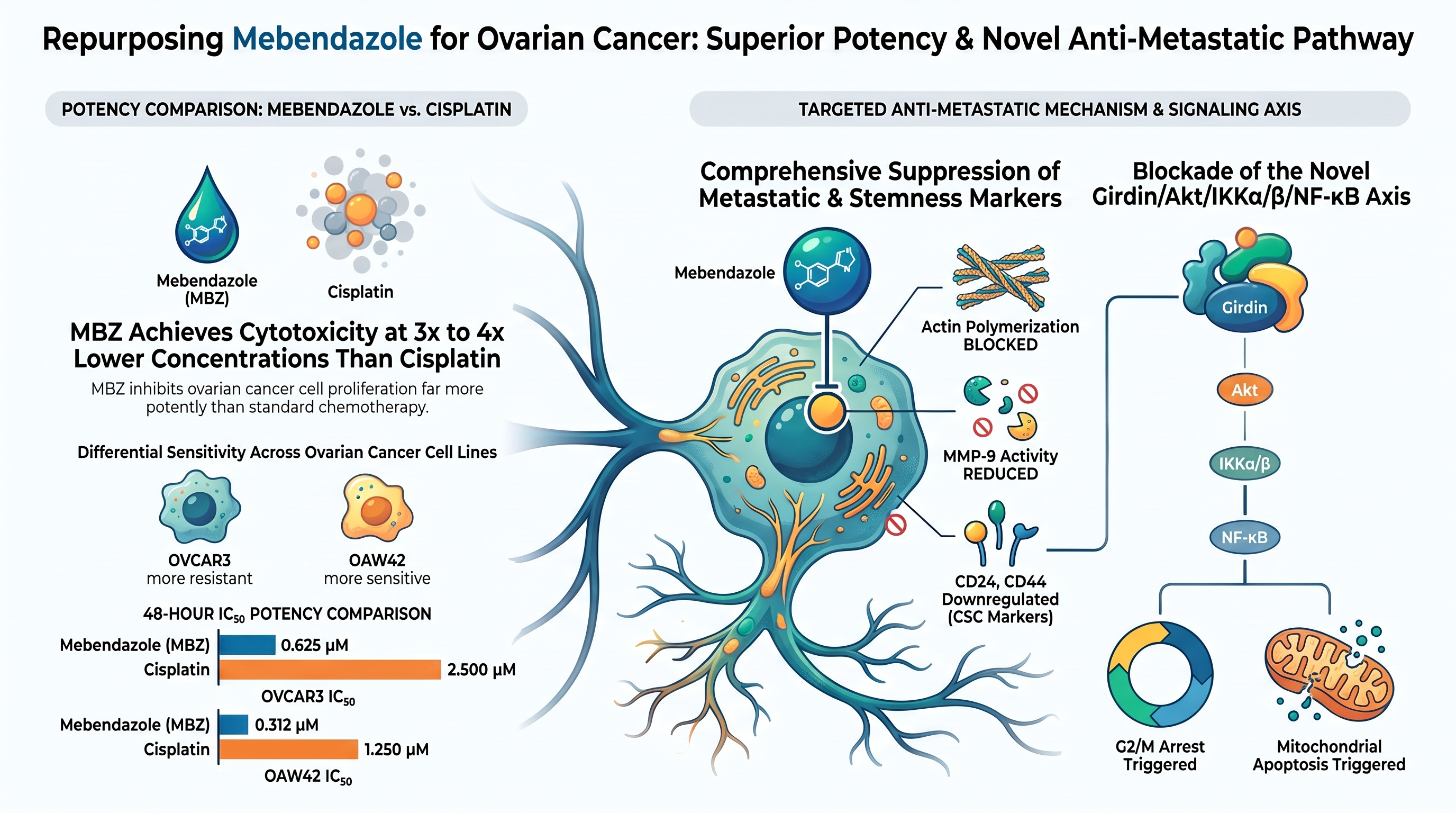
Mebendazole (MBZ), a benzimidazole anthelmintic and cytoskeleton-disrupting compound, exhibits antitumor properties. This study evaluates MBZ effects on OC cell lines OVCAR3 and OAW42, focusing on cell proliferation, migration, invasion, and cancer stemness. We explored the underlying mechanisms, including cytoskeletal disruption, epithelial–mesenchymal transition (EMT), and signaling pathways. MBZ inhibited OVCAR3 and OAW42 cell proliferation in a dose- and time-dependent manner. Additionally, MBZ significantly impeded migration, spheroid invasion, colony formation, and stemness. It also reduced actin polymerization and down-regulated CSC markers (e.g., CD24, CD44, EpCAM). Moreover, MBZ suppressed MMP-9 activity and inhibited the EMT marker as judged by decreased N-Cadherin and Vimentin and increased E-Cadherin. Furthermore, MBZ induced G2/M cell cycle arrest by modulating Cyclin B1, CDC25C, and WEE1. Also, it triggered apoptosis by disrupting mitochondrial membrane potential. Mechanistic studies revealed a significant downregulation of Girdin, an Akt modulator, along with reduced p-Akt, p-IKKα/β, and p-NF-κB, indicating MBZ’s novel mechanism of action through the Girdin-mediated Akt/IKKα/β/NF-κB signaling axis. Thus, by targeting Girdin, MBZ presents a promising repurposed therapeutic strategy to inhibit cancer cell proliferation and metastasis in ovarian cancer.
How does mebendazole compare to traditional chemotherapy in inhibiting ovarian cancer cell proliferation and metastasis?
1. Antiproliferative Potency: MBZ vs. Cisplatin
While both mebendazole and cisplatin inhibit cell proliferation in a dose- and time-dependent manner, mebendazole achieves 50% growth inhibition (IC50) at substantially lower concentrations after 48 hours of treatment:
OVCAR3 Cells: MBZ achieved an IC50 of 0.625 μM, compared to 2.5 μM for cisplatin — making mebendazole approximately 4 times more potent.
OAW42 Cells: MBZ achieved an IC50 of 0.312 μM, compared to 1.25 μM for cisplatin — making mebendazole approximately 3 times more potent.
Overall, OAW42 cells showed greater overall sensitivity than OVCAR3 cells to both treatments. Additionally, prior literature noted in the study highlights that mebendazole can sensitize ovarian cancer cells to traditional chemotherapeutics like cisplatin and paclitaxel.
2. Inhibition of Metastasis and Invasion
Mebendazole suppresses multiple interconnected steps of ovarian cancer metastasis:
Cell Migration & 3D Spheroid Invasion: MBZ significantly impairs cell scratch migration and reduces the invasion area of 3D ovarian cancer spheroids in a dose-dependent manner.
Colony Formation: MBZ markedly bates the clonogenic survival potential of both OVCAR3 and OAW42 cell lines.
Cytoskeletal Disruption: Beyond tubulin inhibition, MBZ impairs actin polymerization, disrupting the structural F-actin network necessary for cell motility and shape changes.
Epithelial-to-Mesenchymal Transition (EMT) & ECM Degradation: MBZ significantly lowers MMP-9 secretion and gelatinolytic activity. It reverses EMT by down-regulating mesenchymal markers (N-cadherin and vimentin) while up-regulating the epithelial adhesion marker E-cadherin.
Cancer Stem Cell (CSC) Suppression: MBZ down-regulates stemness surface markers (CD24, CD44, and EpCAM), reducing the stem-like subpopulations responsible for recurrence and chemoresistance.
What the evidence does show is that the literature on mebendazole and cancer is dominated by:
strong preclinical anticancer evidence across multiple tumor models,
a multi-mechanism anticancer rationale, and
a persistent gap between preclinical promise and clinical proof.
Full Report
Study Scope
Topic scope: mebendazole in oncology, including preclinical efficacy, mechanisms, combination therapy, and limited clinical/translational observations.
Foundational Context
Here, mebendazole is discussed not as an antiparasitic agent, but as a repurposed anticancer candidate. In the supplied evidence, its relevance to oncology comes from repeated reports of anticancer effects across several preclinical tumor models, together with mechanistic observations suggesting that it affects multiple cancer-relevant pathways rather than a single target. This matters because multi-target activity can make a drug attractive for translational development, especially in combination strategies, but it also complicates interpretation when clinical evidence remains sparse or inconsistent.
Evidence for Mebendazole
2.1 Tumor Models and Anticancer Activity
The strongest evidence in the supplied material is preclinical. Mebendazole shows broad anticancer activity in models including brain tumors, gastric cancer, oral tongue squamous cell carcinoma, and other cancers, with reported effects on tumor growth suppression, apoptosis, cell-cycle arrest, and angiogenesis inhibition. The meta-analysis also characterizes this as a consistent pattern across the findings rather than an isolated result from a single study stream.
This pattern is important because it frames mebendazole as a broad-spectrum preclinical anticancer candidate rather than a compound tied to only one tumor type. At the same time, the evidence remains preclinical, so these effects should not be read as proof of patient benefit.
2.2 Mechanistic Pathways
Mechanistically, the evidence points to convergence around a multi-target anticancer profile. Reported mechanisms include microtubule/tubulin disruption, kinase inhibition, PI3K/AKT pathway effects, Hedgehog pathway interference, DNA-repair impairment, and modulation of nucleotide metabolism.
This multi-pathway pattern suggests that mebendazole’s anticancer rationale is not confined to a single canonical mechanism. In translational terms, this may help explain why researchers repeatedly explore the drug across different tumor settings and in combination strategies. Still, the current evidence does not establish which of these mechanisms is most important in humans.
2.3 Combination Therapy Findings
Combination therapy is an emerging translational direction. The evidence reports that mebendazole enhanced the effects of paclitaxel in oral tongue squamous cell carcinoma and also showed promise alongside standard brain-tumor therapies. The meta-synthesis interprets this as an emerging trend toward using mebendazole as an adjunctive rather than standalone therapy
3. Clinical and Translational Evidence
3.1 Early Human Studies
Clinical evidence is much thinner than preclinical evidence. The findings state that early human studies found mebendazole generally tolerable at high oral doses, but observed clinical benefits were modest, inconsistent, and inconclusive, particularly in brain tumor patients. The broader synthesis reinforces that overall efficacy remains unproven despite preclinical enthusiasm.
This creates the central tension in the evidence base: strong laboratory rationale but limited clinical confirmation.
3.2 Real-World Use and Safety Observations
A prospective real-world cohort involving 197 cancer patients using ivermectin plus mebendazole reported high self-reported adherence and a favorable tolerability profile, with mostly mild gastrointestinal side effects. However, the authors concluded that randomized trials are needed, indicating that these data do not establish efficacy.
Because the cohort used a combination regimen, it cannot establish mebendazole's independent anticancer contribution. It is most informative as a tolerability and feasibility signal rather than as proof of therapeutic value.
3.3 Evidence Gaps and Next Steps
The main gap is the lack of rigorous, randomized, cancer-specific clinical trials that can clarify whether mebendazole meaningfully improves patient outcomes. The evidence also leaves open questions about optimal dosing, the best tumor indications, and how to position mebendazole within combination regimens.
Taken together, these findings suggest that the translational bottleneck is no longer a lack of mechanistic hypotheses, but a lack of decisive clinical testing.
For the broader scientific question, the evidence supports the following bottom line:
mebendazole has substantial preclinical anticancer support;
it appears to act through multiple anticancer-relevant mechanisms;
it may be especially relevant as a combination agent;
but clinical efficacy remains unproven despite acceptable tolerability signals in limited human and observational evidence.
References
Blum, C.B., McMenamin, M., Khoo, T., (...), O’Callaghan, L.A. (2026) From anthelmintic to neuro-oncology: A systematic review of mebendazole repurposing for brain tumour therapy. British Journal of Clinical Pharmacology. https://doi.org/10.1002/bcp.70565
Nimbalkar, V.V., Bhongal, S.A., Dhage, N.R., Barkade, G.D. (2025) Repurposing of Mebendazole as an Anticancer Agent: A Review. Research Journal of Pharmacy and Technology. https://doi.org/10.52711/0974-360X.2025.00232
da Silva, E.L., Pantoja Mesquita, F., da Rocha Lima, P.V., (...), Montenegro, R.C. (2026) Mebendazole impairs the expression and function of enzymes in nucleotide metabolism pathways, leading to Selective Cytotoxicity, Cell Cycle Arrest, and Damage to Cell Morphology in Gastric Cancer. Chemico-Biological Interactions. https://doi.org/10.1016/j.cbi.2026.111973
Zhang, J., Cui, Y. (2025) Synergistic inhibition of proliferation and induction of apoptosis in oral tongue squamous cell carcinoma by mebendazole and paclitaxel via PI3K/AKT pathway mitigation. Naunyn-Schmiedeberg’s Archives of Pharmacology. https://doi.org/10.1007/s00210-024-03670-y
Al-Zoubi, R.M., Farhan, A., Hanbali, B., (...), Agouni, A. (2026) Antiparasitic agents in oncology: Innovative mechanisms, emerging evidence and clinical potential in cancer treatment. European Journal of Medicinal Chemistry. https://doi.org/10.1016/j.ejmech.2026.118987
Hulscher, N., Victory, K., Thorp, J.A., (...), Risch, H. (2026) Real-world Clinical Outcomes of Ivermectin and Mebendazole in Cancer Patients: Results from a Prospective Observational Cohort. Anticancer Research. https://doi.org/10.21873/anticanres.18194