
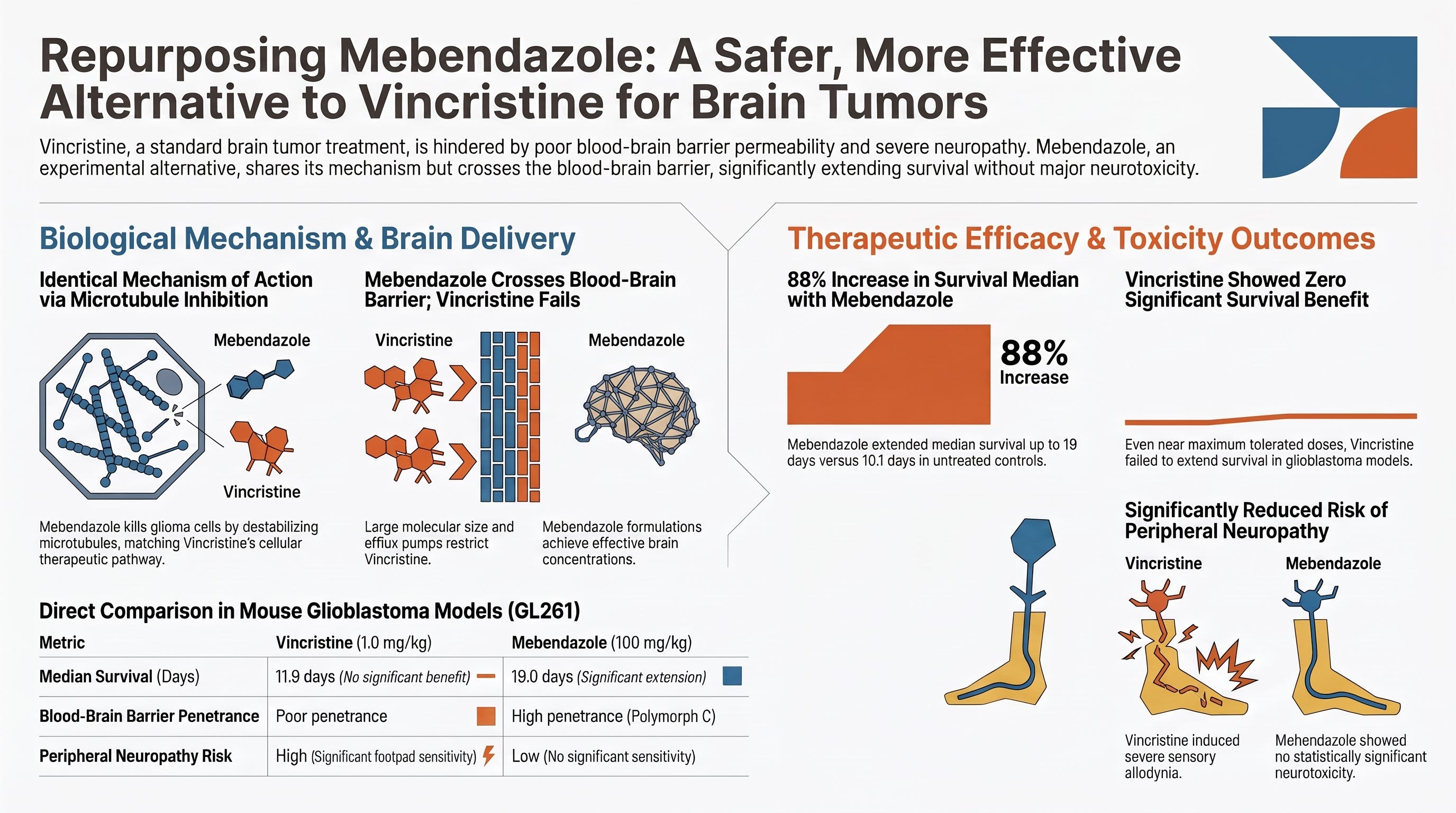
Researchers are currently evaluating the repurposing of mebendazole as an effective alternative to vincristine for combating brain cancers. While vincristine is conventionally used in neuro-oncology, it often fails to provide meaningful survival benefits because its poor blood-brain barrier penetration severely limits its access to intracranial malignancies. In contrast, scientific testing shows that mebendazole shares a similar mechanism of action by disrupting microtubule formation, yet it reaches therapeutic levels in the brain. Animal studies further reveal that mebendazole significantly extends survival in subjects with gliomas, whereas vincristine shows virtually no therapeutic efficacy under the same conditions. Ultimately, because mebendazole offers superior brain penetration and avoids debilitating side effects like severe neuropathy, the findings strongly advocate for its clinical substitution in brain tumor treatments.
In the highlighted study by De Witt et al. (Molecular Medicine), mebendazole (MBZ) is evaluated as a safer, brain-penetrant replacement for the standard microtubule inhibitor vincristine in brain tumor treatment. This article discusses in vitro and in vivo preclinical testing (lab and animal).
1. The Rationale: Overcoming Vincristine’s Limitations
Poor Blood–Brain Barrier (BBB) Permeability: Vincristine is widely used in neuro-oncology (including as part of the procarbazine, lomustine, and vincristine [PCV] regimen for gliomas). However, due to its large molecular weight (825 Da) and susceptibility to efflux by P-glycoprotein (P-gp) and Mrp1, vincristine penetrates brain tumor tissue poorly.
Debilitating Neurotoxicity: Vincristine causes severe, dose-limiting peripheral neuropathy (sensory allodynia) that often halts treatment.
Mebendazole as a Brain-Penetrant Alternative: Oral mebendazole—specifically its active polymorphs B and C—readily crosses the BBB to achieve therapeutic drug concentrations in brain tissue with a favorable clinical safety profile.
2. Identical Cellular Mechanism of Action
To confirm whether mebendazole’s cytotoxicity stems directly from microtubule disruption, the study compared MBZ and vincristine across GL261 glioblastoma cells:
Tubulin Depolymerization & Viability: The half-maximal effective concentration (\(\text{EC}{50}\)) of mebendazole for microtubule depolymerization (132 nM) closely matches its \(\text{EC}{50}\) for cell viability (160 nM).
Metaphase Arrest: The \(\text{EC}_{50}\) for inducing metaphase (mitotic) arrest is 192 nM for mebendazole (mitotic arrest-to-viability ratio of 1.20), mirroring the proportional mechanics of vincristine (ratio of 1.24).
NCI COMPARE Validation: Seeded with mebendazole, the NCI COMPARE algorithm revealed that 70% of the top-scoring matched drugs were known microtubule-targeting agents (e.g., vinblastine, paclitaxel, colchicine, podophyllotoxin).
3. In Vivo Survival Efficacy: Mebendazole vs. Vincristine
In syngeneic orthotopic GL261 glioblastoma mouse models, treatments were initiated after established tumor formation:
Mebendazole Monotherapy: Daily oral administration of polymorph C mebendazole significantly extended median survival from 10.1 days (control) to 17 days at 50 mg/kg (+33% survival) and 19 days at 100 mg/kg (+43% survival).
Vincristine Failure: Weekly administration of vincristine at doses near its maximum tolerated dose (0.5 mg/kg and 1.0 mg/kg) showed no survival benefit (median survival 11–11.9 days), directly indicating its inability to reach effective intracranial concentrations.
4. Safety Profiles & Combination Caution
Peripheral Neuropathy: Von Frey filament testing confirmed that vincristine induced significant mechanical allodynia (footpad hypersensitivity), whereas mebendazole monotherapy caused no statistically significant neuropathy.
Combination Toxicity Warning: Simultaneously co-administering mebendazole and vincristine near their respective maximum tolerated doses induced rapid weight loss and severe toxicity, signaling that these two tubulin-disrupting drugs should not be combined clinically.
Source
De Witt, M., Gamble, A., Hanson, D., Markowitz, D., Powell, C., Al Dimassi, S., Atlas, M., Boockvar, J., Ruggieri, R., & Symons, M. (2017). Repurposing mebendazole as a replacement for vincristine for the treatment of brain tumors. Molecular Medicine, 23, 50–56.