
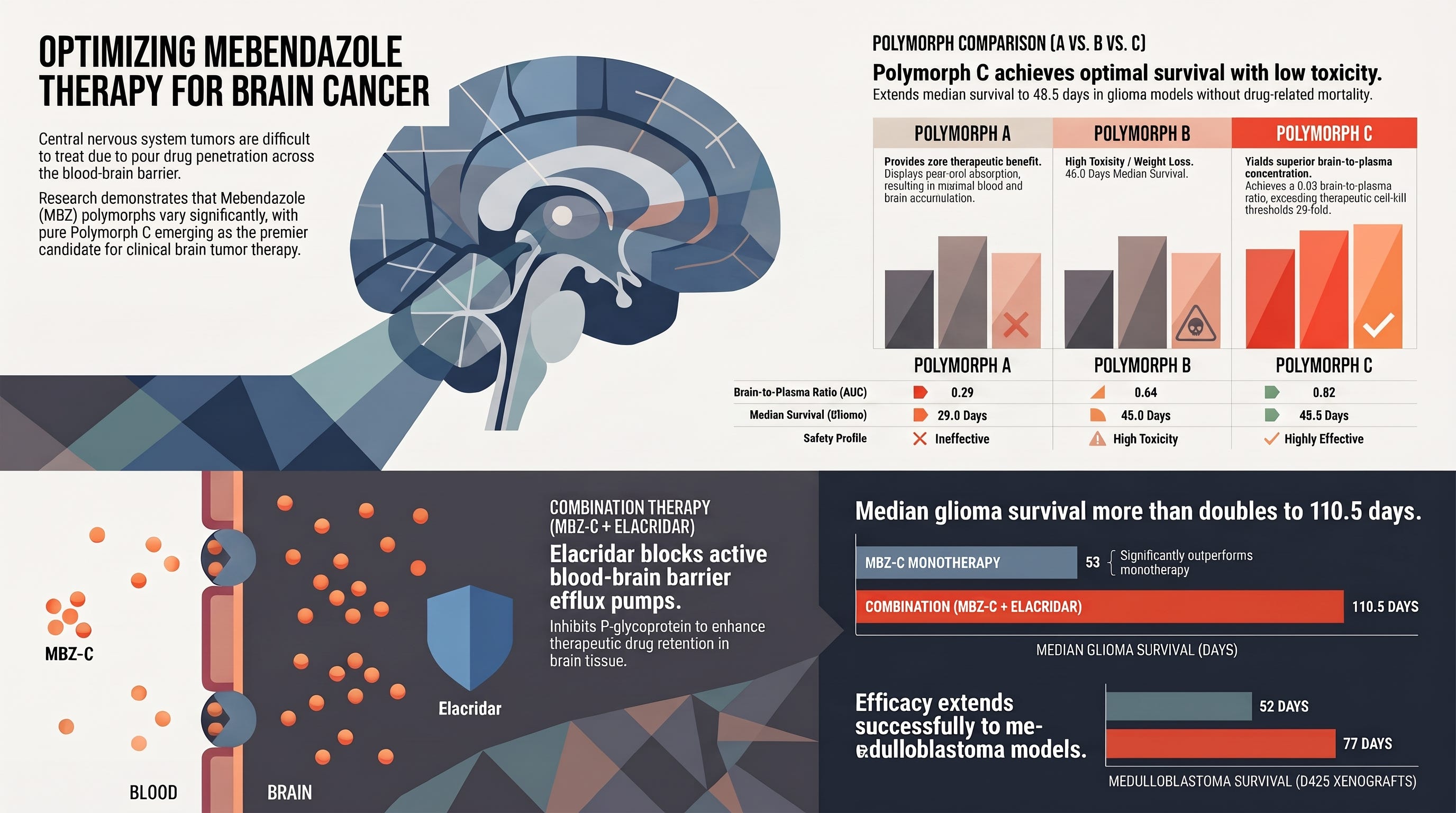
Researchers evaluated the efficacy of repurposing the common antiparasitic medication mebendazole for the treatment of brain tumors, noting that the drug naturally exists in three distinct polymorphic forms labeled A, B, and C. Through extensive preclinical testing in mice, the study determined that polymorph C successfully achieves high therapeutic concentrations within both brain tissue and intracranial tumors while exhibiting minimal toxicity, unlike the ineffective polymorph A or the toxic polymorph B. Furthermore, the scientists found that coadministering polymorph C with the efflux pump inhibitor elacridar significantly improves overall survival in animal models of glioma and medulloblastoma by overcoming biological barriers. Ultimately, the findings strongly recommend using pure polymorph C, potentially paired with elacridar, to optimize future clinical trials for human brain cancer patients.
Crossing the blood–brain barrier (BBB) remains a central challenge in central nervous system (CNS) oncology, as the capillary tight junctions and active efflux pumps prevent approximately 98% of small-molecule drugs from reaching therapeutic concentrations in intracranial tumors.
Within the benzimidazole class, Mebendazole (MBZ) possesses favorable physicochemical properties—such as a low molecular weight (295 Daltons) and lipophilicity—that enable effective brain penetration, though its therapeutic success depends heavily on its solid-state polymorph and efflux pump dynamics:
1. Impact of Mebendazole Polymorphs (A, B, and C)
Mebendazole crystallizes into three distinct solid polymorph forms (A, B, and C) that exhibit marked differences in oral bioavailability, systemic exposure, and brain distribution:
Polymorph C (MBZ-C): Represents the optimal clinical form for brain tumors. Following oral administration, MBZ-C achieves an average brain-to-plasma (B/P) ratio of 0.75 to 0.82. Peak brain concentrations reach 2,016 ng/g (~7.1 µM), significantly exceeding the in vitro IC₅₀ for cultured glioma and medulloblastoma cells (0.11–1.0 µM) and the inhibitory IC₅₀ for VEGFR2 kinase (4.3 µM). Furthermore, MBZ-C distributes equally between intracranial tumor tissue and contralateral normal brain tissue.
Polymorph B (MBZ-B): Reaches total brain tissue concentrations similar to MBZ-C but generates higher systemic plasma AUC, increasing systemic toxicity and treatment-related mortality.
Polymorph A (MBZ-A): Demonstrates very low oral bioavailability—achieving only ~19% of the plasma exposure seen with MBZ-C—and poor brain penetration (B/P ratio of ~0.29–0.32). Consequently, MBZ-A provides no survival benefit in intracranial glioma models.
2. Overcoming Efflux Transporters with Elacridar
The BBB actively restricts CNS entry of xenobiotics via ATP-binding cassette (ABC) efflux transporters, specifically P-glycoprotein (P-gp / ABCB1) and Breast Cancer Resistance Protein (BCRP / ABCG2):
Co-administering MBZ-C with elacridar (a third-generation P-gp/BCRP inhibitor) elevates the average B/P ratio to 1.03 and significantly increases the brain concentration of its active metabolite MBZ-NH₂.
In syngeneic mouse glioma models (GL261), combining MBZ-C with elacridar dramatically extended median survival from 53 days (MBZ alone) up to 92.5–110.5 days.
In orthotopic human medulloblastoma xenografts (D425), the combination increased median survival from 52 days to 77 days.
3. Comparison with Other Benzimidazoles (Fenbendazole, Albendazole)
Compared with mebendazole, other tested benzimidazoles—including fenbendazole, albendazole, flubendazole, thiabendazole, and oxfendazole—failed or showed only statistically insignificant survival improvements in orthotopic GL261 glioma models. This discrepancy is attributed to:
Differences in oral bioavailability and intestinal absorption.
Variable or insufficient blood–brain barrier penetration.
Divergent kinase inhibition profiles (e.g., Mebendazole potently inhibits cancer-related kinases such as VEGFR2, BRAF, and ABL1, which drugs like albendazole lack).
Based on the study evaluating mebendazole (MBZ) in brain cancer models, cancer therapy—particularly for central nervous system (CNS) malignancies like glioblastoma and medulloblastoma—faces major delivery hurdles that can be addressed through drug repurposing, solid-state formulation optimization, and efflux pump inhibition:
1. The Blood–Brain Barrier (BBB) Challenge in CNS Oncology
Delivery Barrier: Intracranial tumors are difficult to treat because tight junctions in capillary endothelial cells form the blood–brain barrier (BBB), preventing approximately 98% of small-molecule drugs from reaching therapeutic concentrations in brain tissue.
Repurposing Mebendazole: MBZ, an established antiparasitic agent with over 40 years of safe clinical use, exhibits antitumor activity by binding tubulin, inhibiting key tyrosine kinases (such as VEGFR2), suppressing Hedgehog signaling, blocking angiogenesis, and inducing apoptosis. These findings supported initiating a dose-escalation Phase I clinical trial in high-grade glioma patients.
2. Impact of Mebendazole Polymorphs (A, B, and C)
Mebendazole exists as three distinct solid-state crystal structures (polymorphs A, B, and C), which differ drastically in oral bioavailability, systemic toxicity, and therapeutic efficacy in brain cancer:
Polymorph C (MBZ-C): The optimal form for brain cancer therapy. Oral administration of MBZ-C achieves a high brain-to-plasma (B/P) AUC ratio of 0.82 and a peak brain concentration of 2,016 ng/g (7.1 µM)—well above the in vitro IC50 for glioma/medulloblastoma cell lines (0.11–1.0 µM) and VEGFR2 kinase inhibition (4.3 µM). It distributes equally between intracranial tumor tissue and normal brain tissue.
Polymorph B (MBZ-B): Reaches similar concentrations in brain tissue as MBZ-C and extends survival, but produces significantly higher plasma AUC levels (26,474 h⋅ng/mL vs. 16,039 h⋅ng/mL) and increased treatment-related toxicity.
Polymorph A (MBZ-A): Exhibits very low oral bioavailability (achieving only ~19% of MBZ-C’s plasma AUC) and poor brain penetration (B/P ratio of ~0.29–0.32), offering no survival benefit in GL261 glioma-bearing mice.
3. Overcoming Efflux Transporters with Elacridar
P-gp / BCRP Inhibition: Active efflux transporters in the BBB, such as P-glycoprotein (P-gp) and breast cancer resistance protein (BCRP), limit drug accumulation in brain tumors.
Synergistic Survival Benefit: Combining oral MBZ-C with elacridar (a third-generation P-gp/BCRP inhibitor) elevates the average brain-to-plasma ratio to 1.03:
GL261 Syngeneic Glioma: Extended median survival from 29.5 days (control) and 53 days (MBZ-C alone) up to 92.5–110.5 days depending on combination treatment length.
D425 Medulloblastoma Xenografts: Extended median survival from 24 days (control) and 52 days (MBZ-C alone) to 77 days.
4. Comparison Across Benzimidazole Anthelmintics
Uniqueness of Mebendazole: Other tested benzimidazoles—including fenbendazole, albendazole, flubendazole, thiabendazole, and oxfendazole—failed or produced only statistically insignificant survival improvements in the GL261 glioma model.
Mechanistic Differences: This divergence is attributed to lower oral bioavailability, inadequate brain penetration, or reduced kinase-inhibitory activity (e.g., VEGFR2 blockade) compared with mebendazole.
Reference
Bai, R.-Y., Staedtke, V., Wanjiku, T., Rudek, M. A., Joshi, A., Gallia, G. L., & Riggins, G. J. (2015). Brain penetration and efficacy of different mebendazole polymorphs in a mouse brain tumor model. Clinical Cancer Research, 21(15), 3462–3470. https://doi.org/10.1158/1078-0432.CCR-14-2681