
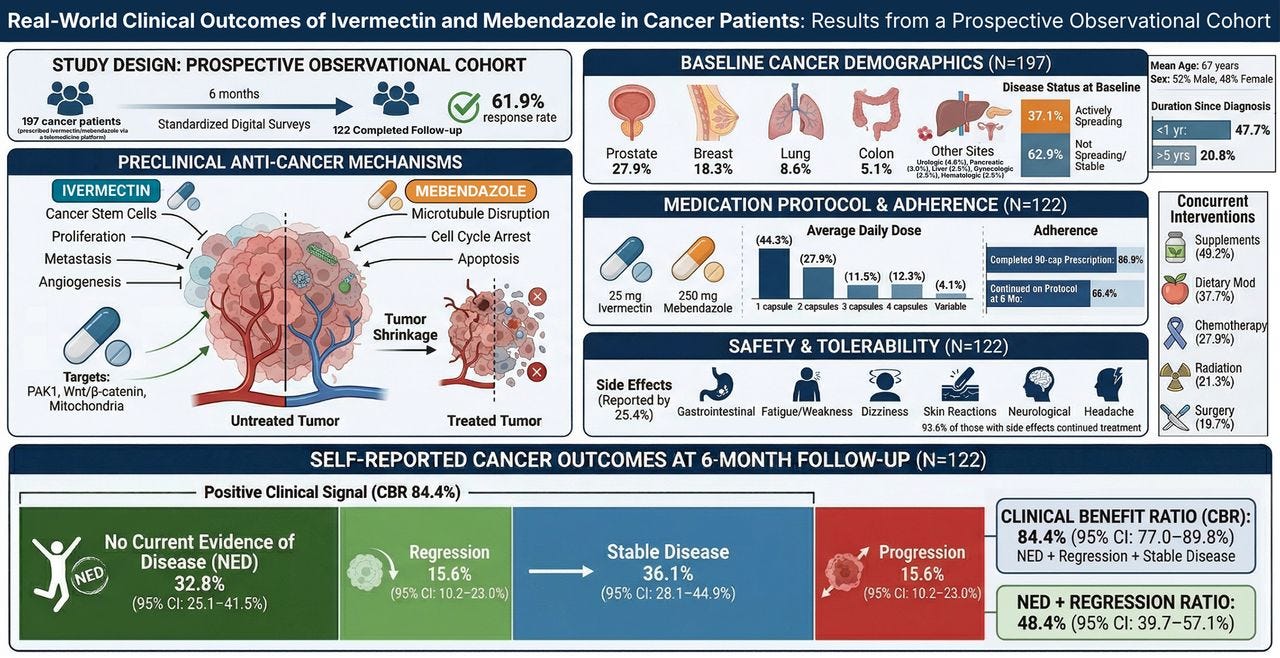
The Hulscher et al. (2026) study, published in Anticancer Research, evaluated the real-world clinical outcomes, safety, and adherence of cancer patients prescribed a compounded combination of ivermectin and mebendazole.
The study makes an important point that shouldn’t be overlooked: lower healthcare costs compared with standard chemotherapy treatments.
In the context of oncology, drug repurposing involves identifying new anti-cancer applications for established, non-oncology medications with well-known safety profiles. This approach seeks to accelerate therapeutic development and lower healthcare costs compared to standard chemotherapies, which average $111,000 annually.
In this prospective real-world cohort, the combination of ivermectin and mebendazole was associated with high proportions of self-reported clinical benefit, with nearly half of participants declaring tumor regression or no current evidence of disease across a heterogeneous population of cancer types. These findings, observed alongside favorable tolerability and strong adherence, support the biological plausibility suggested by preclinical data, indicating this combination may offer therapeutic potential as an adjunctive or repurposed strategy in oncology. However, given the observational design, reliance on self-reported outcomes, and potential for confounding, these results should be interpreted as hypothesis-generating. Rigorous randomized, double blind, placebo-controlled trials are urgently needed to validate safety and efficacy, clarify optimal dosing strategies, and determine the role of this combination across specific cancer types. https://ar.iiarjournals.org/content/46/6/3243#T3
1. Key Antiparasitic Repurposing Candidates
Ivermectin: Demonstrates multi-target anti-cancer activity across numerous tumor types by modulating oncogenic signaling cascades—including PAK1, Wnt/β-catenin, PI3K/Akt/mTOR, and STAT3—inducing mitochondrial dysfunction and eradicating cancer stem cells (CSCs).
Mebendazole: Functions primarily as a microtubule-destabilizing agent, causing G2/M cell-cycle arrest, triggering apoptosis, inhibiting angiogenesis, and blocking cellular glucose uptake.
Mechanistic Synergism: Combining ivermectin and mebendazole provides non-overlapping, complementary mechanisms aimed at depleting cancer stem cells, overcoming multi-drug resistance, and inducing tumor regression.
2. Study Population & Design
Enrollment & Follow-Up: The prospective observational cohort initially enrolled 197 adult cancer patients who received off-label prescriptions via a U.S. telemedicine platform. A total of 122 patients (61.9%) completed the 6-month follow-up evaluation.
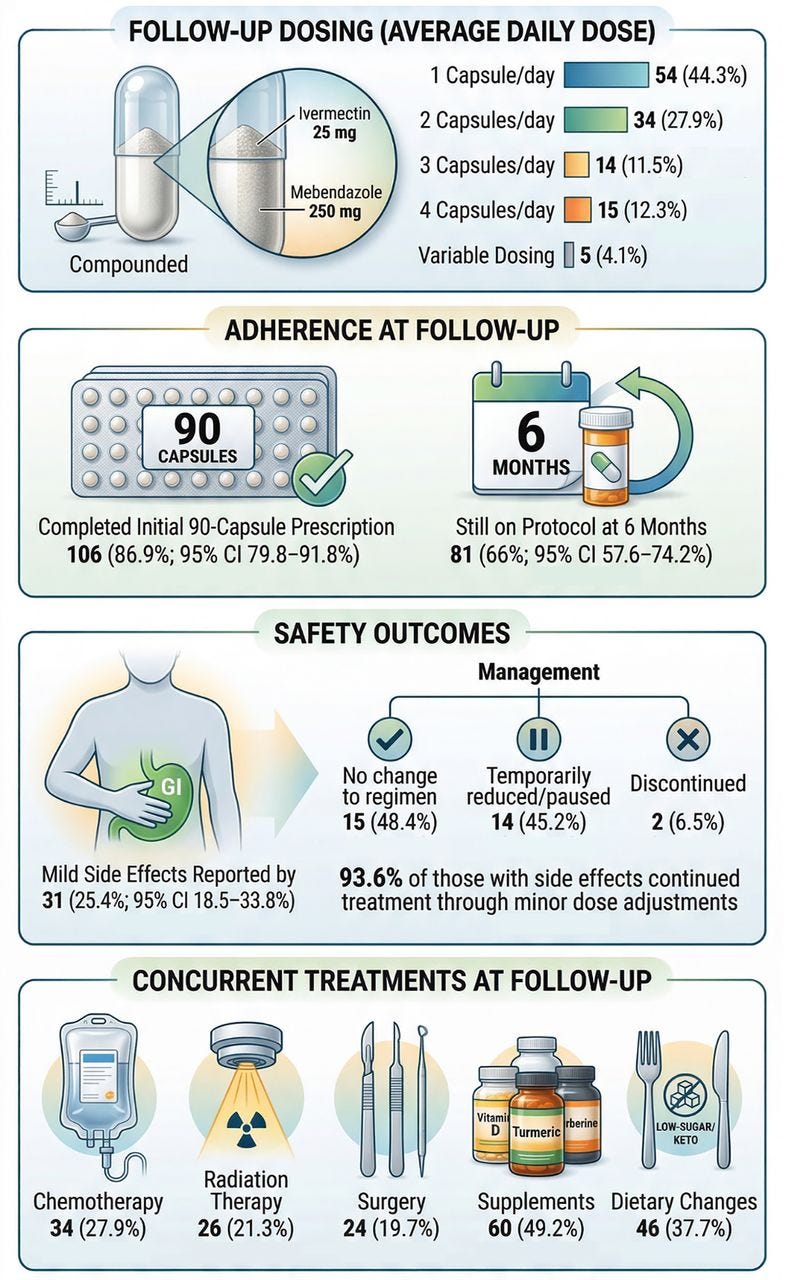
Compounded Regimen: Patients received oral capsules containing 25 mg ivermectin and 250 mg mebendazole per capsule, taking between 1 to 4 capsules daily (most commonly 1 capsule/day taken by 44.3%, or 2 capsules/day taken by 27.9%).
Patient Demographics: The cohort had a mean age of 67 years and presented with diverse malignancies, led by prostate cancer (27.9%), breast cancer (18.3%), lung cancer (8.6%), and colon cancer (5.1%)26. At baseline, 37.1% reported actively progressing disease.
3. Key Clinical Outcomes (At 6-Month Follow-Up)
84.4% Clinical Benefit Ratio (CBR): 84.4% of follow-up participants (103 of 122) achieved clinical benefit, defined as no evidence of disease, tumor shrinkage, or disease stabilization.
32.8% No Current Evidence of Disease (NED): Nearly a third of patients (40 of 122) reported complete disease clearance.
15.6% Active Tumor Regression: 19 of 122 patients demonstrated tumor shrinkage.
Combined NED + Regression Rate: The combined fraction of strongest positive responses (NED plus regression) reached 48.4% (59 of 122 patients).
Disease Stabilization & Progression: 36.1% (44 patients) maintained stable disease, while 15.6% (19 patients) experienced disease progression.
Cost Factor: The estimated annual cost for the daily compounded ivermectin–mebendazole combination ranges from $2,000 to $3,000, representing a fraction of conventional oncologic treatment expenses.
4. Research Limitations & Future Directions
Hypothesis-Generating Status: Because outcomes were self-reported without centralized clinical/radiographic adjudication, a control group, or isolation from concurrent standard/integrative therapies (e.g., chemotherapy in 27.9%, supplements in 49.2%), the study authors emphasize that therapeutic benefit cannot be definitively inferred.
Need for Randomized Trials: The study highlights the urgent need for double-blind, placebo-controlled randomized trials (RCTs) to validate efficacy, establish optimal dosing, and clarify the role of this combination across specific cancer diagnoses.
5. Adherence, Safety, & Tolerability
High Medication Adherence: 86.9% of respondents completed their initial 90-capsule prescription, and 66.4% remained on the protocol at 6 months.
Mild Side-Effect Profile: Side effects were reported by 25.4% of participants and were predominantly mild and gastrointestinal28. 93.6% of patients experiencing side effects continued therapy after minor dose adjustments.
6. Methodological Context & Limitations
Concurrent Interventions: A significant portion of the cohort received concurrent standard therapies during follow-up, including chemotherapy (27.9%), radiation therapy (21.3%), and surgery (19.7%), as well as dietary supplements (49.2%) and dietary changes (37.7%).
Observational & Hypothesis-Generating Nature: Because the study relied on self-reported survey data without clinical/radiographic adjudication or a control group, the authors emphasized that therapeutic benefit cannot be definitively inferred and that the results remain hypothesis-generating.
Editorial Status: Secondary evidence guides in the notebook highlight that the study carries a formal Expression of Concern issued by Anticancer Research in June 2026 over data-integrity and ethical-verification matters.
Hulscher, N., Victory, K., Thorp, J. A., Pinsky, D., Diaz-Villalobos, A., Gillooly, P., Coulson, F., Annazone, M., Radesi, C., Brooks, J., McCullough, P. A., & Risch, H. (2026). Real-world clinical outcomes of ivermectin and mebendazole in cancer patients: Results from a prospective observational cohort. Anticancer Research, 46, 3243–3255.
Authors: Nicolas Hulscher, Kelly Victory, James A. Thorp, Drew Pinsky, Alejandro Diaz-Villalobos, Peter Gillooly, Foster Coulson, Melissa Annazone, Chloe Radesi, Jessica Brooks, Peter A. McCullough, and Harvey Risch
Publication Year: 2026
Article Title: Real-world clinical outcomes of ivermectin and mebendazole in cancer patients: Results from a prospective observational cohort
Journal: Anticancer Research
Volume & Page Range: Volume 46, pages 3243–3255
This paper has been retracted. Below is an explanation of why it was withdrawn.
Retraction
Anticancer Research October 2026, 46 (10) 5877; DOI: https://doi.org/10.21873/anticanres.18425
In this prospective real-world cohort, the combination of ivermectin and mebendazole was associated with high proportions of self-reported clinical benefit, with nearly half of participants declaring tumor regression or no current evidence of disease across a heterogeneous population of cancer types. These findings, observed alongside favorable tolerability and strong adherence, support the biological plausibility suggested by preclinical data, indicating this combination may offer therapeutic potential as an adjunctive or repurposed strategy in oncology. However, given the observational design, reliance on self-reported outcomes, and potential for confounding, these results should be interpreted as hypothesis-generating. Rigorous randomized, double blind, placebo-controlled trials are urgently needed to validate safety and efficacy, clarify optimal dosing strategies, and determine the role of this combination across specific cancer types. https://ar.iiarjournals.org/content/46/6/3243#T3
Following post-publication review, independent expert assessments, and consideration of the authors’ appeal, responses, and proposed correction, the Editor of Anticancer Research retracts the above article because methodological and analytical problems undermine the reliability of its central clinical-benefit conclusions.
The Clinical Benefit Ratio of 84.4% combines self-reported no evidence of disease (NED), regression, and stability. Disease status was recorded using two categories at baseline and four different categories at follow-up, which did not provide directly comparable measures of disease status. The surveys lacked comparable pretreatment disease status, a defined reference point for change, a duration criterion for stability, and systematic participant-level linkage between survey waves. No baseline NED measure was collected, so the data cannot establish whether NED preceded exposure. These limitations undermine the composite’s clinical-benefit interpretation.
The article states that therapeutic benefit cannot be inferred and that the findings are hypothesis-generating. These qualifications do not resolve the measurement problem described above. The article nevertheless presents the composite as a therapeutic signal and compares it with clinical-benefit rates reported for chemotherapy, a comparison for which comparability of outcome definitions and relevant clinical characteristics was not established.
The representativeness analysis compared treatment history up to baseline with treatment during follow-up in overlapping groups. It could not establish baseline comparability between the 122 respondents and 75 nonrespondents, for whom follow-up outcomes were unavailable.
The correction proposed by the authors would retain the clinical-benefit terminology, therapeutic-signal characterisation, and representativeness analysis with further qualifications. The missing clinical reference information cannot be reconstructed for the cohort from the available survey data. An adequate revision would require withdrawing, rather than qualifying, the principal clinical conclusions and supporting claims. It was therefore concluded that correction was insufficient.
No allegation of research misconduct is made. The decision rests solely on the grounds above, and not on an allegation of arithmetic miscalculation.
The authors dispute the grounds for retraction and propose correction as an alternative.
The Expression of Concern of 9 June 2026 (DOI: 10.21873/anticanres.18276) and its update (DOI: 10.21873/anticanres.18380) remain part of the published record. This retraction records the final outcome of the scientific review described in the update. The article remains available and is identified as retracted.