
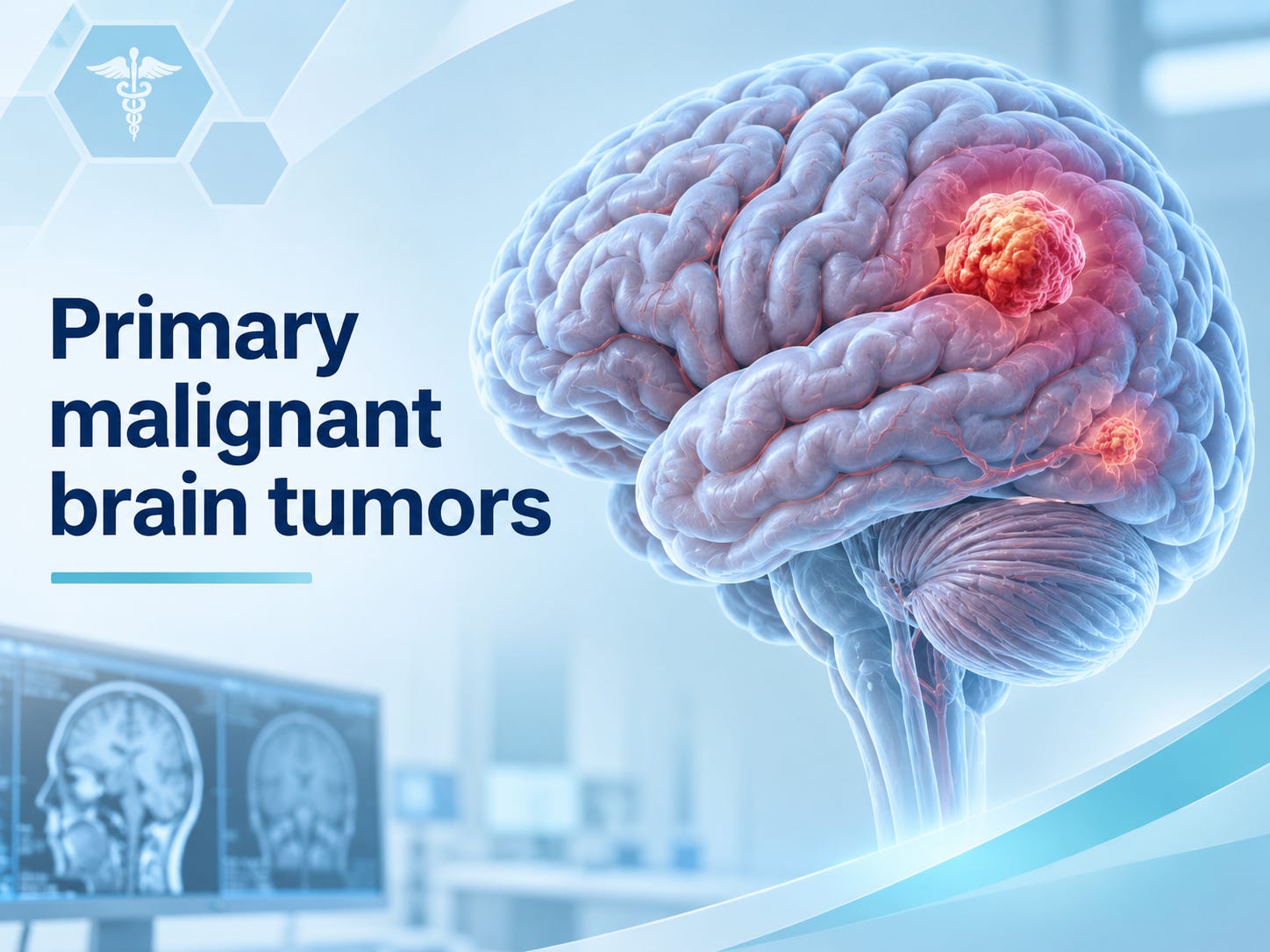
Primary malignant brain tumors are among the most lethal human cancers, characterized by poor long-term survival, an aggressive infiltrative course, and limited systemic therapy options.
1. Classification and Major Types
According to the World Health Organization (WHO) Classification of Tumors of the Central Nervous System (updated with the 5th edition in 2021), primary brain tumours are classified using an integrated approach that merges histopathology with molecular profiling:
Glioblastoma (GBM): Restricted in the 2021 classification to IDH wild-type tumours, glioblastoma is the most common and aggressive primary brain malignancy in adults. It carries a typical life expectancy of only 12–16 months. Infiltrative growth prevents complete surgical removal, and recurrence is virtually universal.
Diffuse Lower-Grade and IDH-Mutant Gliomas: Consolidated into astrocytoma (IDH-mutant) and oligodendroglioma (IDH-mutant with 1p/19q codeletion). Tumors formerly categorized as IDH-mutant glioblastomas are now classified as grade 4 astrocytomas.
Diffuse Midline Glioma (DMG): A universally fatal pediatric and young-adult malignancy located in midline structures (such as the brainstem/pons, thalamus, and spinal cord). Defined genetically as DMG, H3 K27-altered, these tumors typically harbor the H3.3K27M or H3.1K27M mutation, or less commonly EZHIP overexpression with wild-type H3, leading to global hypomethylation of histone H3 lysine 27. The median overall survival is 9–11 months, with a 5-year survival rate of just ~2%.
Medulloblastoma (MB): An embryonal pediatric tumor of the posterior fossa, categorized into distinct molecular subgroups including Sonic Hedgehog (SHH) and Group 3 (frequently c-MYC- and OTX2-amplified).
Malignant Meningioma: High-grade intracranial meningeal tumours displaying rapid growth, recurrence, and resistance to standard modalities.
2. Clinical Challenges and Treatment Barriers
Primary malignant brain tumors present distinctive therapeutic bottlenecks that have stalled clinical progress:
The Blood–Brain Barrier (BBB): Capillary endothelial tight junctions tightly restrict the passage of therapeutic agents into the brain parenchyma. Moreover, active ATP-binding cassette efflux pumps (primarily P-glycoprotein/P-gp and BCRP) actively transport foreign compounds out of endothelial cells back into the blood.
Infiltrative Growth: Gliomas diffuse through normal brain parenchyma, making curative complete surgical resection impossible without causing unacceptable neurological deficits.
Therapeutic Stagnation: Standard treatment typically involves maximal safe surgical resection followed by radiotherapy and alkylating chemotherapy (such as temozolomide, TMZ). In glioblastoma, the overall 5-year survival remains around 22%, and no new systemic therapies have received FDA approval for GBM since temozolomide in 2005. Over 250 clinical trials in DMG testing various chemotherapies, targeted agents, and immunotherapies have failed to alter long-term outcomes.
3. Emerging Repurposing and Combination Strategies
Given the lengthy developmental timelines and high attrition rate of de novo oncology drugs, drug repurposing has emerged as a major focus to accelerate treatment discovery.
Mebendazole (MBZ): Preclinical investigations show that MBZ—especially polymorph C—crosses the BBB and exerts multimodal antineoplastic actions across GBM, DMG, medulloblastoma, and meningioma. It acts by:
Inducing microtubule depolymerization and sustained G2/M mitotic arrest.
Blocking angiogenesis via VEGFR2 inhibition.
Inhibiting Hedgehog/GLI1 signalling (including in vismodegib-resistant SMO mutants).
Triggering caspase-dependent apoptosis and altering Bcl-2 and p53/p21/p27 networks.
Overcoming Resistance with Combinations:
MBZ + ONC201: In DMG, combining MBZ with the ClpP-activating/DRD2-antagonist investigational drug ONC201 produces strong pro-apoptotic synergy and retains potency against ONC201-resistant lines.
MBZ + Efflux Pump Inhibitors: Preclinical co-administration with elacridar (inhibiting P-gp and BCRP) substantially increases CNS drug concentrations and extends survival in glioma and medulloblastoma models.
Radiosensitization: MBZ impairs DNA damage response protein nuclear trafficking (such as Chk2 and Nbs1), enhancing radiation response in GBM, meningioma, and IDH1-mutant gliomas.
4. Current Clinical Status
While preclinical data across these tumour models show marked survival extensions, early-phase human trials have shown that high-dose oral MBZ is generally safe and well-tolerated, but evidence of meaningful single-agent efficacy in humans remains modest and inconsistent. Recent translational research emphasizes the need for optimized delivery formulations (such as nanosuspensions or intranasal microemulsions), clear polymorph reporting, and rational biomarker-guided combination trials.
Sources
1. WHO CNS Classification, Epidemiology, & Systematic Evidence
These sources provided the WHO 2021 integrated classification (IDH wild-type glioblastoma, IDH-mutant astrocytoma, 1p/19q codeleted oligodendroglioma), historical overall survival benchmarks, and cross-tumour syntheses.
Blum, C. B., McMenamin, M., Khoo, T., Edwin, J. M., Jose, P., & O’Callaghan, L. A. (2026). From anthelmintic to neuro-oncology: A systematic review of mebendazole repurposing for brain tumour therapy. British Journal of Clinical Pharmacology, 1–28.
Meco, D., Attinà, G., Mastrangelo, S., Navarra, P., & Ruggiero, A. (2023). Emerging perspectives on the antiparasitic mebendazole as a repurposed drug for the treatment of brain cancers. International Journal of Molecular Sciences, 24(2), Article 1334.
Aliabadi, A., Moradi, S. Z., Abdian, S., Fakhri, S., & Echeverría, J. (2025). Critical dysregulated signaling pathways in drug resistance: Highlighting the repositioning of mebendazole for cancer therapy. Frontiers in Pharmacology, 16, Article 1631419.
2. Pediatric Diffuse Midline Glioma (DMG) & Epigenetics
These sources provided the genetic definitions for DMG, H3 K27-altered (H3.3K27M/H3.1K27M mutations, EZHIP overexpression), survival statistics, and pro-apoptotic synergy with ONC201 [102–104].
Gentile, S., Toma, F., Lucchetti, D., Lisi, L., Navarra, P., Sgambato, A., Servidei, T., & Ruggiero, A. (2025). The therapeutic potential of repurposed mebendazole, alone and in synergistic combination with ONC201, in the treatment of diffuse midline glioma. American Journal of Cancer Research, 15(6), 2701–2718. https://doi.org/10.62347/MXZH5646
3. Blood–Brain Barrier Kinetics, Polymorphism, & Efflux Inhibition
These sources provided the pharmacokinetic data on CNS penetrance, the distinction of mebendazole Polymorph C (peak brain concentration of 2,016 ng/g; brain-to-plasma AUC ratio of 0.82 vs. 0.408 for temozolomide), and combination with the P-gp/BCRP inhibitor elacridar [2–4].
Bai, R.-Y., Staedtke, V., Wanjiku, T., Rudek, M. A., Joshi, A., Gallia, G. L., & Riggins, G. J. (2015). Brain penetration and efficacy of different mebendazole polymorphs in a mouse brain tumor model. Clinical Cancer Research, 21(15), 3462–3470.
Bai, R.-Y., Staedtke, V., Aprhys, C. M., Gallia, G. L., & Riggins, G. J. (2011). Antiparasitic mebendazole shows survival benefit in 2 preclinical models of glioblastoma multiforme. Neuro-Oncology, 13(9), 974–982.
De Witt, M., Gamble, A., Hanson, D., Markowitz, D., Powell, C., Al Dimassi, S., Atlas, M., Boockvar, J., Ruggieri, R., & Symons, M. (2017). Repurposing mebendazole as a replacement for vincristine for the treatment of brain tumors. Molecular Medicine, 23(1), 50–56.
4. Malignant Meningioma, Invasion, & Radiosensitization
These sources provided the data regarding malignant/atypical meningioma (NF2 mutations, KT21MG1/IOMM LEE models), radiation synergy using SARRP (12 Gy), and 3D patient-derived spheroid invasion blockade via Rho-GTPase signaling.
Skibinski, C. G., Williamson, T., & Riggins, G. J. (2018). Mebendazole and radiation in combination increase survival through anticancer mechanisms in an intracranial rodent model of malignant meningioma. Journal of Neuro-Oncology, 140(3), 529–538.
Dell, K., et al. (2026). Mebendazole attenuates cellular invasion in a 3D culture model of meningioma by disrupting Rho-GTPase-mediated microtubule function. Oncology Research, 34(5), Article 74958.
Tamura, R. (2023). Drug repositioning for refractory benign tumors of the central nervous system. International Journal of Molecular Sciences, 24(16), Article 12997.
The Brain Tumour Charity. (2024). Meningioma treatment. The Brain Tumour Charity.
Cleveland Clinic. (2025). Meningioma: What it is, symptoms & treatment. Cleveland Clinic.
5. Clinical Trials & Human Translation Studies
These clinical papers provided the human safety and dosing profiles (up to 200 mg/kg/day), adverse events (reversible ALT/AST transaminitis), and survival findings in newly diagnosed and recurrent gliomas:
Gallia, G. L., Holdhoff, M., Brem, H., Joshi, A. D., Hann, C. L., Bai, R.-Y., Staedtke, V., Blakeley, J. O., Sengupta, S., Jarrell, T. C., Wollett, J., Szajna, K., Helie, N., Mattox, A. K., Ye, X., Rudek, M. A., & Riggins, G. J. (2021). Mebendazole and temozolomide in patients with newly diagnosed high-grade gliomas: Results of a phase 1 clinical trial. Neuro-Oncology Advances, 3(1), Article vdaa154.
Patil, V. M., Menon, N., Chatterjee, A., Tonse, R., Choudhari, A., Mahajan, A., ... & Gupta, T. (2022). Mebendazole plus lomustine or temozolomide in patients with recurrent glioblastoma: A randomised open-label phase II trial. EClinicalMedicine, 49, Article 101449.
Phan, P., Stapleton, S. L., Riggins, G. J., Koldobskiy, M. A., Raabe, E., & Cohen, K. J. (2025). Phase 1 study of mebendazole therapy for refractory/progressive or recurrent pediatric brain tumors. Neuro-Oncology Practice, 12(6), 1092–1098.
Berger, F., Lahrech, H., & Ben-Ari, Y. (2025). Treating aggressive brain tumors with the combo bumetanide/mebendazole: A new cytotoxic, anti-invasive network strategy. Annals of Case Reports, 10(3), Article 102305.