
I constantly hear the same dismissive refrain: “Fenbendazole has no clinical trials. There’s no evidence.”
Yet, as I discussed in my previous article, the available facts raise a troubling question: Will we ever see rigorous human clinical trials investigating fenbendazole as a potential cancer treatment? Or will the research remain confined to laboratories, animal studies, and individual case reports?
Then comes another familiar obstacle: the seemingly relentless scientific scrutiny directed at any study reporting positive results involving fenbendazole and human cancer.
“Sorry, that paper has been retracted. You can’t use it as evidence.” **https://karger.com/cro/article/18/1/864/927630/Retracted-Paper-Fenbendazole-as-an-Anticancer
Of course, scientific scrutiny is essential, and retractions must be taken seriously. But a retraction should also prompt us to examine exactly what went wrong, which findings remain credible, and whether the underlying research deserves further investigation.
The question is not whether fenbendazole has been proven to treat cancer in humans. In scientific terms, it hasn’t. The question is whether promising findings are receiving the rigorous, independent investigation they deserve.
Consider the following case involving an 83-year-old man diagnosed with diffuse large B-cell lymphoma (DLBCL). He declined conventional cancer treatment, reportedly took fenbendazole as his only anticancer medication, and subsequently experienced remission.
Was this a case of spontaneous cancer regression, or could fenbendazole have played a role?
I’m told we must be particularly careful about how we describe this case. The scientifically appropriate wording is “DLBCL regression during fenbendazole self-administration,” rather than “DLBCL successfully treated or cured by fenbendazole.”
That distinction is important. The case provides meaningful evidence that the patient’s lymphoma regressed, but considerably weaker evidence that fenbendazole caused the regression.
The most significant scientific alternative explanation is spontaneous lymphoma regression, potentially triggered by an immune response following the patient’s biopsy. This is not merely hypothetical; spontaneous lymphoma regression has been documented in published medical literature. Even the original authors acknowledge that the precise cause of this patient’s remission remains unknown.
But here is the question I believe deserves serious consideration: If a patient declines conventional cancer treatment, takes fenbendazole, and subsequently experiences remission, shouldn’t we investigate the possibility that the drug contributed to that outcome?
Acknowledging the possibility of spontaneous regression is scientifically responsible. So is acknowledging that fenbendazole’s potential contribution has neither been established nor definitively ruled out.
The purpose of scientific investigation should be to determine what happened and why—not to assume an explanation before the evidence is sufficient to support it.
What makes the case interesting
The patient was an 83-year-old man with biopsy-diagnosed duodenal DLBCL, germinal-center subtype, classified as stage IVa based on PET/CT findings. He declined chemotherapy, self-administered fenbendazole, and subsequently had smaller nodes and improving PET/CT findings. Unlike reports involving concurrent chemotherapy or immunotherapy, there is no reported conventional anticancer treatment that obviously explains the improvement.
That supports a temporal association. It does not identify the cause.
Spontaneous Regression??
“Spontaneous regression is the partial or complete disappearance of a disease, most often a malignant tumor, without any treatment, or with treatment considered inadequate to explain the change….the partial or complete disappearance of a cancer in the absence of treatment capable of causing that effect. It is rare, often cited at roughly 1 in 60,000 to 100,000 cancer cases, though the true rate is uncertain. It occurs disproportionately in certain cancers. “Regression is usually temporary or partial, and relapse is common.”
Why spontaneous regression is a serious alternative
The lymphoma’s germinal-center subtype does not rule out spontaneous regression: untreated regression has been documented in that subtype, including intestinal disease.
Additional uncertainties that weaken the attribution (reasons why fenbendazole was not a significant factor in recovery)
- Biopsy-associated immunity: Regression after biopsy has been described, with immune activation proposed as a mechanism. This remains a hypothesis, not a proven explanation for the fenbendazole patient.
- What actually regressed: Only the duodenal lesion is described as biopsy-confirmed. PET uptake elsewhere can support lymphoma staging, but infection or inflammation can also produce uptake. Some resolving abnormalities could therefore have been non-lymphomatous; this does not invalidate the duodenal diagnosis or prove the assigned stage was wrong.
- Incomplete exposure and outcome reporting: Intake varied, and peripheral neuropathy prompted dose reduction. The accessible narrative reports imaging improvement, not a formally documented complete remission or cure, and lacks a complete co-medication and long-term outcome record.
The defensible description is “DLBCL regression during fenbendazole self-administration,” not “DLBCL successfully treated or cured by fenbendazole.” A drug effect remains possible, but this case cannot distinguish it from spontaneous regression or other contributors. Notably, the abstract’s causal wording is stronger than the discussion, which explicitly concedes that uncertainty.
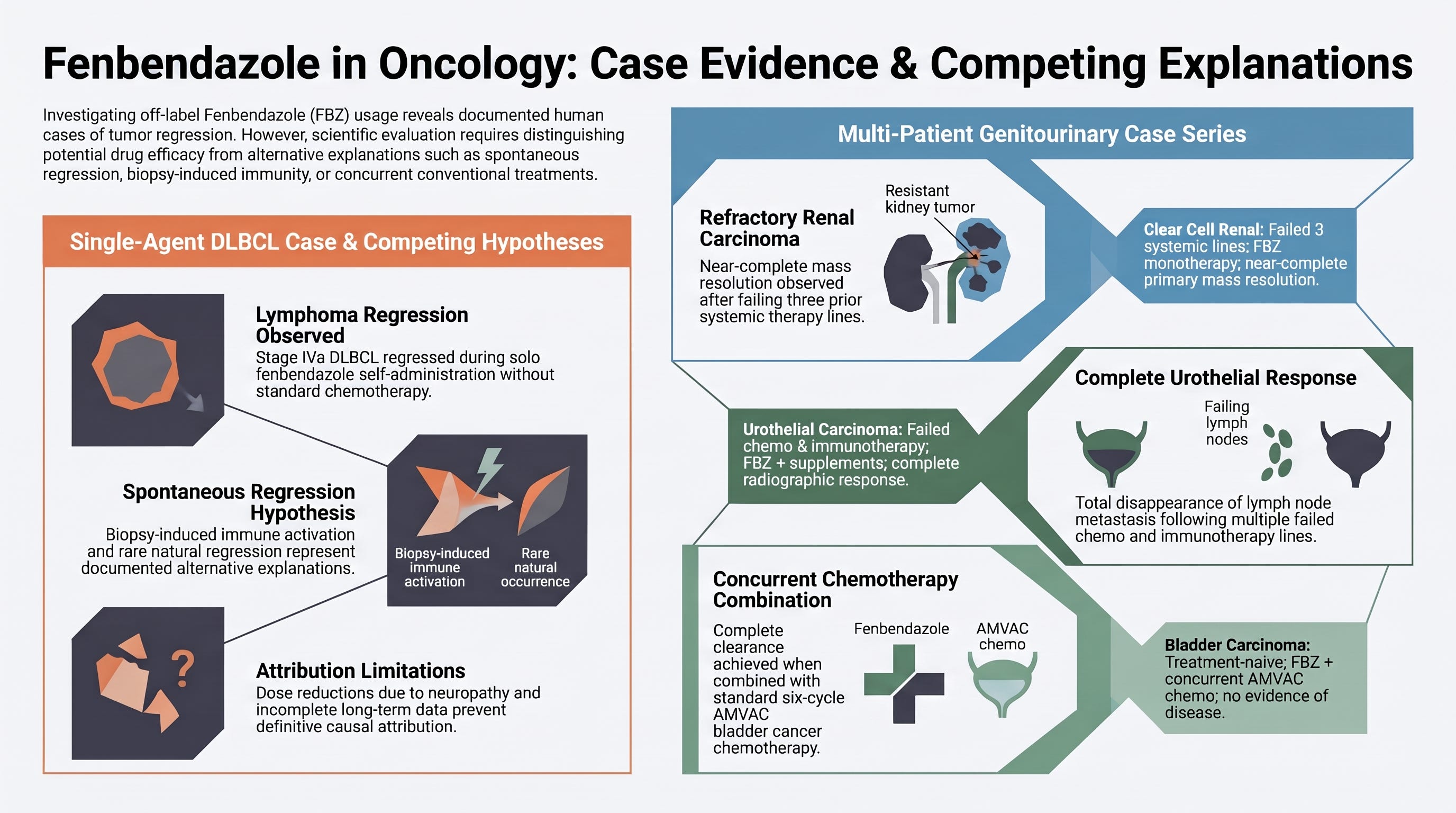
Finally, let’s examine a particularly interesting case series published in 2021, involving three human cancer patients who used fenbendazole during their treatment. The report, titled “Fenbendazole Enhancing Anti-Tumor Effect: A Case Series,” included researchers affiliated with Stanford University Medical Center.
The three patients had different types of advanced genitourinary cancers and experienced notable tumor responses after incorporating fenbendazole into their treatment regimens.
But here’s an important distinction: This was a published case series, not a controlled clinical trial conducted by Stanford University. The patients’ outcomes were documented retrospectively, and the evidence does not establish that fenbendazole caused their responses.
Nevertheless, the cases raise an important question: What can we learn from these observations, and do they provide sufficient justification for further clinical investigation?
Let’s examine what the researchers documented, what the results actually demonstrate, and what questions remain unanswered.
Fenbendazole Enhancing Anti-Tumor Effect: A Case Series: Clinical Oncology Case Reports
The paper highlights a Stanford University case series evaluating fenbendazole.
There were three human patients in this series:
Overcoming Multi-Line Chemotherapy Failure:
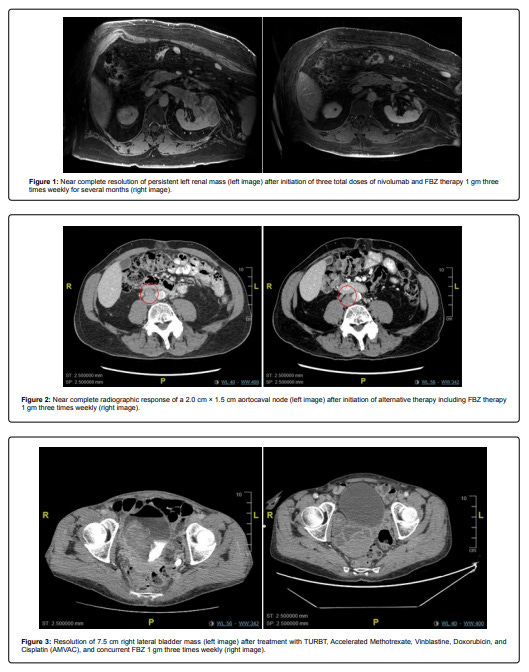
Case 1 (Renal Cell Carcinoma): A 63-year-old man with metastatic stage 4 clear cell renal cell carcinoma failed three consecutive lines of therapy (pazopanib, cabozantinib, and nivolumab). After starting 1,000 mg of fenbendazole three times weekly, follow-up MRI showed near-complete resolution of the primary renal mass and decreased pancreatic and bone metastases.
Case 2 (Urothelial Carcinoma): A 72-year-old man with metastatic urothelial carcinoma experienced disease progression after failing radiotherapy, carboplatin, paclitaxel, pembrolizumab, and six cycles of gemcitabine plus cisplatin. After starting 1,000 mg fenbendazole three days per week (alongside Vitamin E, Curcumin, and CBD oil), follow-up CT scans showed a complete radiographic response, with complete disappearance of his aortocaval lymph node metastasis.
Concurrent Chemotherapy Combination:
Case 3 (Bladder Cancer): A 63-year-old woman with advanced urothelial bladder carcinoma was treated with 6 cycles of AMVAC chemotherapy (accelerated methotrexate, vinblastine, doxorubicin, and cisplatin) concurrently with 1 gram of fenbendazole three times weekly. Follow-up CT revealed no evidence of disease.
Here is the exact paper:

Fenbendazole Enhancing Anti-Tumor Effect: A Case Series
Ryan S Chiang, Ali B Syed, Jonathan L Wright, Bruce Montgomery and Sandy Srinivas
*Corresponding Author:
Ryan Chiang
Department of Medicine
Stanford University Medical Center Stanford
410 Station Park Circle Unit 107
San Mateo CA 94402, CA, USA
Received: October 27, 2020 Accepted: January 15, 2021 Published: February 10, 2021
Citation: Chiang RS, Syed AB, Wright JL, Montgomery B, Srinivas S (2021) Fenbendazole Enhancing Anti-Tumor Effect: A Case Series. Clin Oncol Case Rep 4:2
Introduction
There has been growing popularity in recent years for the use of Fenbendazole (FBZ) as a single agent or supplementary therapy to chemotherapy for those suffering from various forms of cancer. FBZ is a cheap anti-helminthic medication commonly used in veterinary practice and readily available in pet stores and on commercial websites. However, despite multiple anecdotal stories and news outlet reports of its efficacy in treating metastatic cancer, the clinical literature behind utilizing FBZ as a potential anti-neoplastic agent remains nonexistent. Existing scientific studies have primarily studied its mechanism of action through the use of animal models. Herein, we describe three cases where patients achieved complete responses, including two who experienced progression after multiple lines of therapy, when FBZ was used alone or in combination with standard therapies.
Conclusion
There remains limited data with few published studies on the anti-oncogenic properties of FBZ. Other benzimidazoles have been studied to a larger extent, and the knowledge can be drawn upon to help guide future FBZ studies and to gauge the efficacy of this drug class, whether as a solitary agent or in combination therapy. Given the potential benefits of FBZ with what seems to be a limited toxicity profile, further research is warranted to evaluate the clinical settings in which this medication may be beneficial and repurposed for patients with progressive genitourinary malignancy and possibly in other malignant settings as well.
Of course…there’s always the fine print.
The retrieved text discusses the reported cases and the authors’ conclusions, but it does not include a journal policy statement or an article note confirming that the paper underwent peer review.
So, who do you believe?
Is it the FDA and the medical establishment, which promoted COVID-19 vaccines as highly effective and safe for various populations, including children, older adults, and pregnant women?
Or the thousands of reported anecdotal accounts of people who took fenbendazole and say they are alive and cancer-free today?
Of course, anecdotal reports are not the same as controlled clinical evidence, and they cannot establish that fenbendazole caused a patient’s cancer remission.
But should these accounts be dismissed, or do they deserve more rigorous scientific investigation?
When it’s you or your family member, where do you draw the line between trusting established medical authorities and questioning whether potentially important evidence is being overlooked?
I’d genuinely like to hear your thoughts. Please leave a comment below.
Great thought provoking talk! Of course conventional Medicine can't have anything else competing with their poisonous substances.
Would appreciate fenbendozole dosing without chemo or radiation by weight. God bless you 🙏 ❤️ ❣️
Diffuse large B-cell lymphoma
Before & after three months chemo with 444mg Fenbendazole 1x daily.