
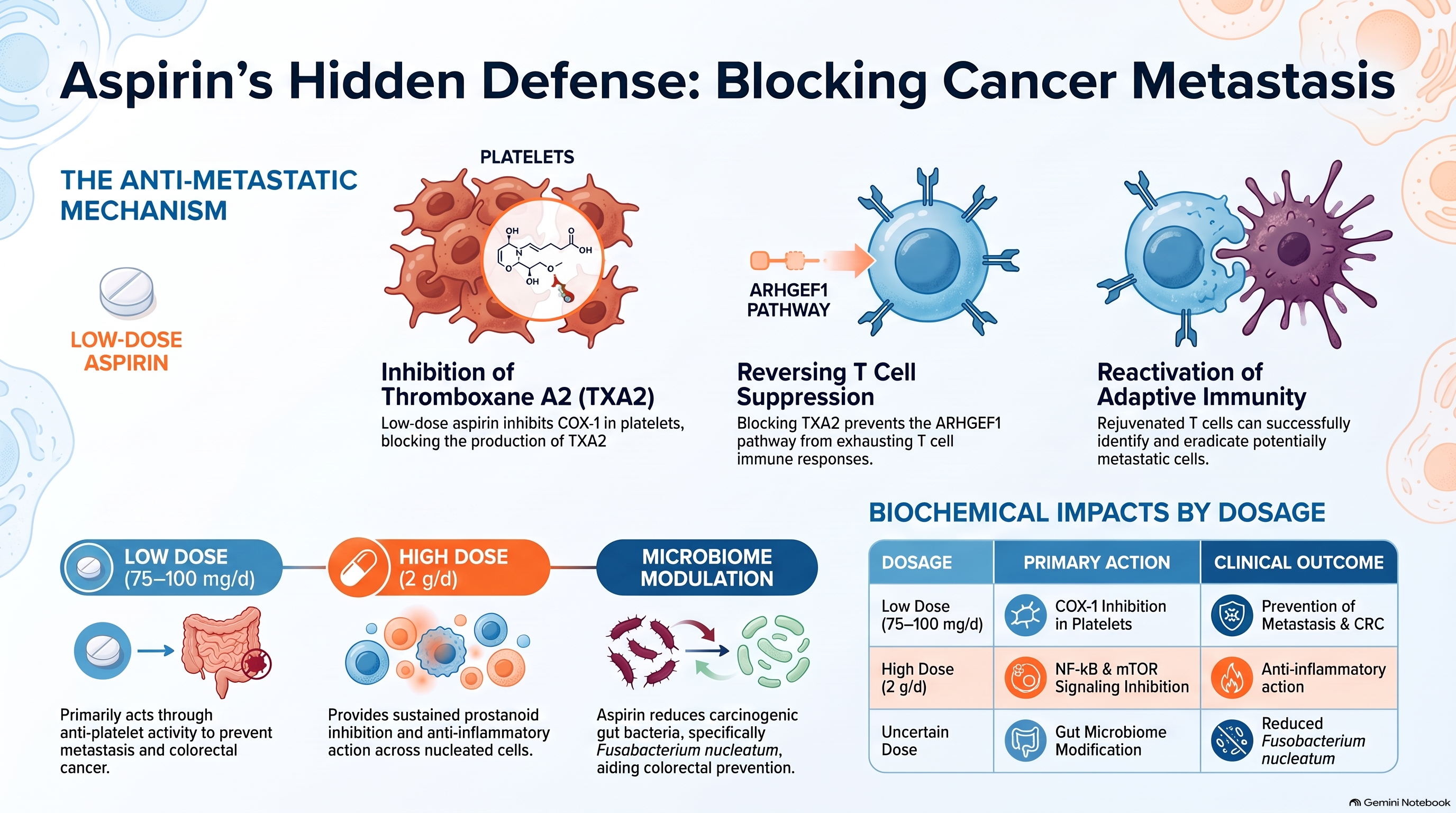
In the video below, Dr. J. Chaplan explains how daily low-dose aspirin is a powerful, inexpensive tool for reducing cancer metastasis and recurrence by protecting the immune system. Rather than attacking large tumors directly, aspirin blocks a specific inflammatory molecule that usually lets platelets suppress killer T-cells, enabling these immune cells to identify and destroy microscopic cancer clusters. This long-standing clinical evidence is further bolstered by the synergistic effects of moderate exercise and the natural supplement apigenin, which target the same biological pathway to maximize survival benefits. The primary goal of this information is to provide patients with accessible, science-backed strategies to maintain remission and improve long-term outcomes after completing chemotherapy.
Strategies for cancer metastasis prevention center on immune-mediated clearance of microscopic circulating tumor cells (CTCs) and micrometastases before they can establish secondary tumors.
1. Clinical Evidence for Aspirin in Cancer Prevention
Metastasis & Recurrence Reduction: Meta-analyses of over 140 clinical trials and observational studies involving tens of thousands of patients show that daily low-dose aspirin (75–100 mg/day or 75–81 mg/day) reduces overall cancer-related mortality by 20–23% across all cancer types.
Primary Prevention vs. Adjuvant Benefit: Low-dose aspirin does not significantly alter the overall incidence or initial development of primary cancers. Instead, its primary survival benefit stems from preventing metastasis and recurrence after initial diagnosis and treatment.
Cancer-Type Efficacy: The anti-metastatic effect is particularly pronounced in adenocarcinomas, which show a 46% reduction in metastasis. The strongest impact occurs in colorectal cancer (CRC), where post-treatment metastasis is reduced by 74%. Across 18 distinct cancer types evaluated in observational analyses, daily aspirin correlates with at least a 10% reduction in mortality for every cancer type assessed.
2. The Molecular Mechanism: Platelets, TXA2, and T-Cell Immunity
While aspirin’s clinical benefit has been documented for decades, research by Yang et al. (2025) elucidated the precise molecular mechanism explaining why aspirin targets metastases rather than primary tumor masses:
Inhibition of Thromboxane A2 (TXA2): Low-dose aspirin irreversibly acetylates and inhibits the cyclooxygenase-1 (COX-1) enzyme in blood platelets. This blocks platelets from synthesizing and releasing Thromboxane A2 (TXA2).
Reversal of T-Cell Exhaustion: Platelet-derived TXA2 normally activates the ARHGEF1 signaling pathway, which suppresses T-cell-mediated immunity and increases the proportion of exhausted T cells among tumor-infiltrating lymphocytes. By eliminating TXA2 production, aspirin prevents platelets from disarming killer T cells, maintaining their functional ability to target cancer cells.
High-Dose vs. Low-Dose Pathways: At low doses (75–100 mg/day), aspirin’s anticancer action is primarily mediated through COX-1/TXA2 inhibition in platelets. Higher doses (e.g., 2–3 g/day) target COX-2, NF-κB, and mTOR pathways, as well as gut microbiome modification (such as reducing carcinogenic Fusobacterium nucleatum), though low-dose regimens remain the standard for clinical survival benefits.
3. Micrometastases vs. Primary Tumors & HLA Class I
Targeting Micrometastases: Aspirin has little effect on shrinking large, established primary tumors because these masses build a dense, protective tumor microenvironment that physically excludes T cells. However, killer T cells are exceptionally effective at identifying and destroying small clusters of circulating tumor cells (micrometastases) before they can establish a secondary tumor bed and construct protective defenses.
HLA Class I Dependence: Killer T cells rely on surface HLA class I antigen presentation to identify target cells. Clinical studies confirm that aspirin’s anti-metastatic benefit occurs exclusively in HLA class I–positive tumors; patients with HLA class I–negative tumors derive no protective benefit from aspirin.
4. Synergistic Multi-Targeting Protocol (Exercise & Apigenin)
The platelet–TXA2–immune axis can be targeted from complementary angles to enhance micrometastase clearance:
Exercise Stacking: Regular aerobic and anaerobic exercise independently lowers platelet TXA2 production, stacking additively with aspirin to prevent platelet-mediated T-cell suppression.
Apigenin Receptor Blockade: Apigenin—a natural plant flavonoid abundant in celery and parsley—acts as a TXA2 receptor antagonist on T cells. While aspirin stops platelets from synthesizing TXA2, apigenin prevents T cells from sensing any residual TXA2. Because apigenin is fat-soluble, take it with a fatty meal for optimal absorption.
Triple Combination: Combining low-dose aspirin, regular exercise, and apigenin hits the immune-suppressive TXA2 pathway at both the synthesis and receptor levels.
5. Clinical Timing, Biomarkers & Safety
Treatment Timing: Aspirin and multi-targeted immune protocols are most effective during chemo holidays or after completing chemotherapy (as well as alongside radiation, targeted therapies, or immunotherapy), because active chemotherapy depletes the T-cell populations required for immune clearance.
Biomarkers: Levels of urinary 11-dehydro-thromboxane B2 (U-TXM), a marker of in vivo platelet activation, are persistently elevated in cancer patients and are reduced by 77–82% with low-dose aspirin. TXA2-receptor (TXA2-R) expression may also serve as a predictive biomarker for aspirin benefit in adjuvant settings.
Safety: Minor GI bleeding risks associated with daily low-dose aspirin are low (around 4 cases per 1,000 person-years). For individuals who cannot take aspirin because of bleeding risk or blood-thinning medications, combining exercise with apigenin (or alternating aspirin and apigenin on a daily schedule) provides access to the same biological pathway with reduced side-effect risk.
Video:
An aspirin a day keeps cancer at bay.
https://pmc.ncbi.nlm.nih.gov/articles/PMC11992038
/pdf/44276_2025_Article_138.pdf
A check point inhibitor that costs nothing compared to many patented, unaffordable mono clonal anti bodies. A compelling example for more serious look at repurposed medicines for cancer. Aspirin never ceases to surprise you. 👍🏻👍🏻👍🏻
Is this another manipulated study from the manufacturers, like when they were claiming aspirin reduced the risk of a second heart attack by 50% study they highly manipulated?
And what about the risk of side effects such as peptic ulcers that can hemorrhage leading to death
There are safer ways to inhibit metastases.