
In preclinical research, the ketogenic diet (KD) facilitates drug transport and accumulation in brain tissue.
Key findings regarding how KD impacts blood-brain barrier (BBB) delivery include:
Lipid Solubilization & Bioavailability: Lipophilic small molecules like mebendazole have poor oral solubility on their own, but co-administration with a high-fat ketogenic diet improves gastrointestinal solubilization and systemic bioavailability.
Enhanced Small-Molecule Transport Across the BBB: Nutritional ketosis facilitates the delivery of structurally diverse small-molecule therapeutics across the blood-brain barrier. For example, brain tumor delivery of the glutamine antagonist DON was three-fold greater in mice fed a ketogenic diet compared to those on a standard high-carbohydrate diet.
Target Engagement & Brain Accumulation: MALDI imaging mass spectrometry confirmed mebendazole presence and accumulation directly in brain tumor tissues when delivered alongside KD. Similarly, co-administering KD with the mitochondrial inhibitor CPI-613 (devimistat) significantly reduced target enzymes like OGDH in brain tissue, whereas CPI-613 administered on a standard diet did not.
Current Mechanistic Limitation: The authors explicitly note as a study limitation that the precise physiological or cellular mechanisms by which nutritional ketosis alters blood-brain barrier transport kinetics remain unclear and require further investigation.
Ketone bodies (such as \(\beta\)-hydroxybutyrate) selectively protect healthy brain and body tissues during metabolic therapy through a fundamental bioenergetic difference between normal and cancerous cells:
1. Sustaining Healthy Cells with Alternative Mitochondrial Fuel
Healthy neural and peripheral tissues possess fully functional mitochondria capable of normal oxidative phosphorylation (OxPhos). When carbohydrate restriction lowers systemic blood glucose and raises circulating ketone bodies, healthy cells readily adapt by oxidizing these non-fermentable ketones as an efficient, neuroprotective energy source to generate cellular ATP.
2. Exploiting Cancer’s Mitochondrial Defect (OxPhos Insufficiency)
In contrast, malignant brain tumor cells harbor well-documented structural and functional defects in their mitochondrial OxPhos machinery. Because cancer cells cannot efficiently metabolize ketone bodies for energy, they remain strictly dependent on cytoplasmic aerobic glucose fermentation (the Warburg effect) and glutamine fermentation to survive.
3. Preventing Systemic Energy Starvation and Organ Toxicity
By shifting the body’s primary circulating fuel from glucose to ketone bodies (lowering the Glucose-Ketone Index), ketogenic therapy starves fuel-dependent tumor cells while keeping normal brain cells fully nourished via ketone respiration. This bioenergetic protection allows targeted drug interventions (such as mebendazole or devimistat) to be administered at reduced or pulsed dosages, achieving potent anti-tumor activity without causing weight loss, tissue necrosis, or liver toxicity in healthy organs.
The ketogenic diet used for cancer treatment.
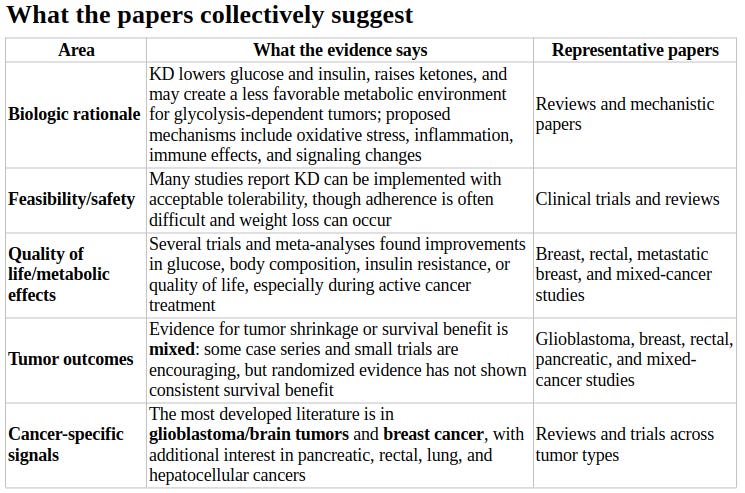
The ketogenic diet has been studied in cancer mostly as an adjunct/supportive therapy, with the strongest human evidence showing it is generally feasible and can improve metabolic markers and quality of life, while clear survival or tumor-control benefit remains unproven and inconsistent across cancers and study designs.
Papers worth reading first
Systematic review of cancer patients: 46 publications, 39 studies, 770 patients; concluded evidence is low quality, heterogeneous, and not conclusive for antitumor or overall survival benefit.
Systematic review in adults with cancer: 11 studies, 102 participants; mixed effects on tumor outcomes and QoL, with low adherence common.
Meta-analysis of randomized trials: KD lowered glucose but did not significantly improve cholesterol, IGF-1, weight, or QoL overall; evidence was insufficient for firm conclusions.
Breast cancer RCT: KD reduced fasting glucose and body fat and showed higher overall survival in the neoadjuvant subgroup, with no severe adverse effects.
Breast cancer RCT on chemo: KD lowered insulin, reduced tumor size in locally advanced disease, but did not improve response rate in metastatic disease.
Glioblastoma phase 1 trial: KD with standard-of-care was safe and feasible, with high adherence and stable or improved QoL/cognition, but efficacy still needs randomized confirmation.
Glioma systematic review: 23 studies, 306 patients; ketosis and safety were achievable, but OS/PFS benefits remained unproven and inconsistent.
KETOCOMP rectal/breast radiotherapy studies: showed feasibility and improved QoL/metabolic health during radiotherapy or radio-chemotherapy, but not clear survival benefit.
Review focused on mechanisms and translation: argues KD should be viewed as a stratified metabolic intervention rather than a universal anticancer therapy.
Bottom line
KD is a biologically plausible and usually feasible adjunct in oncology, but current human evidence supports it more strongly for metabolic/QoL benefits than for definitive anticancer efficacy or survival improvement. The field’s main limitation is that many studies are small, heterogeneous, and cancer-specific, so the most defensible use today is as a carefully supervised adjunct, not a proven stand-alone cancer treatment.
References
Römer, M., Dörfler, J., Hüebner, J. (2021) The use of ketogenic diets in cancer patients: a systematic review. Clinical and Experimental Medicine. https://doi.org/10.1007/s10238-021-00710-2
Ylikomi, T., Nées, M. (2026) Ketogenic Diet as an Adjuvant in Epithelial Cancers: Mechanisms, Model Systems, and Translational Opportunities. Cancers. https://doi.org/10.3390/cancers18162600
Zhao, H., Jin, H., Xian, J., (...), Bai, X. (2022) Effect of Ketogenic Diets on Body Composition and Metabolic Parameters of Cancer Patients: A Systematic Review and Meta-Analysis. Nutrients. https://doi.org/10.3390/nu14194192
Salido-Bueno, B., Gil-Hernández, E., Rueda-Ruzafa, L., (...), Cardona, D. (2024) Effects of ketogenic diets on cancer-related variables: A systematic review and meta-analysis of randomized controlled trials. Nutrition Bulletin. https://doi.org/10.1111/nbu.12693
https://www.sciencedirect.com/science/article/pii/S1476459824002063
Lyle, Nazmun, Hossain, Chowdhury Mobaswar, Pramanik, Krishna (2026) Therapeutic targeting of lipid metabolism in cancer: Mechanisms, pathways, and translational prospects. Pathology - Research and Practice. https://doi.org/10.1016/j.prp.2026.156507
Alhamzah, S.A., Gatar, O.M., Alruwaili, N.W. (2023) Effects of ketogenic diet on oxidative stress and cancer: A literature review. Advances in Cancer Biology - Metastasis. https://doi.org/10.1016/j.adcanc.2023.100093
Neha, Chaudhary, R. (2024) Ketogenic diet as a treatment and prevention strategy for cancer: A therapeutic alternative. Nutrition. https://doi.org/10.1016/j.nut.2024.112427
Allen, B.G., Bhatia, S.K., Anderson, C.M., (...), Fath, M.A. (2014) Ketogenic diets as an adjuvant cancer therapy: History and potential mechanism. Redox Biology. https://doi.org/10.1016/j.redox.2014.08.002
Khodabakhshi Fard, A., Akbari, M.E., Mirzaei, H.R., (...), Davoodi, S.H. (2020) Feasibility, Safety, and Beneficial Effects of MCT-Based Ketogenic Diet for Breast Cancer Treatment: A Randomized Controlled Trial Study. Nutrition and Cancer. https://doi.org/10.1080/01635581.2019.1650942
Klement, R.J., Weigel, M.M., Sweeney, R.A. (2021) A ketogenic diet consumed during radiotherapy improves several aspects of quality of life and metabolic health in women with breast cancer. Clinical Nutrition. https://doi.org/10.1016/j.clnu.2021.01.023
Klement, R.J., Meyer, D., Kanzler, S., Sweeney, R.A. (2022) Ketogenic diets consumed during radio-chemotherapy have beneficial effects on quality of life and metabolic health in patients with rectal cancer. European Journal of Nutrition. https://doi.org/10.1007/s00394-021-02615-y
Tan-Shalaby, J.L., Carrick, J., Edinger, K., (...), Shah, R.B. (2016) Modified Atkins diet in advanced malignancies - Final results of a safety and feasibility trial within the Veterans Affairs Pittsburgh Healthcare System. Nutrition and Metabolism. https://doi.org/10.1186/s12986-016-0113-y
Klement, R.J. (2017) Beneficial effects of ketogenic diets for cancer patients: a realist review with focus on evidence and confirmation. Medical Oncology. https://doi.org/10.1007/s12032-017-0991-5
Sremanakova, J., Sowerbutts, A.M., Burden, S. (2018) A systematic review of the use of ketogenic diets in adult patients with cancer. Journal of Human Nutrition and Dietetics. https://doi.org/10.1111/jhn.12587
Buga, A., Harper, D.G., Sapper, T.N., (...), Volek, J.S. (2024) Feasibility and metabolic outcomes of a well-formulated ketogenic diet as an adjuvant therapeutic intervention for women with stage IV metastatic breast cancer: The Keto-CARE trial. PLoS ONE. https://doi.org/10.1371/journal.pone.0296523
Augustus, E., Granderson, I., Rocke, K.D. (2021) The Impact of a Ketogenic Dietary Intervention on the Quality of Life of Stage II and III Cancer Patients: A Randomized Controlled Trial in the Caribbean. Nutrition and Cancer. https://doi.org/10.1080/01635581.2020.1803930
Klement, R.J., Sweeney, R.A. (2026) Survival outcomes of rectal and head and neck cancer patients receiving radio(chemo)therapy with a ketogenic diet. A post-hoc analysis from the KETOCOMP trial. Strahlentherapie und Onkologie.https://doi.org/10.1007/s00066-025-02499-5
Amaral, L.J., Gresham, G., Kim, S., (...), Hu, J. (2025) A phase 1 safety and feasibility trial of a ketogenic diet plus standard of care for patients with recently diagnosed glioblastoma. Scientific Reports. https://doi.org/10.1038/s41598-025-06675-6
Yang, Y.-F., Mattamel, P.B., Joseph, T., (...), Ming, W.-K. (2021) Efficacy of low-carbohydrate ketogenic diet as an adjuvant cancer therapy: A systematic review and meta-analysis of randomized controlled trials. Nutrients. https://doi.org/10.3390/nu13051388
AlMutairi, H., Mccullough, F., Siddiqui, K., (...), Dandapani, M. (2025) Safety, Feasibility, and Effectiveness of Ketogenic Diet in Pediatric Patients With Brain Tumors: A Systematic Review. Journal of Nutrition and Metabolism. https://doi.org/10.1155/jnme/7935879
Al-Taie, A., Elmasri, J. (2025) Prospects of the therapeutic approaches of ketogenic diet on the clinical outcomes of cancer: A scoping review. Bulletin du Cancer. https://doi.org/10.1016/j.bulcan.2025.05.012
Valerio, J., Borro, M., Proietti, E., (...), Alvarez-Pinzon, A.M. (2024) Systematic Review and Clinical Insights: The Role of the Ketogenic Diet in Managing Glioblastoma in Cancer Neuroscience. Journal of Personalized Medicine. https://doi.org/10.3390/jpm14090929
Li, R., Huang, Q., Ye, C., (...), Wang, Y. (2022) Bibliometric and visual analysis in the field of ketogenic diet on cancer from 2012 to 2021. Frontiers in Nutrition. https://doi.org/10.3389/fnut.2022.1060436
Khodabakhshi Fard, A., Akbari, M.E., Mirzaei, H.R., (...), Davoodi, S.H. (2021) Effects of Ketogenic metabolic therapy on patients with breast cancer: A randomized controlled clinical trial. Clinical Nutrition. https://doi.org/10.1016/j.clnu.2020.06.028
Persiani, M., Dallolio, L., Masini, A., (...), Sacchetti, R. (2026) Ketogenic Diet in the Treatment of Malignant Gliomas: A Systematic Review. Nutrients. https://doi.org/10.3390/nu18132166
Klement, R.J., Schäfer, G., Sweeney, R.A. (2020) A ketogenic diet exerts beneficial effects on body composition of cancer patients during radiotherapy: An interim analysis of the KETOCOMP study. Journal of Traditional and Complementary Medicine. https://doi.org/10.1016/j.jtcme.2019.03.007
https://www.sciencedirect.com/science/article/pii/S2072669426019785