
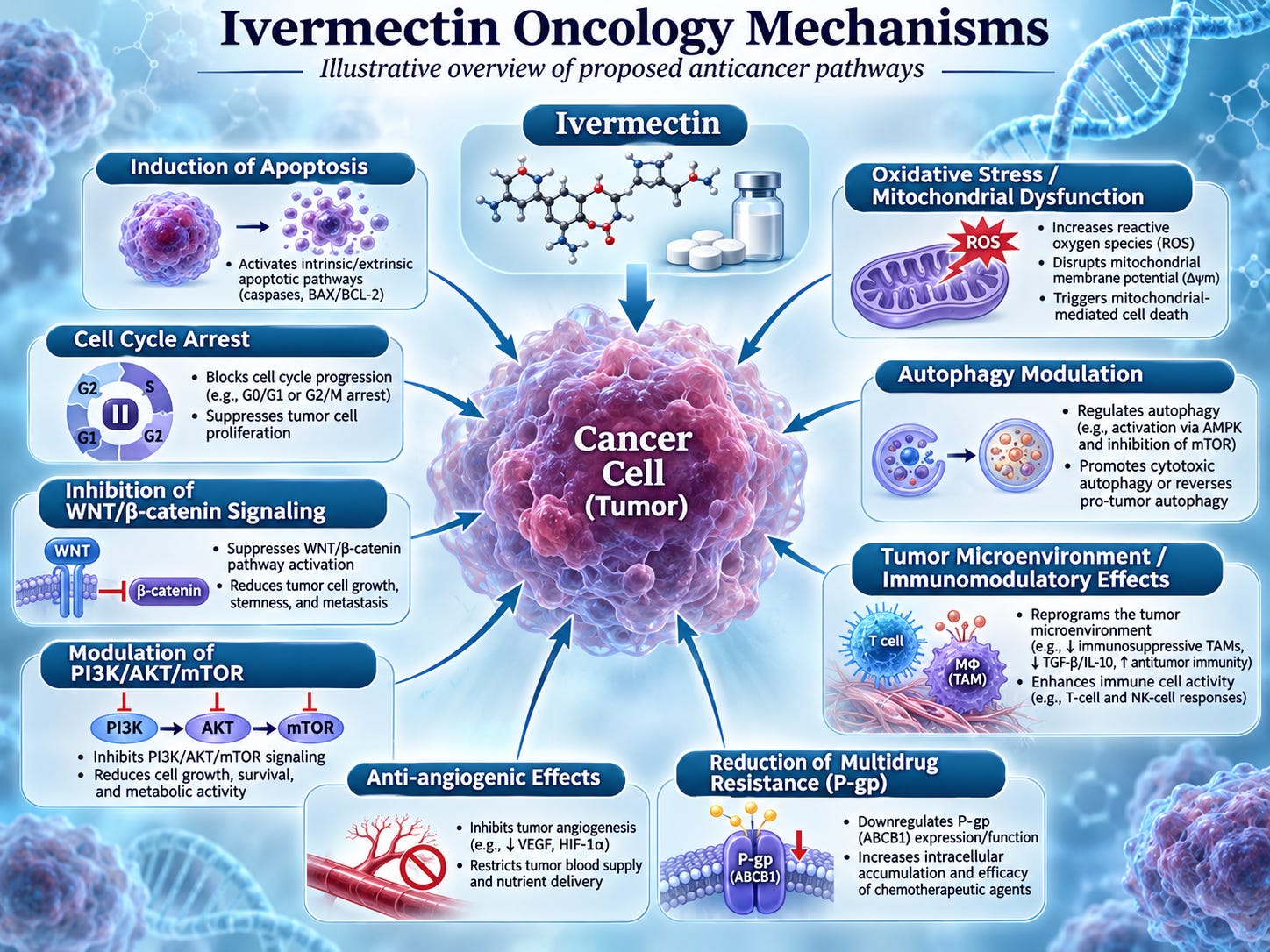
Based on a published scientific paper, this article investigates the potential of the traditional antiparasitic medication ivermectin as a novel treatment for lung adenocarcinoma, a particularly deadly form of cancer. Using laboratory experiments and genetic database analysis, the researchers found that the drug suppresses tumor growth and reduces cancer cell viability. This article discusses in vitro and in vivo preclinical testing (lab & animal). They specifically found that this process occurs because the treatment downregulates the PAK1 protein, triggering a cellular recycling response known as nonprotective autophagy alongside programmed cell death. Ultimately, these findings provide a valuable theoretical foundation for repurposing this well-known medicine into an effective therapeutic strategy against lung cancer.
Ivermectin (IVM) is a 16-membered macrocyclic lactone belonging to the avermectin family, originally derived from soil streptomycetes by Satoshi Ōmura and William C. Campbell (awarded the Nobel Prize in Physiology or Medicine in 2015). Primarily composed of 22,23-dihydroavermectin-B1a (~80%) and 22,23-dihydroavermectin-B1b (~20%), it is widely established as an anthelmintic agent against parasitic diseases like onchocerciasis and lymphatic filariasis. In recent years, it has gained substantial attention in oncology drug repositioning because of its well-characterized human safety profile and broad antineoplastic properties shown in preclinical studies.
Mechanism in LUAD: Ivermectin significantly suppresses lung adenocarcinoma (LUAD) cell proliferation, colony formation, and tumor growth in vivo by downregulating PAK1 protein expression.
Cell Death Pathways: High PAK1 levels correlate with poor overall survival in LUAD patients, and ivermectin counteracts this by triggering apoptosis alongside nonprotective autophagy (confirmed using the autophagy inhibitor 3-MA)
1. Primary Molecular Mechanisms of Action in Cancer
Preclinical investigations indicate that ivermectin acts across multiple interconnected oncogenic nodes rather than a single isolated receptor:
Inhibition of Pro-Survival Signaling Cascades: Ivermectin directly interferes with several key pathways dysregulated across malignancies, notably PI3K/Akt/mTOR, Wnt/β-catenin, and STAT3. It suppresses Akt phosphorylation and downstream mTOR activation, reducing cellular proliferation and enhancing apoptotic sensitivity.
Targeting PAK1 Kinase: p21-activated kinase 1 (PAK1) serves as a central convergence node for ivermectin’s antitumor effects. Ivermectin inhibits PAK1 activity and expression, leading to downstream downregulation of the MEK1/2 and ERK1/2 pathways.
Induction of Apoptosis and Autophagy: Ivermectin triggers programmed cell death via mitochondrial dysfunction, loss of mitochondrial membrane potential, caspase-3/7 activation, and modulation of pro- and anti-apoptotic proteins. It also regulates autophagic flux, depending on the tumor context.
Targeting Cancer Stem Cells (CSCs): Ivermectin preferentially diminishes CSC viability and self-renewal capacity, downregulating pluripotency-associated transcription factors such as NANOG, OCT4, and SOX2, in part via suppression of the PAK1–STAT3 axis.
Reversal of Multidrug Resistance (MDR): A critical antitumor property of ivermectin is its capacity to inhibit P-glycoprotein (P-gp / ABCB1)-mediated drug efflux, enhancing intracellular retention and cytotoxicity of co-administered chemotherapeutic agents.
Immunomodulation and Microenvironment Effects: Ivermectin enhances antitumor immune surveillance by promoting CD8+ T-cell infiltration, reducing regulatory T cells, and inducing immunogenic cell death, converting immunologically “cold” tumors into “hot” ones in preclinical models. It also suppresses VEGF-mediated angiogenic signaling.
2. Preclinical Evidence in Non-Small Cell Lung Cancer (NSCLC)
Within lung cancer research—particularly lung adenocarcinoma (LUAD)—the sources highlight several targeted applications:
Overcoming Paclitaxel (PTX) Chemoresistance: In human lung adenocarcinoma (A549) cells, prolonged exposure to paclitaxel typically induces drug resistance via ABCB1 mRNA upregulation and subsequent P-glycoprotein (P-gp) overexpression. Concurrent treatment with ivermectin completely abolishes P-gp induction, elevating intracellular paclitaxel concentrations and restoring chemosensitivity. This downregulation is mediated through the EGFR/ERK/Akt/NF-κB signaling axis.
PAK1 Downregulation and Nonprotective Autophagy: In lung adenocarcinoma cells, ivermectin impedes colony formation and cell viability while inducing apoptosis and nonprotective autophagy. Mechanistically, it downregulates PAK1 protein levels, and the autophagic response is characterized by an increase in LC3-II and a decrease in p62/SQSTM1. These findings were corroborated in vivo, where ivermectin significantly suppressed tumor growth in LUAD nude mouse xenograft models.
Inhibition of the EGFR/PI3K/Akt/mTOR Axis In Vivo: In a BALB/c mouse model of urethane-induced NSCLC, ivermectin reduced the expression of EGFR, phosphorylated PI3K, Akt, mTOR, and VEGF while augmenting apoptotic markers (Bax/Bcl-2/caspase-3) and suppressing Ki-67.
HSP27 and WNT Pathway Repression: In A549 models, ivermectin directly inhibits Heat Shock Protein 27 (HSP27), sensitizing cells to targeted and taxane therapy. In H358 human bronchioalveolar carcinoma cells, it represses the WNT-TCF gene signature (including AXIN2, LEF1, and Cyclin D1).
3. Clinical Trials and Current Translation Status
Interventional Trials: Early clinical trials are actively testing ivermectin combinations in oncology. For instance, a Phase I/II trial (NCT05318469) has evaluated ivermectin with the immune checkpoint inhibitor balstilimab in metastatic triple-negative breast cancer, demonstrating acceptable safety and tolerability in initial cohorts, though definitive efficacy results remain pending. Other trials, such as the Australian Phase II study (ACTRN12623001164684), have incorporated ivermectin as part of multi-agent repurposing regimens.
Observational Studies: A prospective observational cohort evaluating a compounded combination of ivermectin and mebendazole in cancer patients (including lung cancer) reported high rates of self-reported clinical benefit and disease stabilization; however, this publication was formally retracted, and its findings were recognized as uncontrolled, unadjudicated, and strictly hypothesis-generating.
Translational Challenges: The vast majority of anticancer data for ivermectin is currently derived from in vitro cell assays and animal xenografts. Well-controlled, randomized clinical trials specifically demonstrating therapeutic efficacy and defining optimal dosing, pharmacokinetic bioavailability, and combination regimens in human lung cancer patients are still lacking. Consequently, its use in oncology remains strictly investigational.
Source
Li, M.-Y., Zhang, J., Lu, X., Zhou, D., Deng, X.-F., Liu, Q.-X., Dai, J.-G., & Zheng, H. (2024). Ivermectin induces nonprotective autophagy by downregulating PAK1 and apoptosis in lung adenocarcinoma cells. Cancer Chemotherapy and Pharmacology, 93, 41–54