
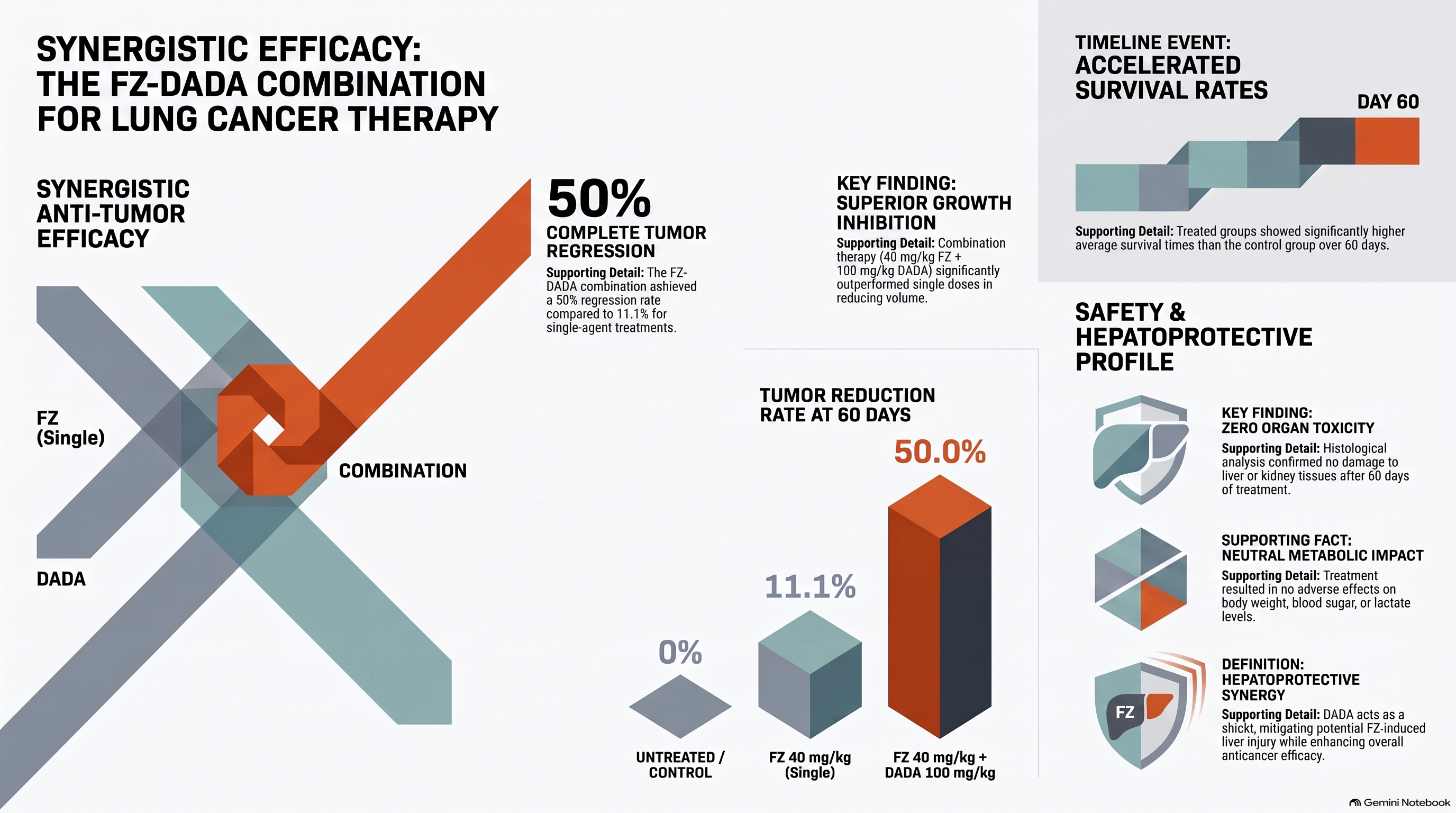
This scientific study investigates a novel combination therapy for non-small cell lung cancer by pairing the antiparasitic drug fenbendazole (FZ) with the metabolic agent diisopropylamine dichloroacetate (DADA). Conducted on immunodeficient mice transplanted with human lung cancer cells, the research demonstrates that these two substances work together to produce a synergistic anti-tumor effect, achieving a 50% rate of complete tumor regression. Beyond merely shrinking tumors, the addition of DADA serves a dual purpose as a hepatoprotective agent, effectively neutralizing the potential liver toxicity typically associated with fenbendazole. The results confirm that this drug pairing is both safe and effective, with no adverse impact on vital organ function or overall survival. Ultimately, the authors propose this well-characterized combination as a promising candidate for drug repurposing and call for further clinical trials to validate its use in human patients.
The Synergistic Equation: FZ & DADA
Synergistic Anticancer Effects of Fenbendazole and Diisopropylamine Dichloroacetate in Lung Cancer Models
Executive Summary
Lung cancer remains the leading cause of cancer-related mortality globally, necessitating the development of novel therapeutic strategies to improve poor prognostic outcomes. Recent research identifies a potent synergistic effect between Fenbendazole (FZ), a veterinary anthelmintic, and Diisopropylamine Dichloroacetate (DADA), a hepatoprotective agent used for chronic liver disease.
The combination therapy (FZ-DADA) demonstrates a multifaceted attack on A549 non-small-cell lung cancer (NSCLC) cells by:
Inducing Apoptosis: Modulating key proteins (BAX/Bcl2) and activating the caspase cascade.
Arresting the Cell Cycle: Blocking progression at the G2/M phase.
Metabolic Reprogramming: Inhibiting glucose uptake and lactate production via the PI3K/AKT signaling pathway.
Enhancing Safety: Utilizing DADA’s hepatoprotective properties to mitigate potential liver toxicity associated with FZ administration.
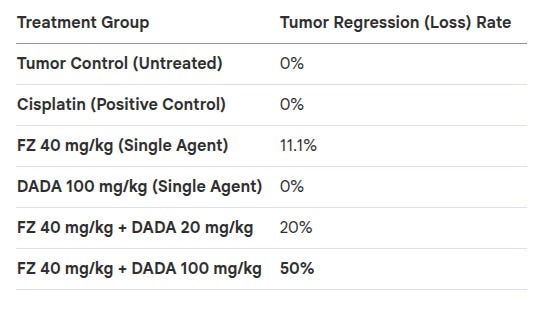
In vivo studies using immunodeficient mice show that the FZ-DADA combination significantly reduces tumor volume and achieves a 50% complete regression rate with 100% survival over 60 days, far outperforming single-agent treatments. This data suggests FZ-DADA is a promising candidate for drug repurposing in lung cancer therapy.
Core Components of the Combination Therapy
The research focuses on the “repurposing” of two established compounds to create a synergistic treatment for lung cancer.
Fenbendazole (FZ)
Primary Use: A broad-spectrum benzimidazole anthelmintic approved for use in animal species.
Anticancer Mechanism: Acts as a moderate microtubule-destabilizing agent by binding to tubulin. It inhibits glucose uptake and induces mitochondrial translocation of p53.
Limitations: While effective in reducing tumor size in self-administration cases, it has been linked to drug-induced liver injury.
Diisopropylamine Dichloroacetate (DADA)
Primary Use: An over-the-counter treatment for chronic liver disease and metabolic disorders (also known as Vitamin B15).
Anticancer Mechanism: Acts as an inhibitor of pyruvate dehydrogenase kinase (specifically PDK-4), which reduces lactate generation.
Synergistic Role: DADA is a hepatoprotective agent. Its inclusion in the therapy is designed to reduce the hepatotoxicity of FZ, making the treatment safer for patients with compromised liver function.
Analysis of In Vitro Mechanisms (A549 Cells)
Detailed cellular analysis confirms that the combination of FZ and DADA is more effective than either drug used in isolation.
1. Inhibition of Proliferation and Cytotoxicity
The studies established the half-maximal inhibitory concentration (IC50) for A549 cells at 1 μM for FZ and 5 mM for DADA.
Synergy Index: The Combination Index (CI) was consistently less than 1.0, which proves a synergistic rather than merely additive effect.
Optimal Ratio: The most effective results in cellular models were found at a ratio of 1 μM FZ to 5 mM DADA.
2. Induction of Apoptosis
The FZ-DADA combination triggers programmed cell death through several pathways:
Protein Modulation: The treatment increases the expression of the pro-apoptotic protein BAX (approx. 17-fold) and decreases the anti-apoptotic protein Bcl2 (approx. 4-fold).
Caspase Activation: The combination significantly upregulates executioner caspases, including Caspase-3 (3.3 to 4 times higher than single agents) and Caspase-7 (12-fold increase).
PARP Cleavage: The therapy increases cleaved Poly (ADP-ribose) polymerase (PARP) levels by about eightfold, a hallmark of irreversible apoptosis.
ROS Production: The combination increases mitochondrial reactive oxygen species (ROS), disrupting mitochondrial function and facilitating cell death.
3. Cell Cycle Arrest
FZ-DADA effectively halts cancer cell replication at the G2/M phase. This is achieved by down-regulating critical checkpoints:
Cyclin A: Decreased approximately 3.5 times compared to single treatments.
Cyclin E: Decreased approximately 6.6 times compared to single treatments.
4. Metabolic Disruption
Cancer cells rely on metabolic flexibility to survive (the Warburg effect). FZ-DADA disrupts this via the PI3K/AKT pathway:
Glucose Uptake: The combination significantly reduces 2-deoxyglucose (2-DG) uptake.
Lactate Production: By inhibiting PDK-4, DADA reduces the synthesis of lactate, a byproduct necessary for cancer cell proliferation.
Signaling Inhibition: The treatment reduces levels of phosphorylated AKT (pAKT) and PI3K (pPI3K), particularly after 5-7 hours of exposure.
In Vivo Efficacy and Safety (Animal Models)
Studies in immunodeficient BALB/c nude mice transplanted with A549 cells provide evidence of the therapy’s systemic effectiveness.
Antitumor Results
The researchers compared eight groups, including controls (Healthy, Tumor, and Cisplatin) and various FZ-DADA dosage combinations.
Survival and Safety Profiles
Survival: The combination treatment (Group 8: 40mg/kg FZ + 100mg/kg DADA) resulted in 100% survival over the 60-day study period, compared to only 22.2% in the untreated tumor control group.
Body Weight: Treated mice maintained or increased body weight, indicating the treatment was well-tolerated.
Organ Health: Histopathological analysis and blood tests confirmed no significant damage to liver or kidney function:
Liver: ALT and AST levels showed no significant hepatocellular damage.
Kidney: Urea and creatinine levels remained within normal ranges.
Metabolism: Blood sugar and blood lactate levels showed no significant changes among the treatment groups.
Conclusion and Clinical Implications
The synthesis of in vitro and in vivo data demonstrates that the FZ-DADA combination is a robust synergistic strategy against A549 lung cancer cells.
Key Conclusions:
Synergistic Superiority: The combination of 40 mg/kg FZ and 100 mg/kg DADA is significantly more effective at inducing tumor regression and extending survival than either agent alone.
Multimodal Attack: The therapy simultaneously targets cell structure (microtubules), cell cycle (G2/M arrest), and cell metabolism (PI3K/AKT pathway).
Hepatoprotective Benefit: DADA effectively mitigates the liver injury risks typically associated with FZ, allowing for potentially safer long-term administration.
Translation Potential: Because both FZ and DADA are well-characterized drugs, this combination is a viable candidate for repurposing as a low-toxicity therapeutic option for Non-Small Cell Lung Cancer (NSCLC).
The researchers conclude that clinical studies are now warranted to validate these findings in human patients.
Sources:
Synergistic anti-tumor effect of fenbendazole and diisopropylamine dichloroacetate in immunodeficient BALB/c nude mice transplanted with A549 lung cancer cells
AME Publishing Company. Transl Lung Cancer Res 2025;14(7):2509-2521 |
Published online Jul 25, 2025. https://dx.doi.org/10.21037/tlcr-2024-1272
https://pmc.ncbi.nlm.nih.gov/articles/PMC12337031/pdf/tlcr-14-07-2509.pdf
Fenbendazole and Diisopropylamine Dichloroacetate Exert Synergistic Anti-cancer Effects by Inducing Apoptosis and Arresting the Cell Cycle in A549 Lung Cancer Cells.
Anticancer Research. 2024 Nov;44(11):4761-4772. doi: 10.21873/anticanres.17302.
https://pubmed.ncbi.nlm.nih.gov/39477286/ https://ar.iiarjournals.org/content/anticanres/44/11/4761.full.pdf