
This article is for educational and informational purposes only. We are not doctors and do not provide medical advice. Nothing shared here is intended to diagnose, treat, cure, or prevent any disease.
1. Introduction: The Power of Drug Repurposing
Developing novel oncology therapeutics through conventional drug discovery pipelines is an extraordinarily costly, labor-intensive, and time-consuming endeavor. Despite decades of technological progress in early diagnostic imaging and targeted molecular regimens, non-small cell lung cancer (NSCLC)—which accounts for the vast majority of lung cancer diagnoses—remains the single leading cause of cancer-related mortality globally, carrying a sobering overall prognosis. More than 75% of NSCLC patients eventually become candidates for systemic chemotherapy due to widespread metastatic dissemination. Unfortunately, standard chemotherapeutic options often yield disappointing response rates, brief progression-free survival windows, and exceptionally rare complete remissions. This article discusses in vitro and in vivo preclinical testing (lab and animal).
To overcome these clinical, financial, and temporal bottlenecks, translational oncologists increasingly turn to “drug repurposing”—the strategic identification of new oncological applications for well-characterized, clinically approved non-cancer medications. In a seminal investigation published in Molecular Cancer Therapeutics by Sasaki et al. (2002), a remarkable drug candidate came to light: Mebendazole (MZ). Widely known as an inexpensive, orally administered antiparasitic agent used worldwide for helminthic infections, Mebendazole demonstrated powerful preclinical efficacy as a targeted antitumor agent against aggressive non-small cell lung cancer.
2. Takeaway 1: An Over-the-Counter Antiparasitic Drug Can Stop Aggressive Lung Cancer
Systemic metastasis and innate chemotherapeutic resistance make NSCLC notoriously refractory to conventional interventions. However, rigorous in vitro evaluations revealed that Mebendazole significantly suppresses tumor cell proliferation and viability across multiple human NSCLC cell lines—including H460, A549, and H1299—at sub-micromolar concentrations.
In cell proliferation assays, MZ inhibited lung cancer growth at doses starting as low as 0.1\,\mu\text{M}. When evaluated for cytotoxicity via XTT assays, MZ suppressed cancer cell viability by more than 50% at concentrations between 0.2\,\mu\text{M} and 0.5\,\mu\text{M}. The half-maximal inhibitory concentration (\text{IC}_{50}) values were recorded at 0.203 \pm 0.012\,\mu\text{M} for H460, 0.26 \pm 0.008\,\mu\text{M} for H1299, and 0.417 \pm 0.038\,\mu\text{M} for A549.
Crucially, cell line genetic profiles highlight an essential mechanistic insight: while H460 and A549 harbor wild-type p53, H1299 is a completely p53-null cell line. Because H1299 exhibited profound sensitivity to MZ (\text{IC}_{50} = 0.26\,\mu\text{M}), the researchers conclusively demonstrated that MZ’s tumor-killing potency operates independently of functional p53 gene status.
“Although echinococcosis requires long-term treatment with MZ, the incidence of severe side effects to the host has been quite low... Because the drug acts by inhibiting microtubule formation and because its delivery to human peripheral lung tissue has few or no side effects, we assumed that MZ may have an antitumor effect on human lung cancer.”
Reflection: Uncovering potent antineoplastic properties in an off-patent compound with decades of documented human safety data represents a massive advantage in modern oncology. Bypassing the multi-year, high-risk Phase I safety trials typically required for novel chemical entities dramatically accelerates the bench-to-bedside translational pathway, lowering development costs while expediting clinical delivery.
3. Takeaway 2: The Biological Sabotage: How Mebendazole Arrests Cancer Cell Division
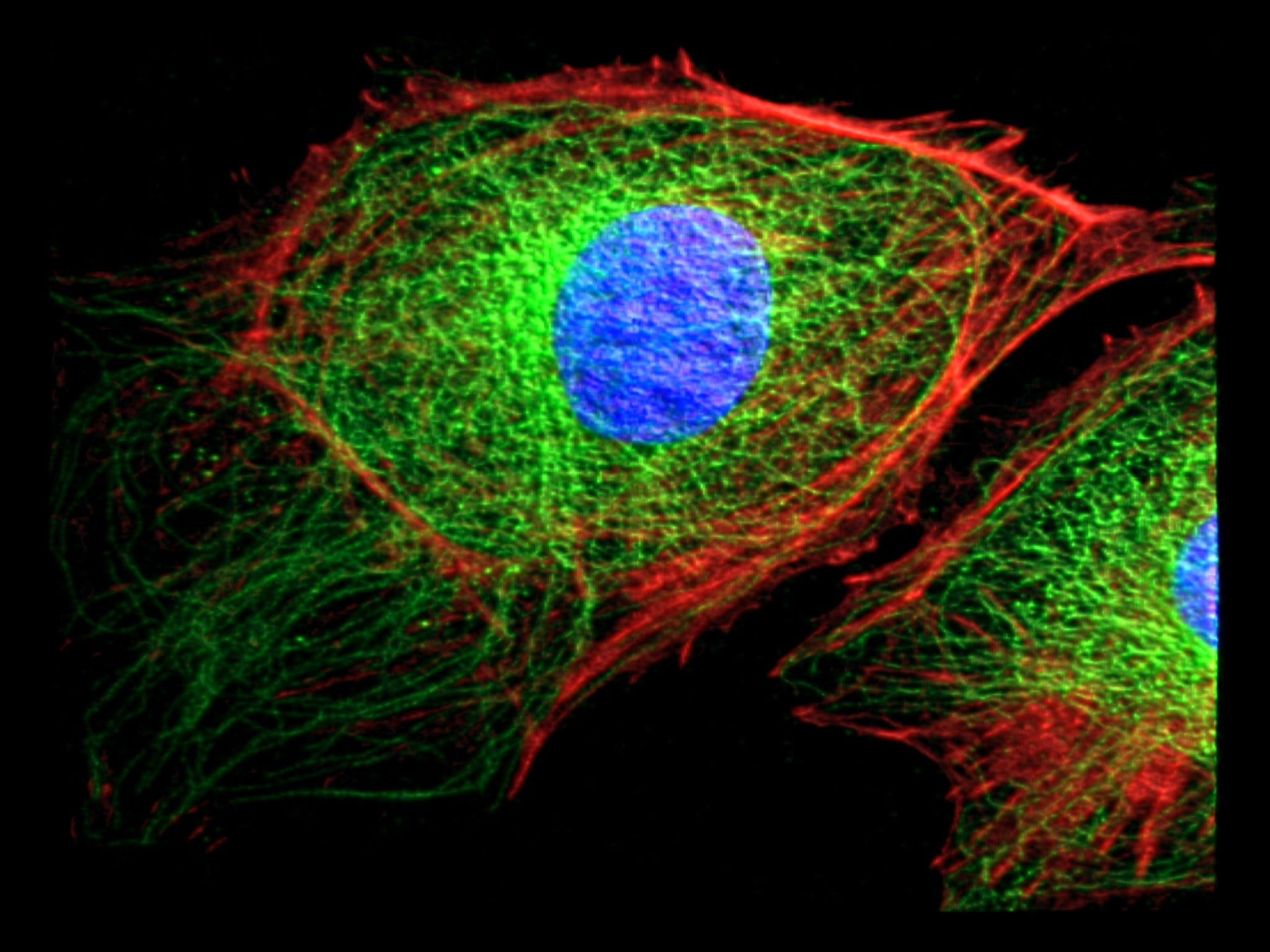
At the sub-cellular level, Mebendazole sabotages the essential structural machinery required for mitotic cell division. Microtubules, constructed through the dynamic assembly and disassembly of tubulin heterodimers, form the mitotic spindle required to segregate duplicated chromosomes during division. MZ binds directly to tubulin, enhancing tubulin depolymerization and disrupting spindle assembly dynamics.
When NSCLC cells attempt division under MZ exposure, they fail to configure functional bipolar spindles, instead developing abnormal, reduced, or monopolar (monoaster) spindle configurations. This severe structural defect triggers the cell’s spindle assembly checkpoint, stalling the cell cycle at the \text{G}_2/\text{M} transition and causing an accumulation of cells with 4N DNA content. Trapped in mitotic arrest, the tumor cells subsequently activate programmed cell death pathways.
Detailed protein analysis revealed that MZ induces mitotic arrest markers—such as the phosphorylation of Cdc25C and MPM-2 epitopes, alongside peak expression of cyclin B1 and Aurora A kinase (AIK) at 12 hours post-treatment. Interestingly, while Bcl-2 underwent phosphorylation in H460 cells at 6–12 hours, no corresponding phosphorylation of Bcl-2 or Bcl-\text{xL} occurred in A549 cells (where Bcl-\text{xL} predominates). This subtle divergence confirmed that Bcl-2/Bcl-\text{xL} phosphorylation acts as a secondary biomarker of \text{M}-phase stalling rather than a universal requirement for MZ-induced apoptosis.
Furthermore, when researchers co-treated H460 cells with z\text{-VAD-FMK}, a broad-spectrum pan-caspase inhibitor, cell survival was rescued by no more than 15% even at maximal concentrations (100\,\mu\text{g/ml}). This pivotal finding demonstrates that while classical caspase cascades are active, MZ also engages parallel, non-caspase-dependent death pathways to execute malignant cells.
The key molecular dominoes that fall during MZ treatment include:
Tubulin Depolymerization & Abnormal Spindle Formation: MZ destabilizes microtubule assembly, forcing mitotic cells into defective, monopolar spindle arrangements rather than normal bipolar mitotic apparatuses.
Mitotic Arrest (\text{G}_2/\text{M} Phase Stalling): Cells accumulate with 4N DNA content within 12 hours of exposure, driven by peak upregulation of cyclin B1 and Aurora A kinase (AIK), alongside Cdc25C phosphorylation.
Mitochondrial Cytochrome c Release: By 24 hours post-treatment, compromised mitochondrial outer membranes leak cytochrome c into the cytosol in a dose-dependent manner.
Caspase Activation & Apoptosis Execution: Cytosolic cytochrome c triggers an enzymatic cascade involving the cleavage and activation of caspases 3, 8, and 9, as well as poly(ADP-ribose) polymerase (PARP), causing extensive nucleosomal DNA fragmentation within 48 hours.
4. Takeaway 3: High Selectivity—Potent Against Cancer, Mild on Healthy Cells
A central limitation of classical antimitotic chemotherapies (such as paclitaxel, docetaxel, or vinorelbine) is their indiscriminate cytotoxicity toward healthy proliferating cells. Mebendazole displays a remarkably favorable therapeutic index, exhibiting sharp selectivity for malignant cells over non-transformed human tissue.
While MZ aggressively ablated viability in NSCLC lines (\text{IC}_{50} of 0.203\,\mu\text{M} in H460), its cytotoxic effect on non-malignant human lung fibroblasts (WI-38) was strikingly subdued. Even when exposed to high doses up to 10\,\mu\text{M}—roughly 50 times the concentration required to kill H460 cancer cells—WI-38 fibroblast survival was reduced by no more than 40%.
Biochemical quantification illuminates the mechanism behind this differential selectivity. Measured after 4 hours of treatment in A549 cells, the soluble-to-polymerized (depolymerized vs. assembled) tubulin ratio was 0.75 \pm 0.12 for MZ, compared to 1.46 \pm 0.25 for the aggressive laboratory spindle poison nocodazole, and 0.42 \pm 0.06 for DMSO vehicle controls. This confirms that MZ acts as a fundamentally “mild” tubulin-depolymerizing agent.
Reflection: This moderate intensity of microtubule disruption represents a major therapeutic advantage. Malignant cells routinely suffer from defective mitotic checkpoints and aberrant cell-cycle controls, rendering them acutely vulnerable to even mild spindle destabilization. Healthy cells, possessing intact checkpoint surveillance, readily tolerate this level of microtubule alteration without triggering apoptotic execution, avoiding the organ toxicity typical of aggressive antimitotic chemotherapies.
5. Takeaway 4: Outperforming Chemotherapy in Animal Models Without Toxic Side Effects
The preclinical efficacy of Mebendazole translates seamlessly from in vitro cultures to in vivo mammalian models. Sasaki et al. evaluated oral administration of homogenized chewable MZ tablets (Vermox) at a dose of 1 mg per mouse administered every other day.
The in vivo findings demonstrated remarkable therapeutic superiority:
Subcutaneous Tumor Regression: In nude mice bearing established subcutaneous H460 xenografts, oral MZ significantly suppressed tumor volume expansion within 14 days of initiation compared to water-treated controls. Fluorescent TUNEL staining of excised tumor tissues confirmed dense, widespread apoptotic cell death throughout the treated tumor mass.
Dramatic Suppression of Lung Metastasis: In an experimental A549 lung metastasis model, oral MZ produced an overall 5-fold reduction in surface lung colonies relative to untreated controls.
Complete Metastatic Clearance in Individual Trials: Granular data from Table 1 reveal even more striking outcomes. Across 5 independent experimental runs, oral MZ achieved total metastatic eradication—reducing surface lung colonies to 0—in two full trial groups (Experiments 2 and 4). By contrast, intraperitoneal paclitaxel failed to meaningfully reduce metastatic burden and caused severe systemic toxicity, resulting in host mortality (”Dead”) in Experiment 2.
Zero Host Toxicity: Mice treated with oral MZ single-agent therapy maintained normal body weight, normal physical activity, and zero treatment-related organ pathology.
“Oral administration of MZ in mice elicited a strong antitumor effect in a s.c. model and reduced lung colonies in experimentally induced lung metastasis without any toxicity when compared with paclitaxel-treated mice.”
6. Takeaway 5: A Multi-Pronged Attack Beyond Tubulin
Because Mebendazole achieves profound tumor suppression despite causing significantly milder tubulin depolymerization than agents like nocodazole, the investigators concluded that microtubule disruption is only one component of a broader, pleiotropic mechanism. MZ executes a multi-pronged attack against tumor survival.
First, in vivo histological analyses established that MZ possesses potent anti-angiogenic activity. Tumors treated with MZ exhibited marked reductions in microvascular density—confirmed by decreased CD31 endothelial staining and diminished intra-tumoral hemoglobin content. By blocking neo-vascularization, MZ starves growing tumor masses of oxygen and vital nutrients.
Second, as noted in the molecular profiling, MZ triggers apoptotic cell death across varied genetic backgrounds. It successfully activates caspases 3, 8, and 9 regardless of whether tumor cells express wild-type p53 (H460, A549) or are completely p53-null (H1299). Coupled with the observation that pan-caspase inhibition with z\text{-VAD-FMK} rescues cell survival by no more than 15%, it is clear that MZ engages redundant, non-caspase death mechanisms simultaneously.
Reflection: Heterogeneous, evolving tumors rapidly develop resistance to highly specialized, single-target molecular therapies. Multi-targeted or pleiotropic agents like Mebendazole—which simultaneously disrupt mitotic spindle formation, inhibit tumor angiogenesis, and trigger multiple apoptotic signaling cascades—present a significantly higher evolutionary barrier for cancer cells to overcome through single-gene mutations.
7. Conclusion: The Promise of Repurposed Therapeutics
The preclinical findings established by Sasaki et al. provide a compelling foundation for repurposing Mebendazole in clinical oncology. By combining selective mitotic arrest, low systemic toxicity, excellent oral bioavailability, anti-angiogenic potency, and low manufacturing costs, MZ overcomes many of the classical failure points associated with standard NSCLC chemotherapies.
If validated in clinical trials, the strategic integration of off-patent, highly accessible compounds like Mebendazole could democratize advanced cancer care—making effective, well-tolerated therapeutics affordable worldwide while providing versatile combination partners for modern immunotherapies and targeted agents.
A Final Thought: With accessible, well-tolerated compounds like Mebendazole demonstrating such profound antineoplastic potential, how many other life-saving remedies are already sitting unexamined on our pharmacy shelves?
Sasaki, J., Ramesh, R., Chada, S., Gomyo, Y., Roth, J. A., & Mukhopadhyay, T. (2002). The anthelmintic drug mebendazole induces mitotic arrest and apoptosis by depolymerizing tubulin in non-small cell lung cancer cells. Molecular Cancer Therapeutics, 1(13), 1201–1209.