
1. The Challenge of Medulloblastoma and the Power of Drug Repurposing
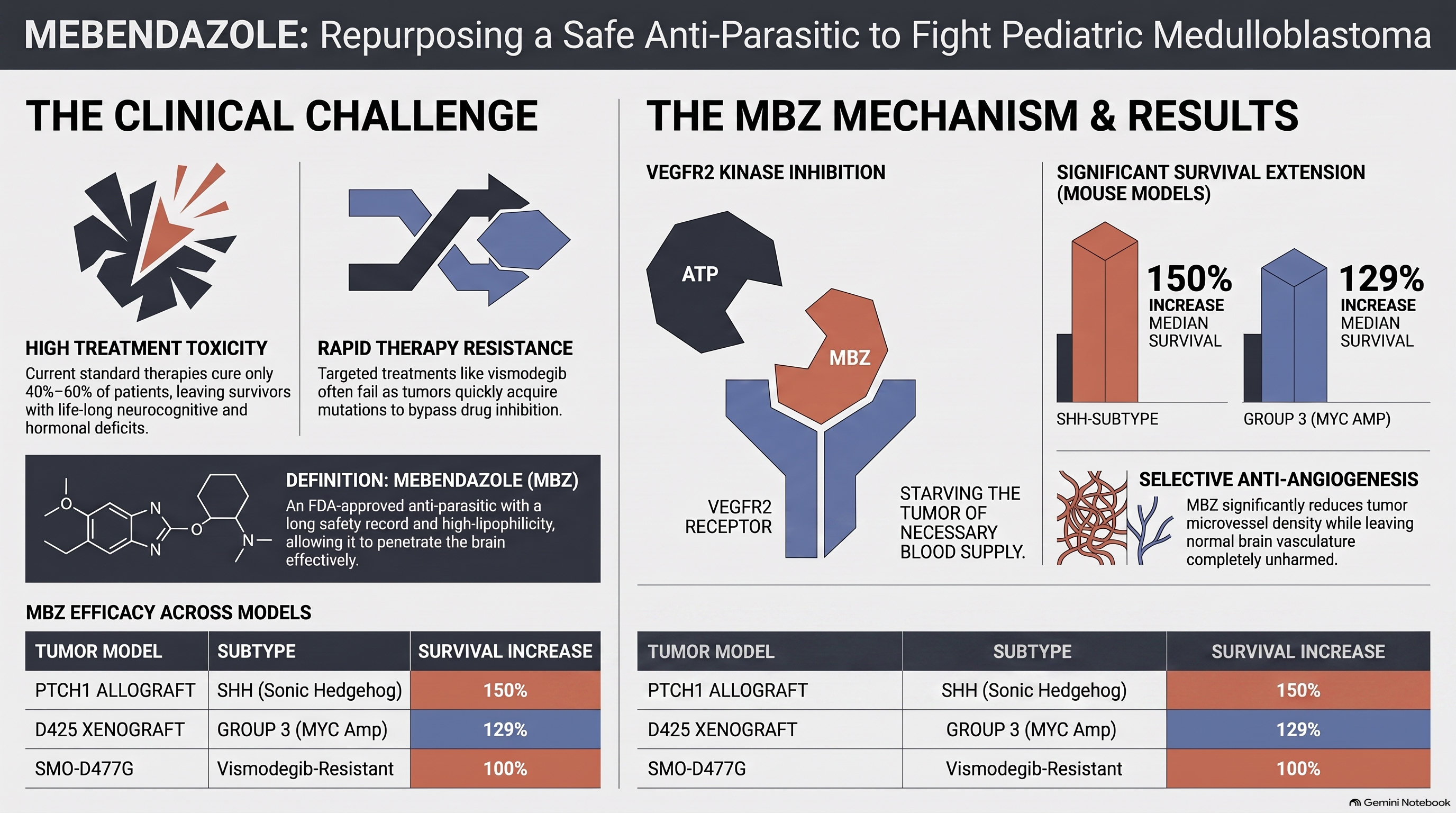
Medulloblastoma is a highly aggressive primitive neuroectodermal tumor arising in the cerebellum, representing the most common malignant brain tumor in children. While modern clinical management has improved survival rates to approximately 40%–60%, the “standard of care” remains problematic. The current therapeutic triad of surgery, craniospinal radiation, and systemic chemotherapy utilizes a non-selective cytotoxic approach that frequently results in severe, long-term neurological and systemic sequelae.
Key Challenge - The developing pediatric brain is exceptionally vulnerable to traditional therapies. Because current treatments cannot sufficiently distinguish between malignant cells and healthy neural tissue, survivors often face permanent cognitive and physiological impairment.
Primary Limitations of Current Therapies:
Neurocognitive Deficiencies: Radiation therapy is linked to impaired neural development, hormone deficits, and significant growth impairment.
Ototoxicity: Platinum-based chemotherapeutics often lead to permanent, irreversible hearing loss.
Secondary Malignancies: The use of alkylating agents increases the long-term risk of developing secondary leukemias.
Infertility: High-dose systemic chemotherapy can result in permanent reproductive dysfunction.
The “So What?” of Mebendazole (MBZ) - To mitigate these risks, researchers are prioritizing drug repurposing—the investigation of established, FDA-approved compounds for new oncological indications. Mebendazole, a long-standing antiparasitic, is a highly promising candidate due to its exceptional safety profile in children. Crucially, MBZ possesses a low molecular weight (295 daltons) and high lipophilicity, characteristics that facilitate its permeability across the blood-brain barrier—a primary obstacle in treating intracranial malignancies.
The transition from theoretical “bench” observations to clinical application requires rigorous validation in controlled laboratory environments to ensure both safety and efficacy.
2. The Laboratory Stand-In: Allografts vs. Xenografts
To evaluate the efficacy of MBZ across the heterogeneous landscape of medulloblastoma, researchers utilize specific mouse models as biological stand-ins. These models allow for the study of the drug’s impact on the distinct molecular pathways that drive different subtypes of the disease, including those that have developed resistance to modern targeted therapies.
(Below: Model Type followed by Biological Origin and Molecular Context)
Orthotopic Allograft - Derived from spontaneous murine tumors with PTCH1 and p53 mutations. It represents the Sonic Hedgehog (SHH) group and includes variants like the SMO-D477G mutant, which models acquired resistance to the smoothened inhibitor vismodegib.
Orthotopic Xenograft - Utilizes human D425 cancer cells (Group 3). This subtype carries c-MYC and OTX2 genomic amplifications, representing the group with the most clinical aggression and poorest prognosis.
Once the appropriate models are selected to reflect the molecular diversity of the disease, researchers follow a precise surgical protocol to simulate the human condition.
3. The Experimental Timeline: Implantation and Dosing
Preclinical validation follows a strict chronological sequence to ensure that changes in tumor volume and animal survival are directly attributable to the experimental intervention.
Bioluminescent Tagging: Tumor cells are infected with a lentivirus carrying the firefly luciferase gene, enabling non-invasive internal imaging.
Stereotactic Implantation: Using a stereotactic frame for sub-millimeter precision, researchers inject 100,000 to 500,000 cells through a burr hole into the cerebellum (right vermis).
Engraftment Phase: A five-day period is observed to allow the tumor to establish its microenvironment and vasculature.
Therapeutic Dosing: MBZ is administered daily via oral gavage at a dosage of 50 mg/kg (the established maximum tolerated dose for daily administration).
Pro-Tip: Why Sesame Oil? Mebendazole is highly lipophilic (fat-soluble). By resuspending the ground drug in a 50% sesame oil mixture, researchers significantly enhance gastrointestinal absorption, ensuring the drug reaches therapeutic concentrations in the bloodstream and, ultimately, the brain.
Following the establishment of the dosing regimen, the focus shifts to quantitative metrics of therapeutic success.
4. Measuring Success: Tumor Load and Survival Rates
Researchers employ two primary metrics to evaluate the success of MBZ: Bioluminescence Imaging and Kaplan-Meier Survival Analysis.
Bioluminescence (Xenogen/IVIS): By measuring the light emitted by luciferase-tagged cells, researchers quantify the tumor load in Relative Light Units (RLU) or photons/second. A significant reduction in RLU compared to control groups indicates effective tumor growth inhibition.
Kaplan-Meier Survival Curves: This statistical tool tracks the lifespan of the cohorts. It is the gold standard for determining if a drug successfully extends life in the face of aggressive malignancy.
By the Numbers: MBZ Efficacy
150% Survival Increase: Observed in the PTCH1-mutant (SHH) allograft model.
129% Survival Extension: In the D425 (Group 3) xenograft model, where median survival was extended from 21 to 48 days.
100% Survival Extension: Achieved in the SMO-D477G model, proving MBZ’s effectiveness even after the tumor has developed resistance to vismodegib.
While survival data confirms efficacy, microscopic investigation is required to elucidate the specific biochemical mechanisms at play.
5. Investigating the Mechanism: Angiogenesis and VEGFR2
Tumors require a robust blood supply to sustain rapid proliferation, a process known as angiogenesis. The study reveals that MBZ acts as a highly promising pleiotropic agent, specifically targeting the tumor’s life-support system by inhibiting VEGFR2 (Vascular Endothelial Growth Factor Receptor 2).
How MBZ Impairs Tumor Growth:
ATP Competition at the Catalytic Domain: MBZ competes with ATP for binding sites within the tyrosine kinase catalytic domain of VEGFR2. This prevents the energy exchange necessary for the receptor to function.
Inhibition of Autophosphorylation: MBZ specifically blocks the autophosphorylation of critical tyrosine residues, including Y1175, Y1054, and Y1059, effectively “switching off” the downstream signals for vessel growth.
Selective Reduction of Microvessel Density: Histological analysis using the CD31 marker shows that MBZ significantly reduces the density of blood vessels within the tumor while leaving the normal brain vasculature completely unharmed.
Primary Driver in Group 3: Notably, while MBZ is known to disrupt tubulin in other cancers, it did not interfere with tubulin polymerization in D425 cells. This suggests that in the aggressive Group 3 subtype, VEGFR2-mediated anti-angiogenesis is the primary mechanism of action.
6. The “So What?” for Future Patients
The evidence synthesized from these preclinical models identifies Mebendazole as a highly promising pleiotropic agent for pediatric oncology. By inhibiting tumor angiogenesis and overcoming acquired resistance in SHH-driven pathways, MBZ addresses the most critical gaps in current medulloblastoma treatment.
Takeaway Checklist: Validating a New Treatment
[x] Safety Profile: Does the drug have an established history of low toxicity in pediatric populations? (MBZ is a proven antiparasitic).
[x] Pharmacokinetics: Can the molecule cross the blood-brain barrier? (MBZ is small—295 Da—and lipophilic).
[x] Broad-Spectrum Efficacy: Is it effective across multiple molecular subtypes? (Validated in SHH and Group 3).
[x] Mechanism of Action: Is the biochemical pathway identified? (Competitive inhibition of VEGFR2 at the ATP-binding site).
[x] Resistance Management: Can it overcome acquired resistance? (Confirmed in SMO-D477G mutant models).
The meticulous application of animal model methodology has transformed an everyday antiparasitic into a robust clinical candidate, providing a foundation of hope for children with treatment-refractory medulloblastoma.
Source:
Effective treatment of diverse medulloblastoma models with mebendazole and its impact on tumor angiogenesis Ren-Yuan Bai, Verena Staedtke, Charles M. Rudin, Fred Bunz, and Gregory J. Riggins
Neuro-Oncology 17(4), 545–554, 2015 doi:10.1093/neuonc/nou234 Advance Access date 24 September 2014