
Introduction
What if an everyday anti-parasitic medication—used safely for over 50 years to treat intestinal worms for mere pennies—holds the key to tackling one of humanity’s most aggressive and lethal brain cancers?
In this lesson, we will explore the cutting-edge science of oncology drug repurposing through the lens of mebendazole (MBZ). We will journey from microscopic cellular targets and blood-brain barrier dynamics all the way to preclinical animal models and human clinical trials.
By the end of this lesson, you will be able to:
Explain the therapeutic rationale for repurposing mebendazole against primary brain tumours such as glioblastoma and medulloblastoma.
Detail the multimodal mechanisms of action by which mebendazole disrupts cancer cell proliferation, kinase signalling, angiogenesis, Hedgehog activity, and DNA repair.
Differentiate between the physical polymorphs of mebendazole and evaluate how formulation and efflux transporters dictate central nervous system exposure.
Critique the current clinical trial landscape, identifying why preclinical success has not yet fully translated into clear human survival benefits.
The Clinical Challenge and the Repurposing Rationale
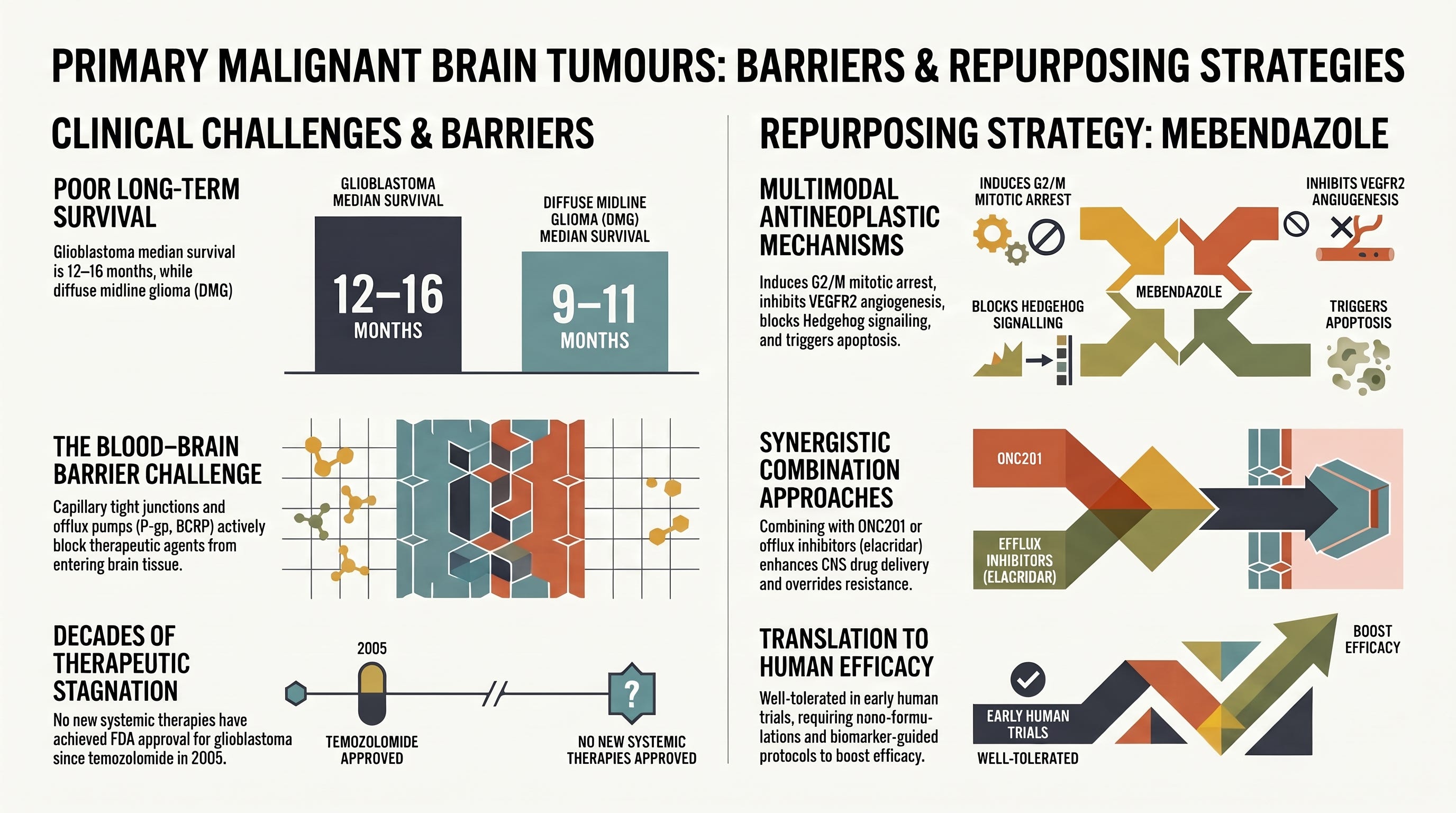
Primary malignant brain tumours, such as IDH wild-type glioblastoma (GBM), represent some of the most formidable challenges in modern medicine. Despite aggressive multimodal standard-of-care treatments—combining surgical resection, external beam radiotherapy, and alkylating chemotherapy with temozolomide (TMZ)—patient outcomes remain sobering, with median overall survival lingering around 12 to 16 months and a 5-year survival rate of just 22%.
A primary biological bottleneck in neuro-oncology is the blood-brain barrier (BBB). Formed by tight junctions between brain microvascular endothelial cells, the BBB functions like a strict security checkpoint, denying entry to more than 98% of small-molecule drugs. Traditional microtubule-targeting chemotherapies like vincristine struggle to cross this barrier in therapeutic quantities and frequently trigger severe, dose-limiting peripheral neuropathy.
This is where drug repurposing enters the narrative. By leveraging compounds with established safety profiles, researchers can dramatically accelerate the timeline and lower the cost of drug development. Mebendazole, a synthetic benzimidazole derivative introduced in 1972 for helminthic infections, stands out as a top candidate. Unlike classical tubulin inhibitors, MBZ crosses the blood-brain barrier effectively while demonstrating minimal neurotoxicity.
In a seminal head-to-head comparison by De Witt et al. (2017), MBZ was directly evaluated against vincristine in an orthotopic GL261 mouse glioma model. While vincristine showed greater nominal potency in vitro, it failed to extend survival in vivo even at maximum tolerated doses and caused severe peripheral neuropathy. In contrast, oral MBZ significantly extended mouse survival without inducing peripheral nerve damage. This key finding underscores a crucial principle in neuro-oncology: nominal in vitro potency matters far less than systemic safety and effective intracranial penetration.

Mechanistic Multitasking: How Mebendazole Attacks Tumours
Targeted cancer therapies often fail because heterogeneous tumours quickly evolve adaptive resistance. Mebendazole avoids this trap by acting like a molecular Swiss-Army knife, simultaneously destabilizing multiple hallmarks of cancer.
Microtubule Depolymerization & Mitotic Arrest: MBZ binds directly to tubulin subunits, inhibiting microtubule assembly. This prevents mitotic spindle formation, locking cancer cells in the G2/M phase of the cell cycle and triggering apoptosis through caspase-3 activation, PARP cleavage, and altered Bcl-2 protein signalling.
Potent Kinase Inhibition: Beyond the cytoskeleton, in silico and biophysical target profiling by Ariey-Bonnet et al. (2020) revealed that MBZ directly inhibits key oncogenic kinases. It shows its highest potency against MAPK14 (p38α MAPK), with an IC50 of 0.10 μM, and also inhibits ABL1, ERK2, VEGFR-2, and PDGFRα.
Anti-Angiogenesis: By competing for the ATP-binding site of VEGFR-2 and blocking its autophosphorylation, MBZ selectively suppresses vessel growth inside tumours without harming surrounding normal brain vasculature, as shown by Bai et al. (2015).
Hedgehog Pathway Interference: The Hedgehog signalling cascade fuels tumour proliferation and stemness. Larsen et al. (2015) showed that MBZ prevents primary cilium formation, blocking Smoothened (SMO) translocation and downregulating downstream GLI1 and PTCH1 expression (IC50 ~516 nM). Remarkably, MBZ remains active against vismodegib-resistant SMO mutants.
Disruption of DNA Repair & Radiosensitization: Markowitz et al. (2017) discovered that nanomolar concentrations of MBZ (25–35 nM) block the nuclear import of vital DNA repair proteins (Chk2 and Nbs1). This prolongs γH2AX damage signalling post-irradiation, turning MBZ into a potent radiosensitizer.
Pyroptosis and Autophagy Modulation: In addition to classic apoptosis, Ren et al. (2022) observed that MBZ triggers NLRP3/GSDMD-mediated pyroptosis (an inflammatory form of programmed cell death), while Jo et al. (2022) showed that combining MBZ with the autophagy inhibitor chloroquine produces synergistic cell killing.
The Polymorph Puzzle and Brain Exposure Optimization
Having a potent molecular weapon is useless if it cannot reach the target in sufficient quantities. For mebendazole, achieving consistent brain exposure depends on navigating solid-state polymorphism and overcoming active drug efflux.
Mebendazole crystallizes into three distinct solid structural forms, known as Polymorphs A, B, and C. Bai et al. (2015) conducted detailed pharmacokinetic comparisons that revealed drastic differences among these three forms:
Polymorph A (MBZ-A): Poorly absorbed in the gastrointestinal tract. It yields extremely low plasma and brain concentrations, offering zero survival benefit in animal models.
Polymorph B (MBZ-B): Achieves high systemic plasma levels but causes substantial systemic toxicity and weight loss, leading to treatment-related deaths in animal studies.
Polymorph C (MBZ-C): The gold standard for neuro-oncology. It yields a favorable brain-to-plasma (B/P) AUC ratio of 0.82, achieving intraparenchymal brain tissue levels that exceed the in vitro IC50 of glioma cells by more than 29-fold while maintaining excellent tolerability.
A hidden risk in clinical development is polymorph transformation: pure Polymorph C can gradually convert into the inactive Polymorph A over time if exposed to high heat and humidity.
Even with Polymorph C, central nervous system exposure is actively limited by blood-brain barrier efflux pumps, specifically P-glycoprotein (P-gp) and breast cancer resistance protein (BCRP). Co-administration of MBZ-C with the efflux inhibitor elacridar blocks apical transporter pumps, raising brain tissue accumulation even higher and extending survival up to fourfold in rodent models.
To further bypass oral absorption barriers and efflux transport, researchers are developing novel delivery platforms. These include albumin- and Polysorbate-80-coated nanosuspensions (Patel et al., 2024) and mucoadhesive intranasal microemulsions (Mena-Hernandez et al., 2020), which deliver MBZ directly to the central nervous system via olfactory and trigeminal nerve pathways.
Bench to Bedside: Clinical Reality and Future Directions
Preclinical studies of mebendazole in glioblastoma, medulloblastoma, and diffuse midline glioma (DMG) consistently demonstrate dramatic tumour growth suppression and survival extensions ranging from 60% to over 150%. However, translating these striking benchtop results to human clinical efficacy has proven complex.
Early-phase human clinical trials have established that high-dose oral mebendazole is safe and remarkably well tolerated:
Gallia et al. (2021): A phase I trial in newly diagnosed high-grade glioma patients tested custom-formulated MBZ-C (up to 200 mg/kg/day) alongside adjuvant temozolomide. The combination was safe, with reversible liver enzyme elevation as the primary toxicity, yielding a median overall survival of 21 months.
Patil et al. (2020): Established recommended phase II doses for oral MBZ combined with temozolomide (4800 mg/day) or lomustine (2400 mg/day) in adults with recurrent high-grade glioma.
Paediatric Trials (Krystal et al. 2024; Phan et al. 2025): Confirmed tolerability at high doses (up to 2500 mg/m²/day) in children with recurrent brain tumours or DMG. While safety was clear, single-agent efficacy was negligible, and all evaluable patients eventually experienced disease progression.
The most definitive randomized clinical test to date comes from Patil et al. (2022), a randomized phase II trial in 88 adults with recurrent glioblastoma comparing MBZ + temozolomide versus MBZ + lomustine (using Polymorph B). Unfortunately, the trial failed to meet its primary efficacy target of a 9-month overall survival rate of 55% in the overall population (achieving 36.6% in the TMZ arm and 45.0% in the lomustine arm), with overall median survival hovering around 6.5 to 6.7 months. A post hoc subgroup analysis revealed potential survival benefit only in patients with high baseline performance status (ECOG 0–1) receiving lomustine plus MBZ.
Why does this translational gap exist? Researchers point to several factors: small trial cohort sizes, patient population heterogeneity, variable reporting of drug polymorphs across trials, and the inherent difficulty of translating mouse intracranial models to complex human disease. Moving forward, MBZ should be viewed as an investigational repurposing candidate whose clinical utility remains unproven, requiring future biomarker-driven, randomized trials with standardized Polymorph C reporting.
Translational Reality: Preclinical Promise vs Clinical Evidence [Short Audio]
Summary
Mebendazole stands out as a biologically plausible repurposed neuro-oncology candidate capable of simultaneously hitting tubulin, oncogenic kinases, Hedgehog signalling, angiogenesis, and DNA repair pathways. However, while human trials prove that high-dose oral MBZ is safe and tolerable, clear clinical efficacy in brain tumour patients remains to be definitively demonstrated.
Key Takeaways:
Multimodal Action: MBZ exerts broad anticancer activity by destabilizing microtubules, inhibiting kinases (MAPK14 IC50 0.10 μM, VEGFR-2), suppressing Hedgehog signalling (GLI1/PTCH1), and blocking DNA repair protein trafficking (Chk2/Nbs1).
Polymorph C is Essential: Formulation matters immensely. Pure Polymorph C delivers superior brain penetration (AUC brain-to-plasma ratio of 0.82) and lower toxicity compared to Polymorphs A and B.
Blood-Brain Barrier & Efflux: Active efflux by P-gp and BCRP limits central nervous system exposure; combining MBZ-C with efflux inhibitors like elacridar or novel nano-formulations dramatically enhances intracranial availability.
Clinical Status: High-dose oral MBZ is safe in adults and children, but randomized trials (e.g., Patil et al., 2022) show that MBZ has not yet produced definitive survival gains over standard regimens in unselected populations.
Future Translational Path: Successful translation requires standardized Polymorph C usage, explicit pharmacokinetic/biomarker tracking, and well-controlled combination trials.
The Systematic Review Article
Blum, C. B., McMenamin, M., Khoo, T., Edwin, J. M., Jose, P., & O’Callaghan, L. A. (2026). From anthelmintic to neuro-oncology: A systematic review of mebendazole repurposing for brain tumour therapy. British Journal of Clinical Pharmacology, 1–28.
The 22 Primary Studies Included in the Review
Preclinical Studies (In Vitro & In Vivo)
Ariey-Bonnet et al. (2020)
Ariey-Bonnet, J., Carrasco, K., Le Grand, M., Hoffer, L., Betzi, S., Feracci, M., ... & Pasquier, E. (2020). In silico molecular target prediction unveils mebendazole as a potent MAPK14 inhibitor. Molecular Oncology, 14(12), 3083–3099.Bai et al. (2011)
Bai, R.-Y., Staedtke, V., Aprhys, C. M., Gallia, G. L., & Riggins, G. J. (2011). Antiparasitic mebendazole shows survival benefit in 2 preclinical models of glioblastoma multiforme. Neuro-Oncology, 13(9), 974–982.Bai et al. (2015a)
Bai, R.-Y., Staedtke, V., Rudin, C. M., Bunz, F., & Riggins, G. J. (2015). Effective treatment of diverse medulloblastoma models with mebendazole and its impact on tumor angiogenesis. Neuro-Oncology, 17(4), 545–554.Bai et al. (2015b)
Bai, R.-Y., Staedtke, V., Wanjiku, T., Rudek, M. A., Joshi, A., Gallia, G. L., & Riggins, G. J. (2015). Brain penetration and efficacy of different mebendazole polymorphs in a mouse brain tumor model. Clinical Cancer Research, 21(15), 3462–3470.De Witt et al. (2017)
De Witt, M., Gamble, A., Hanson, D., Markowitz, D., Powell, C., Al Dimassi, S., Atlas, M., Boockvar, J., Ruggieri, R., & Symons, M. (2017). Repurposing mebendazole as a replacement for vincristine for the treatment of brain tumors. Molecular Medicine, 23(1), 50–56.Gentile et al. (2025)
Gentile, S., Toma, F., Lucchetti, D., Lisi, L., Navarra, P., Sgambato, A., Servidei, T., & Ruggiero, A. (2025). The therapeutic potential of repurposed mebendazole, alone and in synergistic combination with ONC201, in the treatment of diffuse midline glioma. American Journal of Cancer Research, 15(6), 2701–2718. https://doi.org/10.62347/MXZH5646Jo et al. (2022)
Jo, S. B., Sung, S. J., Choi, H. S., Park, J. S., Hong, Y. K., & Joe, Y. A. (2022). Modulation of autophagy is a potential strategy for enhancing the anti-tumor effect of mebendazole in glioblastoma cells. Biomolecules & Therapeutics, 30(6), 616–624.Kipper et al. (2018)
Kipper, F. C., Silva, A. O., Marc, A. L., Confortim, H. D., Junqueira, A. V., & Lenz, G. (2018). Vinblastine and antihelmintic mebendazole potentiate temozolomide in resistant gliomas. Investigational New Drugs, 36(2), 323–331.Lai et al. (2017)
Lai, S. R., Castello, S. A., Robinson, A. C., & Koehler, J. W. (2017). In vitro anti-tubulin effects of mebendazole and fenbendazole on canine glioma cells. Veterinary and Comparative Oncology, 15(4), 1445–1454.Larsen et al. (2015)
Larsen, A. R., Bai, R.-Y., Chung, J. H., Borodovsky, A., Rudin, C. M., Riggins, G. J., & Bunz, F. (2015). Repurposing the antihelmintic mebendazole as a hedgehog inhibitor. Molecular Cancer Therapeutics, 14(1), 3–13.Markowitz et al. (2017)
Markowitz, D., Ha, G., Ruggieri, R., & Symons, M. (2017). Microtubule-targeting agents can sensitize cancer cells to ionizing radiation by an interphase-based mechanism. OncoTargets and Therapy, 10, 5633–5642.Mena-Hernandez et al. (2020)
Mena-Hernandez, J., Jung-Cook, H., Llaguno-Munive, M., Ganem, A., & Quintanar, D. (2020). Preparation and evaluation of mebendazole microemulsion for intranasal delivery: An alternative approach for glioblastoma treatment. AAPS PharmSciTech, 21(7), Article 264.Patel et al. (2024)
Patel, H., Patel, A., Vats, M., & Patel, K. (2024). Albumin and polysorbate-80 coated sterile nanosuspensions of mebendazole for glioblastoma therapy. AAPS PharmSciTech, 25(8), Article 271.Ren et al. (2022)
Ren, L. W., Li, W., Zheng, X. J., Liu, J. Y., Yang, Y. H., Li, S., ... & Wang, J. (2022). Benzimidazoles induce concurrent apoptosis and pyroptosis of human glioblastoma cells via arresting cell cycle. Acta Pharmacologica Sinica, 43(1), 194–208.Skibinski et al. (2018)
Skibinski, C. G., Williamson, T., & Riggins, G. J. (2018). Mebendazole and radiation in combination increase survival through anticancer mechanisms in an intracranial rodent model of malignant meningioma. Journal of Neuro-Oncology, 140(3), 529–538.Wright et al. (2022)
Wright, A., Watanabe, R., & Koehler, J. W. (2022). European mistletoe (Viscum album) extract is cytotoxic to canine high-grade astrocytoma cells in vitro and has additive effects with mebendazole. Veterinary Sciences, 9(1), Article 31.Yamashita et al. (2025)
Yamashita, A. S., da Costa Rosa, M., & Riggins, G. J. (2025). Repurposing the anthelmintic drug mebendazole in combination with radiation therapy in an isocitrate dehydrogenase mutant glioma model. Neuro-Oncology Advances, 7(1), Article vdaf066.
Clinical & Population Studies
Gallia et al. (2021)
Gallia, G. L., Holdhoff, M., Brem, H., Joshi, A. D., Hann, C. L., Bai, R.-Y., Staedtke, V., Blakeley, J. O., Sengupta, S., Jarrell, T. C., Wollett, J., Szajna, K., Helie, N., Mattox, A. K., Ye, X., Rudek, M. A., & Riggins, G. J. (2021). Mebendazole and temozolomide in patients with newly diagnosed high-grade gliomas: Results of a phase 1 clinical trial. Neuro-Oncology Advances, 3(1), Article vdaa154.Krystal et al. (2024)
Krystal, J., Hanson, D., Donnelly, D., & Atlas, M. (2024). A phase 1 study of mebendazole with bevacizumab and irinotecan in high-grade gliomas. Pediatric Blood & Cancer, 71(4), Article e30874.Patil et al. (2020)
Patil, V. M., Bhelekar, A., Menon, N., Bhattacharjee, A., Pande, N., Chandrasekharan, A., ... & Gupta, T. (2020). Reverse swing-M, phase 1 study of repurposing mebendazole in recurrent high-grade glioma. Cancer Medicine, 9(13), 4676–4685.Patil et al. (2022)
Patil, V. M., Menon, N., Chatterjee, A., Tonse, R], Choudhari, A., Mahajan, A., ... & Gupta, T. (2022). Mebendazole plus lomustine or temozolomide in patients with recurrent glioblastoma: A randomised open-label phase II trial. EClinicalMedicine, 49, Article 101449.Phan et al. (2025)
Phan, P., Stapleton, S. L., Riggins, G. J., Koldobskiy, M. A., Raabe, E., & Cohen, K. J. (2025). Phase 1 study of mebendazole therapy for refractory/progressive or recurrent pediatric brain tumors. Neuro-Oncology Practice, 12(6), 1092–1098.
Thku 💜🙏