
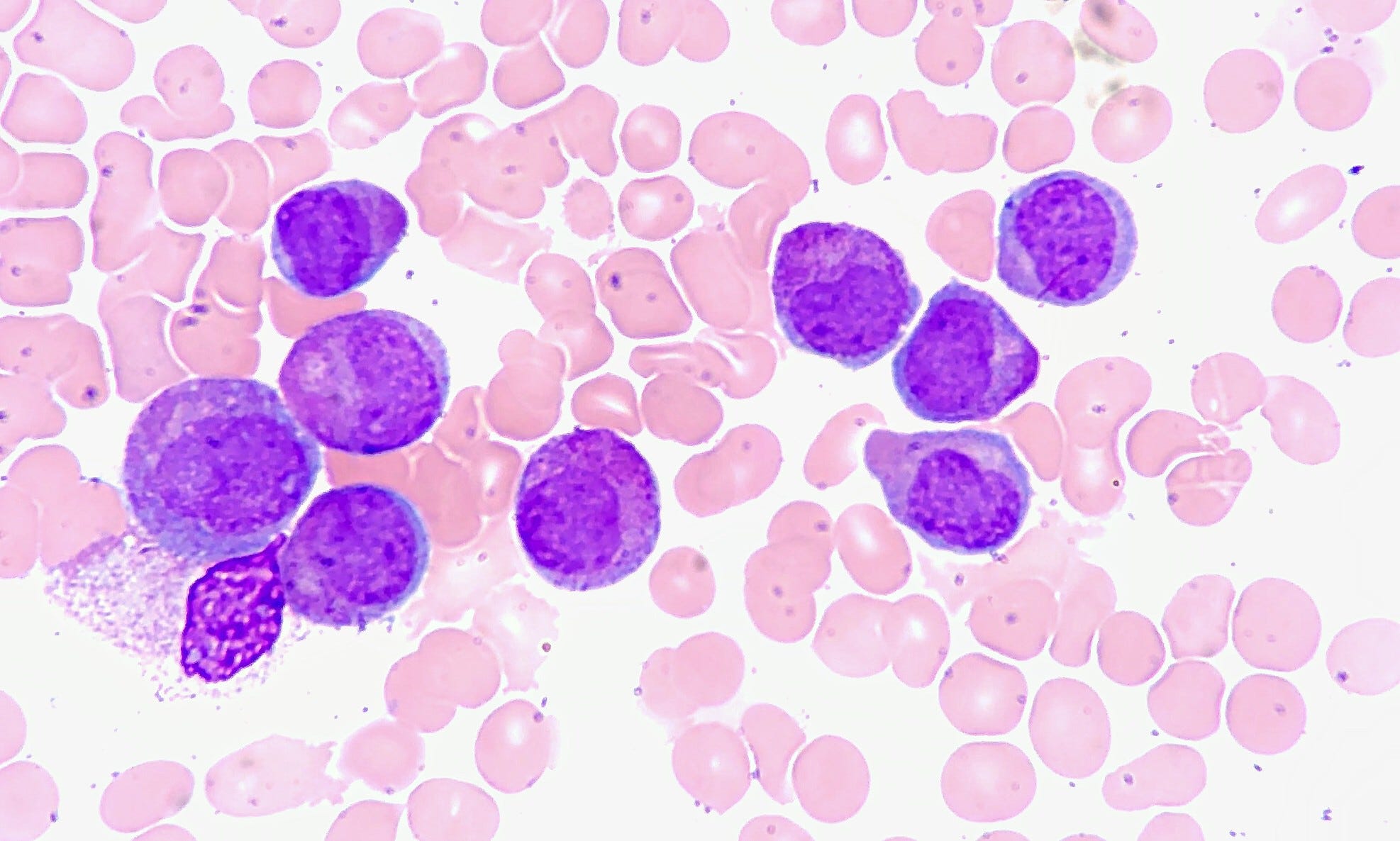
What mechanism did flubendazole show in leukemia cells?
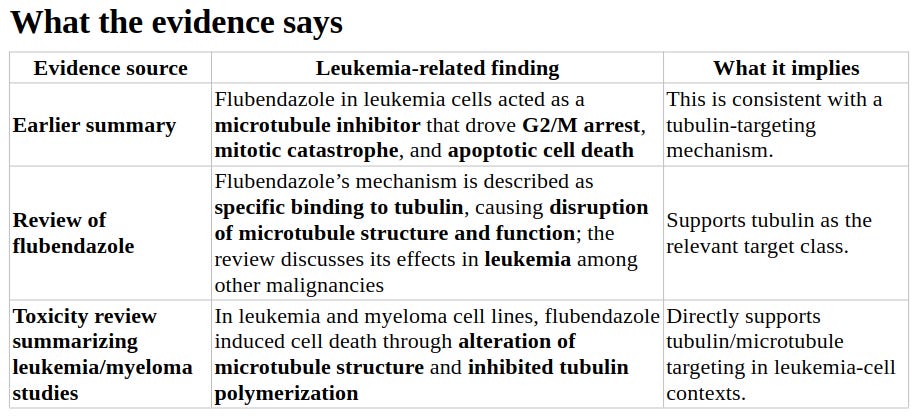
Flubendazole showed a microtubule-targeting, mitotic mechanism in leukemia cells: it inhibited tubulin polymerization / disrupted microtubule structure, which led to G2/M arrest, mitotic catastrophe, and apoptotic cell death. This fits the earlier leukemia-related evidence we discussed, where flubendazole was mostly surfaced through secondary sources rather than a single direct leukemia-primary paper in that set.
Mechanistic details in the retrieved evidence
Primary effect: binding to tubulin and blocking microtubule function
Cell-cycle consequence: arrest at G2/M with multinucleated or mitotically abnormal cells
Downstream outcome: mitotic catastrophe followed by apoptosis
Supporting leukemia/myeloma context: the retrieved review notes flubendazole’s preclinical activity in leukemia and myeloma through inhibition of microtubule function
Bottom line: in leukemia cells, flubendazole acted mainly as a microtubule inhibitor that drove mitotic arrest and cell death, rather than through a leukemia-specific signaling pathway, based on the material provided.
Does flubendazole target tubulin in leukemia cells?
Yes, the evidence supports that flubendazole targets tubulin / disrupts microtubules in leukemia-related cells, with the mechanism described as tubulin polymerization inhibition and microtubule disruption leading to mitotic arrest and cell death.
Bottom line
Yes. In the material provided, flubendazole is consistently presented as a tubulin-targeting benzimidazole in leukemia-related cells, with downstream consequences including microtubule disruption, mitotic arrest, and apoptosis. The evidence here is stronger for a microtubule/tubulin mechanism than for a leukemia-specific target distinct from that pathway.
Confidence level: High — multiple retrieved sources agree on tubulin/microtubule disruption, and the earlier leukemia-specific summary matches the review-level descriptions.
How does flubendazole compare with colchicine in leukemia cells
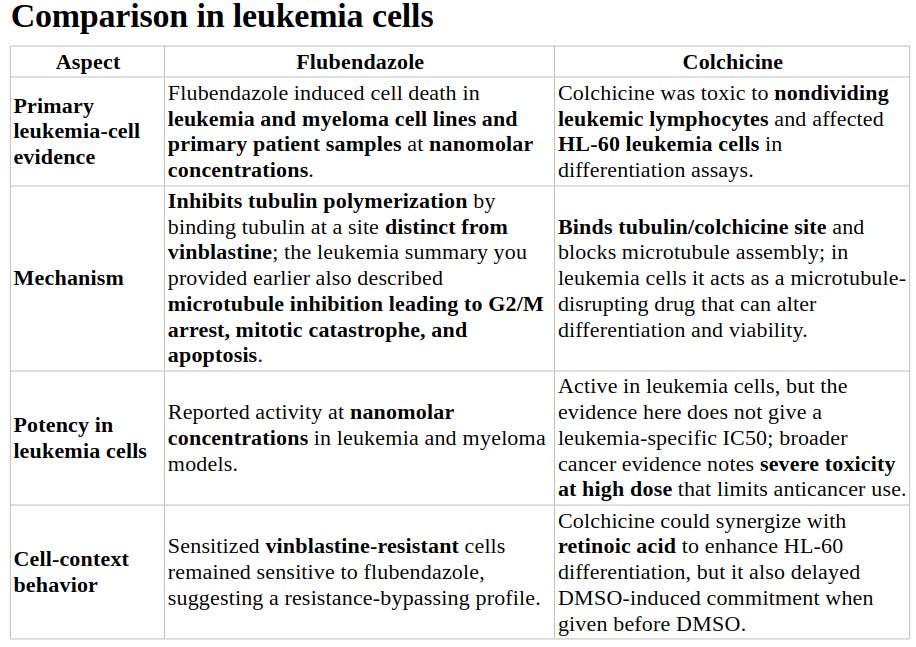
Flubendazole and colchicine are both microtubule-disrupting agents in leukemia-related cells, but the retrieved evidence suggests flubendazole is the stronger leukemia-focused anticancer candidate, while colchicine is a well-known tubulin binder whose leukemia-cell effects are limited by toxicity and historical anticancer failure.
Bottom line
Flubendazole looks more favorable than colchicine in leukemia cells because it shows direct nanomolar cytotoxicity in leukemia and myeloma samples and can overcome at least some vinblastine resistance, whereas colchicine’s leukemia-cell evidence is older, more context-dependent, and constrained by its toxicity. That said, this is an inference rather than a direct head-to-head leukemia comparison, because the retrieved sources do not test both drugs side by side in the same leukemia model.
Confidence level: High — multiple sources consistently support tubulin/microtubule disruption for both drugs, and the leukemia-specific flubendazole paper provides stronger direct anticancer evidence than the colchicine leukemia studies.
How does flubendazole inhibit tubulin polymerization in leukemia cells?
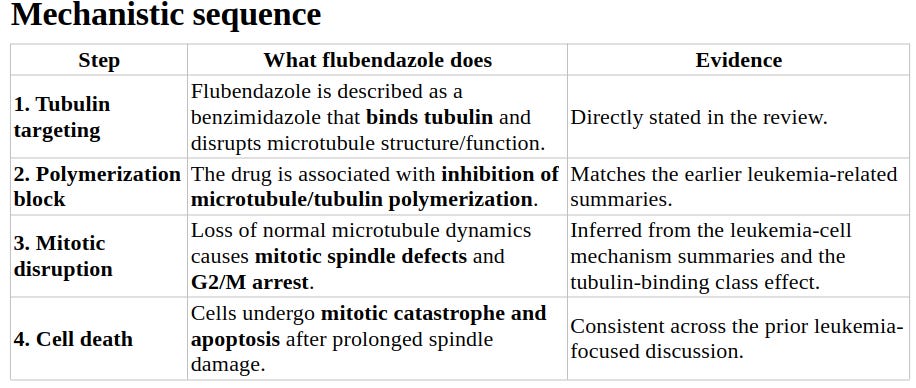
Flubendazole inhibits tubulin polymerization in leukemia cells by binding tubulin and disrupting microtubule assembly, which leads to mitotic arrest at G2/M, abnormal spindle formation, mitotic catastrophe, and apoptotic cell death. In the material provided, that mechanism is the same one repeatedly described for flubendazole’s broader anticancer activity, and the leukemia-specific summaries you asked about are consistent with a microtubule-targeting, tubulin-interacting mode of action rather than a leukemia-unique signaling pathway.
What this means in leukemia cells
The key effect is microtubule destabilization, not inhibition of a leukemia-specific enzyme or receptor.
The downstream biology is cell-cycle arrest followed by death, which is why flubendazole is discussed as a mitotic inhibitor in leukemia-related contexts.
The exact binding pocket on tubulin is not fully pinned down in the leukemia evidence provided, so any claim about a specific site would be an inference rather than a directly shown result.
Bottom line: flubendazole inhibits tubulin polymerization in leukemia cells by targeting tubulin and collapsing microtubule dynamics, which drives G2/M arrest and apoptotic/mitotic-catastrophe cell death.
Confidence level: High — the retrieved evidence and prior leukemia-specific summaries consistently converge on tubulin/microtubule disruption as the mechanism.
References
Benzimidazoles: general mechanism and repurposing
Friedman PA, Platzer EG. Interaction of anthelmintic benzimidazoles and benzimidazole derivatives with bovine brain tubulin. Biochim Biophys Acta Gen Subj. 1978. https://doi.org/10.1016/0304-4165(78)90334-3
Son DS, Lee ES, Adunyah SE. The antitumor potentials of benzimidazole anthelmintics as repurposing drugs. Immune Netw. 2020. https://doi.org/10.4110/in.2020.20.e29
Khattab M, Al-Karmalawy AA. Revisiting activity of some nocodazole analogues as potential anticancer drugs using molecular docking and DFT calculations. Front Chem. 2021. https://doi.org/10.3389/fchem.2021.628398
Garg A, Karhana S, Bano A, et al. Network pharmacology and molecular docking study-based approach to explore mechanism of benzimidazole-based anthelmintics for the treatment of lung cancer. J Biomol Struct Dyn. 2024. https://doi.org/10.1080/07391102.2023.2258419
Fenbendazole
Toxicity of anthelmintic drugs (fenbendazole and flubendazole) to aquatic organisms. Environ Sci Pollut Res. 2015;22(4):2566–2573. https://www.sciencedirect.com/science/article/pii/S0944134414000111
Park H, Lim W, You S, Song G. Fenbendazole induces apoptosis of porcine uterine luminal epithelial and trophoblast cells during early pregnancy. Sci Total Environ. 2019. https://doi.org/10.1016/j.scitotenv.2019.05.116
Han Y, Joo HG. Involvement of reactive oxygen species in the anti-cancer activity of fenbendazole, a benzimidazole anthelmintic. Korean J Vet Res. 2020. https://doi.org/10.14405/kjvr.2020.60.2.79
Lian S, Gao X, Song C, et al. The characteristics of Raman spectroscopy of fenbendazole-gold nanoparticles based on the chemical adsorption effect. Spectrochim Acta A Mol Biomol Spectrosc. 2021. https://doi.org/10.1016/j.saa.2021.119799
Jung H, Lee YJ, Joo HG. Differential cytotoxic effects of fenbendazole on mouse lymphoma EL-4 cells and spleen cells. Korean J Vet Res. 2023. https://doi.org/10.14405/kjvr.20220040
Nguyen J, Nguyen TQ, Han B, Hoang BX. Oral fenbendazole for cancer therapy in humans and animals. Anticancer Res. 2024. https://doi.org/10.21873/anticanres.17197
Flubendazole
Spagnuolo PA, Hu J, Hurren R, et al. The antihelmintic flubendazole inhibits microtubule function through a mechanism distinct from Vinca alkaloids and displays preclinical activity in leukemia and myeloma. Blood. 2010. https://doi.org/10.1182/blood-2009-09-243055
Čáňová K, Rozkydalová L, Rudolf E. Anthelmintic flubendazole and its potential use in anticancer therapy. Acta Medica (Hradec Kralove). 2017. https://doi.org/10.14712/18059694.2017.44
Dong T, Lu Z, Li J, et al. Flubendazole inhibits the proliferation of A549 and H460 cells and promotes autophagy. Chin J Lung Cancer. 2020. https://doi.org/10.3779/j.issn.1009-3419.2020.104.17
Khachigian LM. Emerging insights on functions of the anthelmintic flubendazole as a repurposed anticancer agent. Cancer Lett. 2021. https://doi.org/10.1016/j.canlet.2021.09.013
Albendazole and mebendazole
Chai JY, Jung BK, Hong SJ. Albendazole and mebendazole as anti-parasitic and anti-cancer agents: an update. Korean J Parasitol. 2021. https://doi.org/10.3347/kjp.2021.59.3.189
Choi HS, Ko YS, Jin H, et al. Anticancer effect of benzimidazole derivatives, especially mebendazole, on triple-negative breast cancer (TNBC) and radiotherapy-resistant TNBC in vivo and in vitro. Molecules. 2021. https://doi.org/10.3390/molecules26175118
Fiedler W, Freisleben F, Wellbrock J, Kirschner KN. Mebendazole’s conformational space and its predicted binding to human heat-shock protein 90. J Chem Inf Model. 2022. https://doi.org/10.1021/acs.jcim.2c00290
Parbendazole
Parbendazole as a promising drug for inducing differentiation of acute myeloid leukemia cells with various subtypes. Commun Biol. 2024;7. https://www.sciencedirect.com/science/article/pii/S2399364224000651
Background: microtubule-targeting agents, leukemia, and drug repurposing
Schrek R, Stefani SS. Toxicity of microtubular drugs to leukemic lymphocytes. Exp Mol Pathol. 1981. https://doi.org/10.1016/0014-4800(81)90053-8
Leung MF, Sartorelli AC. The effects of microtubule disrupting drugs on the differentiation of HL-60 leukemia cells. Leuk Res. 1992. https://doi.org/10.1016/0145-2126(92)90038-9
Leung YY, Yao Hui LL, Kraus VB. Colchicine: update on mechanisms of action and therapeutic uses. Semin Arthritis Rheum. 2015. https://doi.org/10.1016/j.semarthrit.2015.06.013
Ölgen S. Clinical trials on combination of repurposed drugs and anticancer therapies. In: Drug Repurposing in Cancer Therapy. Academic Press; 2020. https://doi.org/10.1016/B978-0-12-819668-7.00015-4
Acute myeloid leukemia: from NGS, through scRNA-seq, to CAR-T. Dissect cancer heterogeneity and tailor the treatment. J Exp Clin Cancer Res. 2023;42. https://www.sciencedirect.com/science/article/pii/S1756996623002214
Tan P, Wei X, Wang L, et al. Discovery of furan-trimethoxyphenyl hybrids as novel colchicine-binding site inhibitors that induce mitotic catastrophe with potent anti-acute myeloid leukemia effect. Bioorg Chem. 2026. https://doi.org/10.1016/j.bioorg.2026.110109