
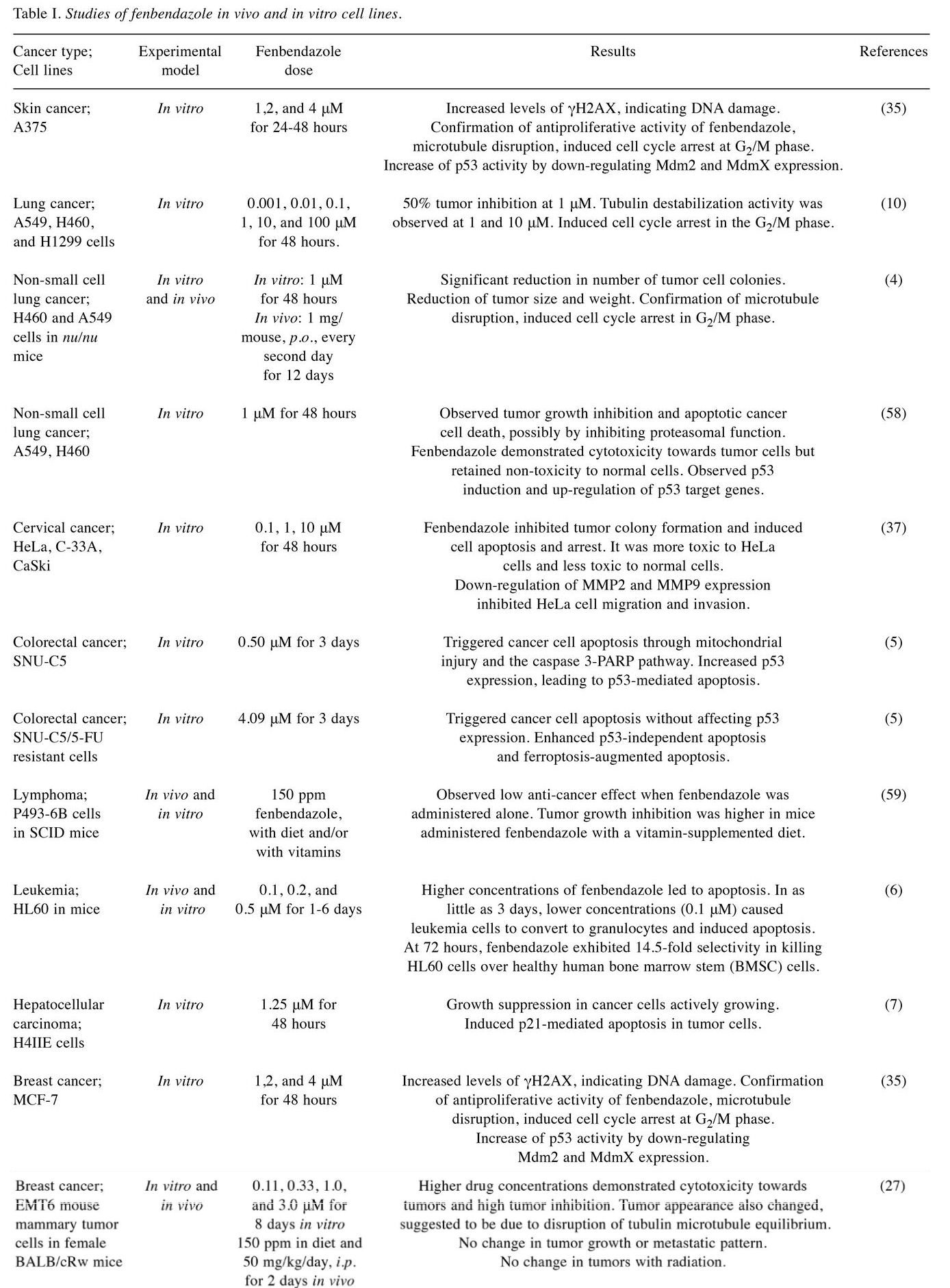
The anticancer activities of the veterinary anthelmintic fenbendazole (FZ) are characterized by a multi-targeted, pleiotropic mechanism of action. While conventional chemotherapies target a single biological node, fenbendazole simultaneously disrupts physical, genetic, and metabolic pathways to eliminate malignant cells:
1. Moderate Microtubule Destabilization
Microtubules are crucial for cell shape, division, and transport. Fenbendazole binds to mammalian tubulin and acts as a moderate microtubule-destabilizing agent:
Colchicine-Site Binding: Competitive fluorescence-binding assays indicate that fenbendazole binds to mammalian tubulin at the colchicine-binding site. This provides an advantage, as colchicine-site binders typically bypass drug resistance caused by \(\beta\)-tubulin isoform overexpression.
Mild Polymerization Inhibition: Unlike aggressive clinical spindle poisons like colchicine or nocodazole, fenbendazole’s physical depolymerization of microtubules is mild and partial.
Preserved Tubulin Acetylation: While other microtubule-disrupting agents (nocodazole, colchicine, vincristine) significantly reduce acetylated \(\alpha\)-tubulin (a marker of microtubule stability), fenbendazole does not alter tubulin acetylation levels.
2. G2/M Cell Cycle Arrest and Caspase-Independent Death
By disrupting the mitotic spindle, fenbendazole halts cancer cell cycle progression and triggers mitotic catastrophe:
Mitotic Gate Blockade: Fenbendazole causes cell cycle arrest specifically in the mitotic G2/M phase. This is marked by an early elevation and stabilization of the Cyclin B1/CDK1 complex and upregulation of the mitotic marker phospho-histone H3 (Ser10).
Mitotic Exit and Apoptosis: Cells accumulate in mitosis and subsequently undergo mitotic exit and apoptosis, corresponding with a time-dependent decrease in Cyclin B1 and a dramatic rise in the sub-G1 apoptotic cell fraction.
Caspase-Independent Pathway: This mitotic cell death is caspase-independent; the broad-spectrum caspase inhibitor Z-VAD-FMK fails to rescue cells from fenbendazole-mediated cytotoxicity.
3. p53 Pathway Stabilization and Mitochondrial Translocation
Fenbendazole exhibits selective cytotoxicity towards tumor cells, particularly those expressing wild-type (WT) p53:
WT p53 Sensitivity: Cancer cells containing WT p53 (such as H460 and A549) are significantly more sensitive to FZ-induced apoptosis compared to p53-mutant or null cells. Restoring WT p53 expression in p53-null H1299 cells via transfection significantly enhances apoptotic cell death.
Nuclear Accumulation: Fenbendazole acts as a proteasome-interfering agent, blocking proteasomal degradation of p53 and allowing transcriptionally active WT p53 to accumulate in the nucleus.
Transcriptional Targets: Active p53 upregulates downstream cell cycle and metabolic target genes, including p21 (which can also be induced independently of p53 via proteasomal pathways), Glutaminase 2, Proline oxidase, TIGAR, and SCO2.
Monoubiquitinated Mitochondrial Translocation: Fenbendazole triggers the translocation of monoubiquitinated p53 to the mitochondria. This localized mitochondrial pool depolarizes the mitochondrial membrane (confirmed with JC-1 staining), triggering cytochrome c release and PARP cleavage.
4. Metabolic Starvation (Warburg Effect Reversal)
Fenbendazole aggressively disrupts the altered energy pathways that cancer cells rely on for survival and proliferation:
Inhibition of Glucose Uptake: Fenbendazole blocks cellular glucose uptake, as demonstrated by reduced uptake of the fluorescent glucose analog 2-NBDG. This results in depleted glucose consumption and reduced lactate output in supernatants.
GLUT-4 and Hexokinase II Downregulation: FZ treatment suppresses GLUT-4 expression and reduces the mRNA expression and enzymatic activity of Hexokinase II (HK II). In silico docking modeling shows FZ stably binding inside the active pocket of HK II, mimicking glucose or glucose-6-phosphate to block its function.
Reactivation of Succinate Dehydrogenase (SDH): FZ enhances SDH activity, a mitochondrial TCA cycle enzyme and tumor suppressor. By oxidizing succinate to fumarate, FZ reverses the pro-survival advantage tumors gain from succinate accumulation.
5. Bypassing Multidrug Resistance (P-glycoprotein Bypass)
Overexpression of the P-glycoprotein (P-gp/MDR-1) efflux pump is a major mediator of chemotherapy resistance. Fenbendazole bypasses this barrier:
Fenbendazole is neither a P-gp substrate nor an inhibitor. Co-treatment with the P-gp inhibitor verapamil does not increase the anti-proliferative potency of FZ, and FZ does not alter the accumulation of the reference P-gp substrate Rhodamine 123.
6. Synergistic Combination Strategies
Because FZ targets multiple cellular nodes, combining it with other metabolic and chemotherapeutic agents generates powerful synergy:
Glycolytic Inhibitors: FZ shows strong synergy with 2-deoxyglucose (2DG) or dichloroacetate (DCA), yielding a highly synergistic Combination Index of 0.04 with DCA.
Diisopropylamine Dichloroacetate (DADA): Combining FZ and DADA synergistically inhibits lung cancer cell proliferation by increasing reactive oxygen species (ROS), upregulating BAX and downregulating Bcl-2, activating Caspase-3, Caspase-7, and PARP, and suppressing Cyclin A and E to arrest cells in G2/M. This metabolic block operates by suppressing the PI3K/AKT signaling pathway to shut down glucose uptake and lactate production.
Vitamins Synergy: Preclinical SCID mice bearing human lymphoma xenografts demonstrated tumor inhibition only when fenbendazole was combined with a vitamin-supplemented diet (containing vitamins A, D, E, K, and B).
7. In Vivo Efficacy and Human Case Observations
In Vivo Models: Oral administration of fenbendazole (1 mg/mouse every second day for 12 days) in nude mice bearing A549 lung cancer xenografts significantly reduced tumor volume, tumor weight, and tumor blood vessel density (CD31-positive endothelial cells).
Human Case Reports: Although fenbendazole lacks standard clinical trial validation, several published case studies document complete or near-complete radiographic tumor regression in patients with Diffuse Large B-cell Lymphoma (DLBCL), metastatic Renal Cell Carcinoma (mRCC), High-Grade Urothelial Carcinoma (HGUC), and bladder urothelial carcinoma after self-prescribing 1g of oral fenbendazole daily for three consecutive days followed by four days off.
Safety Profile: While extremely well-tolerated in animal toxicity models (with rodents tolerating doses exceeding 10 g/kg), human self-administration of fenbendazole has occasionally resulted in severe drug-induced liver injury (DILI) that resolved rapidly upon drug discontinuation.
Oral Fenbendazole for Cancer Therapy in Humans and Animals
Anticancer Research September 2024, 44 (9) 3725-3735;
DOI: https://doi.org/10.21873/anticanres.17197