
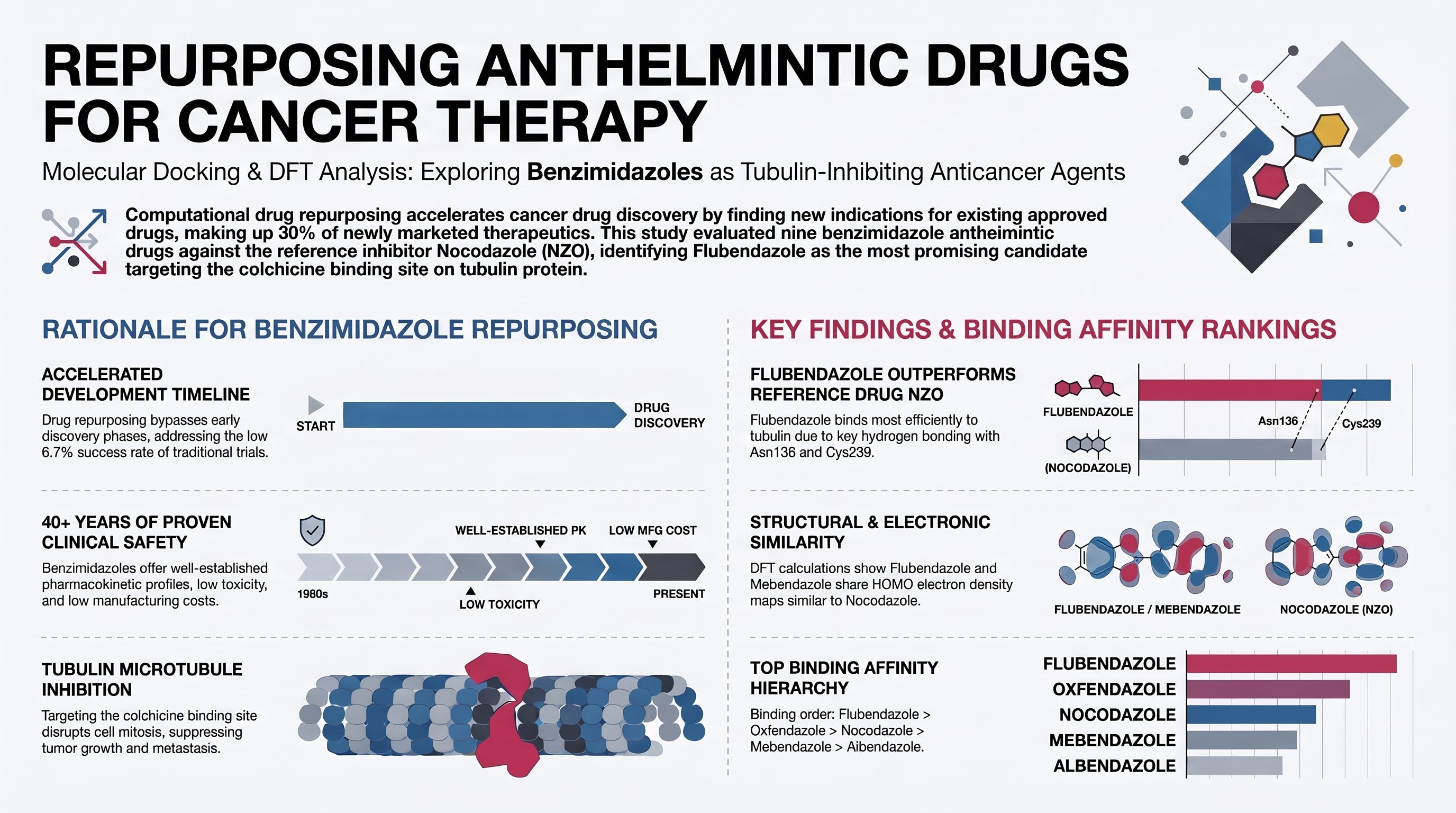
Although potential anticancer activities of benzimidazole-based anthelmintic drugs have been approved by preclinical and clinical studies, modes of binding interactions have not been reported so far. This study aimed to propose binding interactions between some benzimidazole-based anthelmintics and one of the most important cancer targets (Tubulin protein). Studied drugs were selected based on their structural similarity to the cocrystallized ligand (Nocodazole) with the tubulin protein. We also used quantum mechanics calculations to characterize the electronic configuration of the studied drugs at the atomic and molecular level. Order of binding affinities of tested benzimidazole drugs toward colchicine binding site on tubulin protein is as follows: Flubendazole > Oxfendazole > Nocodazole > Mebendazole > Albendazole > Oxibendazole > Fenbendazole > Ciclobendazole > Thiabendazole > Bendazole. By analyzing the binding mode and hydrogen-bond lengths between the nine studied benzimidazole drugs and the colchicine binding site, we found that Flubendazole binds more efficiently to the tubulin protein than the other benzimidazole derivatives. The quantum mechanics studies showed that the electron density of HOMO of Flubendazole and Mebendazole together with their MEP map are quite similar to that of Nocodazole which is also consistent with the calculated binding affinities. Our study supports considering the repurposing of Flubendazole as a promising anticancer candidate.
A molecular docking study examining benzimidazole-based anthelmintic drugs against tubulin protein (PDB ID: 5CA1) provides theoretical characterization of how Fenbendazole and its analogs interact with the colchicine binding site (CBS).
1. Target Active Site & Key Interactions
Protein Target: The docking simulations used the crystal structure of tubulin complexed with the reference ligand Nocodazole (NZO) across two active-site pockets: Subunit B and the larger Subunit D.
Crucial Amino Acids: Binding interactions in the colchicine-binding pocket primarily involve Glu198 and Val236 across both subunits, along with Asn165 in Subunit B, Cys239 in Subunit D, and hydrophobic interactions with Leu253.
2. Fenbendazole Binding Profile
Docking Scores: Using the Molecular Operating Environment (MOE) software package, Fenbendazole achieved placement scores (S) of -7.09 in Subunit B and -7.39 in Subunit D.
Hydrogen Bonding:
In Subunit B, Fenbendazole forms hydrogen bonds with Val236 (2.96 Å) and Glu198 (2.86 Å).
In Subunit D, it forms hydrogen bonds with Val236 (2.95 Å), Glu198 (3.03 Å), and Asn165 (2.81 Å).
Hydrophobic Contact: It maintains stabilizing hydrophobic contacts with Leu253 in both subunits.
3. Relative Binding Affinity Ranking
When evaluated alongside eight other benzimidazole derivatives and the lead compound Nocodazole, the calculated binding affinity order toward the tubulin colchicine binding site is: Flubendazole>Oxfendazole>NZO (docked)>Mebendazole>Albendazole>Oxibendazole>Fenbendazole>Ciclobendazole>Thiabendazole>Bendazole
While Fenbendazole binds with high stability, flubendazole showed the strongest binding affinity, the highest docking score, and the closest fingerprint match to native Nocodazole.
4. Quantum Mechanics & DFT Calculations
Density Functional Theory (DFT) calculations at the B3LYP/6-311+G* level revealed that the Highest Occupied Molecular Orbital (HOMO) electrons of Fenbendazole are localized mainly over its benzene moiety and aromatic side chain, exhibiting a different orbital distribution pattern than Nocodazole.
Molecular Electrostatic Potential (MEP) mapping confirmed that the benzimidazole ring nitrogens function as electron-donating and electron-accepting sites capable of key hydrogen bonding within the tubulin binding pocket.
Flubendazole Tubulin Binding
Molecular docking and Quantum Mechanics/Density Functional Theory (DFT) calculations reveal that Flubendazole binds more effectively to the tubulin colchicine binding site (PDB ID: 5CA1) than other benzimidazole derivatives (including Fenbendazole) due to several structural and electronic features:
1. Fingerprint Binding Mode & Crucial Hydrogen Bonding
Subunit B Interactions: Flubendazole exhibits a “fingerprint” binding mode nearly identical to the co-crystallized reference drug Nocodazole (NZO). It uniquely forms a hydrogen bond through the oxygen atom of its carbamate moiety with Asn165 (3.03 Å), closely matching native NZO (3.19 Å).
Subunit D Water-Bridged H-Bonding: In Subunit D, Flubendazole re-establishes a crucial hydrogen bond with Cys239 via a bridging water molecule (H2O616, calculated at 3.14 Å). This mirrors the native NZO interaction—a feature lost in the docked NZO model.
Conserved Active Site Contacts: Like top-performing inhibitors, Flubendazole maintains stable hydrogen bonds with Val236 and Glu198, along with hydrophobic contacts with Leu253.
2. Superior Docking Scores & Binding Affinity Ranking
Top Placement Scores: In Molecular Operating Environment (MOE) simulations, Flubendazole achieved placement scores of S=−7.36 in Subunit B and S=−7.25 in Subunit D, outperforming docked NZO (−7.34 and −7.04) as well as Fenbendazole (−7.09 and −7.39).
Calculated Affinity Order: Based on docking scores and physical parameters, Flubendazole ranks highest among all tested compounds: Flubendazole>Oxfendazole>NZO (docked)>Mebendazole>Albendazole>Oxibendazole>Fenbendazole>Ciclobendazole>Thiabendazole>Bendazole
3. Electronic Configuration & DFT Parameters
HOMO Orbital Localization: DFT calculations (B3LYP/6-311+G* level) show that Flubendazole’s Highest Occupied Molecular Orbital (HOMO) electron density is localized primarily on the central benzimidazole core, closely matching the electronic distribution pattern of Nocodazole. In contrast, compounds like Fenbendazole have HOMO density delocalized over the benzene ring and side chains.
Electrostatic Potential (MEP) Alignment: Flubendazole’s Molecular Electrostatic Potential map aligns closely with Nocodazole. Its 5(6)-substituted fluorobenzoyl group preserves the optimal electropositive/electronegative distribution required for hydrogen donation and acceptance within the binding pocket.
In computational drug research, docking scores (such as the placement score S in MOE) estimate a drug's theoretical binding affinity and structural fit within a target protein’s active site—in this case, the colchicine binding site (CBS) on tubulin.
While a more negative docking score indicates stronger, more stable binding to the isolated protein pocket, it does not translate directly into cellular cytotoxicity or clinical anticancer potency. The relationship between docking scores and real-world potency involves several factors:
1. Predictor of Binding Efficiency
Docking scores let researchers rank compounds by how well they fit the active site relative to a known reference drug. For example, the study ranked binding affinities toward the tubulin CBS as: Flubendazole>Oxfendazole>NZO (docked)>Mebendazole>Albendazole>Oxibendazole>Fenbendazole>Ciclobendazole>Thiabendazole>Bendazole. This ranking prioritizes compounds like Flubendazole as top candidates for targeting tubulin depolymerization.
2. Physical & Electronic Determinants Beyond Energy Scores
The study emphasizes that binding affinity and therapeutic interaction depend on more than calculated energy scores or orbital energies. They are governed by a complex set of physical determinants:
Specific Hydrogen-Bonding Networks: Crucial interactions with key amino acids like Val236, Glu198, Asn165, and Cys239.
Electrostatic & Van der Waals Forces: Molecular Electrostatic Potential (MEP) maps and hydrophobic contact with residues like Leu253.
Water-Bridged Interactions: Solvent molecules (such as bridging water H2O616) stabilize binding inside the pocket.
3. Isolated Target vs. Whole-Cell Complexity
A docking score measures interaction with a single, rigid or semi-rigid protein structure in silico. In contrast, actual anticancer potency (IC50 or tumor suppression) in cell lines or animal models depends on broader biological processes:
Cellular Uptake & Bioavailability: How effectively the drug crosses cell membranes to reach intracellular tubulin.
Intracellular Accumulation & Efflux: Resistance mechanisms, such as P-glycoprotein efflux pumps, which affect how much drug stays inside the cell.
Off-Target & Multi-Metabolic Effects: Anthelmintic drugs often engage additional cellular pathways (such as glucose metabolism disruption or ROS induction) that contribute to cell death beyond tubulin inhibition alone.
Summary
Docking scores are an essential first-line computational screening tool for identifying and prioritizing lead compounds that fit the tubulin binding site. However, researchers must validate full anticancer potency through in vitro cell assays and in vivo studies that account for cellular uptake, metabolic pathways, and systemic pharmacokinetics.
Source
Khattab, M., & Al-Karmalawy, A. A. (2021). Revisiting activity of some nocodazole analogues as a potential anticancer drugs using molecular docking and DFT calculations. Frontiers in Chemistry, 9, Article 628398
https://www.frontiersin.org/journals/chemistry/articles/10.3389/fchem.2021.628398/full