
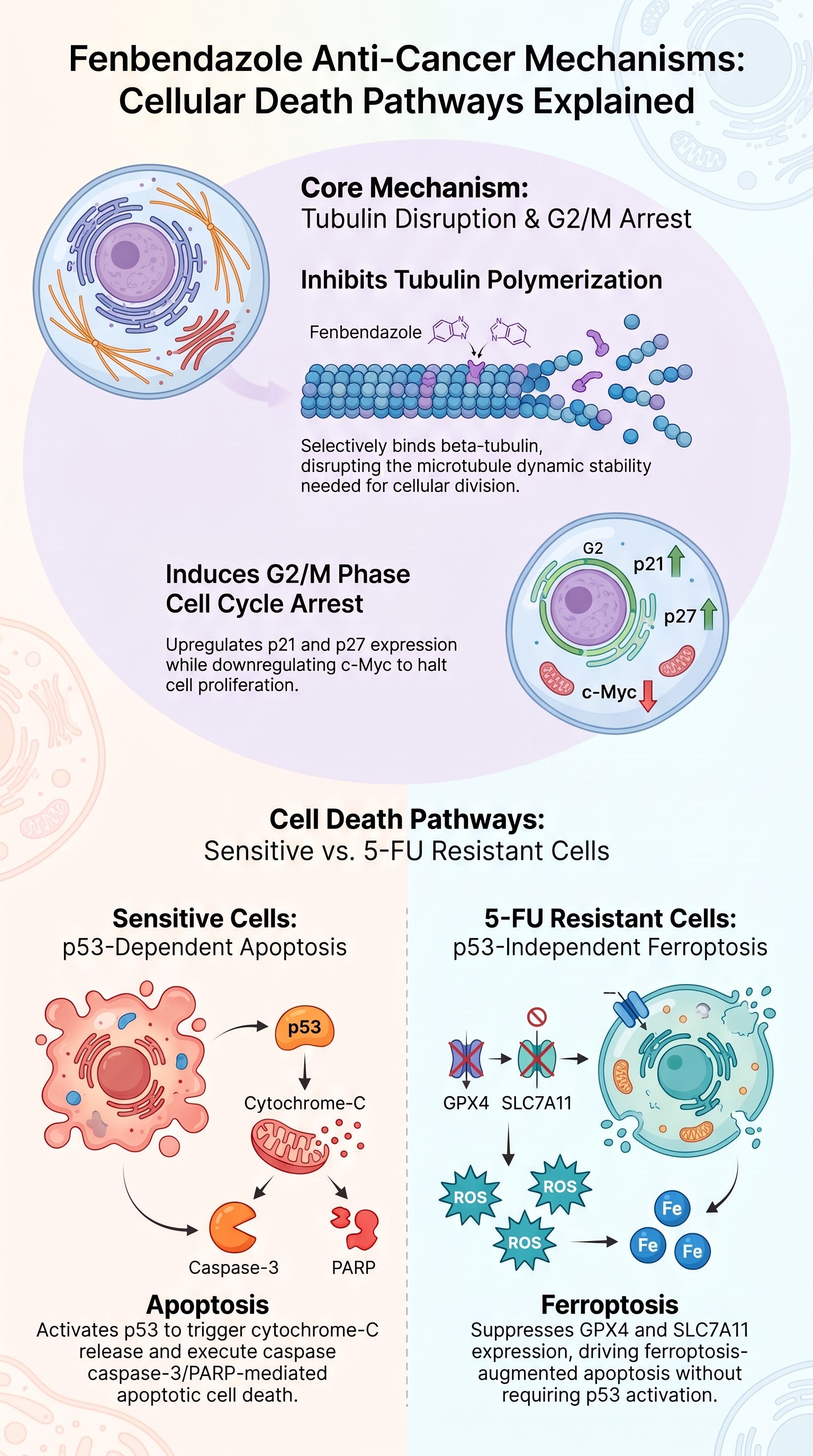
In preclinical research, fenbendazole (FZ) demonstrates several theoretical benefits for human oncology by targeting fundamental tumor cell processes and bypassing standard mechanisms of chemoresistance.
1. Targeting Core Cancer Vulnerabilities (Molecular Pathways)
Microtubule Disruption & G2/M Arrest: Fenbendazole selectively binds to β-tubulin, inhibiting microtubule polymerization. In actively dividing cancer cells, this causes G2/M phase cell cycle arrest accompanied by increased levels of cell cycle inhibitors p21 and p27 and a reduction in c-Myc expression.
Intrinsic Apoptosis Induction: Disruption of tubulin dynamics induces mitochondrial damage, causing cytochrome-C release into the cytoplasm and activating the caspase-3–PARP cleavage pathway.
Blockade of Glucose Energy Supply: Fenbendazole downregulates GLUT transporters and key glycolytic enzymes such as hexokinase, suppressing cellular glucose uptake and starving malignant cells of energy.
ROS Production & ER Stress: Treatment induces loss of mitochondrial membrane potential (MMP), elevation of reactive oxygen species (ROS), and activation of endoplasmic reticulum (ER) stress-associated genes (e.g., ATF3, GADD153, GRP78, NOXA).
2. Bypassing Chemoresistance Mechanisms
Chemotherapeutic resistance—such as resistance to 5-fluorouracil (5-FU)—accounts for up to 90% of deaths in patients receiving conventional anticancer treatments. In 5-FU-resistant colorectal cancer cells (SNU-C5/5-FUR), fenbendazole displays superior antiproliferative activity compared to other benzimidazoles like albendazole:
p53-Independent Cell Death: Standard 5-FU resistance is frequently driven by mutations or loss of function in p53. While fenbendazole relies on p53-dependent apoptosis in 5-FU-sensitive cells, it successfully triggers cell death in 5-FU-resistant cells without requiring p53 activation (p53 phosphorylation levels remain unchanged).
Ferroptosis-Augmented Apoptosis: In 5-FU-resistant cells, fenbendazole downregulates GPX4 (glutathione peroxidase 4) and suppresses SLC7A11 (cysteine/glutamate antiporter), inducing lipid-peroxidation-driven ferroptosis. This induces a 2.36-fold surge in HMGB1 (a damage-associated molecular pattern / DAMP), which acts synergistically to augment mitochondrial apoptotic pathways and bypass conventional drug-resistance blocks.
3. Selective Cytotoxicity & Preserving Host Immune Function
Sparing Normal Immune Cells: Traditional chemotherapeutics (such as vincristine or paclitaxel) cause severe systemic toxicity and impair T-cell-mediated immune responses by depleting lymphocytes.
Preserving Reactivity: In comparative assays evaluating mouse lymphoma (EL-4) cells against normal primary spleen cells, fenbendazole induced marked apoptosis and G2/M arrest in lymphoma cells while causing minimal cytotoxicity (only a 9% reduction in viable cells at 1 µM) in normal spleen cells. Furthermore, spleen cells pretreated with fenbendazole maintained their metabolic activity and functional response when stimulated with lipopolysaccharide (LPS).
4. Essential Human Clinical Reality & Limitations
Preclinical vs. Human Evidence: These mechanisms are established in in vitro cell culture and animal tumor models. There are no verified, completed human clinical trials demonstrating safety, proper human pharmacokinetics, or therapeutic efficacy for fenbendazole in cancer patients.
Toxicity & Absorption Risks: Orally administered fenbendazole is poorly absorbed in the bloodstream. Unmonitored self-administration carries significant clinical risks, including documented drug-induced liver injury (DILI). Medical organizations and regulatory agencies warn patients against self-administering veterinary formulations outside of formal, controlled clinical trials.
Sources:
Jung, H., Lee, Y.-J., & Joo, H.-G. (2023). Differential cytotoxic effects of fenbendazole on mouse lymphoma EL-4 cells and spleen cells. Korean Journal of Veterinary Research, 63(1), Article e2. https://doi.org/10.14405/kjvr.20220040
Li, W., Jaga, S., Shah, S., & Cearras, M. (2025). Cancer’s metabolic hijack: The under-recognized hematologic emergency related to the Warburg effect. Cureus, 17(1), Article e77869. https://doi.org/10.7759/cureus.77869
Park, D., Lee, J.-H., & Yoon, S.-P. (2022). Anti-cancer effects of fenbendazole on 5-fluorouracil-resistant colorectal cancer cells. Korean Journal of Physiology & Pharmacology, 26(5), 377–387. https://doi.org/10.4196/kjpp.2022.26.5.377
Sultana, T., Jan, U., Lee, H., Lee, H., & Lee, J. I. (2022). Exceptional repositioning of dog dewormer: Fenbendazole fever. Current Issues in Molecular Biology, 44(10), 4977–4986. https://doi.org/10.3390/cimb44100338