

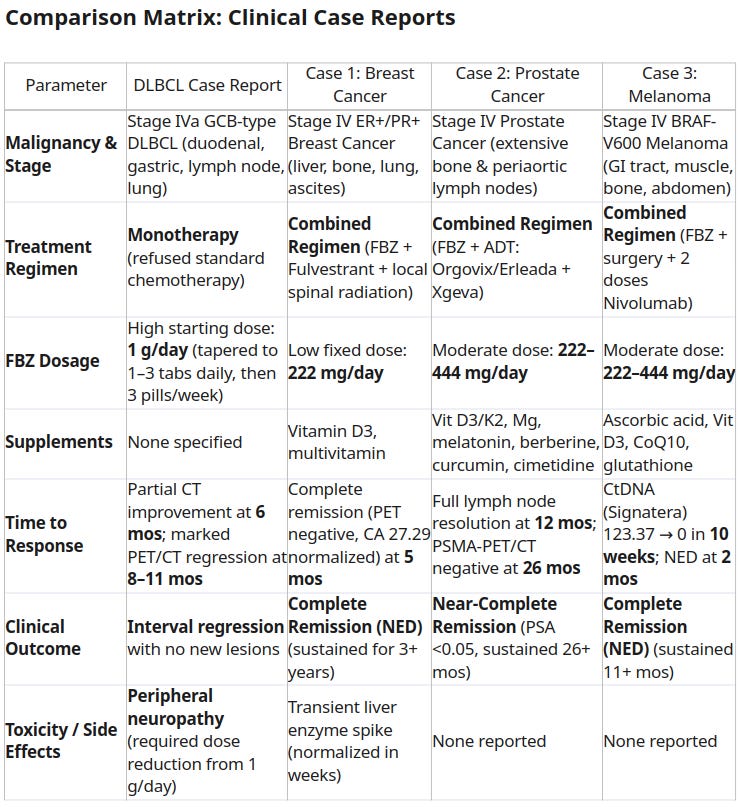
Comparing the Diffuse Large B-Cell Lymphoma (DLBCL) case report with the three solid tumor cases (breast, prostate, and melanoma) reveals key differences in dosing strategies, treatment regimens, response timelines, and side-effect profiles across hematologic vs. solid malignancies.
Key Clinical Takeaways
Monotherapy vs. Multimodal Combinations:
The DLBCL case provides a rare example of FBZ as monotherapy, showing disease regression without concurrent chemo- or immunotherapy.
In contrast, all three solid tumor cases combined FBZ with non-chemotherapeutic standard options (such as hormonal blockade or immune checkpoint inhibitors), making it difficult to isolate FBZ’s exact individual contribution.
Dosing Tolerability & Toxicity Thresholds:
High Dosing (1,000 mg/day) in the DLBCL patient led to peripheral neuropathy, compelling the patient to scale down intake.
Low-to-moderate dosing (222–444 mg/day) in the solid tumor cases achieved near-complete or complete metabolic remissions without neurotoxicity or significant organ toxicity.
Response Speed:
The melanoma case exhibited the fastest response, with circulating tumor DNA dropping to zero in under 10 weeks. The hematologic DLBCL case showed a more gradual, step-wise regression over 6 to 11 months of continuous tapering.
Primary Case Report Publications
Abughanimeh, O., Evans, T., & Kallam, A. (2020). Fenbendazole as a treatment for diffuse large B-cell lymphoma. Annals of Hematology & Oncology, 7(2), Article 1284.
Makis, W., Baghli, I., & Martinez, P. (2025). Fenbendazole as an anticancer agent? A case series of self-administration in three patients. Case Reports in Oncology, 18(1), 864–875. https://doi.org/10.1159/000546362
Referenced Background & Preclinical Case Studies
Chiang, R. S., Syed, A. B., Wright, J. L., Montgomery, B., & Srinivas, S. (2021). Fenbendazole enhancing anti-tumor effect: A case series. Clinical Oncology Case Reports, 4(2), Article 1.
Gao, P., Dang, C. V., & Watson, J. (2008). Unexpected antitumorigenic effect of fenbendazole when combined with supplementary vitamins. Journal of the American Association for Laboratory Animal Science, 47(6), 37–40.