

1. The Strategic Landscape of Oncology Drug Repurposing
The contemporary oncology drug development pipeline is defined by prohibitive economic and temporal barriers. Developing a single antineoplastic agent de novo currently requires an investment of $1 billion to $2.5 billion and takes 11 to 13.5 years. Because about 95% of oncology candidates fail to transition from Phase I trials to regulatory approval, the industry has shifted toward drug repurposing to identify more efficient therapeutic avenues. This strategy leverages existing pharmaceuticals with established pharmacokinetic profiles to address new clinical indications, significantly mitigating R&D risk.
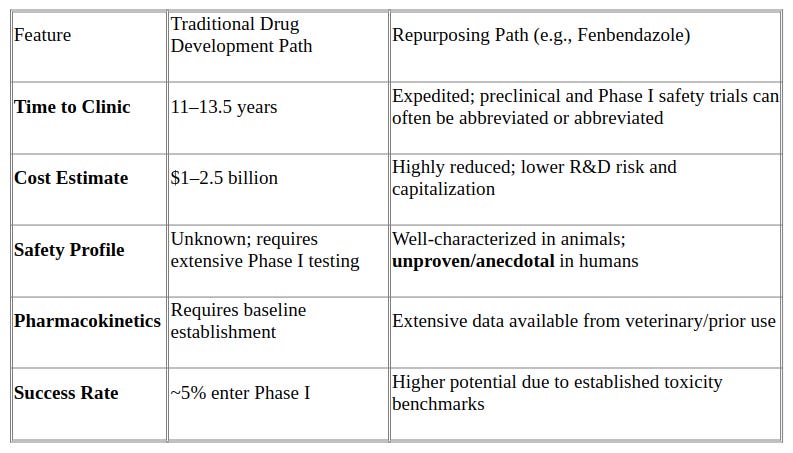
Within the “Repurposing Drugs in Oncology (ReDO)” project, benzimidazoles—specifically Mebendazole (MBZ), Albendazole (ABZ), and Fenbendazole (FZ)—are categorized as high-potential candidates. FZ, historically restricted to veterinary parasitology, has emerged as a subject of intense human interest due to its low cost as a generic agent and its mechanistically relevant profile. However, while veterinary safety margins are well documented, no formal human clinical trials have yet validated its safety or efficacy in oncological indications.
2. Molecular Mechanisms and Microtubule Dynamics: FZ vs. Standard Chemotherapeutics
Microtubules (MTs) are fundamental to the cellular cytoskeleton, governing mitosis, motility, and intracellular transport. Their central role in cell division has long made them a primary target for blockbuster chemotherapeutics. Fenbendazole operates through a sophisticated, multi-pathway mechanism that disrupts these structures while simultaneously inducing metabolic exhaustion in malignant cells.
Technical Analysis of Fenbendazole’s Mechanism:
Selective \beta-tubulin Binding: FZ binds to \beta-tubulin to inhibit MT polymerization. Crucially, FZ exhibits a higher binding affinity for parasitic \beta-tubulin than mammalian equivalents, which provides its historical safety margin in animals.
Secondary Signaling Pathways: FZ induces apoptosis by activating the p53 tumor suppressor and generating reactive oxygen species (ROS), leading to mitochondrial translocation of p53 and cytochrome c release.
Cell Cycle Modulation: FZ treatment causes G2/M phase arrest, facilitated by upregulation of p21 and concomitant downregulation of cyclins B and D.
Metabolic Downregulation: FZ impairs glucose metabolism by downregulating GLUT transporters and hexokinase, a key glycolytic enzyme.
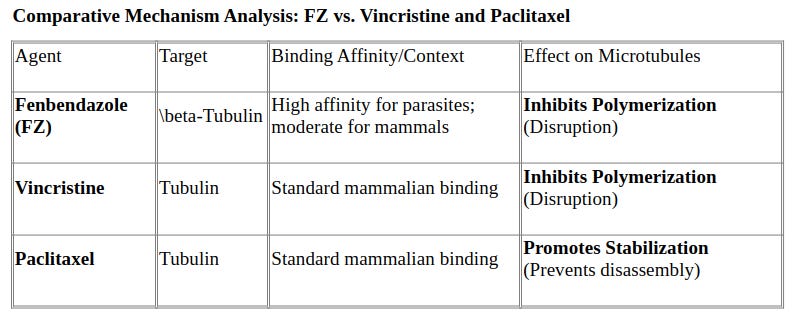
The Metabolic Advantage (”So What?”): FZ provides a distinct metabolic advantage over standard microtubule-targeting agents by starving “Warburg-type” cancer cells. Specifically, the highly glycolytic MDA-MB-231 (triple-negative breast cancer) phenotype is exceptionally sensitive to this glucose uptake blockade. Conversely, “Pasteur-type” cells like MCF7, which can utilize oxidative phosphorylation under normoxic conditions, exhibit slightly more resilience. This dual-action approach—targeting the physical machinery of mitosis while suppressing the hexokinase-driven energy supply—suggests a potent therapeutic index if delivery challenges are addressed.
3. Engineering Solutions for Poor Bioavailability: Nanoformulations and Dissolution
The primary clinical barrier for FZ is the “solubility hurdle.” Dissolution studies in Phosphate Buffer Solution (PBS) and 2% Sodium Dodecyl Sulfate (SDS) confirm a profound distribution weakness, with FZ release generally failing to exceed 20%. Visual observations during these studies characterized the solution as “white/cloudy” with significant undissolved particulate, attributed to the drug’s electrostatic nature and hydrophobic profile. Notably, while Brand S reached a peak release of ~26.6% in 90 minutes (SDS 2%), Brand P peaked at only 15.7–16.1%, confirming that commercial veterinary formulations are inadequate for human systemic circulation.
To overcome this distribution weakness, the following advanced engineered nanomedicine systems are proposed:
PEG-MCM-41 and MCM-48-BLG: Hypothetical mesoporous silica frameworks designed for controlled release to prevent drug precipitation.
PLGA Nanoparticles: Proposed biodegradable polymers to enhance systemic circulation time and bypass rapid excretion.
Soluplus Micelles: Suggested amphiphilic copolymers to increase oral solubility and achieve therapeutic concentrations.
These engineering strategies are required to bridge the gap between potent in vitro sensitivity and the distribution failures observed in current commercial brands.
4. Analysis of In Vitro and In Vivo Preclinical Efficacy
The antineoplastic efficacy of Fenbendazole is highly phenotype-dependent, exhibiting a variable hierarchy of response across cell lines.
In Vitro Cytotoxicity Ranking (AlamarBlue Assays): Precision screening across a 7-cell line panel identifies specific vulnerabilities:
MDA-MB-231 (Triple-negative breast cancer): Highest sensitivity; IC50 of 6.32–6.87 \muM.
MCF7 (Luminal breast cancer): High sensitivity; IC50 of ~8 \muM.
HCT116, PC3, A375: Moderate sensitivity; IC50 range of 11–13 \muM.
COLO699N (Lung) and HuNS1 (Myeloma): Resistant; no statistically significant effect.
In Vivo Reality Check: The EL-4 Paradox. Despite its in vitro potency, FZ failed to demonstrate anticancer effects in EL-4 mouse lymphoma models. Treated subjects exhibited rapid tumor growth and weight loss comparable to controls. Histological analysis of FZ-treated tumor tissues revealed a “Starry Sky Pattern” on H&E staining, indicative of high mitotic activity and active proliferation.
The Tumor Microenvironment (TME) Interaction: Failure in in vivo models likely stems from complex TME interactions. FZ-treated tissues showed a high percentage of immunosuppressive M2 macrophages and an upregulation of PD-L1 and CD86. While increased PD-L1 might theoretically sensitize a tumor to checkpoint inhibitors like Pembrolizumab, the current data suggest that FZ may inadvertently create an immunosuppressive environment that shields the tumor, negating its direct cytotoxic effects.
5. Clinical Risks, Self-Administration, and the “Tippens Effect”
The sociological “Fenbendazole Fever” is driven by unregulated information sharing on Social Network Services (SNS). This phenomenon presents a significant clinical hazard, as anecdotal “success” often obscures severe underlying risks.
Documented Clinical Risks and Toxicity: Unguided self-administration has resulted in severe clinical complications. An 80-year-old NSCLC patient developed Drug-Induced Liver Injury (DILI) after only one month of FZ use. This self-administration complicated the concurrent use of Pembrolizumab monotherapy, eventually requiring the suspension of formal treatment as the tumor enlarged.
The “Joe Tippens Protocol” and SNS Influence: The “Tippens Protocol”—comprising 222 mg of FZ, Vitamin E, CBD, and Curcumin—has reached thousands of patients across 60 countries. Celebrity cases, such as the South Korean comedian Kim Chul-min, initially fueled public fervor when he reported that his body pain was alleviated in the early stages of use. However, Kim eventually ceased FZ use as the disease progressed, citing total ineffectiveness and serious side effects prior to his death.
The “Equivocal Data” Hazard: For the clinical research community, the greatest risk is compromised trial integrity. If patients self-administer FZ during formal trials, the oncologist cannot determine whether the trialed drug or the veterinary dewormer caused the observed toxicity or efficacy. This results in equivocal data, representing a massive economic and temporal loss for legitimate oncology pipelines.
6. Conclusion: The Imperative for Human Clinical Trials
Fenbendazole presents a therapeutic paradox: it is a potent microtubule disruptor with a compelling metabolic advantage in triple-negative breast cancer, yet it is currently limited by profound solubility issues and a lack of human safety data. The transition from anecdotal SNS-based reports to evidence-based practice is clinically necessary.
Strategic Requirements for Future Research:
Interdisciplinary Integration: Research must involve Veterinarians alongside oncologists and pharmacologists to leverage their extensive experience with the drug’s PK/PD in mammalian models.
Nanoformulation Development: Solving the 20% dissolution limit is the mandatory first step for any human therapeutic application.
Formal Safety Verification: Standardized human dosing must be established through trials that monitor for DILI and complex TME interactions, particularly in the context of immunotherapy.
We must move beyond SNS-based anecdotes. Only rigorous, supervised clinical practice can determine if Fenbendazole is a viable repurposed agent or a significant clinical liability.
Sources:
Teaching an Old Dog New Tricks: The Case of Fenbendazole
Authors: Ioanna Vlachou, Panagiotis Parsonidis, Alexandra Mamagkaki, Ioannis Bouris, Ioannis Papasotiriou.
Journal: Cancer Treatment and Research Communications, Vol. 32, 100601 (2022).Exceptional Repositioning of Dog Dewormer: Fenbendazole Fever
Authors: Tania Sultana, Umair Jan, Hyunsu Lee, Hyejin Lee, Jeong Ik Lee.
Journal: Current Issues in Molecular Biology, Vol. 44, No. 10, pp. 4977–4986 (2022).Fenbendazole Exhibits Differential Anticancer Effects In Vitro and In Vivo in Models of Mouse Lymphoma
Authors: Haebeen Jung, Si-Yeon Kim, Hong-Gu Joo.
Journal: Current Issues in Molecular Biology, Vol. 45, No. 11, pp. 8925–8938 (2023).Anti-Cancer Effect of Fenbendazole-Incorporated PLGA Nanoparticles in Ovarian Cancer
Authors: Chi-Son Chang, Ji-Yoon Ryu, June-Kuk Choi, Young-Jae Cho, Jung-Joo Choi, Jae Ryoung Hwang, Ju-Yeon Choi, Joseph J. Noh, Chan Mi Lee, Ji Eun Won, Hee Dong Han, Jeong-Won Lee.
Journal: Journal of Gynecologic Oncology, Vol. 34, No. 5, e58 (2023).Anti-Cancer Effects of Fenbendazole on 5-Fluorouracil-Resistant Colorectal Cancer Cells
Authors: Deokbae Park, Jung-Hee Lee, Sang-Pil Yoon.
Journal: The Korean Journal of Physiology & Pharmacology, Vol. 26, No. 5, pp. 377–387 (2022).Involvement of Reactive Oxygen Species in the Anti-Cancer Activity of Fenbendazole, a Benzimidazole Anthelmintic
Authors: Yong Han, Hong-Gu Joo.
Journal: Korean Journal of Veterinary Research, Vol. 60, No. 2, pp. 79–83 (2020).Differential Cytotoxic Effects of Fenbendazole on Mouse Lymphoma Cells and Normal Spleen Cells
Authors: Haebeen Jung, You-Jeong Lee, Hong-Gu Joo.
Journal: Korean Journal of Veterinary Research, Vol. 63, e40 (2023).A Single Institutional Experience on Patterns of Ivermectin and Fenbendazole Use Among Patients with Gastrointestinal Cancers
Authors: Emmanuella Olutayo, Myhanh V. Phan, Jason Willis, Zishuo Ian Hu.
Publication: Journal of Clinical Oncology / UT MD Anderson Cancer Center Retrospective Study (2024).Physicochemical, Pharmacokinetic, and Toxicity Evaluation of Soluplus® Polymeric Micelles Encapsulating Fenbendazole
Authors: Ik Sup Jin, Min Jeong Jo, Chun-Woong Park, Youn Bok Chung, Jin-Seok Kim, Dae Hwan Shin.
Journal: Pharmaceutics, Vol. 12, No. 10, 1000 (2020).PEGylated Mesoporous Silica Nanoparticles (MCM-41): A Promising Carrier for the Targeted Delivery of Fenbendazole into Prostate Cancer Cells
Authors: Maedeh Koohi Moftakhari Esfahani, Seyed Ebrahim Alavi, Peter J. Cabot, Nazrul Islam, Emad L. Izake.
Journal: Pharmaceutics, Vol. 13, No. 10, 1605 (2021).β-Lactoglobulin-Modified Mesoporous Silica Nanoparticles: A Promising Carrier for the Targeted Delivery of Fenbendazole into Prostate Cancer Cells
Authors: Maedeh Koohi Moftakhari Esfahani, Seyed Ebrahim Alavi, Peter J. Cabot, Nazrul Islam, Emad L. Izake.
Journal: Pharmaceutics, Vol. 14, No. 4, 884 (2022).Investigation of Fenbendazole Solubility Using Particle Size Reduction Methods in the Presence of Soluplus®
Authors: Amirhossein Karimi, Pedro Barea, Óscar Benito-Román, Beatriz Blanco, María Teresa Sanz, Clement L. Higginbotham, John G. Lyons.
Journal: Pharmaceutics, Vol. 17, No. 9, 1163 (2025).Evaluation of the Drug–Polymer Compatibility and Dissolution Behaviour of Fenbendazole–Soluplus® Solid Dispersions Prepared by Hot-Melt Extrusion
Authors: Amirhossein Karimi, Gilberto S. N. Bezerra, Clement L. Higginbotham, John G. Lyons.
Journal: Polymers, Vol. 18, No. 3, 333 (2026).Transcriptome Analysis Reveals the Anticancer Effects of Fenbendazole on Ovarian Cancer: An In Vitro and In Vivo Study
Authors: Xin Wang, Wenda Tian, Ning Wang, Xiangqun Yang, Zhenyan Liu, Lvzhou Li, Taoyu Zhao, Chuanlin Wang, Hongping Zhang, Hongying Yang, Yue Jia.
Journal: BMC Cancer, Vol. 24, 1593 (2024).Synergistic Anti-Tumor Effect of Fenbendazole and Diisopropylamine Dichloroacetate in Immunodeficient BALB/c Nude Mice Transplanted with A549 Lung Cancer Cells
Authors: Thai Q. Nguyen, Uyen T. T. Phan, Mao V. Can, Dang H. Nguyen, Bo Han, Ba X. Hoang.
Journal: Translational Lung Cancer Research, Vol. 14, No. 7, pp. 2509–2521 (2025).
Why hasn't this been tried with DMSO as a carrier of the drug? DMSO frequently excels in this area.