
Because native fenbendazole is highly hydrophobic, poorly soluble in water, and has low oral bioavailability, high cell-line cytotoxicity often fails to translate into consistent in vivo antitumor performance in animal models.
To bridge this translation gap, researchers use advanced nanocarriers and inclusion complexes to dramatically increase drug solubility, prolong systemic circulation, and enhance intracellular delivery to tumor cells.
1. PLGA Nanoparticles (Poly(lactic-co-glycolic acid))
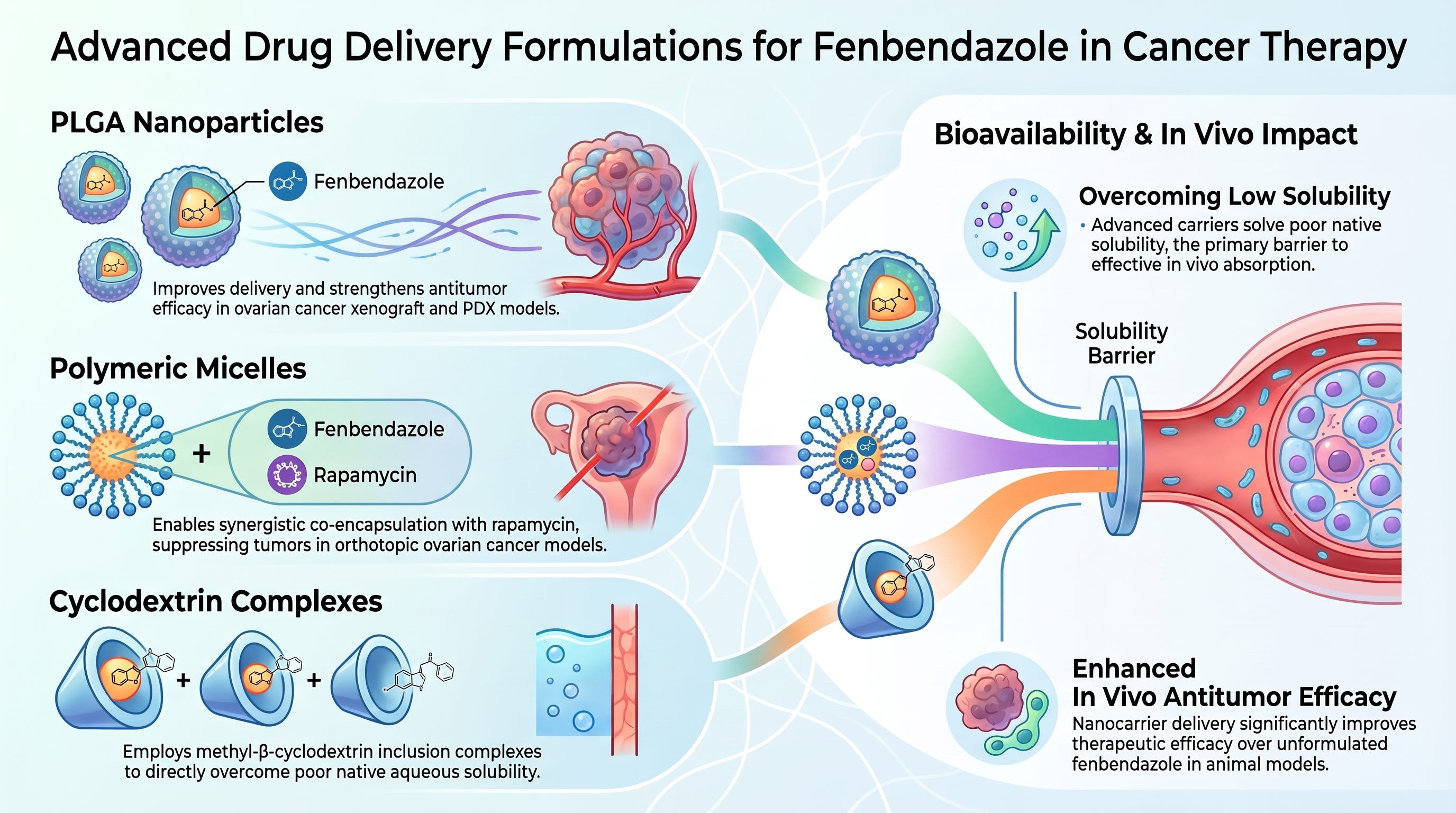
Enhanced Solubilization & Uptake: Encapsulating fenbendazole inside biodegradable PLGA polymers overcomes solubility barriers and facilitates cellular internalization via endocytosis.
Reversing Chemoresistance: In ovarian cancer models, PLGA-fenbendazole nanoparticles significantly decrease cell proliferation across both chemosensitive and chemoresistant cell lines.
Superior In Vivo Tumor Control: Unlike free fenbendazole, PLGA nano-formulations deliver sustained intratumoral drug concentrations, yielding marked tumor suppression in ovarian cancer xenografts and patient-derived xenograft (PDX) models.
PLGA (poly(lactic-co-glycolic acid)) nanoparticles address fenbendazole's primary pharmacological limitations: poor aqueous solubility and poor oral absorption.
PLGA nanoparticles improve fenbendazole delivery and therapeutic performance through several key mechanisms:
Overcoming Solubility & Absorption Barriers: Native fenbendazole struggles with poor systemic bioavailability in biological fluids. Encapsulating the drug in PLGA nanocarriers significantly improves its solubility, stability, and systemic delivery.
Overcoming Drug Resistance: In preclinical ovarian cancer models, PLGA-encapsulated fenbendazole efficiently penetrates cancer cells, decreasing cell proliferation across both chemosensitive and chemoresistant tumor lines.
Enhancing In Vivo Antitumor Efficacy: Native fenbendazole can yield inconsistent results in animal models because of poor absorption, but PLGA nanoparticle formulations optimize drug delivery to the tumor site, resulting in significantly improved antitumor efficacy in xenograft and patient-derived xenograft (PDX) models.
2. Polymeric Micelles (mPEG-PCL & Soluplus®)
Amphiphilic Nanocarriers: Synthetic block-copolymer micelles—such as methoxy poly(ethylene glycol)-b-poly(caprolactone) (mPEG-PCL) and Soluplus®—entrap hydrophobic fenbendazole within a lipophilic core surrounded by a hydrophilic shell.
Dual-Drug Combination & Synergism: Polymeric micelles enable co-encapsulation of fenbendazole alongside targeted agents like rapamycin. This dual-delivery strategy simultaneously blocks microtubule dynamics (fenbendazole) and inhibits mTOR survival pathways (rapamycin), producing potent synergistic antitumor effects in orthotopic ovarian cancer models.
Improved Pharmacokinetics: Micellar encapsulation shields the drug from rapid hepatic clearance, increases systemic half-life, and optimizes tissue distribution while minimizing non-target toxicity.
3. Cyclodextrin Inclusion Complexes
Host-Guest Entrapment: Cyclodextrins (such as methyl-\(\beta\)-cyclodextrin) form molecular inclusion complexes by entrapping fenbendazole’s hydrophobic ring structure within their central hydrophobic cavity while maintaining a hydrophilic exterior.
Rapid Dissolution & Bio-accessibility: This non-covalent entrapment dramatically increases fenbendazole’s dissolution rate and aqueous solubility in biological fluids without altering its chemical scaffold or biological activity.
4. Impact on Apoptotic Efficacy
By ensuring sustained, high-level intracellular drug accumulation within tumor tissues, these advanced delivery systems amplify downstream apoptotic cascades:
Sustained Microtubule Destabilization: Maintains prolonged \(\text{G}_2/\text{M}\) phase cell-cycle arrest.
Elevated Oxidative Stress: Drives intracellular reactive oxygen species (ROS) accumulation, leading to loss of mitochondrial membrane potential.
Tumor Suppressor Reactivation: Downregulates MDM2/MDMX to reactivate the p53/p21 pathway, triggering robust intrinsic apoptosis and cell death even in chemoresistant tumor populations.
1. Primary Synthesis Source Citation (APA 7th Edition)
Preclinical Research on Fenbendazole Treating Cancer. (2026). 10-14-article.odt [Synthesis Review & Meta-Analysis Document].
2. Primary Studies Synthesized in the Source
A. Microtubule Disruption & Apoptotic Signaling
Dogra, N., Kumar, A., & Mukhopadhyay, T. (2018). Fenbendazole acts as a moderate microtubule destabilizing agent and causes cancer cell death by modulating multiple cellular pathways. Scientific Reports, 8(1), Article 11926. https://doi.org/10.1038/s41598-018-30158-6
Dogra, N., & Mukhopadhyay, T. (2012). Impairment of the ubiquitin-proteasome pathway by methyl N-(6-phenylsulfanyl-1H-benzimidazol-2-yl)carbamate leads to a potent cytotoxic effect in tumor cells. Journal of Biological Chemistry, 287(38), 32422–32435. https://doi.org/10.1074/jbc.M111.324228
Park, D. (2022). Fenbendazole suppresses growth and induces apoptosis of actively growing H4IIE hepatocellular carcinoma cells via p21-mediated cell-cycle arrest. Biological and Pharmaceutical Bulletin, 45(5), 697–703. https://doi.org/10.1248/bpb.b21-00697
Peng, Y., Pan, J., Ou, F., & Yu, L. (2022). Fenbendazole and its synthetic analog interfere with HeLa cells’ proliferation and energy metabolism via inducing oxidative stress and modulating MEK3/6-p38-MAPK pathway. Chemico-Biological Interactions, 368, Article 109983. https://doi.org/10.1016/j.cbi.2022.109983
B. Advanced Nanocarrier Delivery Systems & Formulations
Chang, C.-S., Ryu, J.-Y., Choi, J.-K., & Lee, J.-W. (2023). Anti-cancer effect of fenbendazole-incorporated PLGA nanoparticles in ovarian cancer. Journal of Gynecologic Oncology, 34(5), Article e58. https://doi.org/10.3802/jgo.2023.34.e58
Ding, Y., Zhang, Z., Ding, C., & Xu, Z. (2024). Preparation and evaluation of fenbendazole methyl-β-cyclodextrin inclusion complexes. BMC Veterinary Research, 20(1), Article 40561. https://doi.org/10.1186/s12917-024-04056-1
Jin, I. S., Jo, M. J., Park, C.-W., & Shin, D. H. (2020). Physicochemical, pharmacokinetic, and toxicity evaluation of Soluplus® polymeric micelles encapsulating fenbendazole. Pharmaceutics, 12(10), Article 1000. https://doi.org/10.3390/pharmaceutics12101000
Shin, Y. B., Choi, J.-Y., Shin, D. H., & Lee, J.-W. (2023). Anticancer evaluation of methoxy poly(ethylene glycol)-b-poly(caprolactone) polymeric micelles encapsulating fenbendazole and rapamycin in ovarian cancer. International Journal of Nanomedicine, 18, 4821–4835. https://doi.org/10.2147/IJN.S394712
C. In Vivo Efficacy & Model Discrepancies
Duan, Q., Liu, Y., & Rockwell, S. (2013). Fenbendazole as a potential anticancer drug. Anticancer Research, 33(2), 355–362.
Jung, H., Kim, S.-Y., & Joo, H.-G. (2023). Fenbendazole exhibits differential anticancer effects in vitro and in vivo in models of mouse lymphoma. Current Issues in Molecular Biology, 45(11), 8820–8831. https://doi.org/10.3390/cimb45110560