
This medical case report details an elderly patient diagnosed with stage IVa diffuse large B-cell lymphoma who declined conventional chemotherapy and instead self-administered fenbendazole, an animal deworming medication. Over a period of several months, follow-up imaging scans revealed a remarkable regression of the patient’s cancer and shrinking lymph nodes. While laboratory studies suggest this antiparasitic agent may disrupt cellular structures critical for tumor growth, the medical community notes that further clinical research is necessary to definitively establish its safety and efficacy as a human oncology treatment.
The published case report on Diffuse Large B-Cell Lymphoma (DLBCL) details an elderly patient who achieved significant disease regression after self-administering Fenbendazole as a monotherapy:
1. Patient Presentation & Diagnosis
Clinical Profile: An 83-year-old male presented with heartburn, swallowing difficulties, and fatigue.
Biopsy & Subtype: An esophagogastroduodenoscopy (EGD) revealed a superficial duodenal ulcer; biopsy confirmed DLBCL, Germinal Center B-cell (GCB) subtype.
Genetics: Fluorescence in situ hybridization (FISH) was negative for c-MYC, BCL2, and BCL6 rearrangements.
Staging: Baseline PET/CT showed hypermetabolic activity in the distal gastric antrum, proximal duodenum, peri-aortic lymph node, and pulmonary nodules, consistent with Stage IVa DLBCL.
2. Treatment Decisions & Fenbendazole Regimen
Declining Standard Therapy: Given the aggressive nature of DLBCL, standard care called for urgent chemotherapy, which the patient declined due to concerns regarding side effects.
Dosing Schedule: Based on self-directed research, the patient initiated oral Fenbendazole at 1 g daily (varying between 1 and 6 tablets daily according to his symptoms).
Dose Modification: At 6 months, he reduced his dosage to 1–3 tablets daily after developing peripheral neuropathy.
3. Imaging Outcomes & Disease Timeline
6 Months: A chest CT ordered by his primary care physician revealed a reduction in the size of mediastinal lymph nodes.
8 Months: A follow-up PET/CT scan ordered by oncology showed marked improvement in overall lymphadenopathy compared to baseline.
11 Months: After further tapering Fenbendazole to 3 pills weekly, repeat PET/CT imaging showed continued interval regression of his lymphoma with no new lesions.
4. Scientific Context & Limitations
Preclinical Precedent: The authors note that prior animal studies demonstrated antitumor activity for Fenbendazole, including a study by Gao et al. where Fenbendazole combined with supplementary vitamins significantly inhibited lymphoma growth in SCID mice.
Authors’ Caution: The report emphasizes that while regression coincided with Fenbendazole intake, controlled clinical trials are needed to rule out confounding factors or spontaneous remission.
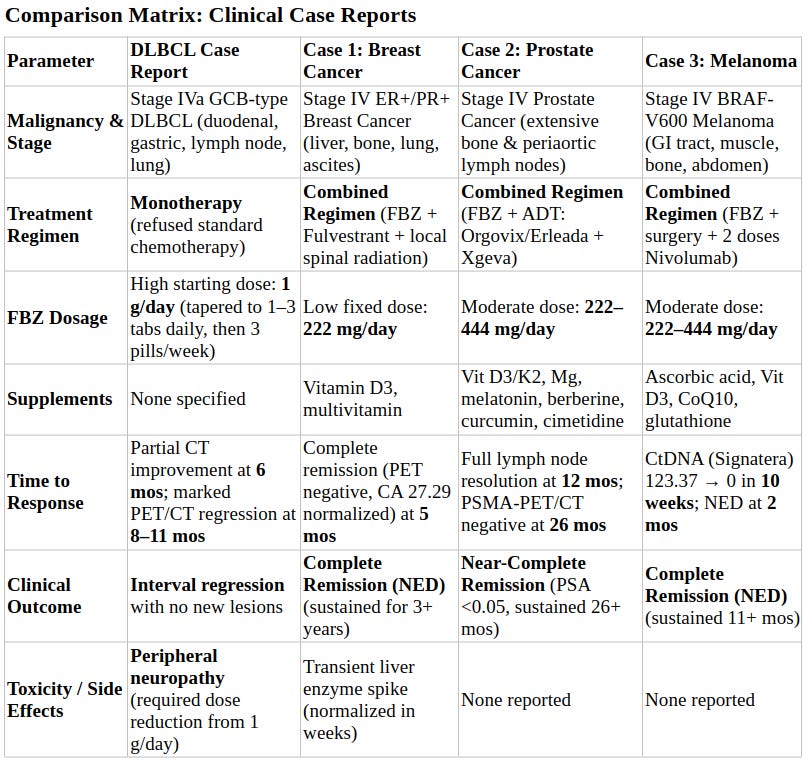
Comparing the Diffuse Large B-Cell Lymphoma (DLBCL) case report with the three solid tumor cases (breast, prostate, and melanoma) reveals key differences in dosing strategies, treatment regimens, response timelines, and side-effect profiles across hematologic vs. solid malignancies.
Key Clinical Takeaways
Monotherapy vs. Multimodal Combinations:
The DLBCL case provides a rare example of FBZ as monotherapy, showing disease regression without concurrent chemo- or immunotherapy.
In contrast, all three solid tumor cases combined FBZ with non-chemotherapeutic standard options (such as hormonal blockade or immune checkpoint inhibitors), making it difficult to isolate FBZ’s exact individual contribution.
Dosing Tolerability & Toxicity Thresholds:
High Dosing (1,000 mg/day) in the DLBCL patient led to peripheral neuropathy, compelling the patient to scale down intake.
Low-to-moderate dosing (222–444 mg/day) in the solid tumor cases achieved near-complete or complete metabolic remissions without neurotoxicity or significant organ toxicity.
Response Speed:
The melanoma case exhibited the fastest response, with circulating tumor DNA dropping to zero in under 10 weeks. The hematologic DLBCL case showed a more gradual, step-wise regression over 6 to 11 months of continuous tapering.
References
Abughanimeh, O., Evans, T., & Kallam, A. (2020). Fenbendazole as a treatment for diffuse large B-cell lymphoma. Annals of Hematology & Oncology, 7(2), Article 1284.
Dogra, N., Kumar, A., & Mukhopadhyay, T. (2018). Fenbendazole acts as a moderate microtubule-destabilizing agent and causes cancer cell death by modulating multiple cellular pathways. Scientific Reports, 8(1), Article 11926. https://doi.org/10.1038/s41598-018-30158-6
Makis, W., Baghli, I., & Martinez, P. (2025). Fenbendazole as an anticancer agent? A case series of self-administration in three patients. Case Reports in Oncology, 18(1), 864–875. https://doi.org/10.1159/000546362
Park, D., Lee, J.-H., & Yoon, S.-P. (2022). Anti-cancer effects of fenbendazole on 5-fluorouracil-resistant colorectal cancer cells. Korean Journal of Physiology & Pharmacology, 26(5), 377–387. https://doi.org/10.4196/kjpp.2022.26.5.377
Semkova, S., Nikolova, B., Tsoneva, I., Antov, G., Ivanova, D., Angelov, A., Zhelev, Z., & Bakalova, R. (2023). Redox-mediated anticancer activity of anti-parasitic drug fenbendazole in triple-negative breast cancer cells. Anticancer Research, 43(3), 1207–1212.
Thank you for this precision and nuance in each case. I think it’s important for patients to understand the effects as well as risks with those therapies, their interactions and also the attribution to the results when several medications are taken. That last one is an important point that often gets lost in case studies and testimonials.