
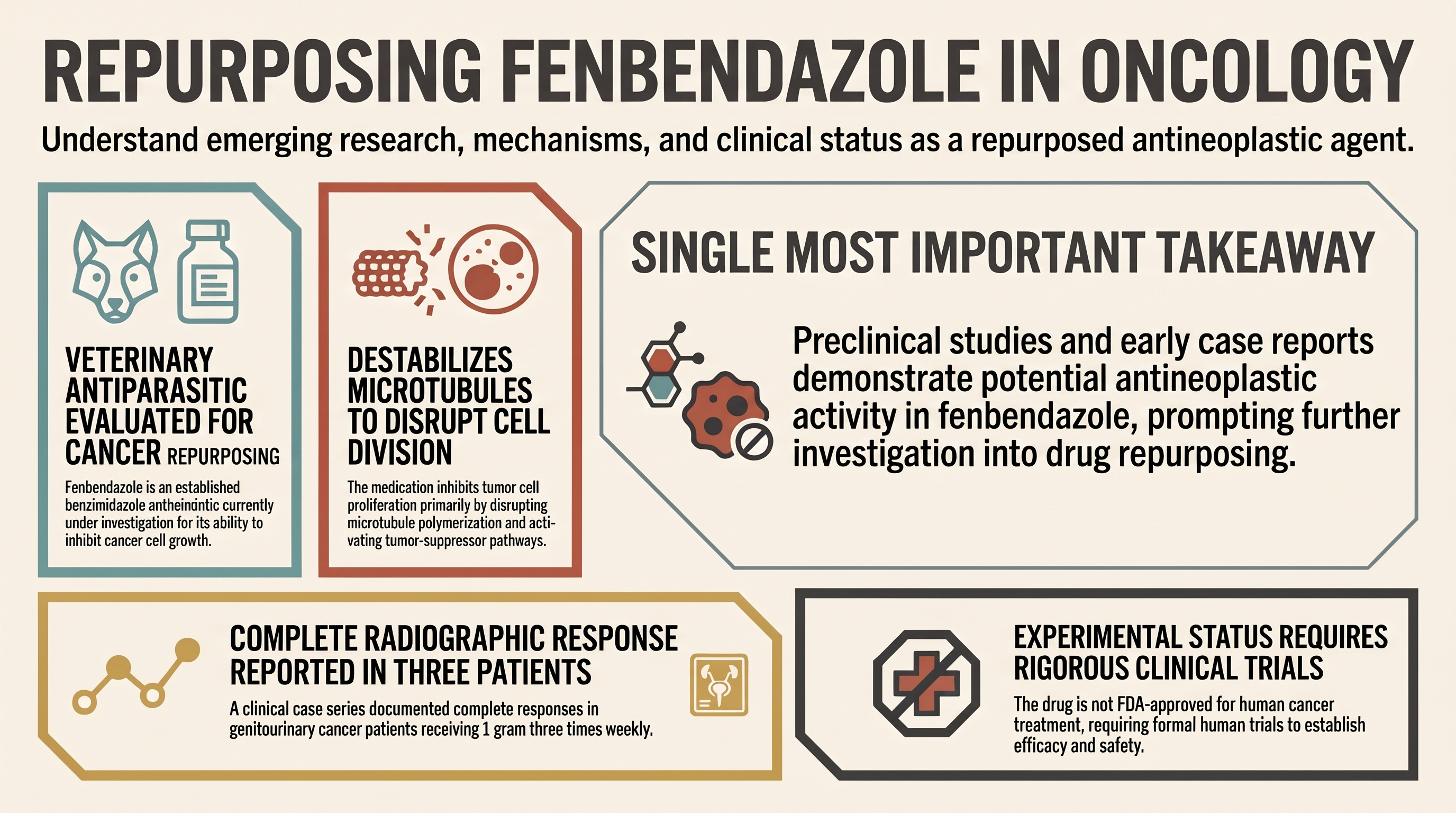
Fenbendazole (FBZ) is an inexpensive, broad-spectrum veterinary anthelmintic belonging to the benzimidazole drug class. In recent years, it has gained substantial interest as a repurposed antineoplastic candidate.
Drug Background & Classification:
Fenbendazole (marketed under brand names such as Panacur and Safe-Guard) is a broad-spectrum anthelmintic belonging to the benzimidazole class of medications. It is primarily formulated and used in veterinary medicine to treat gastrointestinal parasites in animals, including roundworms, hookworms, whipworms, and certain tapeworms.Scientific Interest in Pancreatic Cancer:
Pancreatic cancer is among the most aggressive malignancies, typically characterized by late-stage diagnosis, low survival rates, and limited therapeutic options. Because of the urgent need for new strategies, antiparasitic drugs such as fenbendazole have drawn scientific interest, showing early promise in laboratory settings for inhibiting the growth and spread of cancer cells.Proposed Antitumor Mechanism:
While the exact mechanisms underlying its potential anticancer activity remain under active investigation, researchers suggest that fenbendazole acts primarily as a microtubule disruptor. Microtubules are structural components essential for cellular growth and mitotic division; interfering with their function disrupts the cancer cell’s ability to divide.Related Compounds in Drug Repurposing:
Because fenbendazole is a veterinary drug, researchers also study related benzimidazoles, such as mebendazole (which is approved for human use) and parbendazole (which has shown preclinical synergy with gemcitabine in pancreatic cancer models).Established Standard Treatments:
Standard clinical care for pancreatic cancer remains centered on conventional modalities based on tumor stage:Surgery: Critical for removing localized tumors and adjacent tissue.
Chemotherapy: Common regimens include gemcitabine and nab-paclitaxel, administered before/after surgery or as primary therapy in advanced disease.
Radiation Therapy: Administered pre-operatively, post-operatively, or palliatively to control localized tumor growth and alleviate symptoms.
Immunotherapy & Palliative Care: Investigational options such as immunotherapy are being evaluated in clinical trials, alongside palliative care to manage symptoms and support quality of life.
1. Comparing Fenbendazole to Human-Approved Benzimidazoles
Regulatory and Clinical Translation Status:
Fenbendazole is primarily formulated and restricted to veterinary medicine for treating gastrointestinal parasites in animals. Because of this veterinary status, clinical data in oncology are largely limited to preclinical cell/animal studies and observational reports, with little to no formal human clinical trial data.Human-Approved Counterparts (Mebendazole):
To bypass the regulatory hurdles of veterinary drugs, oncologic repurposing research frequently focuses on mebendazole, a closely related benzimidazole that is already approved for human use.Shared Antitumor Mechanism:
Both fenbendazole and related benzimidazoles act primarily as microtubule disruptors. By interfering with microtubule function—which is essential for cellular structure and mitotic division—these compounds inhibit the growth, division, and spread of malignant cells.
2. Chemotherapy Combinations with Gemcitabine
Standard Chemotherapy Backbone:
In clinical practice, conventional systemic therapy for localized or advanced pancreatic cancer relies heavily on gemcitabine (frequently administered alongside nab-paclitaxel) in neoadjuvant, adjuvant, or palliative settings.Preclinical Synergy (Parbendazole + Gemcitabine):
While direct research evaluating fenbendazole in pancreatic cancer remains limited, preclinical studies have investigated related benzimidazole analogs. Notably, parbendazole has demonstrated preclinical synergy when combined with gemcitabine in pancreatic cancer models, suggesting that benzimidazoles may enhance the efficacy of standard antimetabolite chemotherapy.Translational Needs & Clinical Questions:
Because current evidence remains concentrated in cell cultures, animal models, or observational accounts, formal prospective clinical trials are required to:Establish safe and effective human dosing schedules.
Clarify systemic safety profiles and potential drug–drug toxicities.
Objectively evaluate whether adding benzimidazole microtubule disruptors to standard gemcitabine-based chemotherapy improves overall response rates or survival outcomes in pancreatic cancer patients.
1. Biological Mechanisms of Antitumor Action
Microtubule Destabilization & Mitotic Arrest:
Fenbendazole acts as a microtubule-destabilizing agent through a mechanism similar to conventional anti-oncogenic vinca alkaloids. By interfering with tubulin and disrupting microtubule polymerization, it disrupts the structural apparatus required for mitotic division and cellular growth, ultimately triggering apoptosis.Inhibition of Proteasomal Activity:
Studies indicate that fenbendazole impairs the ubiquitin-proteasome pathway, contributing to cellular cytotoxicity in malignant cells.p53 Pathway Activation:
Fenbendazole has been shown to induce p53 activation, promoting pro-apoptotic signaling pathways.Suppression of Glycolytic Metabolism:
Cancer cells depend heavily on altered energy metabolism; fenbendazole has been documented to downregulate key glycolytic enzymes critical for cancer cell survival. Related benzimidazoles (such as albendazole) also modulate the HIF-1\(\alpha\) pathway, which impairs vascular endothelial growth factor (VEGF) expression and glycolytic function. Targeting multiple metabolic and survival pathways simultaneously may help prevent or limit the development of treatment resistance.
2. Clinical Case-Series Evidence in Humans
While clinical literature evaluating fenbendazole remains limited, a peer-reviewed case series published by clinicians at Stanford and the University of Washington documented complete responses in three patients with advanced genitourinary cancers taking fenbendazole (typically dosed at 1 g three times weekly):
Metastatic Clear Cell Renal Cell Carcinoma (RCC):
A 63-year-old male with recurrent renal cell carcinoma metastatic to the pancreas and iliac bone experienced disease progression on targeted therapies (pazopanib and cabozantinib). After stopping third-line nivolumab after just three doses due to severe toxicity (colitis and rash), he initiated alternative therapy with fenbendazole (1 g three times weekly). Interval MRI revealed near-complete resolution of the renal mass along with regression of pancreatic and bone metastases, maintaining complete radiographic remission for over 10 months without further immunotherapy.Metastatic Urothelial Carcinoma of the Urethra:
A 72-year-old male developed metastatic progression in an aortocaval lymph node (enlarging to 2.0 cm × 1.5 cm) following radiation, chemo-immunotherapy, and maintenance pembrolizumab. Awaiting further systemic therapy, he initiated oral fenbendazole (1 g three days per week) alongside complementary supplements (vitamin E, curcumin, and CBD oil). Serial CT scans over 9 months demonstrated progressive regression to 0.5 cm × 0.5 cm, achieving a complete radiographic response.Locally Advanced T4 Bladder Urothelial Carcinoma:
A 63-year-old female presented with a large (7.5 cm) necrotic bladder mass extending to the pelvic sidewall. She received accelerated MVAC (methotrexate, vinblastine, doxorubicin, cisplatin) chemotherapy alongside concurrent fenbendazole (1 g three times weekly). Follow-up imaging demonstrated complete resolution of disease, allowing her to avoid radical cystectomy and remain recurrence-free under surveillance.
Across these clinical scenarios, fenbendazole was well tolerated, with no reported adverse side effects.
3. Current Limitations & Translational Status
Predominance of Preclinical Data: The vast majority of published evidence regarding fenbendazole remains restricted to in vitro cell cultures, animal models, and anecdotal reports.
Lack of Formal Clinical Trials: Fenbendazole has not received regulatory approval for human oncology applications. There is currently very limited information regarding ongoing, formal interventional clinical trials.
Critical Research Needs: Controlled human clinical trials are necessary to formally determine optimal human dosing schedules, characterize pharmacokinetic and safety profiles, and objectively test whether fenbendazole enhances response rates and survival when combined with or compared to standard-of-care treatments.
Chiang, R. S., Syed, A. B., Wright, J. L., Montgomery, B., & Srinivas, S. (2021). Fenbendazole enhancing anti-tumor effect: A case series. Clinical Oncology: Case Reports, 4(2).
Ruwa, R. (2025, June 13). Can antiparasitic drug fenbendazole treat pancreatic cancer? (T. H. Thomas, Med. Rev.). Healthline. https://www.healthline.com/health/pancreatic-cancer/fenbendazole-for-pancreatic-cancer