
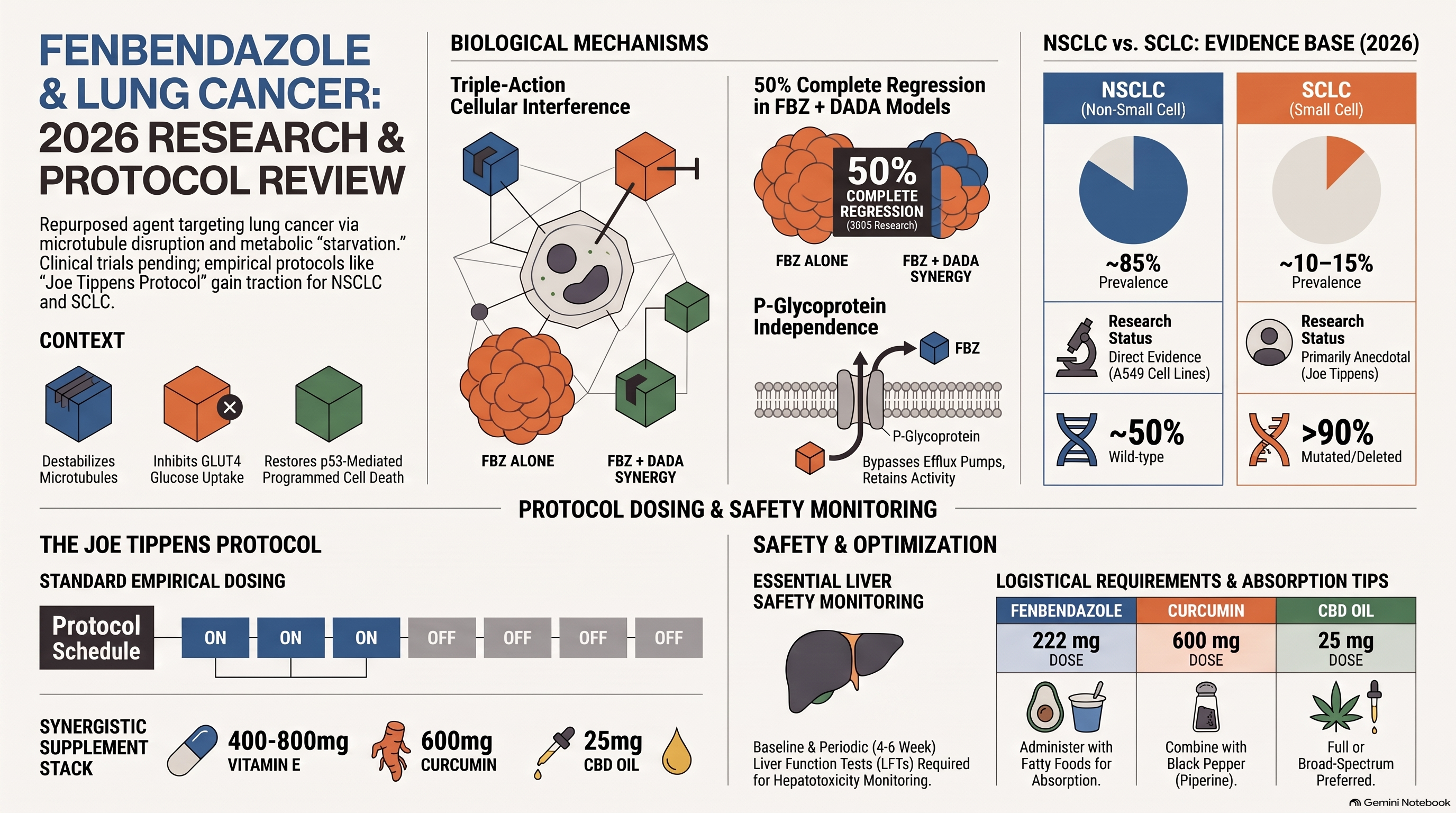
This is a highly technical summary of the research article from Sanare Lab by Dr. Andrew Ellison, MD, July 1, 2026.
Fenbendazole protocols specifically for lung cancer treatment. Dosing strategies, combination therapies, patient case studies, and mechanisms targeting non-small cell and small cell lung cancers.
Ultimately, the source serves as an informational guide on dosing protocols and safety monitoring while emphasizing that these experimental strategies must not replace conventional medical care.
Preclinical research evaluates fenbendazole across five primary mechanisms targeting cancer cells:
1. Microtubule Destabilization & G2/M Phase Arrest
Colchicine-Site Binding: Fenbendazole binds to β-tubulin at the colchicine-binding site, disrupting microtubule polymerization.
Mitotic Spindle Disruption: By preventing proper mitotic spindle assembly, it induces G2/M cell cycle arrest—halting cancer cells at the transition between DNA replication and mitosis—which triggers mitotic catastrophe and apoptosis.
Contrast with Taxanes: Unlike taxane chemotherapy drugs (e.g., paclitaxel) that stabilize microtubules, fenbendazole functions as a moderate microtubule-destabilizing agent.
2. Disruption of Glucose Metabolism (Warburg Effect)
Downregulation of GLUT4 & HK II: Fenbendazole significantly reduces the expression of glucose transporter type 4 (GLUT4) and hexokinase II (HK II), the enzyme catalyzing the first committed step of glycolysis.
Metabolic Starvation: Cancer cells rely heavily on accelerated glycolysis for energy (the Warburg effect). By blocking glucose uptake, fenbendazole starves tumor cells through a metabolic pathway that functions independently of microtubule disruption.
3. p53 Stabilization & Mitochondrial Apoptosis
Mdm2/MdmX Downregulation: Fenbendazole stabilizes the tumor suppressor protein p53 by downregulating its inhibitory regulators, Mdm2 and MdmX.
MOMP Cascade: It promotes p53 translocation to the mitochondria, activating pro-apoptotic Bcl-2 family proteins (Bax and Bak). This leads to mitochondrial outer membrane permeabilization (MOMP), cytochrome release, and caspase-mediated apoptosis.
Subtype Limitations: This mechanism requires functional (wild-type) p53, which is present in roughly 50% of non-small cell lung cancers (NSCLC). In small cell lung cancer (SCLC), where p53 is mutated or deleted in >90 of cases, this specific p53-dependent pathway may be non-operational.
4. Induction of Ferroptosis
Non-Apoptotic Cell Death: Emerging research indicates fenbendazole induces ferroptosis—an iron-dependent cell death pathway characterized by reactive oxygen species (ROS) accumulation and membrane lipid peroxidation.
Overcoming Apoptosis Resistance: Because ferroptosis differs from apoptosis, necroptosis, and autophagy, it allows fenbendazole to remain active in cells resistant to conventional apoptotic signaling.
5. Independence from P-Glycoprotein (P-gp) Efflux
Bypassing Multidrug Resistance: Fenbendazole is neither a substrate nor an inhibitor of P-glycoprotein (P-gp), the ATP-binding cassette pump that tumor cells overexpress to pump out chemotherapy drugs.
Sustained Efficacy: Because it avoids P-gp-mediated efflux, fenbendazole retains cytotoxicity in multidrug-resistant cancer cells that no longer respond to drugs like paclitaxel or vinblastine.
6. Metabolic Trapping with DADA (Diisopropylamine Dichloroacetate)
Dual Metabolic Blockade: Combining fenbendazole with DADA creates a convergent metabolic trap. Fenbendazole blocks glucose entry via GLUT4/HK II inhibition, while DADA inhibits pyruvate dehydrogenase kinase (PDK), forcing cells into oxidative phosphorylation that they cannot sustain.
Preclinical Tumor Regression: In A549 NSCLC xenograft models, the FBZ + DADA combination achieved a 50% complete tumor regression rate (compared to 0% for FBZ alone) without causing liver enzyme elevation, weight loss, or organ toxicity.
Fenbendazole for Lung Cancer: Comprehensive Research Review 2026
By Dr. Andrew Ellison, MD, July 1, 2026. Science editor and health researcher at Sanare Lab
https://www.sanarelab.science/fenbendazole-lung-cancer/
This article is for research and informational purposes only. It does not constitute medical advice. Always consult a qualified healthcare provider before using any supplement, especially alongside cancer treatment.