
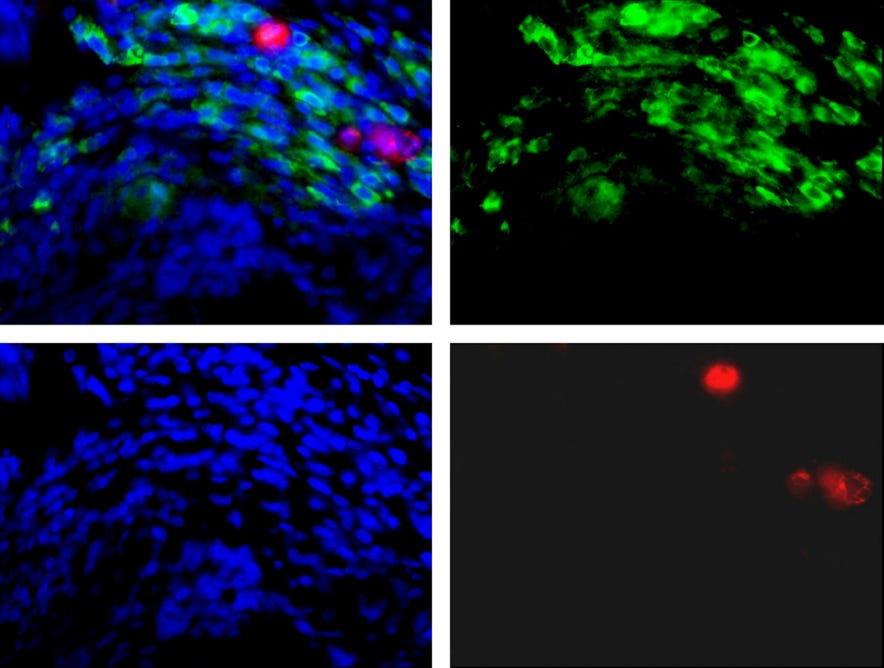
Fenbendazole and related benzimidazole anthelmintics eliminate cancer cells through distinct pathways depending on the specific cancer type and chemoresistance status. While apoptosis serves as the primary mode of cell death in standard, drug-sensitive cancer cells, ferroptosis acts as a crucial auxiliary mechanism to eliminate chemoresistant lines.
1. Apoptosis: Mitochondrial Damage & The p53 Switch
Apoptosis (programmed cell death) induced by fenbendazole operates through the intrinsic mitochondrial pathway across multiple cancer types.
Mitochondrial Cascade & Caspase Activation: Fenbendazole disrupts mitochondrial membrane integrity, causing the release of cytochrome-C into the cytoplasm. This triggers the activation of caspase-3 (increasing cleaved caspase-3) and subsequent cleavage of PARP, executing cellular dismantling.
Bcl-2 Family Dynamics: In ovarian cancer cell lines (A2780 and SKOV3), fenbendazole significantly increases the pro-apoptotic protein BAX and elevates the BAX/BCL-2 ratio. Pretreatment with the pan-caspase inhibitor Z-VAD-FMK partially rescues cell viability, confirming caspase-dependent apoptotic death.
The p53 Divergence (Chemoresistant vs. Wild-Type):
Wild-Type Cells (p53-Dependent): In standard, 5-FU-sensitive colorectal cancer cells (SNU-C5), fenbendazole increases p53 phosphorylation (activation), driving p53-mediated apoptosis.
5-FU-Resistant Cells (p53-Independent): In 5-fluorouracil-resistant cells (SNU-C5/5-FUR), fenbendazole triggers apoptosis without altering p53 expression or activation. This allows the drug to circumvent the loss or mutation of p53 that frequently drives chemotherapy failure.
2. Ferroptosis: Overcoming Chemoresistance
Ferroptosis is an iron-dependent form of regulated cell death driven by the accumulation of toxic lipid reactive oxygen species (ROS) and lipid peroxidation. Fenbendazole engages ferroptosis as a synergistic pathway to overcome drug resistance.
Targeting Antioxidant Defenses:
GPX4 Downregulation: Glutathione peroxidase 4 (GPX4) is a critical lipid repair enzyme. Fenbendazole downregulates GPX4 expression in both wild-type and resistant cancer cells.
SLC7A11 Suppression in Resistant Cells: System xCT (SLC7A11) imports cystine required for glutathione production. While SLC7A11 expression is maintained in sensitive cells, fenbendazole significantly suppresses SLC7A11 in 5-FU-resistant cells, severely crippling their antioxidant defenses.
Iron Homeostasis Alterations: Fenbendazole upregulates ferritin heavy chain (FTH1, an iron storage protein) and ferroportin (FPN, an iron exporter), reflecting alterations in intracellular iron management during ferroptotic stress.
Ferroptosis-Augmented Apoptosis: Co-treatment with ferroptosis inhibitors (Ferrostatin-1 or the iron chelator DFOM) does not fully restore cell viability, demonstrating that ferroptosis is not the sole primary driver. Instead, ferroptosis causes the release of damage-associated molecular patterns like HMGB1, which augment and amplify apoptotic cell death in chemoresistant cells.
3. Mitotic Catastrophe & G2/M Cell Cycle Arrest
By binding to \(\beta\)-tubulin, fenbendazole prevents proper microtubule assembly and function during mitosis.
Morphological Features: In epithelial ovarian cancer cells, fenbendazole causes severe spindle disorganization, leading to mitotic catastrophe characterized by the formation of multinucleated giant cells and micronuclei.
G2/M Checkpoint Regulators: Cells accumulate in the G2/M phase. This arrest is driven by:
Inactivation of CDK1 via increased phosphorylation (p-CDK1).
Upregulation and accumulation of cyclin B1.
Upregulation of cyclin-dependent kinase inhibitors p21 and p27, alongside marked downregulation of the oncogene c-Myc.
4. Non-Functional Pathways: Autophagy & Necroptosis
Fenbendazole selectively modulates cell death, leaving certain alternative pathways incomplete or inactive:
Incomplete Autophagy: Although fenbendazole increases the autophagy-initiating protein Beclin-1, autophagic flux is incomplete due to a lack of LC3-II conversion (particularly in 5-FU-resistant cells).
Inactive Necroptosis: While phosphorylation of receptor-interacting protein kinase (pRIP) increases, the terminal executioner of necroptosis (pMLKL) remains unchanged and RIP3 activation decreases, indicating necroptosis is not functionally executed.
Source:
Vlachou, I., Parsonidis, P., Mamagkaki, A., Bouris, I., & Papasotiriou, I. (2022). Teaching an old dog new tricks: The case of Fenbendazole. Cancer Treatment and Research Communications, 32, 100601. https://doi.org/10.1016/j.ctarc.2022.100601