

Introduction
Can a cheap veterinary dewormer designed for dogs and livestock actually treat human cancer? This provocative question took the internet by storm after one terminal patient’s recovery story went viral, sparking a global movement of self-experimentation. This article explores the biological science, research data, practical risks, and major medical caveats behind the fenbendazole phenomenon.
By finishing this article, you will achieve the following objectives:
Understand what fenbendazole is and how it targets parasites and cells.
Examine the biological connection between microtubule disruption and cancer cell death.
Analyze the critical gap between laboratory animal studies and human clinical trials.
Identify the practical protocols, safety monitoring, and medical risks associated with off-label use.
The Unexpected Origin: What is Fenbendazole?
Fenbendazole was developed in the 1970s as a broad-spectrum veterinary antiparasitic drug designed to kill worms (like roundworms, hookworms, and whipworms) in animals. It belongs to a chemical class of drugs called benzimidazoles, which also includes human-approved antiparasitics like mebendazole and albendazole.
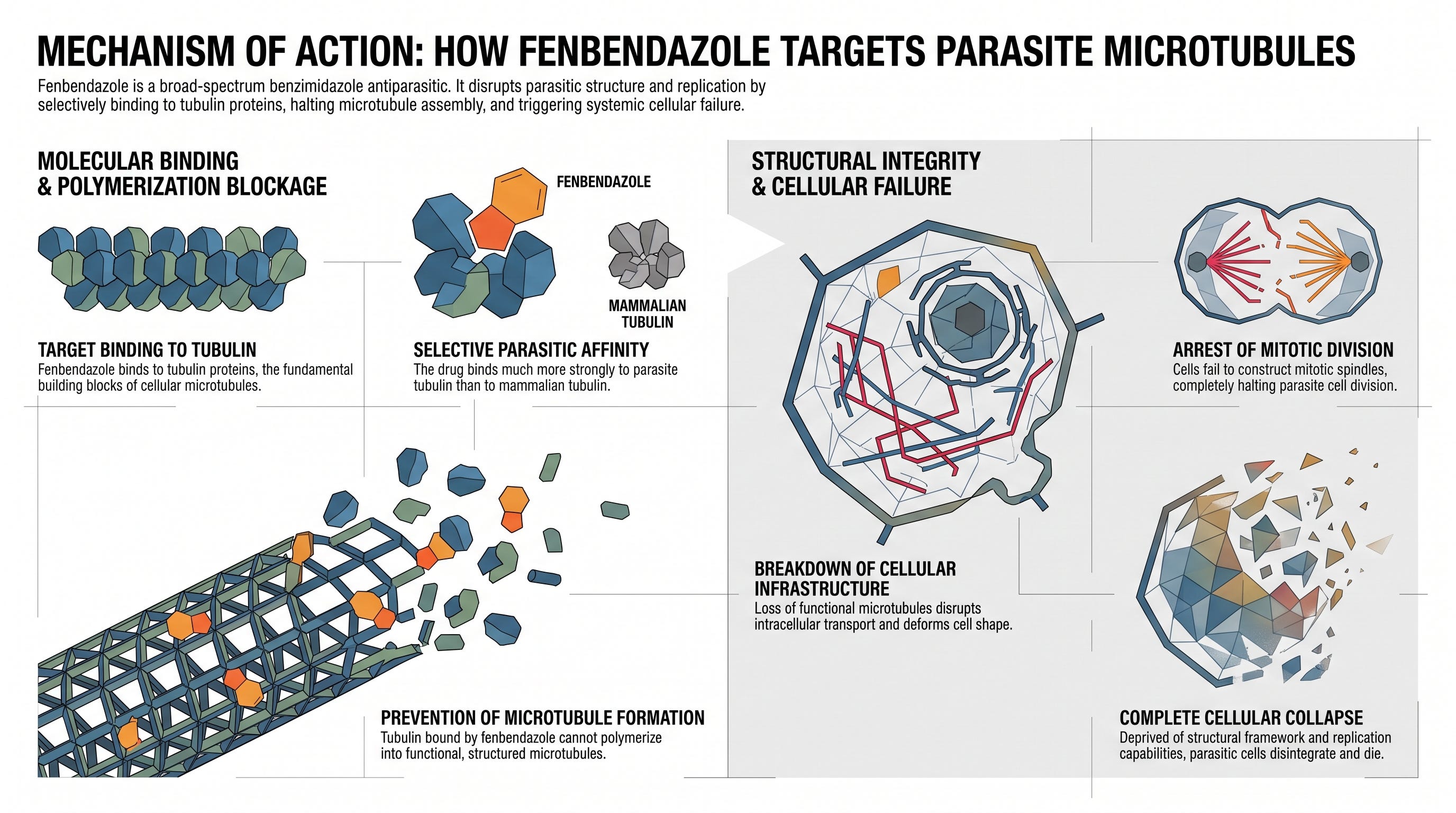
At the cellular level, parasites rely on a structural protein called tubulin to form microtubules. Think of microtubules as both a cell's skeletal scaffolding and its internal highway system, essential for maintaining cell shape, transporting materials, and dividing.
Fenbendazole binds selectively to parasite tubulin, preventing it from assembling into functional microtubules. Without this cellular infrastructure, the parasite literally falls apart and dies. Because the drug binds much more strongly to parasite tubulin than to mammalian tubulin, it has historically maintained an excellent safety record in host animals.
The Scientific Link: How a Dewormer Targets Cancer
Why would an animal worm medicine work against human cancer? The link lies in the rapid and uncontrolled nature of cancer cell division.
During cell division (mitosis), a cell must construct a mitotic spindle—made entirely of microtubules—to pull its duplicated chromosomes apart. Because cancer cells divide constantly, they are highly sensitive to anything that disrupts microtubule dynamics.
In fact, targeting microtubules is a cornerstone of modern, approved oncology. Well-known chemotherapy drugs like Taxanes (paclitaxel, docetaxel) and Vinca alkaloids (vincristine, vinblastine) work by stabilizing or destabilizing microtubules to arrest cell division.
Beyond microtubule disruption, laboratory research suggests fenbendazole may impact cancer through multiple auxiliary pathways:
Glucose Starvation: It may interfere with glucose transporters, cutting off the sugar supply that rapidly growing tumors rely on (the Warburg effect).
p53 Activation: It can stimulate p53, the genome’s primary tumor-suppressor protein, which signals damaged cells to undergo programmed cell death (apoptosis).
The Scientific Evidence: From Lab Dishes to the Human Gap
The idea of using fenbendazole for cancer began with an accidental discovery. In the late 1990s and early 2000s, cancer researchers at Johns Hopkins noticed that experimental tumors in certain groups of mice were failing to grow. The culprit? The mice had been routinely treated with veterinary fenbendazole to prevent pinworm infections.
This finding launched deliberate laboratory studies. Today, the scientific evidence for fenbendazole is structured across three distinct tiers:
In Vitro (Cell Culture): Dozens of studies show fenbendazole successfully kills lung, colorectal, brain (glioblastoma), breast, and prostate cancer cells in laboratory dishes.
In Vivo (Animal Studies): Multiple mouse trials demonstrate that oral fenbendazole can slow tumor growth, reduce metastasis, and work synergistically with radiation or chemotherapy.
Human Evidence: Currently, no published, peer-reviewed human clinical trials test fenbendazole as a cancer treatment.
What about the famous viral case of Joe Tippens? In 2016, Tippens was diagnosed with late-stage, metastatic small-cell lung cancer. He took fenbendazole alongside a suite of supplements and famously went into complete remission. However, medical experts emphasize a crucial, often-omitted detail: Tippens was simultaneously enrolled in a formal clinical trial for Keytruda (pembrolizumab), a highly effective, FDA-approved immunotherapy. Oncologists attribute his recovery to this cutting-edge immunotherapy rather than the veterinary dewormer. It is important to note that out of over 1000 participants, Joe was the only person in the trial who survived his cancer.
Sourcing, Dosing, and Safety Realities
Because fenbendazole is not FDA-approved for human oncology, patients who choose to explore it navigate an unregulated, experimental landscape.
One of the drug’s primary physical traits is its poor water solubility. In veterinary medicine, this is a feature—it allows the drug to remain in the digestive tract to target intestinal worms. However, for systemic diseases like cancer, absorption into the bloodstream is difficult. To overcome this, self-treating patients typically consume the drug alongside fatty foods (such as peanut butter, yogurt, or oils) to enhance its bioavailability.
The most widely discussed self-treatment routine is the “Joe Tippens Protocol,” which typically involves:
Fenbendazole: 222 mg daily for 3 consecutive days, followed by 4 days off.
Supplements: Daily doses of Curcumin, CBD oil, and Vitamin E.
While fenbendazole generally has a mild side-effect profile, it is not without risk. The liver processes the drug, and sustained human doses can elevate liver enzymes and cause chemical-induced liver strain. Patients who use the drug are strongly urged to stay fully transparent with their oncologists and undergo regular safety blood panels (Comprehensive Metabolic Panels and Liver Function Tests) to monitor liver and kidney health.
Summary
The fenbendazole story represents a fascinating intersection of modern drug repurposing, patient-led online communities, and biological plausibility.
Key takeaways from this lesson include:
Origin: Fenbendazole is a veterinary benzimidazole drug designed to kill parasites by binding to tubulin and halting microtubule assembly.
Cancer Connection: Because cancer cells rely heavily on microtubules to divide during mitosis, microtubule-disrupting agents can halt tumor growth and trigger apoptosis.
The Evidence Gap: While cell and mouse studies are promising, no human clinical trials show fenbendazole works in humans. Viral success stories are highly confounded by concurrent conventional therapies, such as immunotherapy.
Clinical Safety: Off-label use requires taking the drug with fat to aid absorption and demands strict monitoring of liver function to avoid potential drug-induced organ toxicity.
I’m interested in more information about Fenbendazole and prostate cancer
What is known about leukemia treatment with fenbendazole