
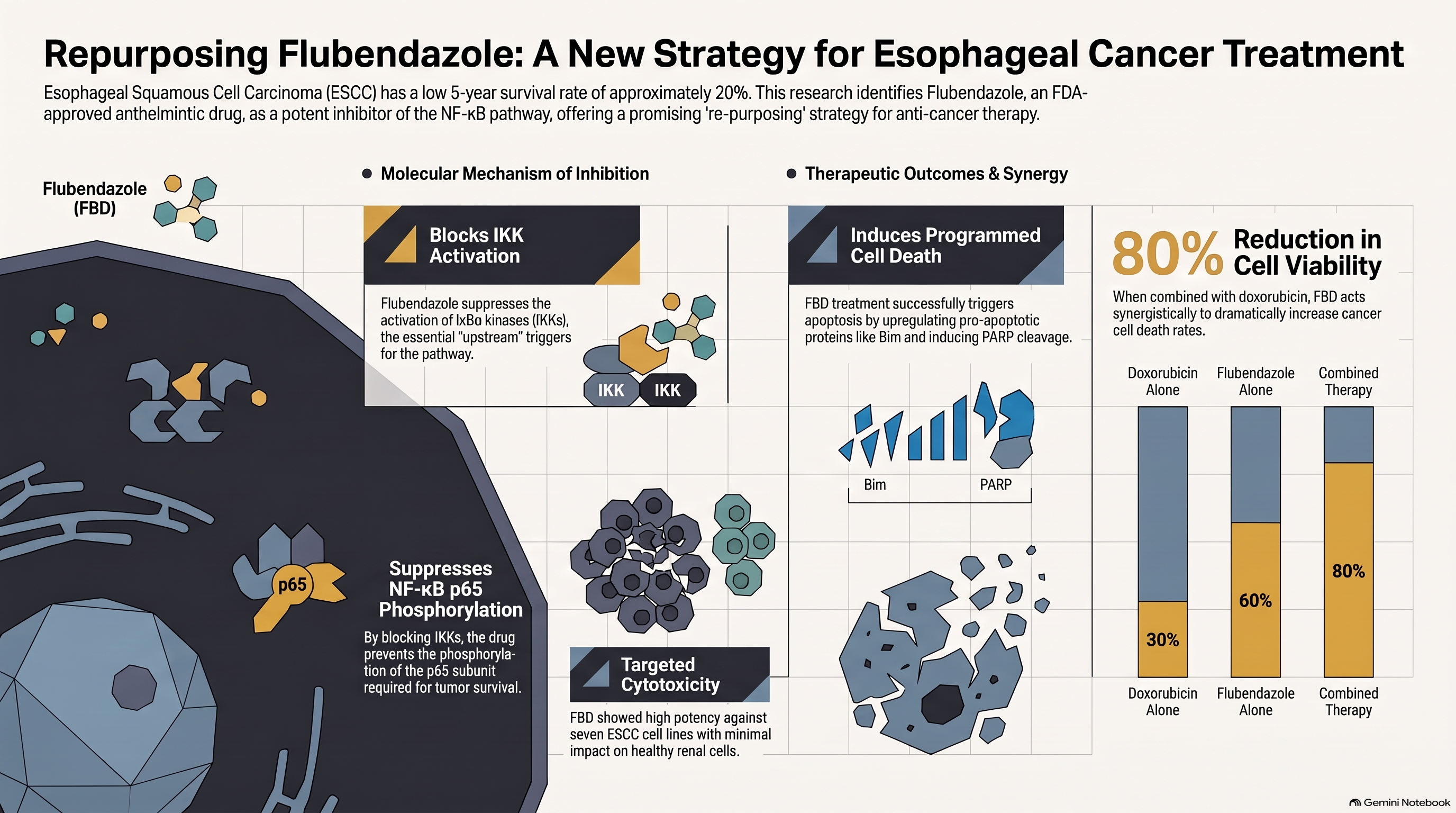
This research article examines how the anthelmintic drug flubendazole can be repurposed to treat esophageal squamous cell carcinoma (ESCC). By testing various cancer cell lines, the authors show that flubendazole triggers apoptosis and inhibits tumor growth by specifically suppressing the NF-κB signaling pathway. The study highlights that the drug works by preventing the activation of IκBα kinases (IKKs), which are essential for the survival of these aggressive cancer cells. Furthermore, the findings suggest that flubendazole can enhance doxorubicin cytotoxicity, potentially overcoming drug resistance in clinical settings. Ultimately, the text proposes that this existing medication could serve as a valuable anti-tumor agent, either alone or in combination with traditional chemotherapy.
Combining flubendazole (2 µM) with doxorubicin (500 nM) synergistically reduces cell viability (~80%) compared with doxorubicin (~30%) or flubendazole (~60%).
Esophageal squamous cell carcinoma (ESCC) is one of the most common and fatal esophageal malignancies, characterized by aggressive behavior, a high mortality rate, and a poor prognosis with a 5-year survival rate of approximately 20%. Existing systemic drug treatments offer limited long-term clinical benefits, creating an urgent need to identify new therapeutic options or repurpose FDA-approved drugs for targeted therapy.
1. NF-κB Pathway Activation in ESCC
Pathway Hyperactivation: The nuclear factor kappa B (NF-κB) signaling pathway is hyperactivated in ESCC cell lines and primary tumor tissues.
Role in Pathogenesis: In tumor cells, active NF-κB drives cell proliferation, survival, invasion, and resistance to chemotherapeutic agents.
Protein Expression: Key subunit NF-κB p65 is universally elevated across ESCC cell lines (such as EC1, EC9706, KYSE70, KYSE140, KYSE450, TE1, and TE13), with phosphorylated p65 highly expressed in the majority of tested lines.
2. Therapeutic Potential of Flubendazole (FBD)
Your sources highlight flubendazole—an FDA-approved anthelmintic drug—as a potent novel inhibitor of NF-κB signaling that can be repurposed for anti-ESCC therapy:
Inhibition of Cell Viability & Apoptosis: Flubendazole concentration-dependently suppresses the survival of various ESCC cell lines, showing IC₅₀ values of approximately 1.8 µM in EC9706 cells and 2.2 µM in TE1 cells, while demonstrating significantly lower toxicity toward normal human renal epithelial cells (HEK293).
Pro-Apoptotic Cascades: Flubendazole treatment increases Annexin V+ apoptotic cell populations, induces dose-dependent PARP cleavage, downregulates anti-apoptotic Bcl-2, and upregulates pro-apoptotic Bim.
Upstream Molecular Target (IKK/IκBα Axis): Flubendazole inhibits the activation/phosphorylation of IκBα kinases (IKKs) and decreases the phosphorylation of IκBα and NF-κB p65 (both baseline and TNFα-induced) without altering total p65, IKKα, or IKKβ protein levels.
Confirmation via CA-IKKβ: Overexpression of constitutively activated IKKβ (CA-IKKβ) markedly diminishes flubendazole-induced cytotoxicity, confirming that blocking IKK activation is central to its therapeutic action.
3. Synergistic Combination with Doxorubicin
Overcoming Resistance: Although doxorubicin is used clinically for ESCC, treatment resistance is common.
Enhanced Cytotoxicity: Combining flubendazole (2 µM) with doxorubicin (500 nM) yields a synergistic reduction in cell viability (~80%) compared with doxorubicin (~30%) or flubendazole (~60%) alone, accompanied by increased PARP cleavage.
1. Drug Nature & Classification
Flubendazole: A synthetic, FDA-approved anthelmintic (anti-parasitic) drug currently being repurposed for anti-tumor therapy in ESCC.
2. NF-κB Pathway Inhibition & Molecular Targets in ESCC
Flubendazole (Specific Upstream Kinase Target): Functions primarily by suppressing the activation and phosphorylation of IκBα kinases (IKKs). This prevents IκBα phosphorylation and degradation, blocking NF-κB p65 phosphorylation (both baseline and TNFα-induced) without altering total p65 or IKK levels. Overexpression of constitutively active IKKβ (CA-IKKβ) directly blocks flubendazole’s cytotoxic action, proving IKK inhibition is its central mechanism.
3. Synergistic Chemotherapy Combinations
Flubendazole + Doxorubicin: When combined with doxorubicin (500 nM), flubendazole (2 µM) produces a synergistic reduction in ESCC cell viability (~80%) compared to doxorubicin (~30%) or flubendazole (~60%) alone, significantly enhancing PARP cleavage and reversing doxorubicin resistance.
4. Apoptotic Profiles & Selectivity
Flubendazole: Demonstrates potent activity across seven ESCC cell lines with low IC₅₀ values (1.8 µM in EC9706 and 2.2 µM in TE1) while exhibiting minimal toxicity toward non-cancerous human renal cells (HEK293). It triggers intrinsic apoptosis via PARP cleavage, Bcl-2 downregulation, and Bim upregulation.
5. Pharmacokinetics & Clinical Challenges
Flubendazole: As an FDA-approved drug with established pharmaceutical properties, it presents a straightforward candidate for clinical repurposing.
Microtubule-targeting agents can sensitize cancer cells to ionizing radiation by an interphase-based mechanism.
Markowitz D, Ha G, Ruggieri R, Symons M. Microtubule-targeting agents can sensitize cancer cells to ionizing radiation by an interphase-based mechanism. Onco Targets Ther. 2017 Nov 24;10:5633-5642. doi: 10.2147/OTT.S143096. PMID: 29200877; PMCID: PMC5703169.
https://pmc.ncbi.nlm.nih.gov/articles/PMC5703169/pdf/ott-10-5633.pdf