

Double repositioning refers to repurposing an existing drug across species (e.g., from veterinary care to human medicine) and disease indications (e.g., from antiparasitic treatment to human oncology) simultaneously. This approach leverages established safety profiles to bypass the prohibitive costs ($1–$2.5 billion) and high attrition rates of traditional anticancer drug development.
Repurposed anthelmintics primarily fall into two chemical classes: benzimidazole (BZ) carbamates and Halogenated Salicylanilides (HS).
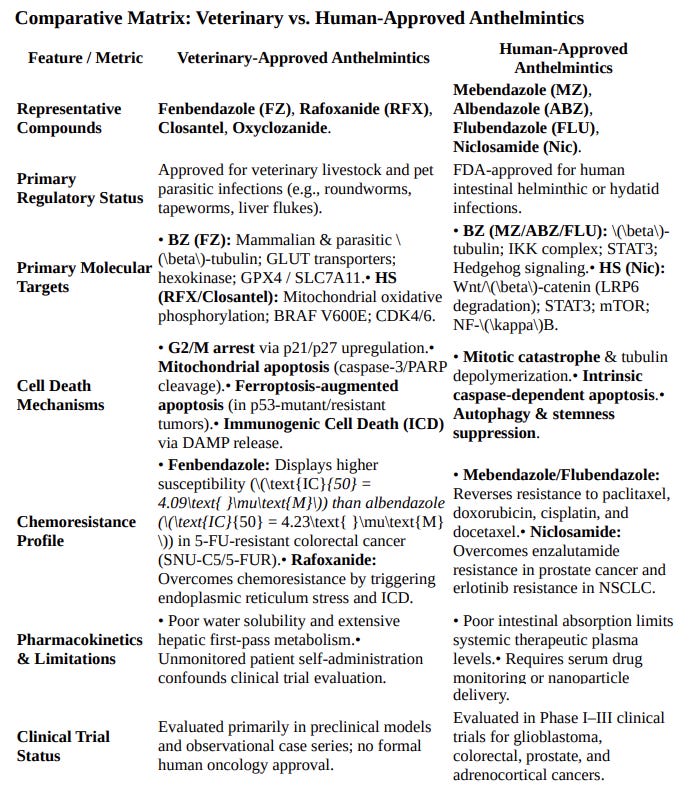
Detailed Outline of Underlying Anti-Cancer Mechanisms
1. Benzimidazole Carbamates (Microtubule, Glucose & Apoptotic Drivers)
Tubulin Depolymerization & Mitotic Arrest: BZ carbamates selectively bind mammalian and parasitic \(\beta\)-tubulin, preventing microtubule assembly. This causes cell cycle arrest at the G2/M phase, driven by marked upregulation of cyclin-dependent kinase inhibitors p21 and p27 alongside downregulation of the oncogene c-Myc.
Metabolic Starvation (Glucose Uptake Disruption): By disrupting the microtubular network, agents like fenbendazole downregulate GLUT glucose transporters and the glycolytic enzyme hexokinase, starving high-demand tumor cells of energy.
Intrinsic Apoptosis: Microtubule inhibition triggers mitochondrial membrane breakdown, releases cytochrome-C into the cytosol, activates caspase-3, and induces PARP cleavage.
p53-Independent & Ferroptosis-Augmented Death: In 5-FU-sensitive cells, fenbendazole activates traditional p53-mediated apoptosis. In 5-FU-resistant cancer cells with mutant or impaired p53, fenbendazole bypasses p53 entirely, inducing p53-independent apoptosis heavily augmented by ferroptosis through concurrent downregulation of GPX4 (glutathione peroxidase 4) and SLC7A11 (cysteine/glutamate transporter), combined with robust release of the DAMP marker HMGB1.
2. Halogenated Salicylanilides (Mitochondrial Uncoupling & Pathway Blockade)
Mitochondrial Uncoupling & Energy Exhaustion: HS compounds (such as niclosamide and rafoxanide) act as protonophores that uncouple mitochondrial oxidative phosphorylation. They inhibit succinate dehydrogenase and fumarate reductase, halting ATP synthesis and forcing cancer cells into bioenergetic collapse.
Multitarget Signal Transduction Blockade:
Wnt/\(\beta\)-Catenin Pathway: Niclosamide induces LRP6 degradation and disrupts the Axin–GSK3 complex, shutting down \(\beta\)-catenin nuclear translocation and cancer stem cell self-renewal.
STAT3 & mTOR Pathways: Suppresses STAT3 phosphorylation and mTOR signaling, overcoming acquired resistance to targeted agents (such as erlotinib, enzalutamide, and sorafenib).
Immunogenic Cell Death (ICD): Rafoxanide induces endoplasmic reticulum stress and promotes ICD in colorectal cancer cells by driving ecto-calreticulin cell-surface exposure and inducing the extracellular release of damage-associated molecular patterns (ATP and HMGB1), stimulating an anti-tumor immune response.
Anti-cancer effects of fenbendazole on 5-fluorouracil-resistant colorectal cancer cells
Park D, Lee J, Yoon S. Anti-cancer effects of fenbendazole on 5-fluorouracil-resistant colorectal cancer cells. Korean J Physiol Pharmacol 2022;26:377-387.