

In preclinical animal models of brain cancer (including glioblastoma and diverse medulloblastoma models), mebendazole impacted tumor angiogenesis by preventing the formation of new, abnormal blood vessels that feed tumor growth.
Specifically, evidence from these preclinical laboratory studies indicates that mebendazole reaches effective concentrations within the brain and brain tumors to exert a dual anti-cancer effect:
Anti-Angiogenesis: It disrupts neo-vascularization, blocking the blood supply necessary to sustain growing tumor tissue.
Antiproliferative Action: It also inhibits tubulin formation, halting cancer cell division.
This anti-angiogenic capability was highlighted in preclinical medulloblastoma studies and served as key rationale for advancing mebendazole into Phase I clinical trials (NCT02644291) for pediatric patients with refractory brain malignancies.
This document outlines the essential details of a completed Phase I clinical trial investigating a novel medical approach for young patients. The primary focus of the research was evaluating the safety and potential application of mebendazole as a targeted treatment for children facing aggressive and recurring central nervous system malignancies. Sponsored by Johns Hopkins, the investigation specifically targeted severe pediatric brain tumors such as medulloblastoma and various forms of high-grade gliomas. Ultimately, this trial served as an exploratory interventional study aimed at finding alternative therapeutic options for children battling difficult-to-treat neurological cancers.
Based on clinical trial records for NCT02644291 at the Sidney Kimmel Comprehensive Cancer Center at Johns Hopkins, mebendazole (MBZ) has been investigated as a repurposed targeted therapy for recurrent and progressive pediatric brain tumors.
1. Target Tumor Types & Patient Population
The phase I trial evaluated pediatric patients aged 1 to 21 years whose brain malignancies continued to grow or recurred after failing standard front-line therapies. Key conditions targeted include:
Medulloblastoma.
High-grade gliomas (WHO Grade III & IV), including pediatric glioblastoma, anaplastic astrocytoma, and diffuse intrinsic pontine glioma (DIPG).
Other malignant gliomas include anaplastic oligodendroglioma, oligodendroblastoma, and malignant brainstem neoplasms.
2. Mechanisms of Action in Pediatric Brain Cancers
Preclinical studies led by Johns Hopkins researchers showed that mebendazole crosses the blood-brain barrier and reaches therapeutic concentrations in brain tumors. It combats pediatric brain tumors through several complementary mechanisms:
Microtubule Disruption: Inhibits tubulin polymerization, halting cancer cell mitosis and proliferation.
Anti-Angiogenesis: Suppresses the formation of new blood vessels needed to feed growing tumor mass.
Hedgehog Pathway Inhibition: Acts as a Hedgehog pathway inhibitor in preclinical medulloblastoma models.
Preclinical Efficacy: Extended overall survival in animal models of glioblastoma multiforme and medulloblastoma.
3. Phase I Clinical Trial Design (NCT02644291)
Formulation & Dosing: Mebendazole was provided as a chewable 500 mg orange-flavored tablet taken three times daily with meals (or crushed into food/beverage) based on patient body surface area.
Primary Objectives: To determine the maximum tolerated dose (MTD), evaluate dose escalation, assess safety, and confirm tolerability in an expansion cohort.
Secondary Objectives: To measure plasma drug levels and track progression-free survival (PFS) and overall survival (OS).
Trial Status: The study enrolled 16 patients and reached primary completion in June 2022.
4. Safety and Tolerability Profile
Because mebendazole has a long history of FDA approval for helminthic infections, its safety profile in pediatric populations is well-documented. Observed side effects are generally rare and reversible, including:
Mild gastrointestinal upset.
Decreased blood counts (leukopenia/neutropenia).
Reversible elevation of liver enzymes (transaminitis).
Clinical Evaluation Report: Phase I Trial of Mebendazole Therapy in Recurrent and Progressive Pediatric Brain Tumors (NCT02644291)
1. Executive Overview and Trial Administration
Pediatric neuro-oncology faces severe therapeutic challenges when managing central nervous system (CNS) malignancies that recur or progress despite aggressive multi-modal front-line therapy. In this refractory clinical setting, repurposing established small-molecule therapeutics with documented safety profiles and anti-neoplastic mechanisms offers a promising translational strategy. Rigorous Phase I clinical evaluations of repurposed agents are essential to establish human safety boundaries, define maximum tolerated doses (MTD), assess systemic pharmacokinetics, and lay the foundation for subsequent efficacy trials in pediatric patients with high-grade or recurrent brain tumors.
The trial titled “Phase I Study of Mebendazole Therapy for Recurrent/Progressive Pediatric Brain Tumors” was launched to evaluate the safety, tolerability, and biological parameters of oral mebendazole in pediatric and young adult populations. Key institutional, operational, and administrative parameters derived from trial registry data are structured below:
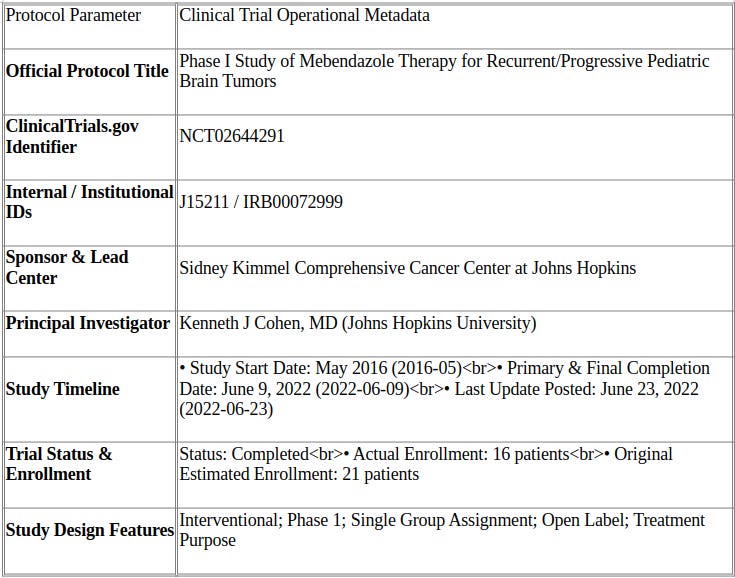
The trial’s objectives were structured to systematically establish clinical safety before evaluating initial therapeutic signals:
Primary Objectives:
Maximum Tolerated Dose Determination: To determine the MTD of orally administered mebendazole in pediatric patients with recurrent or progressive brain tumors across escalating dose tiers.
Dose Expansion Confirmation: To confirm the safety and tolerability of the established MTD in an expanded patient cohort.
Secondary Objectives:
Safety and Toxicity Profile: To characterize the overall toxicity and adverse event profile cumulative to mebendazole administration over an approximate two-year evaluation period.
Pharmacokinetic Assessment: To quantify mebendazole plasma levels to confirm adequate oral absorption and systemic exposure in pediatric cohorts.
Survival and Efficacy Parameters: To determine progression-free survival (PFS) and overall survival (OS) over a two-year study period in an extended cohort of patients with treatment-refractory disease.
Clinical Objective Synthesis: The trial’s architecture directly links its primary phase to its secondary endpoints. Defining the MTD during initial dose escalation provides the precise therapeutic threshold necessary to run the secondary 12-patient expansion cohort. Measuring PFS and OS at this biologically active, MTD-confirmed dose level lets researchers determine whether mebendazole's preclinical anti-tumor mechanisms translate into meaningful clinical disease control without exposing patients to excessive toxicity.
With the administrative and strategic framework of NCT02644291 established, the next section details the clinical criteria and tumor classifications that govern patient eligibility.
2. Patient Eligibility and Target Oncological Indications
Recurrent and progressive pediatric CNS malignancies carry a dismal prognosis, as patients who experience disease progression following standard surgery, craniospinal irradiation, and multi-agent chemotherapy rarely benefit from repeated conventional treatment. Defining precise eligibility boundaries in Phase I trials is critical to protect vulnerable pediatric patients while building a study population that accurately reflects the intended refractory indications.
Protocol NCT02644291 targeted specific pediatric CNS malignancies that progress or recur after standard medical therapy. Eligible target pathologies included:
Medulloblastoma: Recurrent or progressive medulloblastoma across all histologic and molecular subgroups.
High-Grade Gliomas (WHO Grade III and Grade IV):
Pediatric Glioblastoma (Glioblastoma Multiforme)
Anaplastic Astrocytoma
Astrocytoma Grade III
Malignant Glioma
Brainstem Malignancies:
Diffuse Intrinsic Pontine Glioma (DIPG) / Malignant Brainstem Neoplasms
Oligodendroglial Tumors:
Oligodendroblastoma
Anaplastic Oligodendroglioma
To gain entry into the study, candidates had to satisfy stringent physiological, age, and laboratory criteria:
Age Limits & Performance Status: Patients aged 1 to 21 years at enrollment (before their 22nd birthday). Patients who turned 22 while actively receiving protocol therapy remained eligible to continue treatment. Performance status required a Karnofsky Performance Score (KPS) > 50% for patients ≥ 10 years of age, or a Lansky score ≥ 50 for pediatric patients < 10 years of age. Life expectancy must exceed 10 weeks.
Neuro-Oncological Rationale: Maintaining a KPS/Lansky ≥ 50 cutoff ensures enrolled children have adequate functional independence and organ reserve. This baseline reserve prevents disease-related neurological impairment from confounding the attribution of drug-induced toxicities during Phase I dose escalation.
Prior Therapeutic History: Confirmed recurrent or progressive brain malignancy following failure of at least one standard-of-care front-line therapeutic regimen established for the initial diagnosis. Patients who had failed experimental anti-cancer regimens were also eligible.
Organ and Hematologic Baselines:
Leukocytes: ≥ 3,000/µL
Absolute Neutrophil Count (ANC): ≥ 750/µL
Platelets: ≥ 75,000/µL
Hepatic Function: Aspartate aminotransferase (AST) and Alanine aminotransferase (ALT) ≤ 2.5 × Upper Limit of Normal (ULN); Total Bilirubin < 1.5 × ULN.
Renal Function: Serum Creatinine < 1.5 × ULN, OR a calculated Creatinine Clearance ≥ 60 mL/min/1.73 m² for patients whose creatinine exceeded 1.5 × ULN.
Compliance & Consent: The patient, parent, or legal guardian must understand and sign informed consent (and assent when age-appropriate), swallow oral tablets or liquid preparations, and maintain detailed daily medication logs.
Reproductive Precautions: Women of childbearing potential were required to commit to effective contraception during trial participation if a reasonable risk of pregnancy existed.
To mitigate clinical risks, the trial enforced clear exclusion criteria:
Hypersensitivity: Known history of severe allergy or hypersensitivity to mebendazole or other benzimidazole-class compounds.
Prior Benzimidazole Toxicity: Prior occurrence of severe adverse events, such as agranulocytosis or severe neutropenia, during antiparasitic treatment with mebendazole or related benzimidazoles.
Prior Experimental Mebendazole Exposure: Previous receipt of mebendazole within an experimental anti-cancer protocol that resulted in treatment failure.
Concomitant Metronidazole Therapy: Active metronidazole administration when the patient could not be safely transitioned to an alternative antimicrobial agent at least 7 days before starting mebendazole. Co-administration of mebendazole and metronidazole is linked in clinical case reports to severe cutaneous adverse reactions, including Stevens-Johnson Syndrome (SJS) and Toxic Epidermal Necrolysis (TEN).
Intercurrent Medical Conditions: Active, uncontrolled systemic illnesses, including ongoing active infections, uncontrolled hypertension, symptomatic congestive heart failure, unstable angina, cardiac dysrhythmias, or severe psychiatric/social factors compromising protocol adherence.
Viral and Hepatic Disease: Confirmed infection with Human Immunodeficiency Virus (HIV), active Hepatitis B surface antigen, Hepatitis C positivity, or a history of chronic active hepatitis or cirrhosis.
Pregnancy and Lactation: We excluded pregnant females because mebendazole has teratogenic potential in animal models (FDA Pregnancy Class C). Nursing mothers were required to discontinue breastfeeding due to unknown drug excretion kinetics in human milk.
With eligibility parameters and clinical exclusion gates established, the report next reviews the biological and preclinical rationale justifying mebendazole in pediatric brain tumor models.
3. Preclinical Rationale and Pharmacological Mechanisms
Mebendazole is a synthetic benzimidazole derivative that the U.S. Food and Drug Administration (FDA) has long approved as an oral anthelmintic agent. It is indicated to treat gastrointestinal parasitic infections, including roundworm (Ascaris lumbricoides), common hookworm (Ancylostoma duodenale), American hookworm (Necator americanus), pinworm (Enterobius vermicularis), and whipworm (Trichuris trichiura), and is marketed under brand names such as Vermox, Ovex, and Pripsen. In international clinical practice, high-dose mebendazole regimens are routinely used for invasive tissue-space parasitic infections, including CNS hydatid disease and neurocysticercosis.
The rationale for repurposing mebendazole as an anti-neoplastic drug in pediatric neuro-oncology rests on a robust body of translational research demonstrating multimodal tumoricidal activity:
Microtubule Disruption: Mebendazole binds to the colchicine-binding domain of tubulin subunits, inhibiting microtubule polymerization. This disruption prevents mitotic spindle formation, arrests cancer cells in G2/M, and triggers apoptosis.
Inhibition of Tumor Angiogenesis: In preclinical CNS tumor models, mebendazole impairs tumor microvascularization, preventing the neovascular growth required to meet the metabolic demands of expanding brain tumors.
Hedgehog Signaling Pathway Suppression: Research led by Larsen et al. (2015) demonstrated that mebendazole potently inhibits the Hedgehog signaling pathway. Aberrant Hedgehog signaling drives cell proliferation and therapeutic resistance in specific pediatric brain malignancies, particularly SHH-subgroup medulloblastoma.
Central Nervous System Penetration: Pharmacokinetic evaluation confirms that specific mebendazole polymorphs cross the blood-brain barrier (BBB) and accumulate in normal brain tissue and intracranial tumor mass at clinically meaningful therapeutic concentrations.
The translational foundation for protocol NCT02644291 is supported by key preclinical and clinical studies in the published literature:
Glioblastoma Models: Bai et al. (2011) demonstrated that mebendazole monotherapy significantly prolonged overall survival in syngeneic and xenograft animal models of glioblastoma multiforme.
Medulloblastoma Models and Anti-Angiogenesis: Bai et al. (2015) established mebendazole's efficacy across diverse preclinical medulloblastoma models, confirming direct suppression of tumor-associated vascular endothelial growth.
Polymorphic Brain Penetration: Bai et al. (2015) evaluated the brain penetration and pharmacokinetics of different mebendazole polymorphs, identifying specific physical forms with superior intracranial bioavailability and anti-tumor efficacy in orthotopic mouse brain tumor models.
Hedgehog Target Validation: Larsen et al. (2015) validated mebendazole as a repurposed Hedgehog pathway inhibitor, showing it can suppress pathway-dependent growth in primitive neuroectodermal models.
Clinical safety data from an adult Phase I trial in high-grade gliomas complemented this preclinical evidence. That trial reached its maximum protocol-defined enrollment of 24 adult patients with glioblastoma, showing that long-term, high-dose oral mebendazole—mirroring dosing regimens used for severe tissue-invasive helminthiasis—was well tolerated without dose-limiting systemic toxicity.
Building upon these preclinical findings and adult clinical safety data, the study established tailored pediatric dosing schedules, administration guidelines, and pharmacokinetic monitoring parameters.
4. Dosing Protocol, Formulation, and Monitoring Schedule
Phase I oncology trials in pediatric populations require formulations and dosing schedules that ensure precise systemic exposure while remaining practical for infants, young children, and patients with neuro-oncological swallowing difficulties.
To maximize palatability and treatment compliance across all age groups, the trial utilized a patient-friendly formulation provided at no cost:
Physical Formulation: Mebendazole was supplied as a chewable 500 mg tablet with a mild orange flavor and a consistency similar to an antacid tablet.
Administration Guidelines and BSA Calculations: Dosing was calculated based on patient Body Surface Area (BSA) and administered orally in three divided doses daily, taken directly with meals or food.
Pediatric Delivery Solutions: For very young children (ages 1 to 3) or patients with disease-related dysphagia, BSA-derived dosage calculations required splitting 500 mg tablets. To deliver exact fractional doses, patients could crush or grind the chewable tablets into a fine powder and thoroughly mix it with soft foods (such as applesauce or yogurt) or liquids immediately before ingestion.
The trial employed a two-phase cohort architecture to evaluate escalating dose levels and confirm safety:
Dose-Escalation Phase: The initial phase assigned patients across three distinct dose-escalation cohorts receiving incremental tiers of oral mebendazole. This phase aimed to characterize toxicity profiles, track dose-limiting toxicities (DLTs), and establish the MTD for pediatric patients.
Dose-Expansion Phase: After determining the MTD, we enrolled an additional cohort of 12 patients at this fixed MTD tier. This expansion phase validated tolerability and assessed secondary progression-free and overall survival outcomes.
To evaluate oral absorption, systemic clearance, and therapeutic blood levels, participating patients consented to serial pharmacokinetic blood sampling. This protocol required up to three additional venipunctures to quantify peak and trough serum drug concentrations.
Treatment duration was governed by ongoing clinical and radiographic evaluation. Patients continued daily oral mebendazole therapy as long as the treatment was well tolerated without severe adverse events and in the absence of unequivocal disease progression. Patients could voluntarily withdraw from the protocol at any time to pursue alternative experimental regimens.
Ensuring patient safety alongside therapeutic monitoring requires a clear understanding of the drug’s side effect profile and critical drug interactions.
5. Clinical Safety Profile and Drug Interaction Warnings
Safety monitoring represented the primary outcome measure of trial NCT02644291. Historical data from antiparasitic usage and adult neuro-oncology trials indicate that mebendazole possesses a favorable safety profile, with side effects occurring infrequently and reversing upon dose adjustment or treatment cessation.
In this pediatric trial, the primary outcome tracked cumulative adverse events attributed to mebendazole over a two-year evaluation period. The observed clinical safety profile centered on three main organ systems:
Gastrointestinal Toxicity: Mild to moderate abdominal pain, nausea, and general stomach upset, typically manageable with dietary adjustments or supportive care.
Hematologic Toxicity: Cytopenias, including leukopenia and neutropenia, secondary to transient bone marrow suppression.
Hepatic Toxicity: Reversible elevations in serum transaminases (AST/ALT) caused by mild hepatic inflammation.
Pharmacovigilance Directives: Daily administration of high-dose oral benzimidazoles in pediatric cancer patients requires active laboratory surveillance. Clinical protocols mandate bi-weekly or monthly monitoring of complete blood counts (CBC with differential) and comprehensive liver function tests (AST, ALT, Total Bilirubin). Regular lab checks allow clinicians to identify Grade 1 or 2 transaminitis and neutropenia early, enabling proactive dose holds or step-downs before severe, symptomatic Grade 3/4 toxicities develop.
The trial protocol enforced a mandatory safety restriction regarding the co-administration of mebendazole and the synthetic antibacterial agent metronidazole:
CRITICAL DRUG INTERACTION WARNING: METRONIDAZOLE CONTRAINDICATION
Clinical case reports have established that the concurrent administration of mebendazole and metronidazole is strongly associated with the development of severe, life-threatening cutaneous adverse reactions—specifically Stevens-Johnson Syndrome (SJS) and Toxic Epidermal Necrolysis (TEN).
Mandatory Wash-Out Protocol: Any patient receiving metronidazole must transition to an alternative antimicrobial therapy and complete a mandatory wash-out period of more than 7 days before starting oral mebendazole.
In conclusion, the Phase I trial of mebendazole in recurrent and progressive pediatric brain tumors (NCT02644291) successfully completed its evaluation, establishing critical safety, pharmacokinetic, and administration parameters for a repurposed anthelmintic agent. By defining pediatric MTD boundaries, practical delivery methods for young children, and key pharmacovigilance protocols, this study provides a solid foundation for future pediatric neuro-oncology trials and combination treatment strategies. Clinical Trial Registry Record
Sidney Kimmel Comprehensive Cancer Center at Johns Hopkins. (2022). Phase I study of mebendazole therapy for recurrent/progressive pediatric brain tumors ([suspicious link removed] Identifier: NCT02644291). National Library of Medicine (US). https://clinicaltrials.gov/study/NCT02644291. (Principal Investigator: Kenneth J. Cohen, MD).
Referenced Preclinical & Related Publications
Bai, R. Y., Staedtke, V., Aprhys, C. M., Gallia, G. L., & Riggins, G. J. (2011). Antiparasitic mebendazole shows survival benefit in 2 preclinical models of glioblastoma multiforme. Neuro-Oncology, 13(9), 974–982.
Bai, R. Y., Staedtke, V., Rudin, C. M., Bunz, F., & Riggins, G. J. (2015). Effective treatment of diverse medulloblastoma models with mebendazole and its impact on tumor angiogenesis. Neuro-Oncology, 17(4), 545–554.
Bai, R. Y., Staedtke, V., Wanjiku, T., Rudek, M. A., Joshi, A., Gallia, G. L., & Riggins, G. J. (2015). Brain penetration and efficacy of different mebendazole polymorphs in a mouse brain tumor model. Clinical Cancer Research, 21(15), 3462–3470.
Larsen, A. R., Bai, R. Y., Chung, J. H., Borodovsky, A., Rudin, C. M., Riggins, G. J., & Bunz, F. (2015). Repurposing the antihelminthic mebendazole as a hedgehog inhibitor. Molecular Cancer Therapeutics, 14(1), 3–13.